
Luke 10:34
in Luke 10He went to him and bandaged his wounds, pouring on oil and wine. Then he put him on his own animal, brought him to an inn, and took care of him.
BSB
The same verse in ASV and KJV ▾
ASV
and came to him, and bound up his wounds, pouring on them oil and wine; and he set him on his own beast, and brought him to an inn, and took care of him.
KJV
And went to him, and bound up his wounds, pouring in oil and wine, and set him on his own beast, and brought him to an inn, and took care of him.
⋯
This verse in Luke 10
Commentary
27 notes on this verse"And bound up his wounds, pouring in oil and wine." That Physician has many remedies with which he is accustomed to cure. His speech is a remedy. One of his sayings binds up wounds, another treats with oil, another pours in wine. He binds wounds with a stricter rule. He treats with the forgiveness of sins. He stings with the rebuke of judgment as if with wine.
This site's exposition
a Samaritan on a journey came upon him
on Luke 10:33-35
When a Samaritan came upon him, he had compassion, splanchnizomai, the verb of 7:13 at Nain. The verb is now given to the one figure the lawyer's culture despised.
This site's exposition
pouring on oil and wine
Theophylact reads the oil as the word of teaching that prepares for virtue. He says the binding came at once, to stop the wound from growing worse. The Samaritan gives his own animal and his own care.
The record, by era
The Church Fathers5 voices
Or, He binds up our wounds by a stricter commandment, as by oil he soothes by the remission of sin, as by wine he pricks to the heart by the denunciation of judgment.
Or, He places us on His beast in that He bears our sins, and is afflicted for us, (Isai. 53:4, LXX) for man hath been made like to the beasts, (Ps. 49:12) therefore He placed us on His beast, that we might not be as horse and mule, (Ps. 32:9.) in order that by taking upon Him our body, He might abolish the weakness of our flesh.
Robbers left you half-dead on the road, but you have been found lying there by the passing and kindly Samaritan. Wine and oil have been poured on you. You have received the sacrament of the only-begotten Son. You have been lifted onto his mule. You have believed that Christ became flesh. You have been brought to the inn, and you are being cured in the church.That is where and why I am speaking. This is what I too, what all of us are doing. We are performing the duties of the innkeeper. He was told, "If you spend any more, I will pay you when I return." If only we spent at least as much as we have received! However much we spend, brothers and sisters, it is the Lord's money.
(Quæst. Ev. ii. 19.) The binding up of wounds is the checking of sins; oil is the consolation of a good hope, by the pardon given for the reconciliation of man; wine is the incitement to work fervently in spirit. (de Quæst. Ev. ii. q. 19.) His beast is our flesh, in which He has condescended to come to us. To be placed on the beast is to believe in the incarnation of Christ.
A commentator
Origen of AlexandriaHOMILIES ON THE GOSPEL OF LUKE 34.3, 9 · Written before 253.
proposed
One of the elders wanted to interpret the parable as follows. The man who was going down is Adam. Jerusalem is paradise, and Jericho is the world. The robbers are hostile powers. The priest is the law, the Levite is the prophets, and the Samaritan is Christ. The wounds are disobedience. The beast is the Lord's body. The pandochium (that is, the stable), which accepts all who wish to enter, is the church. The two denarii mean the Father and the Son. The manager of the stable is the head of the church, to whom its care has been entrusted. The fact that the Samaritan promises he will return represents the Savior's second coming.…The Samaritan, "who took pity on the man who had fallen among thieves," is truly a "guardian," and a closer neighbor than the Law and the Prophets. He showed that he was the man's neighbor more by deed than by word. According to the passage that says, "Be imitators of me, as I too am of Christ," it is possible for us to imitate Christ and to pity those who "have fallen among thieves." We can go to them, bind their wounds, pour in oil and wine, put them on our own animals, and bear their burdens. The Son of God encourages us to do things like this. He is speaking not so much to the teacher of the law as to us and to everyone when he says, "Go and do likewise." If we do, we will receive eternal life in Christ Jesus, to whom is glory and power for ages of ages. Amen.
19 more voices on this verse
The Church Fathers2 voices
Blessed is He that cometh in the name of the Lord: the Lord to save man who had wandered in error; to put away error; to give light to those who are in darkness; to abolish the imposture of idols; in its place to bring in the saving knowledge of God; to sanctify the world; to drive away the abomination and misery of the worship of false gods. Blessed is He that cometh in the name of the Lord: the one for the many; to deliver the poor out of the hands of them that are too strong for him, yea, the poor and needy from him that spoileth him. Blessed is He that cometh in the name of the Lord, to pour wine and oil upon him who had fallen amongst thieves, and had been passed by. Blessed is He that cometh in the name of the Lord: to save us by Himself, as says the prophet; no ambassador, nor angel, but the Lord Himself saved us.
(Hom. in loc.) Or, he poured in wine, that is, the blood of His passion, and oil, that is, the anointing of the chrism, that pardon might be granted by His blood, sanctification be conferred by the chrism. The wounded parts are bound up by the heavenly Physician, and containing a salve within themselves, are by the working of the remedy restored to their former soundness. Having poured in wine and oil, he placed him upon His beast, as it follows, and placing him upon his beast, &c. (ut sup.) For the Inn is the Church, which receives travellers, who are tired with their journey through the world, and oppressed with the load of their sins; where the wearied traveller casting down the burden of his sins is relieved, and after being refreshed is restored with wholesome food. And this is what is here said, and took care of him. For without is every thing that is conflicting, hurtful and evil, while within the Inn is contained all rest and health.
The Medieval Church9 voices
And because true mercy appears in deed, therefore he adds: And drawing near, by effect, to whom he was already close by affection, calling back to unity, he bound up his wounds, pouring in oil and wine, so that the oil might soothe the pain, …
And coming, Christ does three things for the wounded man: he applied a remedy, and this through the grace of the Sacraments, in which anointings and unctions are performed that heal the wounds of sins, which was not done before the coming of the Savior, …
(20. Moral. c. 8.) Or in the wine he applies the sharpness of constraint, in the oil the softness of mercy. By wine let the corrupt parts be washed, by oil let the healing parts be assuaged; we must then mix gentleness with severity, and we must so combine the two, that those who are put under us be neither exasperated by our excessive harshness, nor be relaxed by too much kindness.
And approaching, he bound up his wounds, pouring on oil and wine. Sins, which he found in men, he restrained by reproving, instilling hope of pardon in those who repent, and terror of punishment in those who sin. For he binds up the wounds when …
And setting him on his own beast, he brought him to an inn, and took care of him. His beast is the flesh, in which he deigned to come to us. And he set the wounded man on it because he bore our sins in …
And rightly He brought him placed on His beast, since no one, except he be united to Christ's body by Baptism, shall enter the Church.
(ubi sup.) Seeing him lying down weak and motionless. And therefore was He moved with compassion, because He saw in him nothing to merit a cure, but He Himself for sin condemned sin in the flesh. (Rom. 8:3.) Hence it follows, And went to him, and bound up his wounds, pouring in oil and wine.
At once he "bound up the wounds," not allowing the disease to grow worse, but restraining it. "He poured oil and wine": the oil is the word of teaching that prepares for virtue by the promise of good things, and the wine is the word …
Or else, intercourse with man is the oil, and intercourse with God is the wine which signifies divinity, which no one can endure unmixed unless oil be added, that is, human intercourse. Hence he worked some things humanly, some divinely. He poured then in oil and wine, as having saved us both by His human and His divine nature. Or He placed us on His beast, that is, on His body. For He hath made us His members, and partakers of His body. The Law indeed did not take in all the Moabites, and the Ammonites shall not enter into the Church of God; (Deut. 23:3.) but now in every nation he that feareth the Lord is accepted by Him, who is willing to believe and to become part of the Church. Wherefore He says, that he brought him to an inn.
The Puritans and the Awakening2 voices
And went to him, and bound up his wounds,....
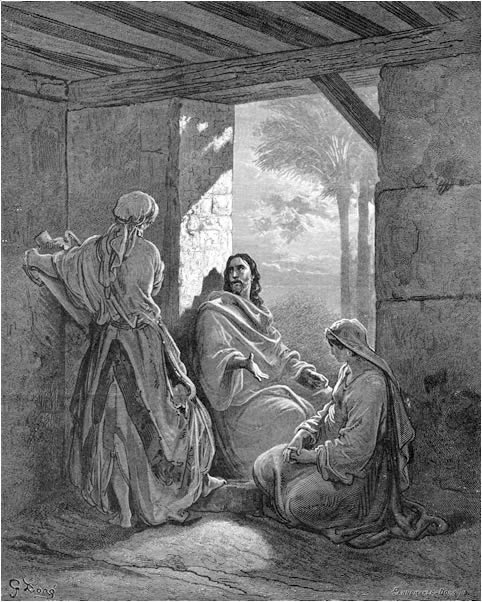
Christ's entertainment at Martha's house, the reproof he gave to her for her care about the world, and his commendation of Mary for her care about her soul,
The Nineteenth Century6 voices
Pouring in oil and wine - These, beaten together, appear to have been used formerly as a common medicine for fresh wounds. Bind up a fresh cut immediately in a soft rag or lint, moistened with pure olive oil, and the parts will heal by what is called the first intention, and more speedily than by any other means. An inn - Πανδοχειον, from παν, all, and δεχομαι, I receive; because it receives all comers.
A commentator
J.C. Ryle1816–1900
Expository Thoughts on the Gospels: Luke (lightly modernized text, Grace Gems edition) (1858)
proposed
These words contain the well-known parable of the good Samaritan. In order to understand the drift of this parable, we must carefully remember the occasion on which it was spoken. It was spoken in reply to the question of a certain lawyer, who asked, "who is my neighbor?" Our Lord Jesus Christ answers that question by telling the story we have just read — and winds up the narrative by an appeal to the lawyer's conscience. Let these things not be forgotten. The object of the parable is to show the nature of true charity and brotherly love.
OUR text is the whole story of the Samaritan, but as that is very long, let us, for our memories' sake, consider the exhortation in the 37th verse to be our text. "Go, and do you likewise." There are certain persons in the world who will not allow the preacher to speak upon anything but those doctrinal statements concerning the way of salvation which are known as "the Gospel."
A commentator
J.C. Ryle1816–1900
Expository Thoughts on the Gospels: Luke (lightly modernized text, Grace Gems edition) (1858)
proposed
These words contain the well-known parable of the good Samaritan. In order to understand the drift of this parable, we must carefully remember the occasion on which it was spoken. It was spoken in reply to the question of a certain lawyer, who asked, "who is my neighbor?" Our Lord Jesus Christ answers that question by telling the story we have just read — and winds up the narrative by an appeal to the lawyer's conscience. Let these things not be forgotten. The object of the parable is to show the nature of true charity and brotherly love. To lose sight of this object, and search for deep allegories in the parable — is to trifle with Scripture, and deprive our souls of most valuable lessons. We are taught, first, in this parable — how rare and uncommon true brotherly love is. This is a lesson which stands out prominently on the face of the narrative before our eyes. Our Lord tells us of a traveler who fell among thieves, and was left naked, wounded, and half dead on the road. He then tells us of a priest and a Levite , who, one after the other, came traveling that way, and saw the poor wounded man — but gave him no help. Both were men, who from their religious office and profession, ought to have been ready and willing to do good to one in distress. But both, in succession, were too selfish, or too unfeeling to offer the slightest assistance. They doubtless reasoned with themselves — that they knew nothing of the wounded traveler — that he had perhaps got into trouble by his own misconduct — that they had no time to stop to help him — and that they had enough to do to mind their own business, without troubling themselves with strangers. And the result was, that one after the other — they both "passed by on the other side." We have in this striking description, an exact picture of what is continually going on in the world.
OUR text is the whole story of the Samaritan, but as that is very long, let us, for our memories' sake, consider the exhortation in the 37th verse to be our text. "Go, and do you likewise." There are certain persons in the world who will not allow the preacher to speak upon anything but those doctrinal statements concerning the way of salvation which are known as "the Gospel." If the preacher shall insist upon some virtue or practical Grace, they straightway say that he is not preaching the Gospel, that he has become legal and is a mere moral teacher. We do not stand in any awe of such criticism, for we clearly perceive that our Lord Jesus Christ, Himself, would very frequently have come under it. Read the Sermon on the Mount and judge whether certain people would be content to hear the likes of it preached to them on the Sabbath. They would condemn it as containing very little Gospel and too much about good works. Our Lord was a great practical Preacher. He frequently delivered addresses in which He made answer to questioners, or gave direction to seekers, or upbraided offenders—and He gave a prominence to practical truth such as some of His ministers dare not imitate! Jesus tells us over and over again the manner in which we are to live towards our fellow men and He lays great stress upon the love which should shine throughout the Christian character. The story of the good Samaritan, which is now before us, is a case in point, for our Lord is explaining, there, a point which arose out of the question, "What shall I do to inherit eternal life?" The question is legal and the answer is to the point. But let it never be forgotten that what the Law demands of us, the Gospel produces in us. The Law tells us what we ought to be and it is one objective of the Gospel to raise us to that condition.
A commentator
Albert Barnes1798–1870
Notes, Explanatory and Practical, on the Old and New Testaments (1832-1869)
proposed
Pouring in oil and wine - These were often used in medicine to heal wounds. Probably they were mingled together, and had a highly sanative quality. How strikingly is his conduct contrasted with the priest and Levite! And, how particularly as well as beautifully by this does our Saviour show what we ought to do to those who are in circumstances of need! He does not merely say “in general” that he showed him kindness, but he “told how” it was done. He stopped - came where he was - pitied him - bound up his wound - set him on his own beast - conducted him to a tavern - passed the night with him, and then secured the kind attendances of the landlord, promising him to pay him for his trouble and all this without desiring or expecting any reward. If this had been by a Jew, it would have been signal kindness; if it had been by a Gentile, it would also have been great kindness; but it was by a Samaritan - a man of a nation most hateful to the Jews, and therefore it most strikingly shows what we are to do to friends and foes when they are in distress.
The words behind it
24 Greek wordsEvery Greek word of this verse in the order it stands, with what it means and the door to its own study. The last column counts the times a word stands in the whole Bible: the rarer the word, the more the places it appears belong together.
| Greek | Sound | Meaning | Word study | In the Bible |
|---|---|---|---|---|
| καὶ | kai | and | G2532 → | 9120 times |
| προσελθὼν | proselthon | having approached | G4334 → | 86 times |
| κατέδησεν | katedesen | he bound up | G2611 → | |
| τὰ | ta | the | G3588 → | 19766 times |
| τραύματα | traumata | wounds | G5134 → | |
| αὐτοῦ | autou | of him | G846 → | 5565 times |
| ἐπιχέων | epicheon | pouring on | G2022 → | |
| ἔλαιον | elaion | oil | G1637 → | 11 times |
| καὶ | kai | and | G2532 → | 9120 times |
| οἶνον. | oinon | wine. | G3631 → | 34 times |
| ἐπιβιβάσας | epibibasas | having put | G1913 → | |
| δὲ | de | then | G1161 → | 2765 times |
| αὐτὸν | auton | him | G846 → | 5565 times |
| ἐπὶ | epi | on | G1909 → | 883 times |
| τὸ | to | <the> | G3588 → | 19766 times |
| ἴδιον | idion | [his] own | G2398 → | 114 times |
| κτῆνος | ktenos | beast | G2934 → | |
| ἤγαγεν | egagen | he brought | G71 → | 68 times |
| αὐτὸν | auton | him | G846 → | 5565 times |
| εἰς | eis | to | G1519 → | 1755 times |
| πανδοχεῖον | pandocheion | an inn | G3829 → | |
| καὶ | kai | and | G2532 → | 9120 times |
| ἐπεμελήθη | epemelethe | took care | G1959 → | |
| αὐτοῦ. | autou | of him. | G846 → | 5565 times |
καὶand
kaiG2532 →9120 times
προσελθὼνhaving approached
proselthonG4334 →86 times
κατέδησενhe bound up
katedesenG2611 →
τὰthe
taG3588 →19766 times
τραύματαwounds
traumataG5134 →
αὐτοῦof him
autouG846 →5565 times
ἐπιχέωνpouring on
epicheonG2022 →
ἔλαιονoil
elaionG1637 →11 times
καὶand
kaiG2532 →9120 times
οἶνον.wine.
oinonG3631 →34 times
ἐπιβιβάσαςhaving put
epibibasasG1913 →
δὲthen
deG1161 →2765 times
αὐτὸνhim
autonG846 →5565 times
ἐπὶon
epiG1909 →883 times
τὸ<the>
toG3588 →19766 times
ἴδιον[his] own
idionG2398 →114 times
κτῆνοςbeast
ktenosG2934 →
ἤγαγενhe brought
egagenG71 →68 times
αὐτὸνhim
autonG846 →5565 times
εἰςto
eisG1519 →1755 times
πανδοχεῖονan inn
pandocheionG3829 →
καὶand
kaiG2532 →9120 times
ἐπεμελήθηtook care
epemeletheG1959 →
αὐτοῦ.of him.
autouG846 →5565 times
A shaded row is a word that stands 400 times or fewer in the Bible.
The walk
8 stopsEach card is a verse this one points to, and under it the verses that one points to in turn. Where several paths arrive at the same place, that place is listed first: the text keeps returning to it.
Through
Psalms 147:3He heals the brokenhearted and binds up their wounds.
it leads to
- Psalms 34:18
The LORD is near to the brokenhearted; He saves the contrite in spirit.
- Job 5:18
For He wounds, but He also binds; He strikes, but His hands also heal.
- Jeremiah 33:6
Nevertheless, I will bring to it health and healing, and I will heal its people and reveal to them the abundance of peace and truth.
- Luke 4:18
“The Spirit of the Lord is on Me, because He has anointed Me to preach good news to the poor. He has sent Me to proclaim liberty to the captives and recovery of sight…
- Isaiah 61:1
The Spirit of the Lord GOD is on Me, because the LORD has anointed Me to preach good news to the poor. He has sent Me to bind up the brokenhearted, to proclaim liberty…
- Psalms 34:18
Through
Romans 12:20On the contrary, “If your enemy is hungry, feed him; if he is thirsty, give him a drink. For in so doing, you will heap burning coals on his head.”
it leads to
- Proverbs 25:21–22
If your enemy is hungry, give him food to eat, and if he is thirsty, give him water to drink.
- Matthew 5:44
But I tell you, love your enemies and pray for those who persecute you,
- Luke 6:27
But to those of you who will listen, I say: Love your enemies, do good to those who hate you,
- Proverbs 25:21–22
Where this verse is studied
On this page
Studies20
On this verse
On this chapter
About Luke
This page draws on 21 works. Open the list of works
This page draws on Adam Clarke, Commentary on the Bible; Albert Barnes, Notes, Explanatory and Practical, on the Old and New Testaments (1832-1869); Alexander Maclaren, Expositions of Holy Scripture, Luke; Ambrose of Milan, Commentary on Luke; Ambrose of Milan, Catena Aurea by Aquinas; Augustine of Hippo, SERMON 179A.7-8; Augustine of Hippo, Catena Aurea by Aquinas; Bede, On the Gospel of Luke; Bede, Catena Aurea by Aquinas; Bonaventure, Commentary on Luke, Chapter 10; Charles Spurgeon, The Metropolitan Tabernacle Pulpit, Sermon No. 1360: “The Good Samaritan” (lightly modernized text, CCEL edition); Gregory the Dialogist, Catena Aurea by Aquinas; J.C. Ryle, Expository Thoughts on the Gospels: Luke (lightly modernized text, Grace Gems edition); John Chrysostom, Catena Aurea by Aquinas; John Gill, Exposition of the New Testament (1746-1748); Matthew Henry, Commentary on the Whole Bible; Methodius of Olympus, Methodius Oration on the Psalms; Origen of Alexandria, HOMILIES ON THE GOSPEL OF LUKE 34.3, 9; Pseudo-Augustine, Catena Aurea by Aquinas; Theophylact of Ohrid, Commentary on Luke and Theophylact of Ohrid, Catena Aurea by Aquinas.