
Luke 10:29
in Luke 10But wanting to justify himself, he asked Jesus, “And who is my neighbor?”
BSB
The same verse in ASV and KJV ▾
ASV
But he, desiring to justify himself, said unto Jesus, And who is my neighbor?
KJV
But he, willing to justify himself, said unto Jesus, And who is my neighbour?
⋯
This verse in Luke 10
Commentary
18 notes on this verseSome think that their neighbor is their brother, family, relative or their kinsman. Our Lord teaches who our neighbor is in the Gospel parable of a certain man going down from Jerusalem to Jericho.… Everyone is our neighbor, and we should not harm anyone. If, on the contrary, we understand our fellow human beings to be only our brother and relatives, is it then permissible to do evil to strangers? God forbid such a belief! We are neighbors, all people to all people, for we have one Father.
This site's exposition
wanting to justify himself
But wanting to justify himself, he asked Jesus who his neighbor was, a follow-up that narrows the command's reach instead of obeying it. The parable that follows turns his question from who counts as a neighbor to how one acts as a neighbor.
The record, by era
The Church Fathers4 voices
He answered that he knew not his neighbour, because he believed not on Christ, and he who knows not Christ knows not the law, for being ignorant of the truth, how can he know the law which makes known the truth?
A commentator
Clement of AlexandriaWho is the Rich Man that Shall Be Saved? · Written before 215.
proposed
The second in order, and not any less than this, He says, is, "Thou shalt love thy neighbour as thyself," consequently God above thyself. And on His interlocutor inquiring, "Who is my neighbour?" He did not, in the same way with the Jews, specify the blood-relation, or the fellow-citizen, or the proselyte, or him that had been similarly circumcised, or the man who uses one and the same law. But He introduces one on his way down from the upland region from Jerusalem to Jericho, and represents him stabbed by robbers, cast half-dead on the way, passed by the priest, looked sideways at by the Levite, but pitied by the vilified and excommunicated Samaritan; who did not, like those, pass casually, but came provided with such things as the man in danger required.
The lawyer, when praised by our Saviour for having answered right, breaks forth into pride, thinking that he had no neighbour, as though there was no one to be compared to him in righteousness. Hence it is said, But he willing to justify himself said unto Jesus, And who is my neighbour? For somehow first one sin and then another takes him captive. From the cunning with which he sought to tempt Christ, ho falls into pride. But here when asking, who is my neighbour, he proves himself to be devoid of love for his neighbour, since he did not consider any one to be his neighbour, and consequently of the love of God; for he who loves not his brother whom he sees, cannot love God whom he does not see. (1 John 4:20.)
He [the Lord] teaches that the man going down was the neighbor of no one except of him who wanted to keep the commandments and prepare himself to be a neighbor to every one that needs help. This is what is found after the end of the parable, "Which of these three does it seem to you is the neighbor of the man who fell among robbers?" Neither the priest nor the Levite was his neighbor, but—as the teacher of the law himself answered—"he who showed pity" was his neighbor. The Savior says, "Go, and do likewise."
The Medieval Church1 voice
Now our Saviour defines a neighbour not in respect of actions or honour, but of nature; as if He says, Think not that because thou art righteous thou hast no neighbour, for all who partake of the same nature are thy neighbours. Be thou also their neighbour, not in place, but in affection and solicitude for them.
11 more voices on this verse
The Medieval Church3 voices
Fourthly, with regard to the investigation of the truth approved, it is added: But he, wishing to justify himself, that is, to show himself just, "because, as the Interlinear Gloss says, he thought he stood not before God but before man," according to that below …
But he, wishing to justify himself, said to Jesus: And who is my neighbor? What a great madness of vain glory! The lawyer, to capture the favor of the people, so that he might be seen to have responded wisely, first confesses that he does …
The lawyer, having received praise from the Savior, displayed arrogance. He said: "and who... is my... neighbor?" He thought that he was righteous and had no one equal to himself or close to him in virtue; for he believed that a righteous man's neighbor is …
The Puritans and the Awakening2 voices
But he willing to justify himself,....
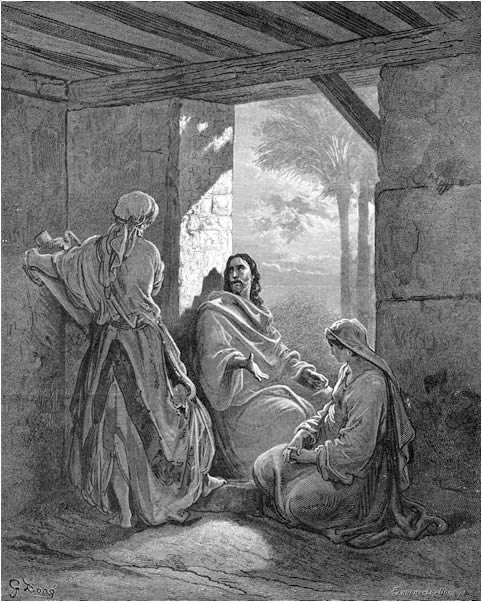
Christ's entertainment at Martha's house, the reproof he gave to her for her care about the world, and his commendation of Mary for her care about her soul,
The Nineteenth Century6 voices
A commentator
Albert Barnes1798–1870
Notes, Explanatory and Practical, on the Old and New Testaments (1832-1869)
To justify himself - Desirous to appear blameless, or to vindicate himself, and show that he had kept the law. Jesus wished to lead him to a proper view of his own sinfulness, and his real departure from the law. The man was desirous of showing that he had kept the law; or perhaps he was desirous of justifying himself for asking the question; of showing that it could not be so easily settled; that a mere reference to the “words” of the law did not determine it.
A commentator
J.C. Ryle1816–1900
Expository Thoughts on the Gospels: Luke (lightly modernized text, Grace Gems edition) (1858)
proposed
These words contain the well-known parable of the good Samaritan. In order to understand the drift of this parable, we must carefully remember the occasion on which it was spoken. It was spoken in reply to the question of a certain lawyer, who asked, "who is my neighbor?" Our Lord Jesus Christ answers that question by telling the story we have just read — and winds up the narrative by an appeal to the lawyer's conscience. Let these things not be forgotten. The object of the parable is to show the nature of true charity and brotherly love.
OUR text is the whole story of the Samaritan, but as that is very long, let us, for our memories' sake, consider the exhortation in the 37th verse to be our text. "Go, and do you likewise." There are certain persons in the world who will not allow the preacher to speak upon anything but those doctrinal statements concerning the way of salvation which are known as "the Gospel."
A commentator
J.C. Ryle1816–1900
Expository Thoughts on the Gospels: Luke (lightly modernized text, Grace Gems edition) (1858)
proposed
These words contain the well-known parable of the good Samaritan. In order to understand the drift of this parable, we must carefully remember the occasion on which it was spoken. It was spoken in reply to the question of a certain lawyer, who asked, "who is my neighbor?" Our Lord Jesus Christ answers that question by telling the story we have just read — and winds up the narrative by an appeal to the lawyer's conscience. Let these things not be forgotten. The object of the parable is to show the nature of true charity and brotherly love. To lose sight of this object, and search for deep allegories in the parable — is to trifle with Scripture, and deprive our souls of most valuable lessons. We are taught, first, in this parable — how rare and uncommon true brotherly love is. This is a lesson which stands out prominently on the face of the narrative before our eyes. Our Lord tells us of a traveler who fell among thieves, and was left naked, wounded, and half dead on the road. He then tells us of a priest and a Levite , who, one after the other, came traveling that way, and saw the poor wounded man — but gave him no help. Both were men, who from their religious office and profession, ought to have been ready and willing to do good to one in distress. But both, in succession, were too selfish, or too unfeeling to offer the slightest assistance. They doubtless reasoned with themselves — that they knew nothing of the wounded traveler — that he had perhaps got into trouble by his own misconduct — that they had no time to stop to help him — and that they had enough to do to mind their own business, without troubling themselves with strangers. And the result was, that one after the other — they both "passed by on the other side." We have in this striking description, an exact picture of what is continually going on in the world.
OUR text is the whole story of the Samaritan, but as that is very long, let us, for our memories' sake, consider the exhortation in the 37th verse to be our text. "Go, and do you likewise." There are certain persons in the world who will not allow the preacher to speak upon anything but those doctrinal statements concerning the way of salvation which are known as "the Gospel." If the preacher shall insist upon some virtue or practical Grace, they straightway say that he is not preaching the Gospel, that he has become legal and is a mere moral teacher. We do not stand in any awe of such criticism, for we clearly perceive that our Lord Jesus Christ, Himself, would very frequently have come under it. Read the Sermon on the Mount and judge whether certain people would be content to hear the likes of it preached to them on the Sabbath. They would condemn it as containing very little Gospel and too much about good works. Our Lord was a great practical Preacher. He frequently delivered addresses in which He made answer to questioners, or gave direction to seekers, or upbraided offenders—and He gave a prominence to practical truth such as some of His ministers dare not imitate! Jesus tells us over and over again the manner in which we are to live towards our fellow men and He lays great stress upon the love which should shine throughout the Christian character. The story of the good Samaritan, which is now before us, is a case in point, for our Lord is explaining, there, a point which arose out of the question, "What shall I do to inherit eternal life?" The question is legal and the answer is to the point. But let it never be forgotten that what the Law demands of us, the Gospel produces in us. The Law tells us what we ought to be and it is one objective of the Gospel to raise us to that condition.
Willing to justify himself - Wishing to make it appear that he was a righteous man, and that consequently he was in the straight road to the kingdom of God, said, Who is my neighbor? supposing our Lord would have at once answered, “Every Jew is to be considered as such, and the Jews only.” Now as he imagined he had never been deficient in his conduct to any person of his own nation, he thought he had amply fulfilled the law. This is the sense in which the Jews understood the word neighbor, as may be seen from Lev 19:15-18. But our Lord shows here, that the acts of kindness which a man is bound to perform to his neighbor when in distress, he should perform to any person, of whatever nation, religion, or kindred, whom he finds in necessity. As the word πλησιον signifies one who is near, Anglo Saxon, he that is next, this very circumstance makes any person our neighbor whom we know; and, if in distress, an object of our most compassionate regards. If a man came from the most distant part of the earth, the moment he is near you he has a claim upon your mercy and kindness, as you would have on his, were your dwelling-place transferred to his native country. It is evident that our Lord uses the word πλησιον (very properly translated neighbor, from nae or naer, near, and buer, to dwell) in its plain, literal sense. Any person whom you know, who dwells hard by, or who passes near you, is your neighbor while within your reach.
The words behind it
14 Greek wordsEvery Greek word of this verse in the order it stands, with what it means and the door to its own study. The last column counts the times a word stands in the whole Bible: the rarer the word, the more the places it appears belong together.
| Greek | Sound | Meaning | Word study | In the Bible |
|---|---|---|---|---|
| Ὁ | ho | <the> | G3588 → | 19766 times |
| δὲ | de | But | G1161 → | 2765 times |
| θέλων | thelon | desiring | G2309 → | 208 times |
| δικαιῶσαι | dikaiosai | to justify | G1344 → | 38 times |
| ἑαυτὸν | he'auton | himself | G1438 → | 322 times |
| εἶπεν | eipen | he said | G2036 → | 925 times |
| πρὸς | pros | to | G4314 → | 700 times |
| τὸν | ton | <the> | G3588 → | 19766 times |
| Ἰησοῦν· | iesoun | Jesus; | G2424 → | 908 times |
| καὶ | kai | And | G2532 → | 9120 times |
| τίς | tis | who | G5101 → | 563 times |
| ἐστίν | estin | is | G1510 → | 2333 times |
| μου | mou | my | G3165 → | 1936 times |
| πλησίον; | plesion | neighbour? | G4139 → | 17 times |
Ὁ<the>
hoG3588 →19766 times
δὲBut
deG1161 →2765 times
θέλωνdesiring
thelonG2309 →208 times
δικαιῶσαιto justify
dikaiosaiG1344 →38 times
ἑαυτὸνhimself
he'autonG1438 →322 times
εἶπενhe said
eipenG2036 →925 times
πρὸςto
prosG4314 →700 times
τὸν<the>
tonG3588 →19766 times
Ἰησοῦν·Jesus;
iesounG2424 →908 times
καὶAnd
kaiG2532 →9120 times
τίςwho
tisG5101 →563 times
ἐστίνis
estinG1510 →2333 times
μουmy
mouG3165 →1936 times
πλησίον;neighbour?
plesionG4139 →17 times
A shaded row is a word that stands 400 times or fewer in the Bible.
The walk
8 stopsEach card is a verse this one points to, and under it the verses that one points to in turn. Where several paths arrive at the same place, that place is listed first: the text keeps returning to it.
Through
Galatians 3:11Now it is clear that no one is justified before God by the law, because, “The righteous will live by faith.”
it leads to
- Habakkuk 2:4
Look at the proud one; his soul is not upright—but the righteous will live by faith—
- Romans 1:17
For the gospel reveals the righteousness of God that comes by faith from start to finish, just as it is written: “The righteous will live by faith.”
- Hebrews 10:38
But My righteous one will live by faith; and if he shrinks back, I will take no pleasure in him.”
- Habakkuk 2:4
Through
Luke 16:15So He said to them, “You are the ones who justify yourselves before men, but God knows your hearts. For what is prized among men is detestable before God.
it leads to
- 1 Samuel 16:7
But the LORD said to Samuel, “Do not consider his appearance or height, for I have rejected him; the LORD does not see as man does. For man sees the outward appearance, but the…
- Proverbs 21:2
All a man’s ways seem right to him, but the LORD weighs the heart.
- 1 Corinthians 4:5
Therefore judge nothing before the appointed time; wait until the Lord comes. He will bring to light what is hidden in darkness and will expose the motives of men’s hearts. At that time each…
- Jeremiah 17:10
I, the LORD, search the heart; I examine the mind to reward a man according to his way, by what his deeds deserve.
- Proverbs 16:5
Everyone who is proud in heart is detestable to the LORD; be assured that he will not go unpunished.
- 1 Samuel 16:7
Where this verse is studied
On this page
Studies11
About Luke
This page draws on 16 works. Open the list of works
This page draws on Adam Clarke, Commentary on the Bible; Albert Barnes, Notes, Explanatory and Practical, on the Old and New Testaments (1832-1869); Ambrose of Milan, Catena Aurea by Aquinas; Bede, On the Gospel of Luke; Bonaventure, Commentary on Luke, Chapter 10; Charles Spurgeon, The Metropolitan Tabernacle Pulpit, Sermon No. 1360: “The Good Samaritan” (lightly modernized text, CCEL edition); Clement of Alexandria, Who is the Rich Man that Shall Be Saved?; Cyril of Alexandria, Catena Aurea by Aquinas; J.C. Ryle, Expository Thoughts on the Gospels: Luke (lightly modernized text, Grace Gems edition); Jamieson, Fausset & Brown, Commentary Critical and Explanatory on the Whole Bible; Jerome, HOMILY ON PSALM 14 (15); John Gill, Exposition of the New Testament (1746-1748); Matthew Henry, Commentary on the Whole Bible; Origen of Alexandria, HOMILIES ON THE GOSPEL OF LUKE 34.2; Theophylact of Ohrid, Catena Aurea by Aquinas and Theophylact of Ohrid, Commentary on Luke.