
Luke 10:36
in Luke 10Which of these three do you think was a neighbor to the man who fell into the hands of robbers?”
BSB
The same verse in ASV and KJV ▾
ASV
Which of these three, thinkest thou, proved neighbor unto him that fell among the robbers?
KJV
Which now of these three, thinkest thou, was neighbour unto him that fell among the thieves?
⋯
This verse in Luke 10
Commentary
18 notes on this verseSince no one is closer than he who tended to our wounds, let us love him as our Lord, and let us love him as our neighbor. Nothing is so close as the head to the members. Let us also love him who is the follower of Christ, let us love him who in unity of body has compassion on another's need.
This site's exposition
Which of these three
on Luke 10:36-37
Jesus reverses the question, asking who of the three was a neighbor to the man who fell into the hands of robbers. Unable to name the Samaritan, the expert answers, The one who showed him mercy. Jesus closes with Go and do likewise, a command in place of a definition.
The record, by era
The Church Fathers5 voices
For relationship does not make a neighbour, but compassion, for compassion is according to nature. For nothing is so natural as to assist one who shares our nature.
God our Lord wished to be called our neighbor. The Lord Jesus Christ meant that he was the one who gave help to the man lying half-dead on the road, beaten and left by the robbers. The prophet said in prayer, "As a neighbor and as one's own brother, so did I please." Since the divine nature is far superior and above our human nature, the command by which we are to love God is distinct from our love of our neighbor. He shows mercy to us because of his own goodness, while we show mercy to one another because of God's goodness. He has compassion on us so that we may enjoy him completely, while we have compassion on another that we may completely enjoy him.
(de. Doc. Chris. lib. i. c. 30.) Hereby we understand that he is our neighbour, to whomsoever we must show the duty of compassion, if he need it, or would have shown if he had needed it. From which it follows, that even he who must in his turn show us this duty, is our neighbour. For the name of neighbour has relation to something else, nor can any one be a neighbour, save to a neighbour; but that no one is excluded to whom the office of mercy is to be denied, is plain to all; as our Lord says, Do good to them that hate you. (Matt. 5:44.) Hence it is clear, that in this command by which we are bid to love our neighbour, the holy angels are included, by whom such great offices of mercy are bestowed upon us. Therefore our Lord Himself wished also to be called our neighbour, representing Himself to have assisted the half dead man who lay in the way.
After what has gone before, our Lord fitly questions the lawyer; Which of these three thinkest thou was neighbour to him who fell among thieves? But he said, He that showed mercy on him. For neither Priest nor Levite became neighbour to the sufferer, but he only who had compassion on him. For vain is the dignity of the Priesthood, and the knowledge of the Law, unless they are confirmed by good works. Hence it follows, And Jesus saith unto him, Go and do thou likewise.
A commentator
Clement of AlexandriaWho is the Rich Man that Shall Be Saved? · Written before 215.
proposed
But He introduces one on his way down from the upland region from Jerusalem to Jericho, and represents him stabbed by robbers, cast half-dead on the way, passed by the priest, looked sideways at by the Levite, but pitied by the vilified and excommunicated Samaritan; who did not, like those, pass casually, but came provided with such things as the man in danger required, such as oil, bandages, a beast of burden, money for the inn-keeper, part given now, and part promised. "Which," said He, "of them was neighbour to him that suffered these things?" and on his answering, "He that showed mercy to him," (replied), Go thou also, therefore, and do likewise, since love buds into well-doing.
11 more voices on this verse
The Medieval Church2 voices
Which of these three seems etc. Here in the fourth place is subjoined the doctrine following from the parable, and this with respect to two things: first, as regards the instruction of the intellect, and second, as regards the exhortation of the affections. First, therefore, …
Which of these three do you think was a neighbor to the man who fell into the hands of robbers? And he said: The one who showed mercy towards him. According to the letter, the Lord's judgment is clear: no one is more our neighbor …
The Puritans and the Awakening2 voices
Which now of these three,.... The priest, the Levite, and the Samaritan, thinkest thou, was neighbour to him that fell among the thieves? the priest and Levite that passed by, and took no notice of him, and gave him no relief, neither by words nor actions; or the Samaritan, that did all the above kind and generous things to him?
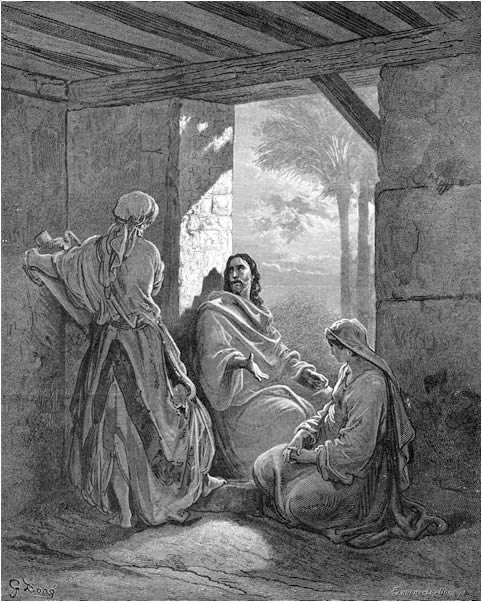
Christ's entertainment at Martha's house, the reproof he gave to her for her care about the world, and his commendation of Mary for her care about her soul,
The Nineteenth Century7 voices
A commentator
Jamieson, Fausset & Brown1802–1910
Commentary Critical and Explanatory on the Whole Bible (1871)
(3) Making him commend one of a deeply hated race. And he does it, but it is almost extorted. For he does not answer, "The Samaritan"--that would have sounded heterodox, heretical--but "He that showed mercy on him." It comes to the same thing, no doubt, but the circumlocution is significant.
A commentator
J.C. Ryle1816–1900
Expository Thoughts on the Gospels: Luke (lightly modernized text, Grace Gems edition) (1858)
proposed
These words contain the well-known parable of the good Samaritan. In order to understand the drift of this parable, we must carefully remember the occasion on which it was spoken. It was spoken in reply to the question of a certain lawyer, who asked, "who is my neighbor?" Our Lord Jesus Christ answers that question by telling the story we have just read — and winds up the narrative by an appeal to the lawyer's conscience. Let these things not be forgotten. The object of the parable is to show the nature of true charity and brotherly love.
OUR text is the whole story of the Samaritan, but as that is very long, let us, for our memories' sake, consider the exhortation in the 37th verse to be our text. "Go, and do you likewise." There are certain persons in the world who will not allow the preacher to speak upon anything but those doctrinal statements concerning the way of salvation which are known as "the Gospel."
A commentator
J.C. Ryle1816–1900
Expository Thoughts on the Gospels: Luke (lightly modernized text, Grace Gems edition) (1858)
proposed
These words contain the well-known parable of the good Samaritan. In order to understand the drift of this parable, we must carefully remember the occasion on which it was spoken. It was spoken in reply to the question of a certain lawyer, who asked, "who is my neighbor?" Our Lord Jesus Christ answers that question by telling the story we have just read — and winds up the narrative by an appeal to the lawyer's conscience. Let these things not be forgotten. The object of the parable is to show the nature of true charity and brotherly love. To lose sight of this object, and search for deep allegories in the parable — is to trifle with Scripture, and deprive our souls of most valuable lessons. We are taught, first, in this parable — how rare and uncommon true brotherly love is. This is a lesson which stands out prominently on the face of the narrative before our eyes. Our Lord tells us of a traveler who fell among thieves, and was left naked, wounded, and half dead on the road. He then tells us of a priest and a Levite , who, one after the other, came traveling that way, and saw the poor wounded man — but gave him no help. Both were men, who from their religious office and profession, ought to have been ready and willing to do good to one in distress. But both, in succession, were too selfish, or too unfeeling to offer the slightest assistance. They doubtless reasoned with themselves — that they knew nothing of the wounded traveler — that he had perhaps got into trouble by his own misconduct — that they had no time to stop to help him — and that they had enough to do to mind their own business, without troubling themselves with strangers. And the result was, that one after the other — they both "passed by on the other side." We have in this striking description, an exact picture of what is continually going on in the world.
OUR text is the whole story of the Samaritan, but as that is very long, let us, for our memories' sake, consider the exhortation in the 37th verse to be our text. "Go, and do you likewise." There are certain persons in the world who will not allow the preacher to speak upon anything but those doctrinal statements concerning the way of salvation which are known as "the Gospel." If the preacher shall insist upon some virtue or practical Grace, they straightway say that he is not preaching the Gospel, that he has become legal and is a mere moral teacher. We do not stand in any awe of such criticism, for we clearly perceive that our Lord Jesus Christ, Himself, would very frequently have come under it. Read the Sermon on the Mount and judge whether certain people would be content to hear the likes of it preached to them on the Sabbath. They would condemn it as containing very little Gospel and too much about good works. Our Lord was a great practical Preacher. He frequently delivered addresses in which He made answer to questioners, or gave direction to seekers, or upbraided offenders—and He gave a prominence to practical truth such as some of His ministers dare not imitate! Jesus tells us over and over again the manner in which we are to live towards our fellow men and He lays great stress upon the love which should shine throughout the Christian character. The story of the good Samaritan, which is now before us, is a case in point, for our Lord is explaining, there, a point which arose out of the question, "What shall I do to inherit eternal life?" The question is legal and the answer is to the point. But let it never be forgotten that what the Law demands of us, the Gospel produces in us. The Law tells us what we ought to be and it is one objective of the Gospel to raise us to that condition.
Which - was neighbor - Which fulfilled the duty which one neighbor owes to another?
A commentator
Albert Barnes1798–1870
Notes, Explanatory and Practical, on the Old and New Testaments (1832-1869)
proposed
Was neighbour - Showed the kindness of a neighbor, or evinced the proper feelings of a neighbor. The lawyer had asked him who was his neighbor? Jesus in this beautiful narrative showed him who and what a neighbor was, and he did this in a way that disarmed his prejudice, deeply affected him in regard to his own duty, and evinced the beauty of religion.
The words behind it
13 Greek wordsEvery Greek word of this verse in the order it stands, with what it means and the door to its own study. The last column counts the times a word stands in the whole Bible: the rarer the word, the more the places it appears belong together.
| Greek | Sound | Meaning | Word study | In the Bible |
|---|---|---|---|---|
| τίς | tis | Which | G5101 → | 563 times |
| τούτων | touton | of these | G3778 → | 1381 times |
| τῶν | ton | <the> | G3588 → | 19766 times |
| τριῶν | trion | three | G5140 → | 69 times |
| πλησίον | plesion | a neighbour | G4139 → | 17 times |
| δοκεῖ | dokei | seems | G1380 → | 62 times |
| σοι | soi | to you | G4771 → | 2973 times |
| γεγονέναι | gegonenai | to have been | G1096 → | 667 times |
| τοῦ | tou | of the [one] | G3588 → | 19766 times |
| ἐμπεσόντος | empesontos | falling | G1706 → | |
| εἰς | eis | among | G1519 → | 1755 times |
| τοὺς | tous | the | G3588 → | 19766 times |
| λῃστάς; | lestas | robbers? | G3027 → | 15 times |
τίςWhich
tisG5101 →563 times
τούτωνof these
toutonG3778 →1381 times
τῶν<the>
tonG3588 →19766 times
τριῶνthree
trionG5140 →69 times
πλησίονa neighbour
plesionG4139 →17 times
δοκεῖseems
dokeiG1380 →62 times
σοιto you
soiG4771 →2973 times
γεγονέναιto have been
gegonenaiG1096 →667 times
τοῦof the [one]
touG3588 →19766 times
ἐμπεσόντοςfalling
empesontosG1706 →
εἰςamong
eisG1519 →1755 times
τοὺςthe
tousG3588 →19766 times
λῃστάς;robbers?
lestasG3027 →15 times
A shaded row is a word that stands 400 times or fewer in the Bible.
The walk
8 stopsEach card is a verse this one points to, and under it the verses that one points to in turn. Where several paths arrive at the same place, that place is listed first: the text keeps returning to it.
Through
Matthew 17:25“Yes,” he answered. When Peter entered the house, Jesus preempted him. “What do you think, Simon?” He asked. “From whom do the kings of the earth collect customs and taxes: from their own sons,…
it leads to
- Matthew 22:21
“Caesar’s,” they answered. So Jesus told them, “Give to Caesar what is Caesar’s, and to God what is God’s.”
- Matthew 22:19
Show Me the coin used for the tax.” And they brought Him a denarius.
- Romans 13:6–7
This is also why you pay taxes. For the authorities are God’s servants, who devote themselves to their work.
- Matthew 22:21
Through
Matthew 22:42“What do you think about the Christ? Whose son is He?” “David’s,” they answered.
it leads to
- Jeremiah 23:5–6
Behold, the days are coming, declares the LORD, when I will raise up for David a righteous Branch, and He will reign wisely as King and will administer justice and righteousness in the land.
- Matthew 16:13–17
When Jesus came to the region of Caesarea Philippi, He questioned His disciples: “Who do people say the Son of Man is?”
- Amos 9:11
“In that day I will restore the fallen tent of David. I will repair its gaps, restore its ruins, and rebuild it as in the days of old,
- Ezekiel 34:23–24
I will appoint over them one shepherd, My servant David, and he will feed them. He will feed them and be their shepherd.
- John 6:68–69
Simon Peter replied, “Lord, to whom would we go? You have the words of eternal life.
- Jeremiah 23:5–6
Where this verse is studied
About Luke
This page draws on 17 works. Open the list of works
This page draws on Adam Clarke, Commentary on the Bible; Albert Barnes, Notes, Explanatory and Practical, on the Old and New Testaments (1832-1869); Ambrose of Milan, Commentary on Luke; Ambrose of Milan, Catena Aurea by Aquinas; Augustine of Hippo, CHRISTIAN INSTRUCTION 33; Augustine of Hippo, Catena Aurea by Aquinas; Bede, On the Gospel of Luke; Bonaventure, Commentary on Luke, Chapter 10; Charles Spurgeon, The Metropolitan Tabernacle Pulpit, Sermon No. 1360: “The Good Samaritan” (lightly modernized text, CCEL edition); Clement of Alexandria, Who is the Rich Man that Shall Be Saved?; Cyril of Alexandria, Catena Aurea by Aquinas; J. C. Ryle, Expository Thoughts on the Gospels, Luke; J.C. Ryle, Expository Thoughts on the Gospels: Luke (lightly modernized text, Grace Gems edition); Jamieson, Fausset & Brown, Commentary Critical and Explanatory on the Whole Bible; John Gill, Exposition of the New Testament; John Gill, Exposition of the New Testament (1746-1748) and Matthew Henry, Commentary on the Whole Bible.