
Luke 10:25
in Luke 10One day an expert in the law stood up to test Him. “Teacher,” he asked, “what must I do to inherit eternal life?”
BSB
The same verse in ASV and KJV ▾
ASV
And behold, a certain lawyer stood up and made trial of him, saying, Teacher, what shall I do to inherit eternal life?
KJV
And, behold, a certain lawyer stood up, and tempted him, saying, Master, what shall I do to inherit eternal life?
⋯
This verse in Luke 10
Commentary
21 notes on this verseFor he was one of those who think themselves skilled in the law, and who keep the letter of the law, while they know nothing of its spirit. From a part of the law itself our Lord proves them to be ignorant of the law, showing that at the very first the law preached the Father and the Son, and announced the sacraments of the Lord's Incarnation; for it follows, And he answering said, Thou shall love the Lord thy God with all thy heart, and with all thy soul, and with all thy strength, and with all thy mind.
This site's exposition
an expert in the law stood up to test Him
on Luke 10:25-28
Testing Him, an expert in the law asked about eternal life, a scholar probing a teacher without formal credentials. Sent back to his own text, he joined the Shema's love of God to the love of neighbor from Leviticus. Do this and you will live holds him to his answer.
The record, by era
The Church Fathers5 voices
For in this law given to Adam we recognise in embryo all the precepts which afterwards sprouted forth when given through Moses; that is, Thou shalt love the Lord thy God from thy whole heart and out of thy whole soul; Thou shalt love thy neighbour as thyself; Thou shalt not kill; Thou shall not commit adultery; Thou shalt not steal; False witness thou shall not utter; Honour thy father and mother; and, That which is another's, shall thou not covet.
But suppose they sent Him the message for the purpose of tempting Him? Well, but the Scripture does not say so; and inasmuch as it is usual for it to indicate what is done in the way of temptation ("Behold, a certain lawyer stood up, and tempted Him; " again, when inquiring about tribute, the Pharisees came to Him, tempting Him ), so, when it makes no mention of temptation, it does not admit the interpretation of temptation.
First of all, nobody would have told Him that His mother and brethren were standing outside, if he were not certain both that He had a mother and brethren, and that they were the very persons whom he was then announcing,-who had either been known to him before, or were then and there discovered by him; although heretics have removed this passage from the gospel, because those who were admiring His doctrine said that His supposed father, Joseph the carpenter, and His mother Mary, and His brethren, and His sisters, were very well known to them. But it was with the view of tempting Him, that they had mentioned to Him a mother and brethren which He did not possess. The Scripture says nothing of this, although it is not in other instances silent when anything was done against Him by way of temptation. "Behold," it says, "a certain lawyer stood up, and tempted Him." And in another passage: "The Pharisees also came unto Him, tempting Him." Who was to prevent its being in this place also indicated that this was done with the view of tempting Him? I do not admit what you advance of your own apart from Scripture.
(in Ps. 44.) By saying, with all thy mind, he does not admit of any division of love to other things, for whatever love you cast on lower things necessarily takes away from the whole. For as a vessel full of liquid, whatever flows therefrom must so much diminish its fulness; so also the soul, whatever love it has wasted upon things unlawful, has so much lessened its love to God. (Reg. fus. ad int. 2.) But if any one ask how the love of God is to be obtained, we are sure that the love of God cannot be taught. For neither did we learn to rejoice in the presence of light, or to embrace life, or to love our parents and children; much less were we taught the love of God, but a certain seminal principle was implanted in us, which has within itself the cause, that man clings to God; which principle the teaching of the divine commands is wont to cultivate diligently, to foster watchfully, and to carry on to the perfection of divine grace. For naturally we love good; we love also what is our own, and akin to us; we likewise of our own accord pour forth all our affections on our benefactors. If then God is good, but all things desire that good, which is wrought voluntarily, He is by nature inherent in us, and although from His goodness we are far from knowing Him, yet from the very fact that we proceeded forth from Him, we are bound to love Him with exceeding love, as in truth akin to us; He is likewise also a greater benefactor than all whom by nature we love here. (ad int 3.). And again. The love of God then is the first and chief command, but the second, as filling up the first and filled up by it, bids us to love our neighbour. Hence it follows, And thy neighbour as thyself. But we have an instinct given us by God to perform this command, as who does not know that man is a kind and social animal? […]
Anyone who thoroughly understands the mystery of the incarnation may say to the lawyer, "If you were skillful in the law and in the meaning of its hidden teaching, you would not forget who he is you try to tempt. You thought that he was a mere man, only man, and not God who appeared in human likeness, knows what is secret, and can look into the hearts of those who approach him. In many ways Emmanuel is depicted to you by the shadowing of Moses. You saw him there sacrificed as a lamb, yet conquering the destroyer and abolishing death by his blood. You saw him in the arrangement of the ark, in which the divine law was deposited. In his holy flesh he was as in an ark, being the Word of the Father, the Son that was begotten of him by nature. You saw him as the mercy seat in the holy tabernacle, around which stood the seraphim." He is our mercy seat for pardon of our sins. Yes, and even as man he is glorified by the seraphim, who are the intelligent and holy powers above. They stand around his divine and exalted throne.
14 more voices on this verse
The Church Fathers1 voice
For there were in fact certain men who then went about the whole country of the Jews bringing charges against Christ, and saying that He spoke of the commands of Moses as useless, and Himself introduced certain strange doctrines. A lawyer then, wishing to entrap Christ into saying something against Moses, comes and tempts Him, calling Him Master, though not bearing to be His disciple. And because our Lord was wont to speak to those who came to Him concerning eternal life, the lawyer adopts this kind of language.
The Medieval Church4 voices
And behold, a certain lawyer stood up, tempting him, and saying: Master, what shall I do to possess eternal life? The lawyer, who tests the Lord by asking about eternal life, as I think, took the occasion of testing from the very words of the …
Our Lord had told His disciples above that their names were written in Heaven; from this it seems to me the lawyer took occasion of tempting our Lord, as it is said, And, behold, a certain lawyer stood up, and tempted him.
This lawyer was a boastful man, very arrogant, as is evident from what follows, and moreover crafty. Therefore he approaches the Lord, testing Him, probably thinking that he would trap the Lord in His answers. But the Lord points him to that very Law in …
The second part treats of the form of living given to the disciples in two ways. And behold, a certain lawyer etc. After the Evangelist described the form of preaching, here secondly he introduces the form of living. Now one can be instructed in right …
The Puritans and the Awakening3 voices
And behold a certain lawyer stood up,.... From his seat, having been hearing Christ preach, very likely, in some synagogue; when and where this was, is not certain.
This was a good question: What shall I do to inherit eternal life? But it lost all its goodness when it was proposed with an ill design, or a very mean one. Note, It is not enough to speak of the things of God, and to enquire about them, but we must do it with a suitable concern.
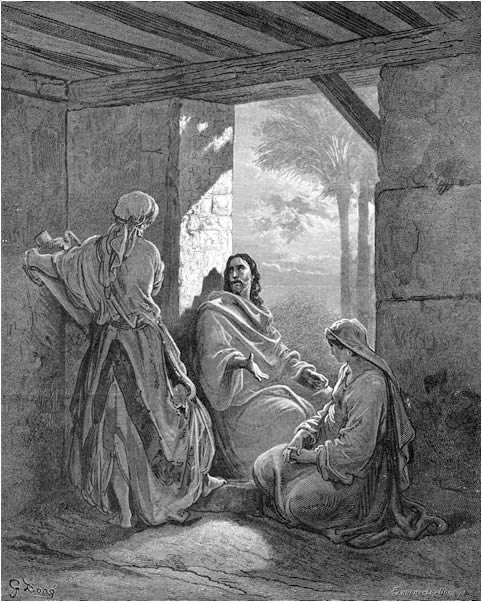
Christ's entertainment at Martha's house, the reproof he gave to her for her care about the world, and his commendation of Mary for her care about her soul,
The Nineteenth Century6 voices
A commentator
Albert Barnes1798–1870
Notes, Explanatory and Practical, on the Old and New Testaments (1832-1869)
A certain lawyer - One who professed to be well skilled in the laws of Moses, and whose business it was to explain them. Stood up - Rose - came forward to address him. Tempted him - Feigned a desire to be instructed, but did it to perplex him, or to lead him, if possible, to contradict some of the maxims of the law. Inherit eternal life - Be saved. This was the common inquiry among the Jews. “They” had said that man must keep the commandments - the written and oral law.
OUR text is the whole story of the Samaritan, but as that is very long, let us, for our memories' sake, consider the exhortation in the 37th verse to be our text. "Go, and do you likewise." There are certain persons in the world who will not allow the preacher to speak upon anything but those doctrinal statements concerning the way of salvation which are known as "the Gospel."
A commentator
J.C. Ryle1816–1900
Expository Thoughts on the Gospels: Luke (lightly modernized text, Grace Gems edition) (1858)
proposed
We should notice in this passage — the solemn question which was addressed to our Lord Jesus Christ. We are told that a certain lawyer asked Him, "What shall I do to inherit eternal life?" The motive of this man was evidently not right. He only asked this question to "test" our Lord, and to provoke Him to say something on which His enemies might lay hold of. Yet the question he propounded was undoubtedly one of the deepest importance. It is a question which deserves the principal attention of every man, woman, and child on earth.
A commentator
J.C. Ryle1816–1900
Expository Thoughts on the Gospels: Luke (lightly modernized text, Grace Gems edition) (1858)
proposed
We should notice in this passage — the solemn question which was addressed to our Lord Jesus Christ. We are told that a certain lawyer asked Him, "What shall I do to inherit eternal life?" The motive of this man was evidently not right. He only asked this question to "test" our Lord, and to provoke Him to say something on which His enemies might lay hold of. Yet the question he propounded was undoubtedly one of the deepest importance. It is a question which deserves the principal attention of every man, woman, and child on earth. We are all sinners — dying sinners, and sinners going to be judged after death. "How shall our sins be pardoned? With what shall we come before God? How shall we escape the damnation of Hell? Where shall we flee from the wrath to come? What must we do to be saved?" These are inquiries which people of every rank ought to put to themselves — and never rest until they find an answer. It is a question which unhappily few care to consider. Thousands are constantly inquiring, "What shall we eat? What shall we drink? With what shall we be clothed? How can we get money? How can we enjoy ourselves? How can we prosper in the world?" Few, very few — will ever give a moment's thought to the salvation of their souls. They hate the subject. It makes them uncomfortable. They turn from it and put it away. Faithful and true is that saying of our Lord's, "Wide is the gate and broad is the way that leads unto destruction — and many enter through it. But small is the gate and narrow the way that leads to life — and only a few find it." (Matthew 7:13-14.) Let us not be ashamed of putting the lawyer's question to our own souls. Let us rather ponder it, think about it — and never be content until it fills the first place in our minds.
OUR text is the whole story of the Samaritan, but as that is very long, let us, for our memories' sake, consider the exhortation in the 37th verse to be our text. "Go, and do you likewise." There are certain persons in the world who will not allow the preacher to speak upon anything but those doctrinal statements concerning the way of salvation which are known as "the Gospel." If the preacher shall insist upon some virtue or practical Grace, they straightway say that he is not preaching the Gospel, that he has become legal and is a mere moral teacher. We do not stand in any awe of such criticism, for we clearly perceive that our Lord Jesus Christ, Himself, would very frequently have come under it. Read the Sermon on the Mount and judge whether certain people would be content to hear the likes of it preached to them on the Sabbath. They would condemn it as containing very little Gospel and too much about good works. Our Lord was a great practical Preacher. He frequently delivered addresses in which He made answer to questioners, or gave direction to seekers, or upbraided offenders—and He gave a prominence to practical truth such as some of His ministers dare not imitate! Jesus tells us over and over again the manner in which we are to live towards our fellow men and He lays great stress upon the love which should shine throughout the Christian character. The story of the good Samaritan, which is now before us, is a case in point, for our Lord is explaining, there, a point which arose out of the question, "What shall I do to inherit eternal life?" The question is legal and the answer is to the point. But let it never be forgotten that what the Law demands of us, the Gospel produces in us. The Law tells us what we ought to be and it is one objective of the Gospel to raise us to that condition.
A certain lawyer - See on Mat 22:35 (note).
The words behind it
14 Greek wordsEvery Greek word of this verse in the order it stands, with what it means and the door to its own study. The last column counts the times a word stands in the whole Bible: the rarer the word, the more the places it appears belong together.
| Greek | Sound | Meaning | Word study | In the Bible |
|---|---|---|---|---|
| Καὶ | kai | And | G2532 → | 9120 times |
| ἰδοὺ | idou | behold | G2400 → | 200 times |
| νομικός | nomikos | a lawyer | G3544 → | 9 times |
| τις | tis | certain | G5100 → | 528 times |
| ἀνέστη | aneste | stood up | G450 → | 107 times |
| ἐκπειράζων | ekpeirazon | testing | G1598 → | |
| αὐτὸν | auton | Him | G846 → | 5565 times |
| λέγων· | legon | saying; | G3004 → | 1325 times |
| διδάσκαλε, | didaskale | Teacher, | G1320 → | 58 times |
| τί | ti | what | G5101 → | 563 times |
| ποιήσας | poiesas | having done | G4160 → | 569 times |
| ζωὴν | zoen | life | G2222 → | 135 times |
| αἰώνιον | aionion | eternal | G166 → | 68 times |
| κληρονομήσω; | kleronomeso | will I inherit? | G2816 → |
ΚαὶAnd
kaiG2532 →9120 times
ἰδοὺbehold
idouG2400 →200 times
νομικόςa lawyer
nomikosG3544 →9 times
τιςcertain
tisG5100 →528 times
ἀνέστηstood up
anesteG450 →107 times
ἐκπειράζωνtesting
ekpeirazonG1598 →
αὐτὸνHim
autonG846 →5565 times
λέγων·saying;
legonG3004 →1325 times
διδάσκαλε,Teacher,
didaskaleG1320 →58 times
τίwhat
tiG5101 →563 times
ποιήσαςhaving done
poiesasG4160 →569 times
ζωὴνlife
zoenG2222 →135 times
αἰώνιονeternal
aionionG166 →68 times
κληρονομήσω;will I inherit?
kleronomesoG2816 →
A shaded row is a word that stands 400 times or fewer in the Bible.
The walk
8 stopsEach card is a verse this one points to, and under it the verses that one points to in turn. Where several paths arrive at the same place, that place is listed first: the text keeps returning to it.
Through
Luke 18:18Then a certain ruler asked Him, “Good Teacher, what must I do to inherit eternal life?”
it leads to
- Mark 10:17–31
As Jesus started on His way, a man ran up and knelt before Him. “Good Teacher,” he asked, “what must I do to inherit eternal life?”
- Acts 16:30
Then he brought them out and asked, “Sirs, what must I do to be saved?”
- Matthew 19:16–30
Just then a man came up to Jesus and inquired, “Teacher, what good thing must I do to obtain eternal life?”
- Ezekiel 33:31
So My people come to you as usual, sit before you, and hear your words; but they do not put them into practice. Although they express love with their mouths, their hearts pursue dishonest…
- Luke 10:25–28
One day an expert in the law stood up to test Him. “Teacher,” he asked, “what must I do to inherit eternal life?”
- Mark 10:17–31
Through
Galatians 3:18For if the inheritance depends on the law, then it no longer depends on a promise; but God freely granted it to Abraham through a promise.
it leads to
- Romans 4:13–16
For the promise to Abraham and his offspring that he would be heir of the world was not given through the law, but through the righteousness that comes by faith.
- Galatians 2:21
I do not set aside the grace of God. For if righteousness comes through the law, Christ died for nothing.
- Hebrews 6:12–15
Then you will not be sluggish, but will imitate those who through faith and patience inherit what has been promised.
- Romans 4:13–16
Where this verse is studied
About Luke
This page draws on 18 works. Open the list of works
This page draws on Adam Clarke, Commentary on the Bible; Albert Barnes, Notes, Explanatory and Practical, on the Old and New Testaments (1832-1869); Ambrose of Milan, Catena Aurea by Aquinas; Basil of Caesarea, Catena Aurea by Aquinas; Bede, On the Gospel of Luke; Bede, Catena Aurea by Aquinas; Bonaventure, Commentary on Luke, Chapter 10; Charles Spurgeon, The Metropolitan Tabernacle Pulpit, Sermon No. 1360: “The Good Samaritan” (lightly modernized text, CCEL edition); Cyril of Alexandria, COMMENTARY ON LUKE, HOMILY 68; Cyril of Alexandria, Catena Aurea by Aquinas; J.C. Ryle, Expository Thoughts on the Gospels: Luke (lightly modernized text, Grace Gems edition); John Gill, Exposition of the New Testament; John Gill, Exposition of the New Testament (1746-1748); Matthew Henry, Commentary on the Whole Bible; Tertullian, An Answer to the Jews; Tertullian, Against Marcion Book IV; Tertullian, On the Flesh of Christ and Theophylact of Ohrid, Commentary on Luke.