
Luke 10:40
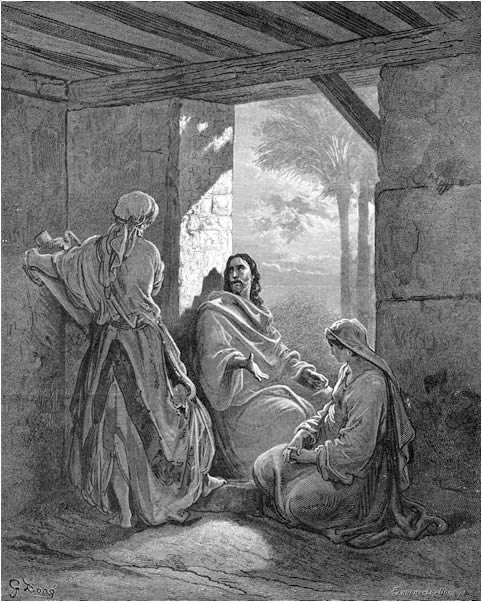
in Luke 10But Martha was distracted by all the preparations to be made. She came to Jesus and said, “Lord, do You not care that my sister has left me to serve alone? Tell her to help me!”
BSB
The same verse in ASV and KJV ▾
ASV
But Martha was cumbered about much serving; and she came up to him, and said, Lord, dost thou not care that my sister did leave me to serve alone? bid her therefore that she help me.
KJV
But Martha was cumbered about much serving, and came to him, and said, Lord, dost thou not care that my sister hath left me to serve alone? bid her therefore that she help me.
⋯
This verse in Luke 10
Commentary
23 notes on this verse(6. Mor. c. 18.) Or by Mary who sat and heard our Lord's words, is signified the contemplative life; by Martha engaged in more outward services, the active life. Now Martha's care is not blamed, but Mary is praised, for great are the rewards of an active life, but those of a contemplative are far better. Hence Mary's part it is said will never be taken away from her, for the works of an active life pass away with the body, but the joys of the contemplative life the rather begin to increase from the end.
This site's exposition
Martha was distracted by all the preparations
on Luke 10:40-42
Martha was distracted by all the preparations and aimed her complaint past Mary at Jesus. Martha, Martha, He answers, the doubled name He gives Simon Peter elsewhere. Only one thing is necessary, and Mary has chosen the good portion, hearing Him.
The record, by era
The Church Fathers5 voices
(ubi sup.) Martha was well engaged in ministering to the bodily wants or wishes of our Lord, as of one who was mortal, but He who was clothed in mortal flesh; in the beginning was the Word. Behold then what Mary heard, The Word was made flesh. Behold then Him to whom Martha ministered. The one was labouring, the other at rest. But yet Martha, when much troubled in her occupation and business of serving, interrupted our Lord, and complained of her sister. For it follows, And said, Lord, dost thou not care that my sister hath left me to serve alone? For Mary was absorbed in the sweetness of our Lord's words; Martha was preparing a feast for our Lord, in whose feast Mary was now rejoicing. While then she was listening with delight to those sweet words, and was feeding on them with the deepest affection, our Lord was interrupted by her sister. What must we suppose was her alarm, lest the Lord should say to her, "Rise, and help thy sister?" Our Lord therefore, who was not at a loss, for He had shewn He was the Lord, answered as follows, And Jesus answered and said unto her, Martha, Martha. The repetition of the name is a mark of love, or perhaps of drawing the attention, that she should listen more earnestly. When twice called, she hears, Thou art troubled about many things, that is, thou art busied about many things. For man wishes to meet with something when he is serving, and can not; and thus between seeking what is wanting and preparing what is at hand, the mind is distracted. For if Martha had been sufficient of herself, she would not have required the aid of her sister. There are many, there are diverse things, which are carnal, temporal, but one is preferred to many. For one is not from many, but many from one. Hence it follows, But one thing is needful. Mary wished to be occupied about one, according to that, It is good for me to cling close unto the Lord. (Ps. […]
Mary came and sat at his feet. This was as though she were sitting on firm ground at the feet of him who had forgiven the sinful woman her sins. She had put on a crown in order to enter into the kingdom of the …
To cling always to God and to the things of God—this must be our major effort, this must be the road that the heart follows unswervingly. Any diversion, however impressive, must be regarded as secondary, low-grade and certainly dangerous. Martha and Mary provide a most beautiful scriptural paradigm of this outlook and of this mode of activity. In looking after the Lord and his disciples, Martha did a very holy service. Mary, however, was intent on the spiritual teaching of Jesus, and she stayed by his feet, which she kissed and anointed with the oil of her good faith.… In saying "Mary chose the good portion," he was saying nothing about Martha, and in no way was he giving the appearance of criticizing her. Still, by praising Mary he was saying that the other was a step below her. Again, by saying "it will not be taken away from her," he was showing that Martha's role could be taken away from her, since the service of the body can only last as long as the human being is there, whereas the zeal of Mary can never end.
When certain brethren have received God, they will not be anxious about much service, nor ask for those things which are not in their hands, and are beyond their needs. For every where and in every thing that which is superfluous is burdensome. For it begets weariness in those who are wishing to bestow it, while the guests feel that they are the cause of trouble.
(Const. Mon. c. 1.) Now every work and word of our Saviour is a rule of piety and virtue. For to this end did He put on our body, that as much as we can we might imitate His conversation. (in reg. fus. int. 19.) It is foolish also to take food for the support of the body, and thereby in return to hurt the body, and to hinder it in the performance of the divine command.
16 more voices on this verse
The Medieval Church4 voices
And she stood and said: Lord, do you not care that my sister has left me to serve alone? Tell her therefore to help me. He speaks from the perspective of those who, still ignorant of divine contemplation, consider that the work of brotherly love …
Our Lord does not then forbid hospitality, but the troubling about many things, that is to say, hurry and anxiety. And mark the wisdom of our Lord, in that at first He said nothing to Martha, but when she sought to tear away her sister from hearing, then the Lord took occasion to reprove her. For hospitality is ever honoured as long as it keeps us to necessary things. But when it begins to hinder us from attending to what is of more importance, then it is plain that the hearing of the divine word is the more honourable.
Note also the prudence of the Lord. He said nothing to Martha before He received from her an occasion for reproof. But when she attempted to draw her sister away from listening, then the Lord, taking the occasion, reproves her. For hospitality is praiseworthy only …
Third, with regard to the exercise of the active life, it is added: But Martha was busy about much serving; and this as a good active person, avoiding idleness, according to the counsel of the Wise Man, in Ecclesiastes nine: "Whatever your hand is able …
The Puritans and the Awakening3 voices
But Martha was cumbered about much serving,.... "Or was drawn off", from hearing the word, from attending on Christ; being taken up in providing for him, and those that came with him; in dressing food, or in ordering her servants, how she would have every thing done, and in overlooking them, that every thing was done in proper order; so that she had a great deal of business upon her head and hands, which distracted her thoughts, or took them off of divine things, and put her in great hurry and concern.
Martha was encumbered - The Greek word properly signifies to be drawn different ways at the same time, and admirably expresses the situation of a mind, surrounded (as Martha's then was) with so many objects of care, that it hardly knows which to attend to first.
They were seventy elders of the Jews that were employed by Ptolemy king of Egypt in turning the Old Testament into Greek, whose translation is thence called the Septuagint. The great sanhedrim consisted of this number. We are glad to find that Christ had so many followers fit to be sent forth; his labour was not altogether in vain, though he met with much opposition.
The Nineteenth Century8 voices
Martha was cumbered - Περιεσπατο, perplexed, from περι, about, and σπαω, I draw. She was harassed with different cares and employments at the same time; one drawing one way, and another, another: a proper description of a worldly mind. But in Martha’s favor it may be justly said, that all her anxiety was to provide suitable and timely entertainment for our Lord and his disciples; for this is the sense in which the word διακονιαν, serving, should be taken.
IT is not an easy thing to maintain the balance of our spiritual life. No man can be spiritually healthy who does not meditate and commune. No man, on the other hand, is as he should be unless he is active and diligent in holy service. David sweetly sang, "He makes me to lie down in green pastures." There was the contemplative. "He leads me beside the still waters." There was the active and progressive. The difficulty is to maintain the two—and to keep each in its relative proportion to the other.
A commentator
J.C. Ryle1816–1900
Expository Thoughts on the Gospels: Luke (lightly modernized text, Grace Gems edition) (1858)
proposed
The little history which these verses contain, is only recorded in the Gospel of Luke. So long as the world stands, the story of Mary and Martha will furnish the Church with lessons of wisdom which ought never to be forgotten. Taken together with the eleventh chapter of John's Gospel, it throws a most instructive light on the inner life of the family which Jesus loved. Let us observe, for one thing — how different the characters and personalities of true Christians may be. The two sisters of whom we read in this passage were faithful disciples. Both had believed. Both had been converted. Both had honored Christ when few gave Him honor. Both loved Jesus — and Jesus loved both of them. Yet they were evidently women of very different turn of mind. Martha was active, stirring, and impulsive, feeling strongly — and speaking out all she felt. Mary was quiet, still, and contemplative, feeling deeply — but saying less than she felt. Martha, when Jesus came to her house, rejoiced to see Him — and busied herself with preparing a suitable refreshment. Mary, also, rejoiced to see Him — but her first thought was to sit at His feet and hear His Word. Grace reigned in both hearts — but each showed the effects of grace at different times, and in different ways. We shall find it very useful to ourselves to remember this lesson. We must not expect all believers in Christ to be exactly like one another. We must not set down others as having no grace — because their experience does not entirely tally with our own. The sheep in the Lord's flock have each their own peculiarities. The trees in the Lord's garden are not all precisely alike. All true servants of God agree in the principal things of religion. All are led by one Spirit. All feel their sins — and all trust in Christ. All repent, all believe — and all are holy.
IT is not an easy thing to maintain the balance of our spiritual life. No man can be spiritually healthy who does not meditate and commune. No man, on the other hand, is as he should be unless he is active and diligent in holy service. David sweetly sang, "He makes me to lie down in green pastures." There was the contemplative. "He leads me beside the still waters." There was the active and progressive. The difficulty is to maintain the two—and to keep each in its relative proportion to the other. We must not be so active as to neglect communion, nor so contemplative as to become unpractical. In the chapter from which our text is taken we have several lessons on this subject. The seventy disciples returned from their preaching tour flushed with the joy of success. And our Savior, to refine that joy and prevent its degenerating into pride, bids them rather rejoice that their names were written in Heaven. He conducted their contemplations to the glorious doctrine of election, that grateful thoughts might sober them after successful work. He bids them consider themselves as debtors to Divine Grace, which reveals unto babes the mysteries of God—for He would not allow their new position as workers to make them forget that they were the chosen of God—and therefore debtors. Our wise Master next returns to the subject of service, and instructs them by the memorable parable of the good Samaritan and the wounded man. And then as if they might vainly imagine philanthropy, as it is the service of Christ, to be the only service of Christ, and to be the only thing worth living for, He brings in the two sisters of Bethany. The Holy Spirit meant thereby to teach us that while we ought to abound in service, and to do good abundantly to our fellow men, yet we must not fail in worship, in spiritual reverence, in meek discipleship, and quiet contemplation.
A commentator
Charles Spurgeon1834–1892
The Metropolitan Tabernacle Pulpit, Sermon No. 3163: “Cumbered With Much Serving” (lightly modernized text, CCEL edition) · Written before 1892.
proposed
THE preacher will have one hearer tonight to whom his text will be amazingly applicable—himself! Here we have meeting after meeting and engagement after engagement. We are always working as hard as we can, but we have put on much extra canvas just now, serving much and not being exempt from Martha's sin of being cumberedwith much serving.
A commentator
Charles Spurgeon1834–1892
The Metropolitan Tabernacle Pulpit, Sermon No. 3163: “Cumbered With Much Serving” (lightly modernized text, CCEL edition) · Written before 1892.
proposed
THE preacher will have one hearer tonight to whom his text will be amazingly applicable—himself! Here we have meeting after meeting and engagement after engagement. We are always working as hard as we can, but we have put on much extra canvas just now, serving much and not being exempt from Martha's sin of being cumberedwith much serving. I should not wonder but what there may be some others here besides the preacher who may have fallen into the same state of mind and, perhaps, just now while engaged more than ever in God's work, it may be well for us to pull ourselves up a little and look around us, and see what state we are in, lest, like Martha, we get more and more cumbered, till at last we speak as we ought not to speak and begin to upbraid others who are less wrong than ourselves! I. We will first say a little on this point—WHAT WAS IT THAT MARTHA WAS PROBABLY CUMBERED ABOUT? Her fault was not that she served. Oh, that is no fault! The condition of a servant should be the condition of every Christian. "I serve," should be the motto of all the princes of the royal family of God! It was not her fault that she had "much serving." We cannot do too much. Let us do all that we possibly can—head, heart and hands—let every single power and passion of our nature be engaged in the Master's service! "Hereby shall you be My disciples, if you bring forth much fruit." It was no fault of hers that she was busy preparing a feast for the Master. Happy Martha to have an opportunity of entertaining so blessed a Guest! And happy Martha, too, to have the spirit to throw her whole soul so heartily into the engagement. But her fault was that she grew "cumberedwith much serving," so that she forgot Him and only remembered the service! She overrode her union with Christ by her service of Christ—and herein was the mischief.
A commentator
J.C. Ryle1816–1900
Expository Thoughts on the Gospels: Luke (lightly modernized text, Grace Gems edition) (1858)
proposed
The little history which these verses contain, is only recorded in the Gospel of Luke. So long as the world stands, the story of Mary and Martha will furnish the Church with lessons of wisdom which ought never to be forgotten. Taken together with the eleventh chapter of John's Gospel, it throws a most instructive light on the inner life of the family which Jesus loved. Let us observe, for one thing — how different the characters and personalities of true Christians may be. The two sisters of whom we read in this passage were faithful disciples. Both had believed.
A commentator
Albert Barnes1798–1870
Notes, Explanatory and Practical, on the Old and New Testaments (1832-1869)
proposed
Martha was cumbered about much serving - Was much distracted with the cares of the family, and providing suitably to entertain the Saviour. It should be said here that there is no evidence that Martha had a worldly or covetous disposition. Her anxiety was to provide suitable entertainment for the Lord Jesus. As mistress of the family, this care properly devolved on her; and the only fault which can be charged on her was too earnest a desire to make such entertainment, when she might have sat with Mary at his feet, and, perhaps, too much haste and fretfulness in speaking to Jesus about Mary. Dost thou not care ... - This was an improper reproof of our Lord, as if “he” encouraged Mary in neglecting her duty. Or perhaps Martha supposed that Mary was sitting there to show him the proper expressions of courtesy and kindness, and that she would not think it proper to leave him without his direction and permission. She therefore “hinted” to Jesus her busy employments, her need of the aid of her sister, and requested that he would signify his wish that Mary should assist her.
Modern Voices1 voice
A commentator
GK ChestertonThe Everlasting Man, Part 2 Ch. 2: The Riddles of the Gospel (1925) (1925)
proposed
Something of the same thing may be said about the incident of Martha and Mary; which has been interpreted in retrospect and from the inside by the mystics of the Christian contemplative life. But it was not at all an obvious view of it; and …
The words behind it
28 Greek wordsEvery Greek word of this verse in the order it stands, with what it means and the door to its own study. The last column counts the times a word stands in the whole Bible: the rarer the word, the more the places it appears belong together.
| Greek | Sound | Meaning | Word study | In the Bible |
|---|---|---|---|---|
| ἡ | he | <the> | G3588 → | 19766 times |
| δὲ | de | But | G1161 → | 2765 times |
| Μάρθα | martha | Martha | G3136 → | 13 times |
| περιεσπᾶτο | periespato | was distracted | G4049 → | |
| περὶ | peri | about | G4012 → | 332 times |
| πολλὴν | pollen | much | G4183 → | 367 times |
| διακονίαν. | diakonian | service. | G1248 → | |
| ἐπιστᾶσα | epistasa | having come up | G2186 → | 21 times |
| δὲ | de | now | G1161 → | 2765 times |
| εἶπεν· | eipen | she said; | G2036 → | 925 times |
| κύριε, | kurie | Lord, | G2962 → | 711 times |
| οὐ | ou | not | G3756 → | 1664 times |
| μέλει | melei | is it concerning | G3199 → | |
| σοι | soi | to You | G4771 → | 2973 times |
| ὅτι | hoti | that | G3754 → | 1292 times |
| ἡ | he | the | G3588 → | 19766 times |
| ἀδελφή | adelphe | sister | G79 → | 26 times |
| μου | mou | of mine | G3165 → | 1936 times |
| μόνην | monen | alone | G3441 → | 110 times |
| με | me | me | G3165 → | 1936 times |
| κατέλιπεν | katelipen | has left | G2641 → | 23 times |
| διακονεῖν; | diakonein | to serve? | G1247 → | 37 times |
| εἰπὲ | eipe | do speak | G2036 → | 925 times |
| οὖν | oun | therefore | G3767 → | 497 times |
| αὐτῇ | autea | to her | G846 → | 5565 times |
| ἵνα | ina | that | G2443 → | 668 times |
| μοι | moi | me | G3165 → | 1936 times |
| συναντιλάβηται.¶ | sunantilabetai | she may help! | G4878 → |
ἡ<the>
heG3588 →19766 times
δὲBut
deG1161 →2765 times
ΜάρθαMartha
marthaG3136 →13 times
περιεσπᾶτοwas distracted
periespatoG4049 →
περὶabout
periG4012 →332 times
πολλὴνmuch
pollenG4183 →367 times
διακονίαν.service.
diakonianG1248 →
ἐπιστᾶσαhaving come up
epistasaG2186 →21 times
δὲnow
deG1161 →2765 times
εἶπεν·she said;
eipenG2036 →925 times
κύριε,Lord,
kurieG2962 →711 times
οὐnot
ouG3756 →1664 times
μέλειis it concerning
meleiG3199 →
σοιto You
soiG4771 →2973 times
ὅτιthat
hotiG3754 →1292 times
ἡthe
heG3588 →19766 times
ἀδελφήsister
adelpheG79 →26 times
μουof mine
mouG3165 →1936 times
μόνηνalone
monenG3441 →110 times
μεme
meG3165 →1936 times
κατέλιπενhas left
katelipenG2641 →23 times
διακονεῖν;to serve?
diakoneinG1247 →37 times
εἰπὲdo speak
eipeG2036 →925 times
οὖνtherefore
ounG3767 →497 times
αὐτῇto her
auteaG846 →5565 times
ἵναthat
inaG2443 →668 times
μοιme
moiG3165 →1936 times
συναντιλάβηται.¶she may help!
sunantilabetaiG4878 →
A shaded row is a word that stands 400 times or fewer in the Bible.
The walk
8 stopsEach card is a verse this one points to, and under it the verses that one points to in turn. Where several paths arrive at the same place, that place is listed first: the text keeps returning to it.
Through
John 6:27Do not work for food that perishes, but for food that endures to eternal life, which the Son of Man will give you. For on Him God the Father has placed His seal of…
it leads to
- Colossians 3:2
Set your minds on things above, not on earthly things.
- Isaiah 55:2
Why spend money on that which is not bread, and your labor on that which does not satisfy? Listen carefully to Me, and eat what is good, and your soul will delight in the…
- John 6:54
Whoever eats My flesh and drinks My blood has eternal life, and I will raise him up at the last day.
- 2 Timothy 2:19
Nevertheless, God’s firm foundation stands, bearing this seal: “The Lord knows those who are His,” and, “Everyone who calls on the name of the Lord must turn away from iniquity.”
- John 6:40
For it is My Father’s will that everyone who looks to the Son and believes in Him shall have eternal life, and I will raise him up at the last day.”
- Colossians 3:2
Through
Luke 12:29And do not be concerned about what you will eat or drink. Do not worry about it.
it leads to
- Matthew 6:31
Therefore do not worry, saying, ‘What shall we eat?’ or ‘What shall we drink?’ or ‘What shall we wear?’
- Luke 12:22
Then Jesus said to His disciples, “Therefore I tell you, do not worry about your life, what you will eat, or about your body, what you will wear.
- Luke 22:35
Then Jesus asked them, “When I sent you out without purse or bag or sandals, did you lack anything?” “Nothing,” they answered.
- Matthew 6:31
Where this verse is studied
On this page
Studies13
On this verse
About Luke
Who and where
1 name in this verse with a page on the site.
This page draws on 21 works. Open the list of works
This page draws on Adam Clarke, Commentary on the Bible; Albert Barnes, Notes, Explanatory and Practical, on the Old and New Testaments (1832-1869); Alexander Maclaren, Expositions of Holy Scripture, Luke; Augustine of Hippo, Catena Aurea by Aquinas; Basil of Caesarea, Catena Aurea by Aquinas; Bede, On the Gospel of Luke; Bonaventure, Commentary on Luke, Chapter 10; Charles Spurgeon, The Metropolitan Tabernacle Pulpit, Sermon No. 927: “Martha And Mary” (lightly modernized text, CCEL edition); Charles Spurgeon, The Metropolitan Tabernacle Pulpit, Sermon No. 3163: “Cumbered With Much Serving” (lightly modernized text, CCEL edition); Cyril of Alexandria, Catena Aurea by Aquinas; Ephrem the Syrian, COMMENTARY ON TATIAN'S DIATESSARON 8.15; GK Chesterton, The Everlasting Man, Part 2 Ch. 2: The Riddles of the Gospel (1925); Gregory the Dialogist, Catena Aurea by Aquinas; J.C. Ryle, Expository Thoughts on the Gospels: Luke (lightly modernized text, Grace Gems edition); Jamieson, Fausset & Brown, Commentary Critical and Explanatory on the Whole Bible; John Cassian, CONFERENCE 1.8; John Gill, Exposition of the New Testament (1746-1748); John Wesley, Explanatory Notes upon the New Testament; Matthew Henry, Commentary on the Whole Bible; Theophylact of Ohrid, Catena Aurea by Aquinas and Theophylact of Ohrid, Commentary on Luke.