
Luke 10:26
in Luke 10“What is written in the Law?” Jesus replied. “How do you read it?”
BSB
The same verse in ASV and KJV ▾
ASV
And he said unto him, What is written in the law? how readest thou?
KJV
He said unto him, What is written in the law? how readest thou?
⋯
This verse in Luke 10
Commentary
15 notes on this verseFor he was one of those who think themselves skilled in the law, and who keep the letter of the law, while they know nothing of its spirit. From a part of the law itself our Lord proves them to be ignorant of the law, showing that at the very first the law preached the Father and the Son, and announced the sacraments of the Lord's Incarnation; for it follows, And he answering said, Thou shall love the Lord thy God with all thy heart, and with all thy soul, and with all thy strength, and with all thy mind.
This site's exposition
an expert in the law stood up to test Him
on Luke 10:25-28
Testing Him, an expert in the law asked about eternal life, a scholar probing a teacher without formal credentials. Sent back to his own text, he joined the Shema's love of God to the love of neighbor from Leviticus. Do this and you will live holds him to his answer.
This site's exposition
How do you read it?
Jesus sends the expert in the law to his own reading of Scripture. Matthew Henry calls it a mercy that the law is written and so made certain. Bonaventure sees a Master who honours the Law.
The record, by era
The Church Fathers2 voices
With these verses belongs the text that exposes those who seem to themselves to be experts on the law, who keep the letter of the law but disregard its spirit. He teaches that they are ignorant of the law from its very first chapter. He proves this immediately at the beginning of the law. Both the Father and the Son proclaimed and announced the sacrament of the divine incarnation, saying, "You shall love the Lord your God" and "You shall love your neighbor as yourself." The Lord said to the lawyer, "Do this, and you shall live."
And since he tempted Him subtly, he receives no other answer than the command given by Moses; for it follows, He said unto him, What is written in the law? how readest thou?
The Medieval Church2 voices
But he said to him: What is written in the law? How do you read it? He answered, saying: You shall love the Lord your God with all your heart, and with all your soul, and with all your strength, and with all your mind, …
Second, regarding the discovery of the truth sought, he adds: But he said to him: What is written in the Law? How do you read? From this it is apparent that the Master of truth was a friend of the Law, according to Matthew five: …
The Puritans and the Awakening1 voice
What is written in the law?.... Christ, with great propriety, sends him to the law, to see and observe what was written there, what are the terms and conditions of life, as fixed there; partly, because this man, by his office and character, was an interpreter of the law; and partly, because his question was, what shall I do? how readest thou? in the law, every day; referring to the "Keriat Shema", the reading of the Shema, i.e. those words in Deu 6:4, &c, "Hear, O Israel, &c." morning and evening (i) as appears by his answer (i) Vid. Misn.
7 more voices on this verse
The Puritans and the Awakening2 voices
We must have recourse to our bibles, to the law, as it is now in the hand of Christ and walk in the way that is shown us there. It is a great mercy that we have the law written, that we have it thereby reduced to certainty, and that thereby it is capable of spreading the further, and lasting the longer.
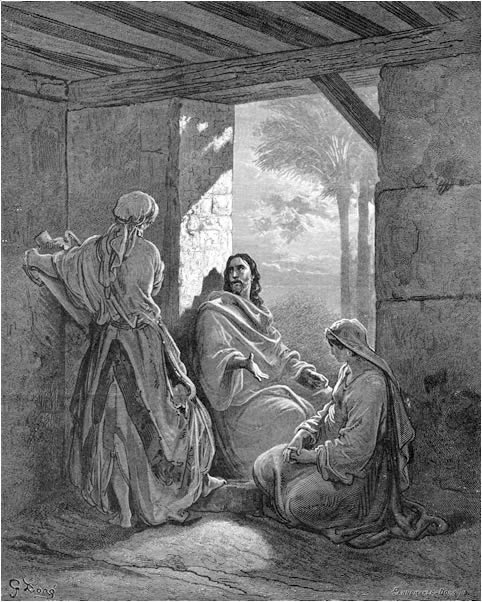
Christ's entertainment at Martha's house, the reproof he gave to her for her care about the world, and his commendation of Mary for her care about her soul,
The Nineteenth Century5 voices
A commentator
Albert Barnes1798–1870
Notes, Explanatory and Practical, on the Old and New Testaments (1832-1869)
What is written ... - Jesus referred him to the “law” as a safe rule, and asked him what was said there. The lawyer was doubtless endeavoring to justify himself by obeying the law. He trusted to his own works. To bring him off from that ground - to make him feel that it was an unsafe foundation, Jesus showed him what the law “required,” and thus showed him that he needed a better righteousness than his own. This is the proper use of the law.
A commentator
J.C. Ryle1816–1900
Expository Thoughts on the Gospels: Luke (lightly modernized text, Grace Gems edition) (1858)
proposed
We should notice in this passage — the solemn question which was addressed to our Lord Jesus Christ. We are told that a certain lawyer asked Him, "What shall I do to inherit eternal life?" The motive of this man was evidently not right. He only asked this question to "test" our Lord, and to provoke Him to say something on which His enemies might lay hold of. Yet the question he propounded was undoubtedly one of the deepest importance. It is a question which deserves the principal attention of every man, woman, and child on earth.
A commentator
J.C. Ryle1816–1900
Expository Thoughts on the Gospels: Luke (lightly modernized text, Grace Gems edition) (1858)
proposed
We should notice in this passage — the solemn question which was addressed to our Lord Jesus Christ. We are told that a certain lawyer asked Him, "What shall I do to inherit eternal life?" The motive of this man was evidently not right. He only asked this question to "test" our Lord, and to provoke Him to say something on which His enemies might lay hold of. Yet the question he propounded was undoubtedly one of the deepest importance. It is a question which deserves the principal attention of every man, woman, and child on earth. We are all sinners — dying sinners, and sinners going to be judged after death. "How shall our sins be pardoned? With what shall we come before God? How shall we escape the damnation of Hell? Where shall we flee from the wrath to come? What must we do to be saved?" These are inquiries which people of every rank ought to put to themselves — and never rest until they find an answer. It is a question which unhappily few care to consider. Thousands are constantly inquiring, "What shall we eat? What shall we drink? With what shall we be clothed? How can we get money? How can we enjoy ourselves? How can we prosper in the world?" Few, very few — will ever give a moment's thought to the salvation of their souls. They hate the subject. It makes them uncomfortable. They turn from it and put it away. Faithful and true is that saying of our Lord's, "Wide is the gate and broad is the way that leads unto destruction — and many enter through it. But small is the gate and narrow the way that leads to life — and only a few find it." (Matthew 7:13-14.) Let us not be ashamed of putting the lawyer's question to our own souls. Let us rather ponder it, think about it — and never be content until it fills the first place in our minds.
OUR text is the whole story of the Samaritan, but as that is very long, let us, for our memories' sake, consider the exhortation in the 37th verse to be our text. "Go, and do you likewise." There are certain persons in the world who will not allow the preacher to speak upon anything but those doctrinal statements concerning the way of salvation which are known as "the Gospel." If the preacher shall insist upon some virtue or practical Grace, they straightway say that he is not preaching the Gospel, that he has become legal and is a mere moral teacher. We do not stand in any awe of such criticism, for we clearly perceive that our Lord Jesus Christ, Himself, would very frequently have come under it. Read the Sermon on the Mount and judge whether certain people would be content to hear the likes of it preached to them on the Sabbath. They would condemn it as containing very little Gospel and too much about good works. Our Lord was a great practical Preacher. He frequently delivered addresses in which He made answer to questioners, or gave direction to seekers, or upbraided offenders—and He gave a prominence to practical truth such as some of His ministers dare not imitate! Jesus tells us over and over again the manner in which we are to live towards our fellow men and He lays great stress upon the love which should shine throughout the Christian character. The story of the good Samaritan, which is now before us, is a case in point, for our Lord is explaining, there, a point which arose out of the question, "What shall I do to inherit eternal life?" The question is legal and the answer is to the point. But let it never be forgotten that what the Law demands of us, the Gospel produces in us. The Law tells us what we ought to be and it is one objective of the Gospel to raise us to that condition.
OUR text is the whole story of the Samaritan, but as that is very long, let us, for our memories' sake, consider the exhortation in the 37th verse to be our text. "Go, and do you likewise." There are certain persons in the world who will not allow the preacher to speak upon anything but those doctrinal statements concerning the way of salvation which are known as "the Gospel."
The words behind it
12 Greek wordsEvery Greek word of this verse in the order it stands, with what it means and the door to its own study. The last column counts the times a word stands in the whole Bible: the rarer the word, the more the places it appears belong together.
| Greek | Sound | Meaning | Word study | In the Bible |
|---|---|---|---|---|
| ὁ | ho | <the> | G3588 → | 19766 times |
| δὲ | de | And | G1161 → | 2765 times |
| εἶπεν | eipen | He said | G2036 → | 925 times |
| πρὸς | pros | to | G4314 → | 700 times |
| αὐτόν· | auton | him; | G846 → | 5565 times |
| ἐν | en | In | G1722 → | 2738 times |
| τῷ | to | the | G3588 → | 19766 times |
| νόμῳ | nomo | law | G3551 → | 192 times |
| τί | ti | what | G5101 → | 563 times |
| γέγραπται; | gegraptai | has been written? | G1125 → | 189 times |
| πῶς | pos | How | G4459 → | 103 times |
| ἀναγινώσκεις;¶ | anaginoskeis | read you? | G314 → | 32 times |
ὁ<the>
hoG3588 →19766 times
δὲAnd
deG1161 →2765 times
εἶπενHe said
eipenG2036 →925 times
πρὸςto
prosG4314 →700 times
αὐτόν·him;
autonG846 →5565 times
ἐνIn
enG1722 →2738 times
τῷthe
toG3588 →19766 times
νόμῳlaw
nomoG3551 →192 times
τίwhat
tiG5101 →563 times
γέγραπται;has been written?
gegraptaiG1125 →189 times
πῶςHow
posG4459 →103 times
ἀναγινώσκεις;¶read you?
anaginoskeisG314 →32 times
A shaded row is a word that stands 400 times or fewer in the Bible.
The walk
8 stopsEach card is a verse this one points to, and under it the verses that one points to in turn. Where several paths arrive at the same place, that place is listed first: the text keeps returning to it.
Through
Romans 10:5For concerning the righteousness that is by the law, Moses writes: “The man who does these things will live by them.”
it leads to
- Leviticus 18:5
Keep My statutes and My judgments, for the man who does these things will live by them. I am the LORD.
- Nehemiah 9:29
You admonished them to turn back to Your law, but they were arrogant and disobeyed Your commandments. They sinned against Your ordinances, by which a man will live if he practices them. They stubbornly…
- Ezekiel 20:11
And I gave them My statutes and made known to them My ordinances—for the man who does these things will live by them.
- Leviticus 18:5
Through
Romans 3:19Now we know that whatever the law says, it says to those who are under the law, so that every mouth may be silenced and the whole world held accountable to God.
it leads to
- Galatians 3:10
All who rely on works of the law are under a curse. For it is written: “Cursed is everyone who does not continue to do everything written in the Book of the Law.”
- Galatians 3:22–23
But the Scripture pronounces all things confined by sin, so that by faith in Jesus Christ the promise might be given to those who believe.
- Romans 2:12–18
All who sin apart from the law will also perish apart from the law, and all who sin under the law will be judged by the law.
- Galatians 3:10
Through
Isaiah 8:20To the law and to the testimony! If they do not speak according to this word, they have no light of dawn.
it leads to
- 2 Peter 1:19
We also have the word of the prophets as confirmed beyond doubt. And you will do well to pay attention to it, as to a lamp shining in a dark place, until the day…
- 2 Timothy 3:15–17
From infancy you have known the Holy Scriptures, which are able to make you wise for salvation through faith in Christ Jesus.
- 2 Peter 1:19
Where this verse is studied
On this page
Studies20
On this verse
On this chapter
About Luke
This page draws on 12 works. Open the list of works
This page draws on Adam Clarke, Commentary on the Bible; Albert Barnes, Notes, Explanatory and Practical, on the Old and New Testaments (1832-1869); Ambrose of Milan, Catena Aurea by Aquinas; Ambrose of Milan, Commentary on Luke; Bede, On the Gospel of Luke; Bonaventure, Commentary on Luke, Chapter 10; Charles Spurgeon, The Metropolitan Tabernacle Pulpit, Sermon No. 1360: “The Good Samaritan” (lightly modernized text, CCEL edition); Cyril of Alexandria, Catena Aurea by Aquinas; J.C. Ryle, Expository Thoughts on the Gospels: Luke (lightly modernized text, Grace Gems edition); John Gill, Exposition of the New Testament; John Gill, Exposition of the New Testament (1746-1748) and Matthew Henry, Commentary on the Whole Bible.