
Exoduschapter 32
35 verses · Moses, by tradition · 15th or 13th century BC · The Law
In Jewish life
The reading
Weekly portion 21 of 54
כִּי תִשָּׂא Ki Tisa, Exodus 30:11 to 34:35
Read with it: 1 Kings 18:1 to 18:39 in Ashkenazi use, and 1 Kings 18:20 to 18:39 in Sephardi use.
The verse numbers here are the ones a Hebrew Bible carries, which differ from an English Bible by a verse or two in several places. The Sephardi reading is named only where this site records a difference; communities vary beyond what is listed. What these books are, and how a Christian reader meets them →
How it is read
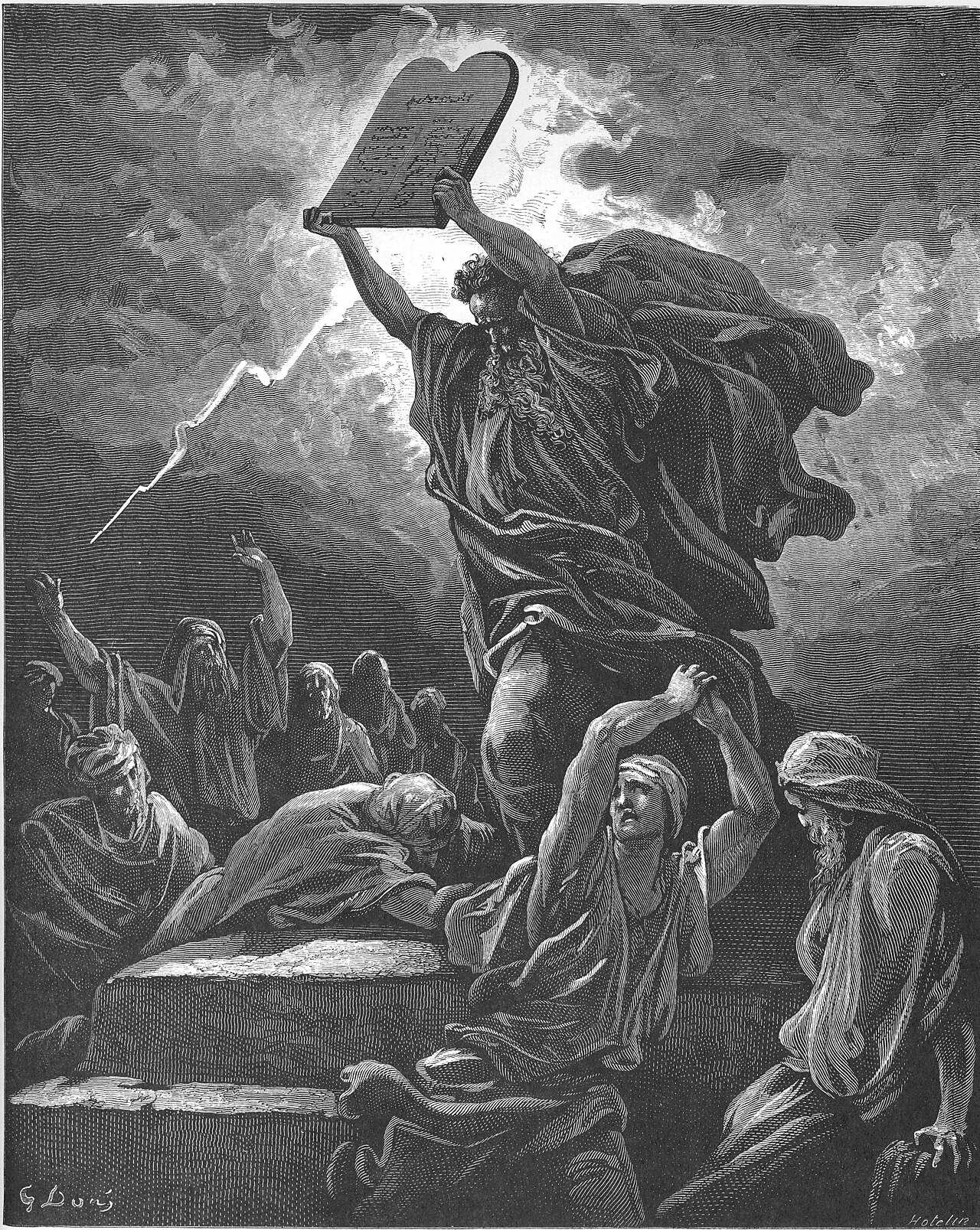
The golden calf is the chapter the classical commentators work hardest, and Rashi begins with the clock. Moses had told the people he would return within the first six hours of the fortieth day, and they counted the day of his ascent among the forty (Rashi on Exodus 32:1:1). Aaron asked for the ornaments of the wives and children in the hope that the delay would save the day, and the men tore off their own instead (Rashi on Exodus 32:2:1). On the making of the calf Rashi gives two readings of the same words, one taking them of gold tied in a cloth and the other of a goldsmith's engraving tool (Rashi on Exodus 32:4:1). Sforno reads God's complaint about the speed of the fall as a gift cut short. "I have not even been able to complete the gift of the Torah I had wanted to give to you" (Sforno on Exodus 32:8:1, from Eliyahu Munk, HaChut Hameshulash, CC-BY). Rashi reads the words let me alone as an opening rather than a refusal. They told Moses that prayer would hold the sentence back (Rashi on Exodus 32:10:1, citing Shemot Rabbah 42:9 and Berakhot 32a). The plea itself he fills out from the Midrash. Israel had broken ten commandments, and Abraham had stood ten trials whose reward was still owed. Moses asked that the one be set against the other (Rashi on Exodus 32:13:1, citing Midrash Tanchuma, Ki Tisa 24 and Shemot Rabbah 44:4). The writing on the tablets could be read from both sides, which he calls a miraculous piece of work (Rashi on Exodus 32:15:1, citing Shabbat 104a). The breaking of the tablets he explains by a rule of law. Moses reasoned that a stranger may not eat the Passover, and that the people had put themselves outside the whole Torah (Rashi on Exodus 32:19:1, citing Shabbat 87a). Rashi is quoted from the Rosenbaum and Silbermann edition of 1929 to 1934, public domain. Ibn Ezra comments at Exodus 32:14:1 and Malbim at Exodus 32:23:1, both cited by reference.
What the rabbis say
The corpus records forty places where the Midrash and the Talmud draw on this chapter, cited here by reference. Bamidbar Rabbah reads the calf and its aftermath at 1:12, 1:13, 4:8 and 12:4. It reads it again at 13:8, 15:21, 18:6, 20:14, 20:20, 20:23 and 21:10. Aggadat Bereshit carries the chapter at 5:3, 10:2, 32:1, 51:1 and 63:1. The prayer of Moses is read in Berakhot at 32a:14 and 32a:20, and in Arakhin at 15b:18. The breaking and the burning are read at Avodah Zarah 44a:2 and 53b:10, and at Megillah 25b:12. The Jerusalem Talmud takes up the chapter at Nazir 6:1:4, Shekalim 1:1:6, Terumot 10:2:2 and Megillah 4:11:3. Midrash Aggadah reads it at Exodus 32:22:1 and 32:29:1, and at Deuteronomy 9:15:1 and 9:20:1. Midrash Lekach Tov reads it at Exodus 32:23:1, 32:28:1 and 32:33:1. Devarim Rabbah 9:2 reads the plea, and Eikhah Rabbah 1:28 the noise in the camp.
The text, verse by verse
Each word shows the Hebrew, the English under it, how it sounds and its Strong’s number. A rule between verses marks where the Hebrew manuscripts end a paragraph.
The Golden Calf
Ramban on Exodus 32:1
MAKE US A GOD WHO ‘YEILCHU’ (SHALL GO — in the plural) BEFORE US. “They wished to have many gods.
Read it in full at Sefaria · Commentary on the Torah by Ramban (Nachmanides). Translated and annotated by Charles B. Chavel. New York, Shilo Pub. House, 1971-1976
Moses Stands in the Breach
Ramban on Exodus 32:10
The meaning of this cannot be “ let Me alone and I will become angry,” for if His anger had not been aroused yet, why should it wax hot as soon as Moses leaves Him alone?
Read it in full at Sefaria · Commentary on the Torah by Ramban (Nachmanides). Translated and annotated by Charles B. Chavel. New York, Shilo Pub. House, 1971-1976
Onkelos Exodus 32:10
Now leave Me alone [ leave your prayer from before Me ] and My wrath will blaze against them and destroy them.
Read it in full at Sefaria · Metsudah Chumash, Metsudah Publications, 2009 [with Onkelos translation]
Ibn Ezra on Exodus 32:14
Heaven forbid for the Lord to repent. 63 To change His mind. Medieval Jewish philosophers taught that God is unchanging.
Read it in full at Sefaria · Ibn Ezra's commentary on the Pentateuch, tran. and annot. by H. Norman Strickman and Arthur M. Silver. Menorah Pub., 1988-2004
Tablets Broken at the Mountain's Foot
Who Is on the Lord's Side?
Hebrew words in this chapter
The 40 most used Hebrew words of the chapter, counted by lemma. The article, the object marker, the negatives and the common prepositions are left out.
| Word | Sense here | Uses | Strong’s |
|---|---|---|---|
| אָמַרʼâmar | to say | 23 | H559 |
| עַםʻam | people | 19 | H5971 |
| מֹשֶׁהMôsheh | Moses | 17 | H4872 |
| יְהֹוָהYᵉhôvâh | of yahweh | 13 | H3068 |
| עָשָׂהʻâsâh | to make | 12 | H6213 |
| אַהֲרוֹןʼAhărôwn | Aaron | 9 | H175 |
| אֱלֹהִיםʼĕlôhîym | God | 9 | H430 |
| אִישׁʼîysh | man | 8 | H376 |
| עָלָהʻâlâh | he brought up us | 7 | H5927 |
| אֶרֶץʼerets | land | 7 | H776 |
| מִצְרַיִםMitsrayim | Egypt | 6 | H4714 |
| עֵגֶלʻêgel | calf | 6 | H5695 |
| רָאָהrâʼâh | and it saw | 5 | H7200 |
| הָלַךְhâlak | they will go | 5 | H1980 |
| בֵּןbên | son | 5 | H1121 |
| יָדyâd | hand | 5 | H3027 |
| יִשְׂרָאֵלYisrâʼêl | Israel | 5 | H3478 |
| אַףʼaph | anger | 5 | H639 |
| גָּדוֹלgâdôwl | great | 5 | H1419 |
| לוּחַlûwach | tablet | 5 | H3871 |
| Word | Sense here | Uses | Strong’s |
|---|---|---|---|
| קוֹלqôwl | sound of | 5 | H6963 |
| הַרhar | mountain | 4 | H2022 |
| זָהָבzâhâb | gold | 4 | H2091 |
| דָבַרdâbar | and he spoke | 4 | H1696 |
| עַתָּהʻattâh | now | 4 | H6258 |
| חָרָהchârâh | so may it burn | 4 | H2734 |
| רַעraʻ | with evil | 4 | H7451 |
| מַחֲנֶהmachăneh | camp | 4 | H4264 |
| יוֹםyôwm | day | 4 | H3117 |
| יָרַדyârad | to go down | 3 | H3381 |
| קוּםqûwm | arise | 3 | H6965 |
| יָדַעyâdaʻ | to know | 3 | H3045 |
| פָּרַקpâraq | to tear | 3 | H6561 |
| בּוֹאbôwʼ | and bring | 3 | H935 |
| פָּנִיםpânîym | face | 3 | H6440 |
| יָצָאyâtsâʼ | to come out | 3 | H3318 |
| שׁוּבshûwb | to return | 3 | H7725 |
| נָתַןnâthan | to give | 3 | H5414 |
| כָּתַבkâthab | written | 3 | H3789 |
| אַיִןʼayin | there not | 3 | H369 |
Keep studying
Studies6
Words12
Trails1
Sources for this chapter
The Hebrew text
STEP Bible, the tagged Hebrew text and its English glosses and James Strong, Strong's Exhaustive Concordance.
In Jewish life
Rashi, Rashi on Exodus 32:1 to 32:24, the Pentateuch with Rashi's commentary by M. Rosenbaum and A. M. Silbermann, 1929 to 1934, public domain; Sforno, Sforno on Exodus 32:8:1, Eliyahu Munk, HaChut Hameshulash, CC-BY; Ibn Ezra, Ibn Ezra on Exodus 32:14:1, cited by reference, CC-BY-NC; Malbim, Malbim on Exodus 32:23:1, cited by reference, no English version in the corpus; Shemot Rabbah, 42:9 and 44:4, as Rashi cites them; Midrash Tanchuma, Ki Tisa 24, as Rashi cites it; Babylonian Talmud, Berakhot 32a, Shabbat 87a and 104a, as Rashi cites them, and Avodah Zarah 44a:2 and Megillah 25b:12, cited by reference; Bamidbar Rabbah, 1:12, 1:13, 4:8, 12:4, 13:8 and 15:21, cited by reference; The Sefaria corpus, scripts/data/sources/sefaria/exodus/32.json, fetched 2026-09-19 and MannaFest, the commentators and their dates, src/app/featured/the-jewish-writings/page.tsx.
The rabbinic texts
Ramban, Commentary on the Torah by Ramban (Nachmanides). Translated and annotated by Charles B. Chavel. New York, Shilo Pub. House, 1971-1976; Ibn Ezra, Ibn Ezra's commentary on the Pentateuch, tran. and annot. by H. Norman Strickman and Arthur M. Silver. Menorah Pub., 1988-2004; Targum, Metsudah Chumash, Metsudah Publications, 2009 [with Onkelos translation] and Sefaria, texts and citation data.