
Subject
Prayer
How Scripture teaches talking with God, models it, and promises that He hears.
Part of What God asks
Also called: asking God, intercession, supplication, crying out, talking with God, petition
This subject covers talking with God: how Scripture teaches it, models it and promises to hear it. Praise and coming near in the assembly belong to Worship. Sorrow poured out in words belongs to Grief.
What Prayer covers, and where it stops
This subject covers talking with God: how Scripture teaches it, models it and promises to hear it. Praise and coming near in the assembly belong to Worship. Sorrow poured out in words belongs to Grief.
On this page, 8 sections
The one drawing
Across the canon
Old Testament
New Testament
The other 44 books of the canon carry none.
12 passages
Where Scripture speaks
The passages this subject stands on, in canon order.
And to Seth also a son was born, and he called him Enosh. At that time men began to call upon the name of the LORD.Abraham stepped forward and said, “Will You really sweep away the righteous with the wicked?Then the man said, “Let me go, for it is daybreak.” But Jacob replied, “I will not let you go unless you bless me.”But Moses sought the favor of the LORD his God, saying, “O LORD, why does Your anger burn against Your people, whom You brought out of the land of Egypt with great power and a mighty hand?Thus the LORD would speak to Moses face to face, as a man speaks to his friend. Then Moses would return to the camp, but his young assistant Joshua son of Nun would not leave the tent.In her bitter distress, Hannah prayed to the LORD and wept with many tears.Yet regard the prayer and plea of Your servant, O LORD my God, so that You may hear the cry and the prayer that Your servant is praying before You today.and if My people who are called by My name humble themselves and pray and seek My face and turn from their wicked ways, then I will hear from heaven, forgive their sin, and heal their land.O Lord, may Your ear be attentive to my prayer and to the prayers of Your servants who delight to revere Your name. Give Your servant success this day, I pray, and grant him mercy in the sight of this man.” (At that time I was the cupbearer to the king.)After Job had prayed for his friends, the LORD restored his prosperity and doubled his former possessions.In the morning, O LORD, You hear my voice; at daybreak I lay my plea before You and wait in expectation.Morning, noon, and night, I cry out in distress, and He hears my voice.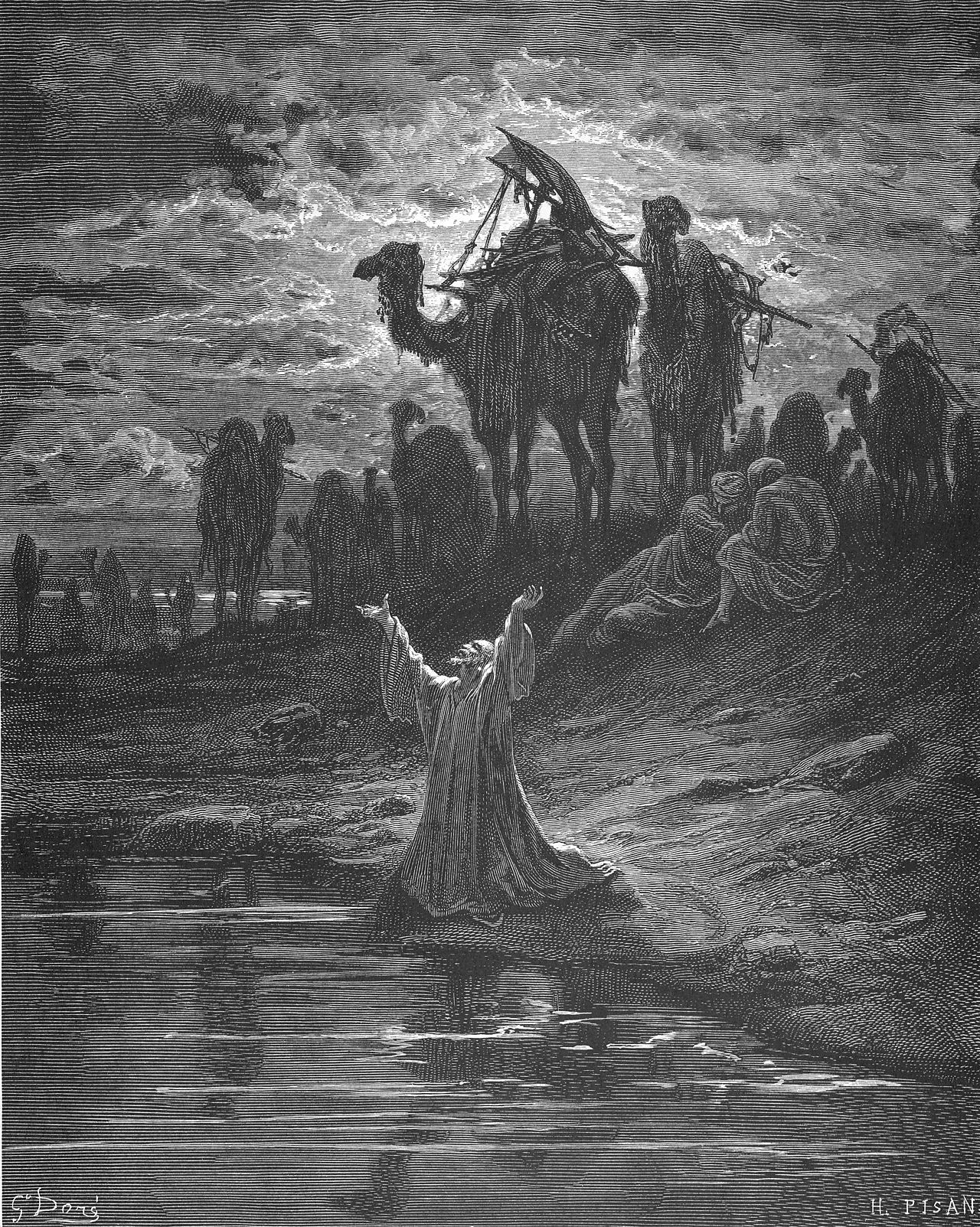
Prayer in Scripture, in full
Prayer enters the canon as a corporate act, not a private technique: "then began men to call upon the name of Jehovah" (Genesis 4:26) describes a community, not a method. The patriarchal narratives show it as argument and struggle — Abraham bargaining over Sodom, Jacob refusing to release the wrestler at Peniel until blessed. Moses stands in the gap after the golden calf and, uniquely, speaks with God "face to face, as a man speaketh unto his friend."
Hannah's silent, grief-driven petition becomes the template Israel returns to for personal need; Solomon's temple dedication, Hezekiah's and Nehemiah's court prayers, and Daniel's fixed three-times-daily discipline in exile show the practice scaling from tabernacle to empire without losing its address. The Psalms institutionalize rhythm — morning, evening, and noon — and root confidence not in technique but in God's character: "thou that hearest prayer"
(Psalm 65:2), "Jehovah is nigh unto all them that call upon him" (Psalm 145:18).
Jesus receives this inheritance and intensifies it rather than replacing it. The model prayer he gives (Matthew 6:9 following) is built from Israel's own vocabulary — kingdom, daily bread, forgiveness, deliverance — while his instruction to pray "in secret" targets the performative piety of his day, not prayer itself.
He promises persistence answered (Matthew 7:7's ask/seek/knock; Luke 18:1's parable of the unjust judge, spoken "to the end that they ought always to pray, and not to faint") and in Gethsemane embodies a prayer that outruns any formula — agony, repetition, and submission ("not my will, but thine, be done") held together in one scene. John 17 shows him functioning as intercessor for the church before the cross is even reached, praying not for himself but for those the Father gave him.
The early church treats prayer as the engine of its corporate life, not an individual add-on: Acts 2:42 lists it alongside the apostles' teaching, fellowship, and the breaking of bread as a defining devotion, and Acts 4:31 has a prayed-over room physically shaken. Paul locates the Spirit as a co-intercessor inside human weakness — "the Spirit himself maketh intercession for us with groanings which cannot be uttered"
(Romans 8:26) — and repeatedly commands unceasing, thankful prayer (Philippians 4:6, 1 Thessalonians 5:17, Ephesians 6:18's "praying always... in the Spirit"). Hebrews reframes the act itself: access is now bold, not tentative, because it rests on a high priest who has already gone in (Hebrews 4:16). James ties prayer to confession, physical healing, and Elijah's ordinary humanity as proof that "the supplication of a righteous man availeth much in its working"
(James 5:16, ASV; KJV "the effectual fervent prayer of a righteous man availeth much"); John makes confidence conditional on asking "according to his will" (1 John 5:14) rather than on the asker's certainty.
Scripture holds these postures together without flattening any of them into a formula. Mark 11:24's language of receiving before the answer is seen sits beside Luke 18's insistence on repeated, unanswered-for-a-while asking; Daniel's disciplined daily rhythm sits beside Gethsemane's single desperate night. Two of these are places this site plants a flag rather than leaving the reader to guess.
On persistence: the biblical pattern is sustained asking until breakthrough — Luke 18's importunate widow and Daniel's twenty-one-day fast are read here as normative, against the once-and-believe teaching that treats a repeated request as evidence of unbelief.
On declaration: Job 22:28 and Mark 11:23 do describe a real authority in the believer's speech, but one exercised under Spirit-discernment rather than applied as a formula — this site holds declaration as real but disciplined, and rejects the Word-of-Faith framing in which confession itself is the creative mechanism. The streams that read those verses more permissively are named on the sources page rather than erased, but the site's own position is stated, not hidden.
What the canon does not leave ambiguous is the address itself: prayer throughout is conversation with a Father who hears, mediated by a Son who intercedes, and carried by a Spirit who groans within — not a technique to master but a relationship the whole Bible describes as already open.
4 voices
What teachers have said
“See the power of prayer, of effectual fervent prayer, and how much it avails, what great things it prevails for. A stop has many a time been put to a judgment by making supplication to the Judge.”
Matthew Henry · Commentary on the Whole Bible, 1710
“He promises, however, that His Father will very readily grant their requests, not indeed as induced thereto by the intercessions of the Son in His capacity as our Mediator and Advocate, but prompted by His own Will to be liberal in His dealings towards them, and making haste to shower upon those who love Christ the exceeding riches of His goodness”
Cyril of Alexandria · Commentary on the Gospel of John, Book 11
Written before 444.
“All this time he probably spent in supplication to God; waiting for a favorable opening in the Divine providence. Every good work is not to be undertaken hastily; prayer and watchfulness are necessary to its completion. Many good works have been ruined by making haste.”
Adam Clarke · Commentary on the Bible
Written before 1832.
“Isaac too demonstrated the power of prayer when he prayed over Rebekah, and she gave birth.”
Aphrahat the Persian Sage · On Prayer 4
Written before 345.
Where it leads
Everything the site holds on prayer
On this page
The words underneath
Each card is one Hebrew or Greek word behind prayer. It gives the sense, the count across the canon, and the number in Strong's 1890 concordance.
tephillah: prayer
Hebrew · H8605Strong's entry: intercession, supplication; by implication, a hymn
the standard Hebrew noun for prayer itself
72 times in the Old Testament · tephillah, in full →
proseuchomai: to pray
Greek · G4336Strong's entry: to pray to God, i.e. supplicate, worship
the New Testament's core verb
85 times in the New Testament · proseuchomai, in full →
proseuche: prayer
Greek · G4335Strong's entry: prayer (worship); by implication, an oratory (chapel)
proseuchḗ — prayer as an act of worship, not mere request
35 times in the New Testament · proseuche, in full →
palal: to pray
Hebrew · H6419Strong's entry: to judge (officially or mentally); by extension, to intercede, pray
the root behind Hebrew prayer
84 times in the Old Testament · palal, in full →
22 verses
The complete list
This subject carries 34 curated verses. 12 of them are quoted above, and the other 22 stand here, book by book. Open a book to read the references with a clause of each verse.
Psalms2
Daniel2
Matthew3
- Matthew 6:6But when you pray, go into your inner room, shut your door, and pray to your Father, who is...
- Matthew 6:9So then, this is how you should pray: ‘Our Father in heaven, hallowed be Your name.
- Matthew 7:7Ask, and it will be given to you; seek, and you will find; knock, and the door will be opened...
Luke3
- Luke 11:1One day in a place where Jesus had just finished praying, one of His disciples requested...
- Luke 18:1Then Jesus told them a parable about their need to pray at all times and not lose heart:
- Luke 22:44And in His anguish, He prayed more earnestly, and His sweat became like drops of blood falling...
Acts2
1 Thessalonians1
What God asks