
Jonah 3 · Story · Repentance
Nineveh Repents
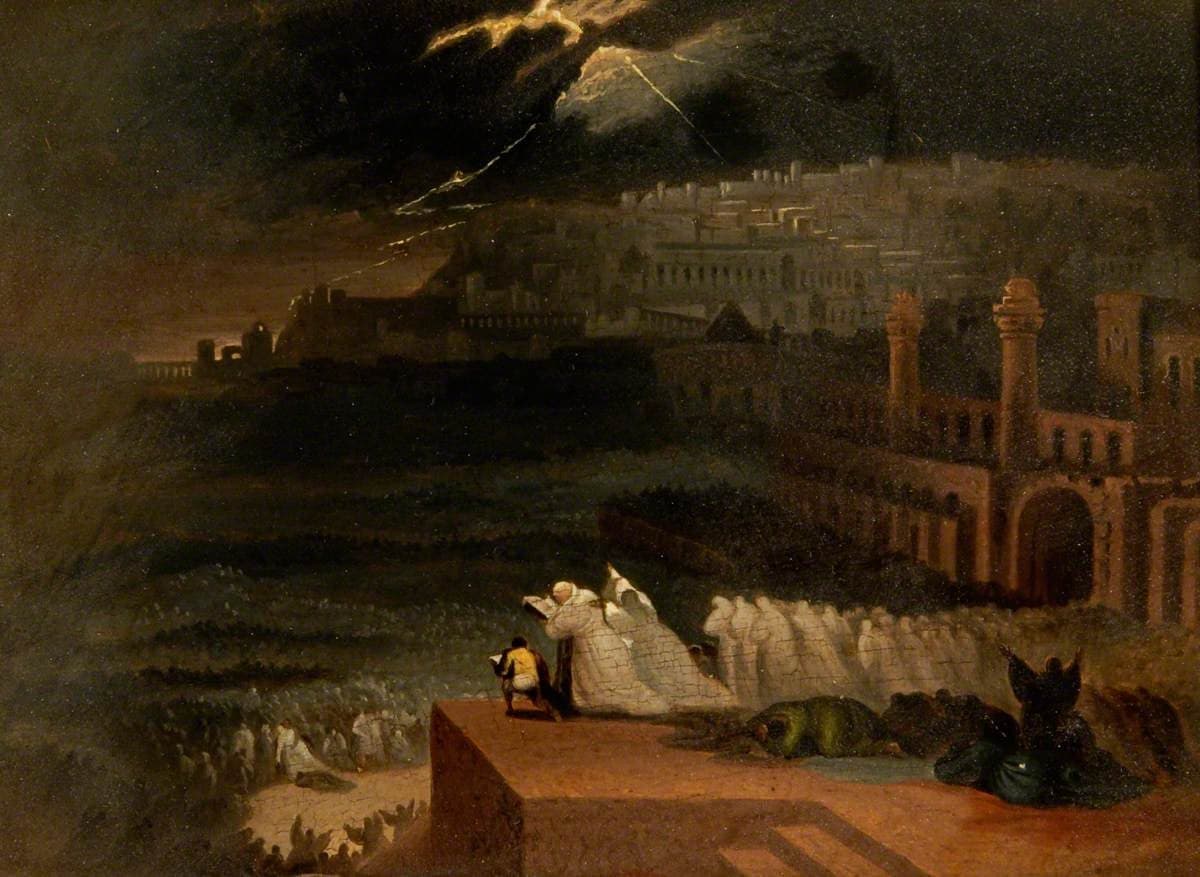
Jonah 3 is the account of how the city of Nineveh answered the warning God sent it by the prophet Jonah.
The king of Nineveh ordered even the herds and flocks to fast and to be covered with sackcloth.
When God saw their actions—that they had turned from their evil ways—He relented from the disaster He had threatened to bring upon them.
- Where
- Nineveh
- Who
- Jonah
Summary
Nineveh is the Old Testament's great picture of a whole city turning to God. Its people had a warning and no promise, and they acted on God's word in hope alone. The account shows repentance as faith that turns from evil before it knows how God will answer, and it shows God answering that turn with mercy.
- Jonah had fled from his first commission to Nineveh, and he obeyed the second (Jonah 1:3 and Jonah 3:3).
- The fasting and the sackcloth began among the citizens before any decree came from the throne (Jonah 3:5 to 7).
- The king's decree called everyone to turn from his evil ways and from violence (Jonah 3:8).
- Jonah resented the mercy, because he had known God as One who relents from sending disaster (Jonah 4:1 to 2).
- Jesus called Jonah a sign to the Ninevites and set their repentance against the unbelief of His own generation (Luke 11:29 to 32).
The City That Turned
The chapter begins where Jonah's flight and the great fish end.
Nineveh's repentance belongs to the value of repentance, the turn from sin back to God, which the prophets of Israel preached to their own people. The Ninevites were not of Israel.
The question is what the Ninevites did when they repented, and why Jesus held them up to His own hearers. The answer lies in the order of their acts, from faith to fasting to a change of life, and in what their king asked of them. It also asks what the record leaves untold about the city and its king.
The Turning in Ten Events
Nine events come from the book of Jonah, and the tenth is Jesus's word on the men of Nineveh in Luke 11:32.
Nineveh's turning runs from a second word to the prophet to a fast that reached the king's throne, and it ends with the prophet displeased at the city's sparing.
- The word of the LORD comes to Jonah again"came to Jonah a second time"Jonah 3:1 to 2
- Jonah goes to Nineveh"This time Jonah got up and went"Jonah 3:3
- Jonah preaches in the city"Forty more days"Jonah 3:4
- The people believe God"And the Ninevites believed God."Jonah 3:5
- The king mourns with his people"sat in ashes"Jonah 3:6
- The nobles join the king's order"the king and his nobles"Jonah 3:7
- Each one is told to cry out to God"call out earnestly to God"Jonah 3:8
- The king asks who knows"Who knows?"Jonah 3:9
- The city is spared, and Jonah is displeased"greatly displeased"Jonah 4:1
- Jesus names the men of Nineveh at the judgment"they repented at the preaching of Jonah"Luke 11:32
A timeline of ten events, eight in Jonah 3, one in Jonah 4 and one in Luke 11:32, each card carrying words of its verse from the Berean text.
Each one is told to cry out to God, The king asks who knows, The city is spared, and Jonah is displeased, Jesus names the men of Nineveh at the judgment
The Turning Told in Order
The chapter's first scenes belong to the prophet and its longest speech to the king.
Jonah's errand repeatedJonah 3:1 to 3
The LORD repeated the commission in the same terms, to go to the great city and proclaim the message He would give (Jonah 3:1 to 2).
Jonah proclaimed the overthrow of the cityJonah 3:4
Jonah went a day's walk into the city and proclaimed its overthrow in forty days (Jonah 3:4).
“It is no longer a cry against the sins of Nineveh, but an announcement of its ruin in forty days. This number is in Scripture associated often with humiliation. It was forty days that Moses, Elijah, and Christ fasted.”
Jamieson, Fausset & Brown · Commentary Critical and Explanatory on the Whole Bible · on Jonah 3:4Reformed
The king came down from his throneJonah 3:6 to 9
When the word reached him, the king took off his royal robe and covered himself with sackcloth (Jonah 3:6). He ended his decree with a question, and the question gave the reason for the fast (Jonah 3:9).
What Nineveh Shows of Repentance
Jonah 3 shows the city's repentance as faith, as a change of deeds and as hope in God's mercy.
The city believed God before it did anything else (Jonah 3:5), and Jesus names its whole response with one word when He says that they repented (Luke 11:32).
God looked at what they did, and the verse of His answer names their actions (Jonah 3:10).
Who knows? He may turn and relent and leave a blessing behind Him—grain and drink offerings for the LORD your God.The king's question in Jonah 3:9 repeats these words of Joel, who set them inside a call to return to the LORD.
The Hebrew verb shuv, to turn back, stands in Jonah 3:8, Jonah 3:9 and Jonah 3:10. It names the turn the king asked of his people, the turn he hoped for from God and the turn God saw.
Numbers 23:19 says that God is not a man, that He should change His mind, and Scripture sets that verse beside His relenting at Nineveh.
Chrysostom on a hope that had no promiseJohn Chrysostom, Homilies Concerning the Statues, Homily 5, on Jonah 3:10
“Let us imitate the spiritual wisdom of the barbarians. They repented even on uncertain grounds! For the sentence had no such clause, ‘If ye turn and repent, I will set up the city;’ but simply, ‘Yet three days, and Nineveh shall be overthrown.’ What then said they? ‘Who knoweth whether God will repent of the evil He said He would do unto us?’ Who knoweth? They know not the end of the event, and yet they do not neglect repentance! They are unacquainted with God's method of shewing mercy, and yet they change upon the strength of uncertainties! For neither was it in their power to look at other Ninevites who had repented and been saved; nor had they read prophets; nor had they heard patriarchs; nor had they enjoyed counsel, or partaken of admonition; nor had they persuaded themselves that they should certainly propitiate God by repentance. For the threatening did not imply this: but they were doubtful, and hesitating concerning it; and yet they repented with all diligence. What reason then shall we have to urge, when those, who had no ground for confidence as to the issue, are seen to have exhibited so great a change; but thou who hast ground of confidence in the mercy of God, and who hast frequently received many pledges of His care, and hast heard prophets, and apostles, and hast been instructed by actual events; hast yet no emulation to reach the same measure of virtue as these did! Great assuredly was their virtue! but greater by far was the mercy of God!… For that fear was the cause of its safety. The threatening effected the deliverance from the peril. The sentence of overthrow put a stop to the overthrow. O strange and astonishing event! the sentence threatening death, brought forth life!… Was Nineveh overthrown? Was the city destroyed? […]”
John Chrysostom · Homilies Concerning the Statues 5 · on Jonah 3:10Patristic
The City and the Prophet
The book gives the size of the city, and the Greek translation gives a different number of days.
The book calls Nineveh the great city (Jonah 1:2, Jonah 3:2 and Jonah 4:11) and says that crossing it took three days (Jonah 3:3). In the book's last verse God speaks of more than 120,000 people in it who cannot tell their right hand from their left, and many cattle as well (Jonah 4:11).
The Greek Septuagint reads three days in Jonah 3:4 where the Hebrew has forty. Jerome, in his Commentary on Jonah, wrote that the Hebrew letters give no ground for the Greek reading.
What the Record Leaves Unsaid
Three things a reader may want to know about Nineveh's turning are left untold.
The book does not name the king of Nineveh. Adam Clarke reported in his Commentary on the Bible that some took him to be Pul and others Sardanapalus. Clarke himself judged it more probable that the king reigned in the time of Joash of Judah.
The city's turning is told in Scripture alone, and no Assyrian text tells of a fast at Nineveh or a turning to Israel's God.
The book does not say how long the city's turning lasted. Nahum later carried the burden against Nineveh (Nahum 1:1).
The Men of Nineveh at the Judgment
Luke and Matthew set Jesus's word on Nineveh in two settings.
Luke sets the saying among crowds that were growing and demanding a sign (Luke 11:29). Matthew sets it after some of the scribes and Pharisees asked Jesus for a sign (Matthew 12:38).
Matthew places it beside Jonah's three days and three nights in the great fish, which Jesus gives as the sign of the Son of Man (Matthew 12:40).
Who Knows?
Jeremiah states as a rule of God's dealing with nations what happened at Nineveh.
Nineveh was spared because it turned. The warning of ruin also gave the city forty days in which to turn.
But if that nation I warned turns from its evil, then I will relent of the disaster I had planned to bring.The rule stands in the LORD's own words, so the sparing of Nineveh was His way with any nation that turns.
Sources
Scripture is the Berean Standard Bible.
- Jamieson, Fausset and Brown, Commentary Critical and Explanatory on the Whole Bible (1871), on Jonah 3:4.
- John Chrysostom, Homilies Concerning the Statues, Homily 5 (Chrysostom died in 407)
- Jerome, Commentary on Jonah, chapter 3, on Jonah 3:4 (Jerome died in 420)
- Adam Clarke, Commentary on the Bible (1832), on Jonah 3:6.
- Jonah: History or Parable?, the section Nineveh in the Record, citing Jack M. Sasson, Jonah, Anchor Bible (1990)