
Nahum 2 and 3 · Story · Featured Study
The Fall of Nineveh, 612 BC
The armies of Babylon and the Medes besieged and took Nineveh, the capital of Assyria.
A clay tablet of Babylon records the summer the city of blood was taken.
- Where
- Nineveh
- Who
- Nahum, Zephaniah, Josiah
- When
- 612 BC, the month of Ab
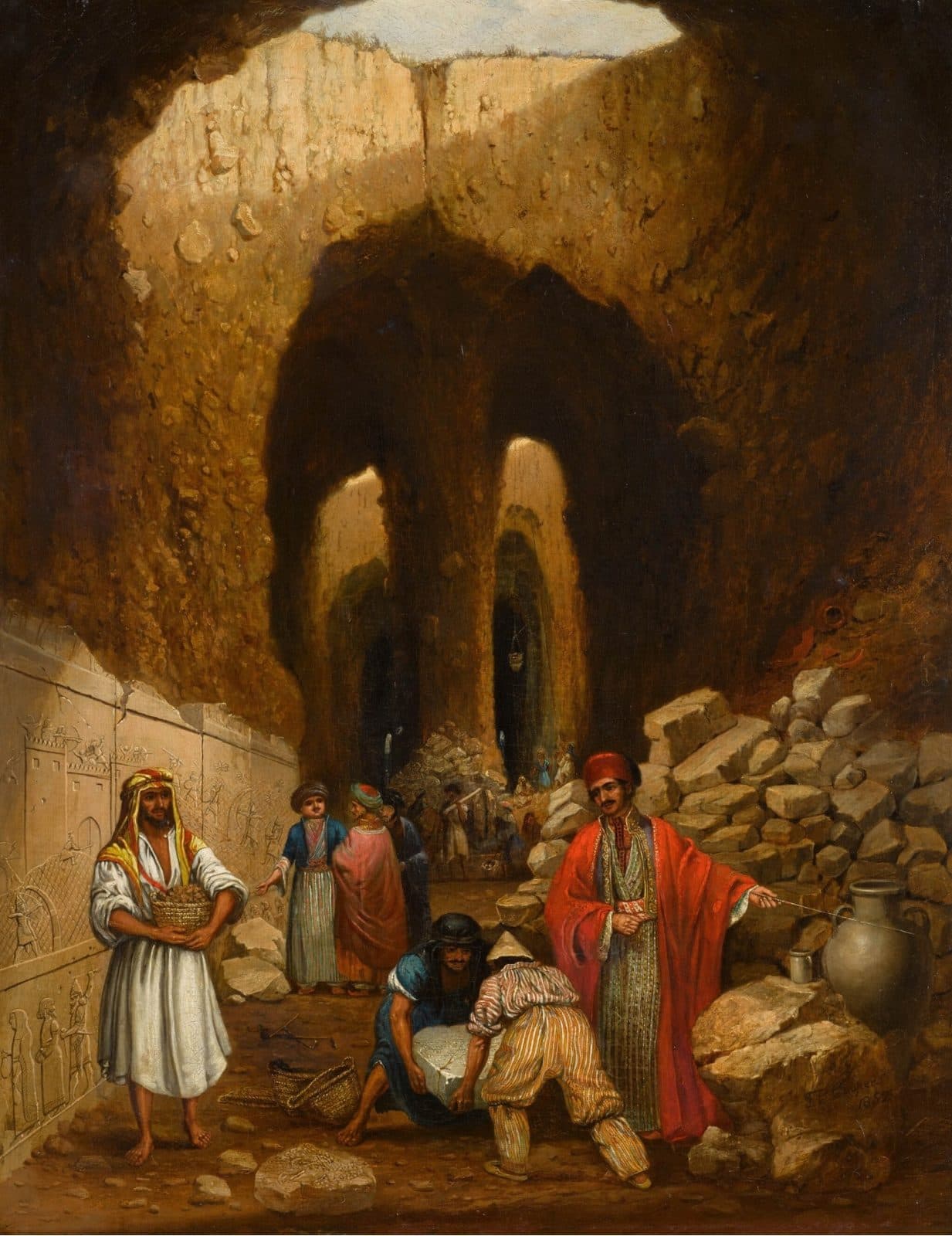
Frederick Charles Cooper, Excavation of the City of Nineveh, 1852. Public domain, via Wikimedia Commons.
THE ARTWORKCooper painted the tunnels dug into the mound of Nineveh, with a wall of carved slabs on the left and workmen hauling stone under a shaft of daylight. He was the artist of Layard's second expedition, and the reliefs he painted had lain buried since the city fell.
Summary
Nineveh, spared once at Jonah's preaching, was judged in the end, and the date of its fall was fixed only in 1923.
- Nahum and Zephaniah foretold the city's end and named no conqueror.
- A Greek history says a swollen river broke the wall, and the Babylonian tablet says nothing of a flood.
- Reliefs dug from a palace of Nineveh in 1853 show an Assyrian king hunting lions, the beast Nahum used for the city.
- The site lay unknown for centuries until excavators dug its mounds in the 1840s and 1850s.
The Burden Against Nineveh
Two prophets of Judah in the seventh century BC.
Nahum's book is one oracle against one city. Zephaniah, who prophesied in the days of Josiah, gives the same sentence on it in Zephaniah 2:13 to 15.
This is the burden against Nineveh, the book of the vision of Nahum the Elkoshite:The word burden marks every chapter after it as a sentence of judgment.
One who scatters advances against you, O Nineveh. Guard the fortress! Watch the road! Brace yourselves! Summon all your strength!The siege Nahum describes runs from this verse to the end of chapter 2.
There is no healing for your injury; your wound is severe. All who hear the news of you applaud your downfall, for who has not experienced your constant cruelty?Nahum ends his book on this verse, so judgment is his last word on Nineveh.
And He will stretch out His hand against the north and destroy Assyria; He will make Nineveh a desolation, as dry as a desert.Zephaniah names Assyria and Nineveh together, so the sentence falls on the empire and its capital alike.
The Siege of 612 BC
The Babylonian Chronicle in C. J. Gadd's edition, with the finds of the excavators.
Nabopolassar of Babylon had been at open war with Assyria since 616 BC. In the fourteenth year of his reign, the king of Babylon joined his army to the army of Kyaxares, king of the Medes. Together they marched on Nineveh.
The siege ran from the month of Sivan to the month of Ab. The tablet appears to record three battles, a reading Gadd marked as uncertain, and then a great assault.
The city was taken in Ab, which Gadd sets in July and August of 612 BC. The victors carried off spoil beyond counting and left the city a mound of ruins.
The tablet names Sin-shar-ishkun as king of Assyria at the capture. The line that told his end is broken, so his fate is not known.
An Assyrian named Ashur-uballit then took the throne of Assyria in the city of Harran. Gadd reads the march of Pharaoh Neco, which cost Josiah his life, as Egypt going to help that last king of Assyria.
Before the tablet was published in 1923, commentators dated the fall anywhere from 625 BC to 606 BC.
Fire finished the work. Gadd notes the marks of burning in the ruins, and Hormuzd Rassam found reliefs in a palace of Nineveh damaged by fire.
Look at your troops—they are like your women! The gates of your land are wide open to your enemies; fire consumes their bars.The tablet records the city taken by assault, as this verse foresaw.
There the fire will devour you; the sword will cut you down and consume you like a young locust. Make yourself many like the young locust; make yourself many like the swarming locust!The prophet spoke of this burning before the siege began.
The Opened Gates
What the Hebrew of Nahum 2:6 says, and what a Greek historian adds.
In Hebrew the line of the river gates reads sha'arei hanneharot niftachu vehaheikhal namog, the gates of the rivers are opened and the palace melts.
The verb namog comes from mug, which means to melt, to flow down or to faint with fear. It describes a thing giving way, whether by water or by fear.
Diodorus of Sicily, a Greek historian, says Nineveh's king trusted an old oracle that no one would take the city by force unless the river first became its enemy.
In the third year of a siege, Diodorus says, heavy rains swelled the river, flooded part of the city and threw down twenty stades of the wall. Gadd judged the story possible. He thought Kyaxares may have pressed his assault where a high spring river had broken the wall.
The river gates are thrown open and the palace collapses.Whether a flood took the city turns on what these opened gates were.
Nineveh has been like a pool of water throughout her days, but now it is draining away. “Stop! Stop!” they cry, but no one turns back.The flight of the people in this verse shows the city emptying once its defence has failed.
The Lions' Den
Nahum's Hebrew for the den and its beasts, and a room Rassam found in 1853.
The word Nahum uses for the lions' lair, ma'on, means a dwelling of men or a den of beasts. His lions are arayot and kephirim, the grown lions and the young lions.
On the night of 20 December 1853 Hormuzd Rassam found a palace on the mound of Kuyunjik. One room, about fifty feet long, was lined with reliefs given wholly to the royal lion hunt.
Rassam's account names it the palace of Assur-bani-pal. Its slabs are an Assyrian king's own picture of himself as a lion killer, set beside Nahum's picture of the city as a den of lions.
Where is the lions’ lair or the feeding ground of the young lions, where the lion and lioness prowled with their cubs, with nothing to frighten them away?Nahum asks the question of a ruin, as though the fall were already done.
The lion mauled enough for its cubs and strangled prey for the lioness. It filled its dens with the kill, and its lairs with mauled prey.The prey the lion stored up is what the LORD says in the next verse He will cut off.
A City Lost and Found
From Xenophon's march to the excavations at Kuyunjik.
Long after the fall, Xenophon's Greek army reached the Tigris on its retreat from Persia. He describes a great deserted fortress called Mespila, where the Medes once lived, and he never names Nineveh.
Adam Clarke, writing on Zephaniah 2:14 in 1832, said the city was so completely destroyed that its site was not then known, and that Mosul was supposed to stand near it.
By the summer of 1842 the French consul at Mosul, Paul-Emile Botta, was digging the mound of Kuyunjik across the river. He found little there and moved to Khorsabad, where he uncovered carved slabs.
The palaces dug from Kuyunjik in the years that followed showed where Nineveh had stood.
What the Text Leaves Unsaid
Four things Scripture leaves out of the fall.
Nahum names no Babylonian, no Mede, no king of Assyria and no date.
In Nahum 1:8 the Hebrew says the LORD will make an end of her place. The Berean text supplies the name Nineveh.
Nahum never names Jonah or the city's repentance in Jonah's day.
Scripture tells no story of the fall itself. The histories of Kings and Chronicles move from Josiah to Babylon with no account of the city's capture.
But with an overwhelming flood He will make an end of Nineveh and pursue His enemies into darkness.This is the first verse of Nahum to speak of a flood, the word the river readings of the fall build on.
The City That Was Spared and Then Fell
Isaiah's warning to the king of Assyria stands between Jonah and Nahum.
Albert Barnes, in his Notes on Nahum 1:1, reads the burden in that light. The Nineveh that repented at Jonah's preaching fell back into the sins it had repented of, and set itself to uproot God's people.
When God saw their actions—that they had turned from their evil ways—He relented from the disaster He had threatened to bring upon them.This is the mercy Jonah later complained of in Jonah 4:2.
So when the Lord has completed all His work against Mount Zion and Jerusalem, He will say, “I will punish the king of Assyria for the fruit of his arrogant heart and the proud look in his eyes.Isaiah names the arrogance that Nahum's oracle later judges.
Three Voices on the Fall
Commentators of 1765, 1832 and 1871 on the flood, the lion and the conquerors.
John Wesley: the flood as the judgments of GodExplanatory Notes upon the Old Testament, 1765
“An over-running flood - His judgments like a mighty flood that overflows all banks, shall swallow up Assyria. Thereof - Of Nineveh, that is Nineveh itself.”
John Wesley · Explanatory Notes upon the Old Testament · on Nahum 1:8Evangelical
Adam Clarke: the lion as Assyria's way of conquestCommentary on the Bible, 1832
“The lion did tear - This verse gives us a striking picture of the manner in which the Assyrian conquests and depredations were carried on. How many people were spoiled to enrich his whelps - his sons, princes, and nobles! How many women were stripped and slain, whose spoils went to decorate his lionesses - his queen, concubines, and mistresses. And they had even more than they could assume; their holes and dens - treasure-houses, palaces, and wardrobes - were filled with ravin, the riches which they got by the plunder of towns, families, and individuals.”
Adam Clarke · Commentary on the Bible · on Nahum 2:12Evangelical
Jamieson, Fausset and Brown: the two kings who took the cityCommentary Critical and Explanatory, 1871
“Here he passes suddenly to the north. Nineveh was destroyed by Cyaxares and Nabopolassar, 625 B.C. The Scythian hordes, by an inroad into Media and thence in the southwest of Asia (thought by many to be the forces described by Zephaniah, as the invaders of Judea, rather than the Chaldeans), for a while interrupted Cyaxares' operations; but he finally succeeded.”
Jamieson, Fausset & Brown · Commentary Critical and Explanatory on the Whole Bible · on Zephaniah 2:13Reformed
Three Readings of the River Gates
Readers from Rashi to Gadd disagree on what the gates were and what opened them.
A flood broke the wallAdam Clarke, 1832; C. J. Gadd, 1923; Albert Barnes in part, 1832 to 1869
Adam Clarke, citing Bishop Newcome, reads Nahum 1:8 and Nahum 2:6 as the river that overflowed and threw down part of the wall, and he sets the account of Diodorus beside the verse.
Albert Barnes, in his Notes on Nahum 2:6, takes a middle way. He calls the report of Ctesias, the Greek writer behind the story Diodorus tells, exaggerated but resting on a real breach by the river. He also notes that Nahum speaks of the gates, never of the wall.
The objection: the only witness is Diodorus, and the Babylonian tablet records no flood. Diodorus sets the siege at two years where the tablet gives a few months, names the Euphrates though Nineveh stood on the Tigris, and tells the story of a legendary king. Gadd takes that king, the Sardanapallus of Diodorus, to be the king the tablet names at the capture.
The gates were the city's sluicesJamieson, Fausset and Brown, 1871
Jamieson, Fausset and Brown read the river gates as the dams and sluices that held the city's water, with which the whole city could be ringed by a barrier of water.
The objection: the commentators inferred the sluices from traces seen in the nineteenth century, and no record of the siege mentions them.
City gates forced in a siegeRashi, eleventh century; Matthew Henry, 1710
Rashi reads the river gates as the gates of the cities that stand on the rivers, and he says the palace shook from the stones hurled by siege engines. Matthew Henry reads them as the gates of Nineveh opening on the Tigris, forced by the enemy or betrayed to him.
The objection: Nahum also speaks of an overwhelming flood and likens Nineveh to a pool of water, so water stands in the text beside the gates.
Read the Sources
Four older works on the fall and the finding of Nineveh, each free to read online.
The Fall of Nineveh
C. J. Gadd · 1923
Gadd prints a transliteration of the tablet, a line by line translation and the classical accounts in English.
READ IT FREE AT ARCHIVE.ORG →Nineveh and Its Remains
Austen Henry Layard · 1850
Layard gives the account of his first seasons digging the mounds of Assyria.
READ IT FREE AT ARCHIVE.ORG →Asshur and the Land of Nimrod
Hormuzd Rassam · 1897
Rassam tells of his digging in the ruins of Nineveh, Asshur, Sepharvaim and Calah.
READ IT FREE AT ARCHIVE.ORG →Anabasis
Xenophon · Fourth century BC
Xenophon tells the march of the Greek army home from Persia.
READ IT FREE AT GUTENBERG →A Stronghold in the Day of Distress
Assyria had carried Israel away, and its own capital fell in one summer.
Scripture asks its reader to turn while there is time.
The LORD is good, a stronghold in the day of distress; He cares for those who trust in Him.The same oracle that condemns Nineveh holds out this word to the faithful.
The men of Nineveh will stand at the judgment with this generation and condemn it; for they repented at the preaching of Jonah, and now One greater than Jonah is here.Jesus pressed Nineveh's repentance on His own hearers as a warning.
Keep studying
Studies5
Peoples and groups1