
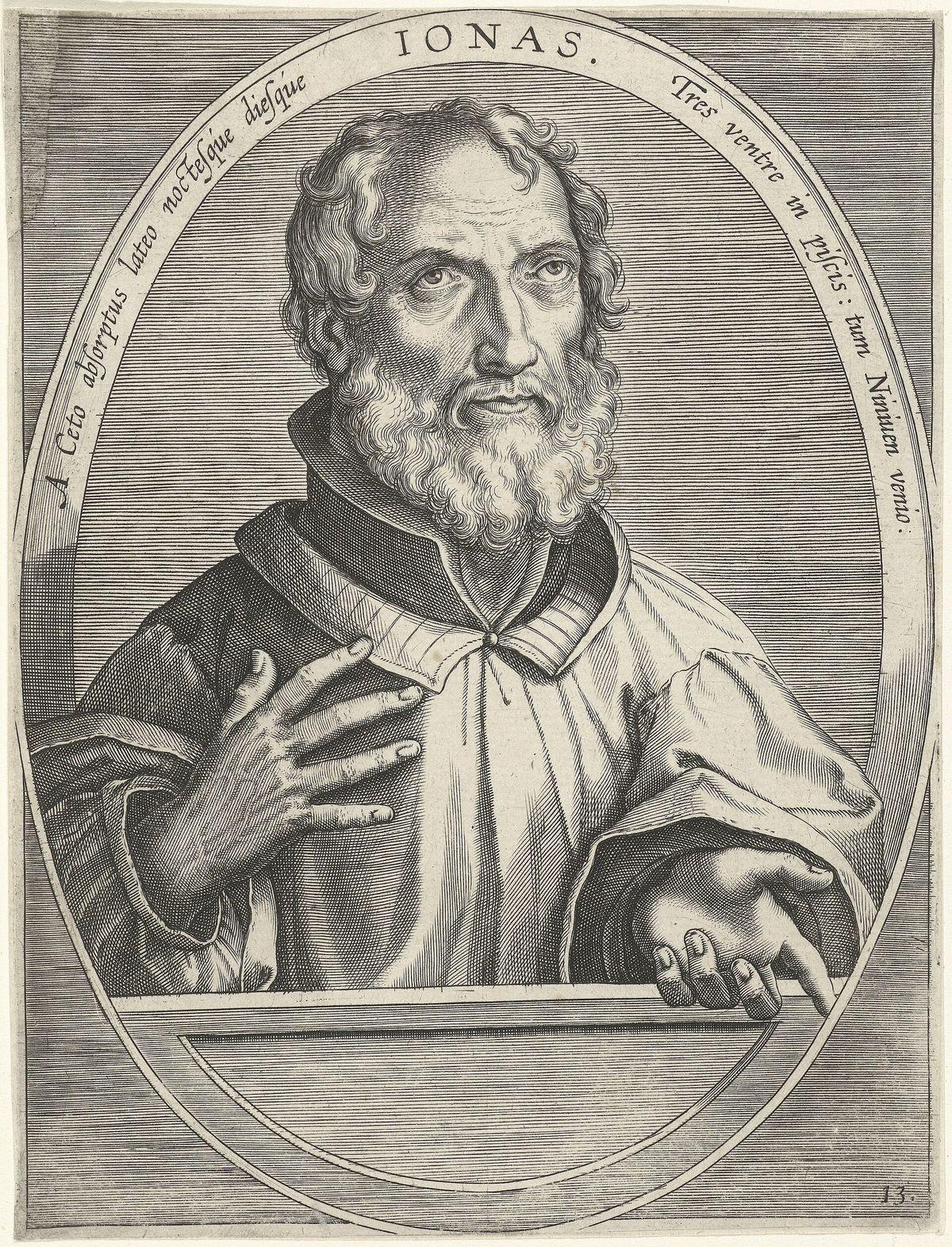
Cornelis Galle I after Jan van der Straet, Jona, 1613. CC0.
Jonah 3 and 4 and Nahum 1 to 3 · Debate · Featured Study
Nineveh's Two Prophets
Jonah and Nahum both carried the word of the LORD to Nineveh, the capital of Assyria.
Jonah was angry that the LORD showed mercy to the city he had warned.
So should I not care about the great city of Nineveh, which has more than 120,000 people who cannot tell their right hand from their left, and many cattle as well?”
So should I not care about the great city of Nineveh, which has more than 120,000 people who cannot tell their right hand from their left, and many cattle as well?”
- The question
- How can the God who spared Nineveh in the book of Jonah bring it to ruin in the book of Nahum?
- The texts
- Jonah 3:10, Jonah 4:2, Nahum 1:3, Nahum 3:19
Summary
This study sets the book of Jonah beside the book of Nahum. It weighs how readers have joined the two books.
- Jonah spoke in the days of King Jeroboam of Israel.
- Nahum charges the city with cruelty that every nation around it had felt.
- Readers differ on whether God changed His mind and on why the city fell.
Jonah's City and Nahum's
The two prophets stand at two different points in the history of Israel and Assyria.
This Jeroboam restored the boundary of Israel from Lebo-hamath to the Sea of the Arabah, according to the word that the LORD, the God of Israel, had spoken through His servant Jonah son of Amittai, the prophet from Gath-hepher.The verse names Jonah's home town and an earlier word of his to Israel.
Are you better than Thebes, stationed by the Nile with water around her, whose rampart was the sea, whose wall was the water?Nahum warns Nineveh with the example of another great city beside a river.
The Same Questions, Two Answers
Jonah and Nahum reply in their own verses, side by side.
The two books end on opposite verdicts about one city.
| The question | Jonah | Nahum |
|---|---|---|
| What does the prophet announce? | Ruin for the city when forty days have passed (Jonah 3:4). | An oracle of judgment against the city (Nahum 1:1). |
| How does the city answer? | Its people believe God and proclaim a fast (Jonah 3:5). | No turning is recorded, and the city stands charged (Nahum 3:19). |
| What does God do? | He relents from the disaster (Jonah 3:10). | He leaves the city's wound past healing (Nahum 3:19). |
| How does the book end? | God asks Jonah a question (Jonah 4:11). | The prophet asks the city a question (Nahum 3:19). |
The Name Both Books Quote
The LORD's proclamation to Moses at Sinai stands behind the words of both prophets.
Then the LORD passed in front of Moses and called out: “The LORD, the LORD God, is compassionate and gracious, slow to anger, abounding in loving devotion and faithfulness, maintaining loving devotion to a thousand generations, forgiving iniquity, transgression, and sin. Yet He will by no means leave the guilty unpunished; He will visit the iniquity of the fathers on their children and grandchildren to the third and fourth generations.”Mercy and justice stand together in the name the LORD gave Himself.
So he prayed to the LORD, saying, “O LORD, is this not what I said while I was still in my own country? This is why I was so quick to flee toward Tarshish. I knew that You are a gracious and compassionate God, slow to anger, abounding in loving devotion—One who relents from sending disaster.Jonah gives this as his reason for running to Tarshish.
Why the City Was Spared
Jonah 3:10 shows a rule the LORD gave Jeremiah in words.
At any time I might announce that a nation or kingdom will be uprooted, torn down, and destroyed. But if that nation I warned turns from its evil, then I will relent of the disaster I had planned to bring.The rule stands in the LORD's own words, so the sparing of Nineveh is no exception.
Who knows? God may turn and relent; He may turn from His fierce anger, so that we will not perish.”The king's hope rested on God's character, with no promise to lean on.
Jonah 3:10 uses the verb nacham for God's turning from the disaster. The same verb stands in Jonah 4:2, where Jonah names the LORD as One who relents.
Voices on the Two Books
Three teachers from the first century to the fifth draw lessons from the spared city.
Clement of Rome (died 99)
Clement of Rome set Nineveh among the examples of repentance he offered the church.
“Let us turn to every age that has passed, and learn that, from generation to generation, the Lord has granted a place of repentance to all such as would be converted unto Him... Jonah proclaimed destruction to the Ninevites; but they, repenting of their sins, propitiated God by prayer, and obtained salvation, although they were aliens [to the covenant] of God.”
Clement of Rome · Clement's First Letter to the Corinthians, Chapter 7 · on Jonah 3:4 to 5Patristic
Gregory of Nazianzus (died 390)
Gregory of Nazianzus preached the city's repentance as a pattern for his own hearers.
“Let us sow in tears, so that we may reap in joy. Let us show ourselves people of Nineveh, not of Sodom. Let us amend our wickedness, lest we be consumed with it. Let us listen to the preaching of Jonah, lest we be overwhelmed by fire and brimstone. And if we have departed from Sodom, let us escape to the mountain. Let us flee to Zoar. Let us enter it as the sun rises. Let us not stay in all the plain. Let us not look around us, lest we be frozen into a pillar of salt, a really immoral pillar, to accuse the soul that returns to wickedness.”
Gregory of Nazianzus · On His Father's Silence, ORATION 16:14 · on Jonah 3:5Patristic
Cyril of Alexandria (died 444)
Cyril of Alexandria turned to the infants of the city.
“And should I not spare Nineveh, that great city, in which dwell more than twelve myriads of people who do not know their right hand from their left, and also much cattle? For these things are somehow indistinguishable among those who are still infants, to whom it was fitting, even before others, to grant kindness, having sinned in nothing. For one who does not yet know his own hands, with what faults could he be charged? And if he names also the cattle and deems them worthy of being spared, this too is from love of goodness. For if ‘a righteous man has mercy on the souls of his cattle,’ and this is to his praise, what is surprising, if the Creator of all things himself bestows sparing and pity upon these as well?”
Cyril of Alexandria · Commentary on the Twelve Minor Prophets: Jonah · on Jonah 4:11Patristic
Where Readers Differ
Commentators part on three points, and their works are named.
The readers agree that one God speaks in both books, and they part on how His mercy and judgment met in Nineveh.
| The question | One answer | The other answer |
|---|---|---|
| Did God change His mind at Nineveh? | The threat held an unspoken condition, so God kept His word when He spared the city (John Chrysostom, Homilies Concerning the Statues 5). | The sentence was the only word God's justice allowed while the city stood in its sin, and their repentance changed their standing before it (Jamieson, Fausset and Brown, Commentary Critical and Explanatory, on Jonah 3:10). |
| Did the city believe on Jonah's bare word? | A stranger's threat alone could not have won belief, so Jonah must have told them more (Theodore of Mopsuestia, Commentary on Jonah 3:5 to 9). | The people repented on uncertain grounds, with no promise of mercy in the sentence (Augustine, Explanation of the Psalms, on Psalm 51). |
| Why did Nineveh fall after it was spared? | The city fell back into the sins it had repented of and set itself to uproot the chosen people (Albert Barnes, Notes on the Old Testament, on Nahum 1:1). | Assyria had been the rod that chastened Israel, and with that work done God destroyed the rod (Adam Clarke, Commentary on the Bible, on Nahum 1:1). |
Books to Read Next
Two older commentaries can be read free, one on each book.
Commentary on the Whole Bible
Matthew Henry · 1710
Henry follows Nineveh's fast, its sackcloth and God's sparing through Jonah 3.
Read it free at BibleHubExposition of the Old Testament
John Gill · 1748 to 1763
Gill reads the last verse of Nahum as the end of the Assyrian empire.
Read it free at BibleHubOne Greater Than Jonah
The Gospel of Matthew carries Nineveh into the teaching of Jesus.
Nineveh turned at the word of a prophet who did not want it spared. The reader who hears Christ stands where that generation stood.
The men of Nineveh will stand at the judgment with this generation and condemn it; for they repented at the preaching of Jonah, and now One greater than Jonah is here.Luke 11:30 keeps a related word of Jesus, that Jonah was a sign to the Ninevites.
Sources
Scripture is the Berean Standard Bible.
- James Strong, Exhaustive Concordance, Hebrew numbers H750, H639 and H5162 in Jonah 3:10, Jonah 4:2 and Nahum 1:3.
- Clement of Rome, First Letter to the Corinthians; Gregory of Nazianzus, Oration 16; Cyril of Alexandria, Commentary on the Twelve Minor Prophets; and the commentaries named below.
- Albert Barnes, Notes, Explanatory and Practical, on the Old Testament, on Nahum 1:1 and Nahum 1:3.
- Adam Clarke, Commentary on the Bible (1832), on Jonah 3:10 and Nahum 1:1.
- John Chrysostom, Homilies Concerning the Statues 5.
- Theodore of Mopsuestia, Commentary on Jonah, on Jonah 3:5 to 9.
- Augustine of Hippo, Explanation of the Psalms, on Psalm 51 (Psalm 50 in the Latin numbering)
- Gregory of Nazianzus, Oration 16, On His Father's Silence.
- Cyril of Alexandria, Commentary on the Twelve Minor Prophets, on Jonah 4:11.
- Clement of Rome, First Letter to the Corinthians, chapter 7.
- John Gill, Exposition of the Old Testament, on Nahum 3:19.
- Jamieson, Fausset and Brown, Commentary Critical and Explanatory on the Whole Bible (1871), on Jonah 3:10.
- Matthew Henry, Commentary on the Whole Bible (1710), on Jonah 3.
Keep Studying
Read it6