
Jonah 1 to 4 · Story · Obedience
Jonah, the Man Who Ran
The book of Jonah follows one prophet from his flight at sea to his anger at the sparing of Nineveh.
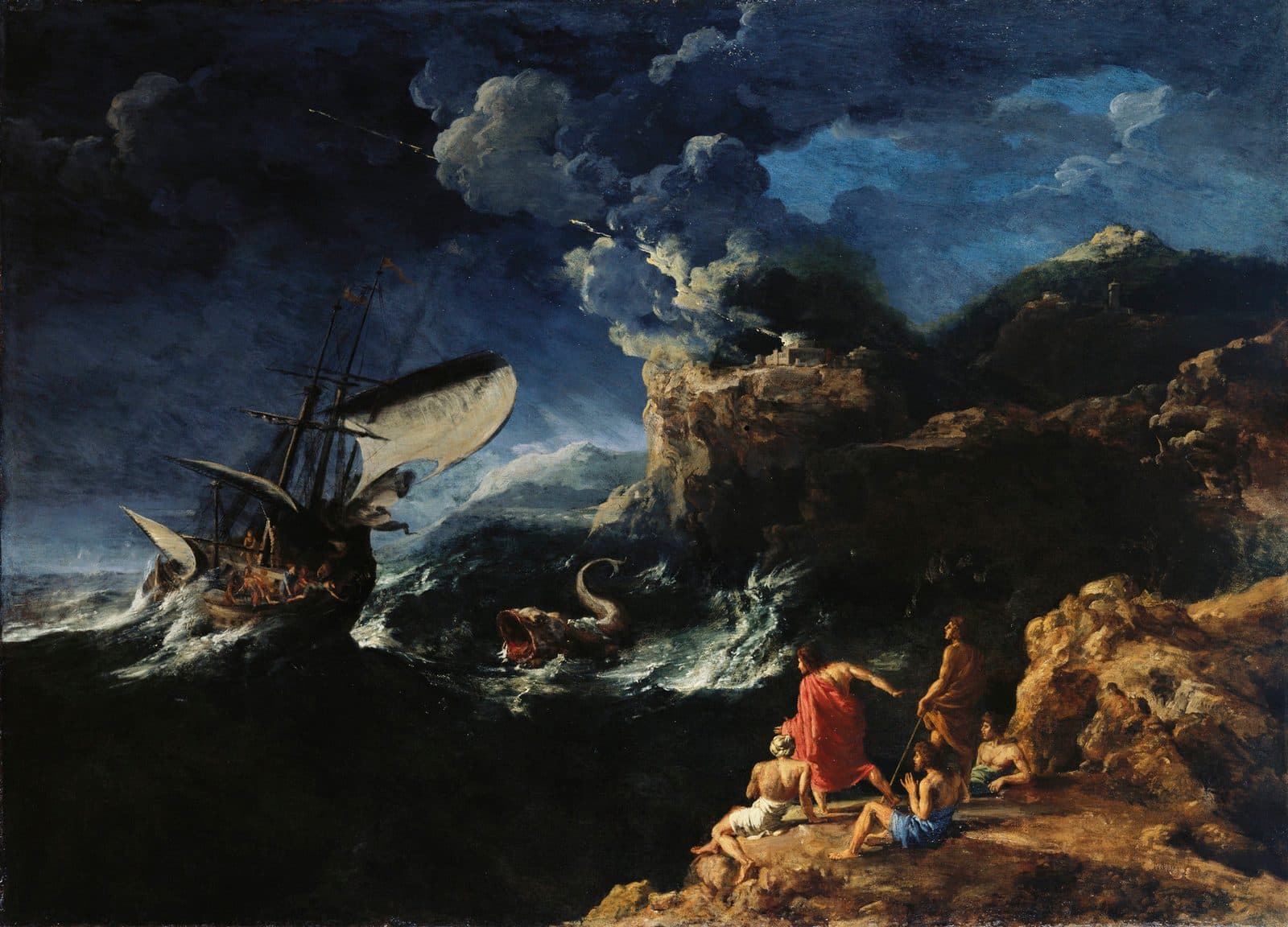
In the storm the ship's captain had to wake the LORD's prophet and tell him to call on his God.
Jonah, however, got up to flee to Tarshish, away from the presence of the LORD. He went down to Joppa and found a ship bound for Tarshish. So he paid the fare and went aboard to sail for Tarshish, away from the presence of the LORD.
- Where
- Nineveh, Joppa
- Who
- Jonah
Summary
Jonah fled from the LORD's command, and a storm and a great fish turned him back. When he preached in Nineveh the city believed God and turned from its evil ways, and God relented from the disaster He had threatened. Jonah then told God why he had run, and he was angry that the city had been spared. The book closes on God's care for Nineveh and for the prophet who resented it.
- Jonah son of Amittai, from Gath-hepher, spoke the word of the LORD in the reign of Jeroboam son of Jehoash over Israel (2 Kings 14:23 to 25).
- When the LORD spoke to Jonah again after the fish, he went to Nineveh and preached there (Jonah 3:1 to 4).
- The LORD appointed the great fish, and God appointed the vine, the worm and the scorching east wind (Jonah 1:17; Jonah 4:6 to 8).
The Prophet Sent to Nineveh
The command sent an Israelite prophet away from his own people to a foreign city.
Jonah, the Man Who Ran belongs to obedience, the value Scripture asks of everyone who hears God's word, because Jonah is the prophet who heard the LORD's command plainly and went the other way. His story shows what disobedience costs, what the LORD does with a servant who runs, and how obedience can be outward while the heart still resists.
This study asks what Jonah's flight, his return and his anger teach about obeying God. It tells the four chapters in their order and follows the prophet down into the ship and the sea. It weighs the readings of why Jonah ran and ends with the question God puts to him.
The Story in Ten Events
The book moves from the command to the flight, the return, the city's repentance and the prophet's anger.
The storm, the fish and the city's repentance carry the story, and it closes on Jonah's anger at God's mercy.
- The LORD sends Jonah to Nineveh“Go to the great city of Nineveh”Jonah 1:2
- The LORD sends a storm on the sea“a great wind upon the sea”Jonah 1:4
- The sailors cast lots to find the cause“the lot fell on Jonah”Jonah 1:7
- The sailors throw Jonah overboard“the raging sea grew calm”Jonah 1:15
- A great fish swallows Jonah“three days and three nights”Jonah 1:17
- Jonah gives thanks and makes a vow“Salvation is from the LORD!”Jonah 2:9
- The word comes again and Jonah goes“in accordance with the word of the LORD”Jonah 3:3
- Nineveh believes and fasts“And the Ninevites believed God”Jonah 3:5
- God relents, and Jonah is angry“greatly displeased, and he became angry”Jonah 4:1
- The vine withers, and God questions Jonah“Have you any right to be angry”Jonah 4:9
A timeline of ten events in Jonah 1 to 4, each with words of the Berean text and its verse.
The word comes again and Jonah goes, Nineveh believes and fasts, God relents, and Jonah is angry, The vine withers, and God questions Jonah
Down and Away from the LORD
Jonah's flight takes him down into the ship and down into the sea.
The Berean text marks the flight with a descent. On board Jonah "had gone down to the lowest part of the vessel" (Jonah 1:5). In his prayer he says, "To the roots of the mountains I descended" (Jonah 2:6). The man who would not go up to Nineveh went down at every step.
“I am a Hebrew,” replied Jonah. “I worship the LORD, the God of the heavens, who made the sea and the dry land.” Then the men were even more afraid and said to him, “What have you done?” The men knew that he was fleeing from the presence of the LORD, because he had told them.The card stands here because Jonah's own words show that he knew which God he was running from.
Jonah told the sailors to throw him into the sea, and only then did the storm stop. Inside the fish he prayed, "I have been banished from Your sight; yet I will look once more toward Your holy temple" (Jonah 2:4).
Matthew Henry read the prayer as the turning point of the flight.
“His sin for which God pursued him was fleeing from the presence of the Lord, the folly of which he is now convinced of, and promises not only that he will never again look towards Tarshish, but that he will again look towards the temple, and will go from strength to strength till he appear before God there.”
Matthew Henry · Commentary on the Whole Bible · on Jonah 2:9Puritan
The Word a Second Time
Jonah's return to the work began with a word from the LORD.
Then the word of the LORD came to Jonah a second time: “Get up! Go to the great city of Nineveh and proclaim to it the message that I give you.”The card stands here because it shows the commission renewed after the flight, with the message left to the LORD's giving.
Jonah's message promised no mercy, and the king of Nineveh called the city to repent on a hope: "Who knows? God may turn and relent; He may turn from His fierce anger, so that we will not perish" (Jonah 3:9). Augustine summed up the city's case in one line.
“In uncertainty they repented and obtained certain mercy.”
Augustine of Hippo · Explanation of the Psalms 50 · on Jonah 3:10Patristic
Nineveh and This Generation
Jesus set the repentance of Nineveh beside the unbelief of His hearers.
A foreign city obeyed the word of the LORD at the first hearing, while the prophet who carried it resisted it. Jamieson, Fausset and Brown wrote that Jonah was sent "not solely for Nineveh's good, but also to shame Israel, by the fact of a heathen city repenting at the first preaching of a single stranger".
The men of Nineveh will stand at the judgment with this generation and condemn it; for they repented at the preaching of Jonah, and now One greater than Jonah is here.Jesus names the Ninevites as witnesses against a generation that heard One greater than Jonah and did not repent.
Why Did Jonah Run?
Teachers of the early church read Jonah's flight in three ways, beside the answer the prophet gives himself.
So he prayed to the LORD, saying, “O LORD, is this not what I said while I was still in my own country? This is why I was so quick to flee toward Tarshish. I knew that You are a gracious and compassionate God, slow to anger, abounding in loving devotion—One who relents from sending disaster. And now, O LORD, please take my life from me, for it is better for me to die than to live.”The card stands here because Jonah's own words are the first evidence for any reading of his flight.
Jonah's words take up the name the LORD proclaimed to Moses on Mount Sinai (Exodus 34:5 to 6), and Jonah speaks it as a complaint. The prophet knew the character of the God who sent him, and that knowledge is what he ran from.
To spare his own peopleJerome, Commentary on Jonah
Jerome read the flight as love for Israel. Commenting on Jonah 1:3, he wrote that the prophet knew "that the repentance of the people is the destruction of the Jews". On his reading Jonah was like Moses, who offered to be blotted out for his people.
Jonah 4:2 gives God's mercy as the reason and names no fear for Israel.
To keep his word from failingTertullian, On Purity 10
Tertullian asked whether Jonah fled because he "foresaw that the mercy of God would be poured out on the heathen also, and so feared it would prove him a false prophet".
The same objection holds, since Jonah's own words in Jonah 4:2 speak of God's character and say nothing of his own name.
A prophet who knew God's purposeGregory of Nazianzus, Oration 2
Gregory of Nazianzus held that "it was not likely that such a prophet should be ignorant of the design of God". He judged the thought of hiding from God at sea unworthy of any sensible person.
Jonah 1:3 says twice that he fled from the LORD's presence, and Gregory's reading has to explain what that flight meant to a man who knew he could not hide.
The Question Left Open
Jonah's reply to God's last question is not recorded.
But the LORD said, “You cared about the plant, which you neither tended nor made grow. It sprang up in a night and perished in a night. So should I not care about the great city of Nineveh, which has more than 120,000 people who cannot tell their right hand from their left, and many cattle as well?”The verses stand here because they are the last words of the book.
Jonah was angry when God spared the city he had warned (Jonah 4:1). The question teaches that God's compassion reaches a foreign city, and it leaves Jonah to judge his anger by that compassion (Jonah 4:10 to 11).
Sources
Scripture is the Berean Standard Bible.
- Matthew Henry, Commentary on the Whole Bible (1710), on Jonah 2:9.
- Augustine of Hippo, Explanation of the Psalms, Psalm 50, on Jonah 3:10.
- Jerome, Commentary on Jonah, chapter 1, on Jonah 1:3.
- Tertullian, On Purity, chapter 10, on Jonah.
- Gregory of Nazianzus, In Defence of His Flight to Pontus, Oration 2.107, on Jonah.
- Robert Jamieson, A. R. Fausset and David Brown, Commentary Critical and Explanatory on the Whole Bible (1871), on Jonah 1:2.
Keep Studying
Read it1
People and groups3