
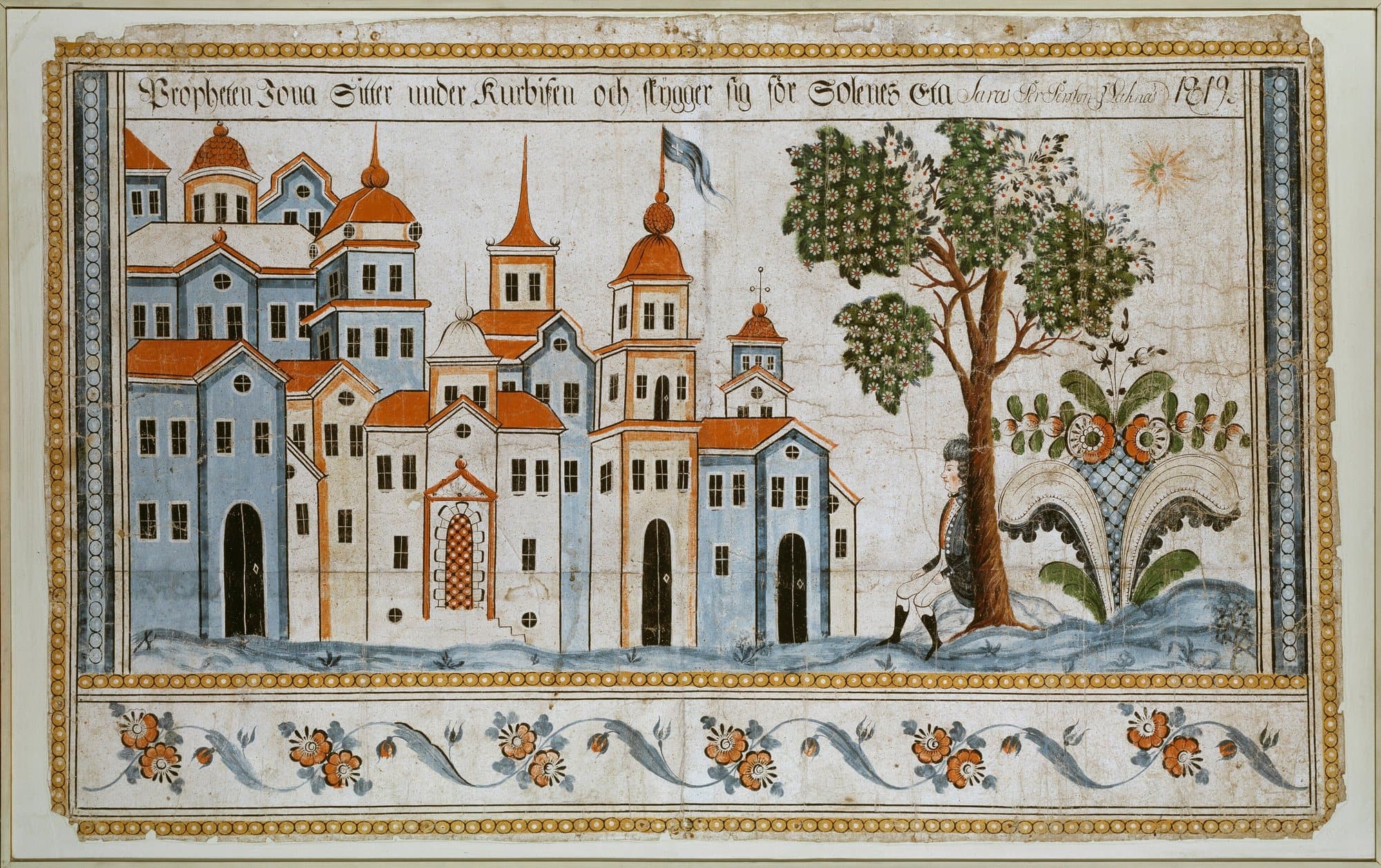
Jonah 4 · Story · Anger
Jonah, Angry Enough to Die
The book of Jonah ends with a question God puts to His angry prophet.
The Hebrew noun for Jonah's great displeasure, raah, is the word the book uses for Nineveh's wickedness and for the disaster God relented from sending (Jonah 1:2 and Jonah 3:10).
Then God asked Jonah, “Have you any right to be angry about the plant?” “I do,” he replied. “I am angry enough to die!”
- Where
- Nineveh
- Who
- Jonah
Summary
Jonah 4 turns from the city to the prophet. Jonah resents the mercy God showed after his preaching, asks to die, and twice hears God ask whether his anger is right. God uses a plant that grows and dies to show Jonah the difference between his care for his own shade and God's care for a city of people and animals.
- Jonah asked twice to die, once after Nineveh was spared and once after the plant withered (Jonah 4:3 and Jonah 4:8).
- Both of God's questions to Jonah turn on charah, the Hebrew word for his burning anger.
- Teachers have traced Jonah's anger to his name as a prophet, to Israel's disappointed hopes, and to a grudge at mercy shown to Gentiles.
Displeased and Angry
Jonah's anger began on the day Nineveh was spared.
Jonah, Angry Enough to Die reads Jonah 4, the chapter in which a prophet is angry at God's mercy, as part of the study of anger.
The question it answers is why Jonah was angry and what God did with his anger. It gives the four things God appointed in the book, the chapter in its order, and three readings of the cause of Jonah's anger with the teachers who hold them. It also gives the letters of Augustine and Jerome about the plant.
Four Things God Appointed
The name of God changes across the appointments, from the LORD to the LORD God to God.
The God who appointed a fish to save Jonah appointed a plant, a worm and a wind to teach him.
- A great fishthe LORD“Now the LORD had appointed a great fish to swallow Jonah”Jonah 1:17
- A vinethe LORD God“So the LORD God appointed a vine, and it grew up to provide shade over Jonah’s head”Jonah 4:6
- A wormGod“God appointed a worm that attacked the plant so that it withered”Jonah 4:7
- A scorching east windGod“God appointed a scorching east wind”Jonah 4:8
A timeline of four rows from Jonah 1:17 to Jonah 4:8, each with words of its verse from the Berean text.
The Chapter in Order
Jonah prays, waits outside the city and is questioned twice.
In the Hebrew of Jonah 4:1 the displeasure itself burns in Jonah, with the verb wayyichar. Jonah then prayed, telling the LORD that he had fled toward Tarshish because he knew God would show mercy (Jonah 4:2).
Jonah asked the LORD to take his life, as Elijah had prayed under a broom tree, “Take my life, for I am no better than my fathers” (1 Kings 19:4).
In Jonah 4:4 the LORD answered with a question, “Have you any right to be angry?” Its Hebrew, hahetev charah lakh, is built on charah, the verb of Jonah's anger in Jonah 4:1.
Jonah sat east of the city to watchJonah 4:5
Jonah made himself a shelter east of the city and sat in its shade to see what would happen to Nineveh.
But the LORD said, “You cared about the plant, which you neither tended nor made grow. It sprang up in a night and perished in a night. So should I not care about the great city of Nineveh, which has more than 120,000 people who cannot tell their right hand from their left, and many cattle as well?”The verse stands here because it answers the anger of the chapter with the reason for God's mercy.
The Plant and the Tumult at Oea
Jerome's Latin version of Jonah 4 once set off an uproar in a congregation in North Africa.
The Hebrew name of the plant is qiqayon, which Strong's glosses “the gourd (as nauseous).” Its five uses in Scripture all stand in Jonah 4.
Augustine of Hippo wrote to Jerome that a bishop who read Jerome's new Latin version of Jonah met a word that differed from the one the church had long chanted. Augustine wrote that “such a tumult in the congregation” arose “that the bishop was compelled to ask the testimony of the Jewish residents (it was in the town of Oea).”
“You tell me that I have given a wrong translation of some word in Jonah, and that a worthy bishop narrowly escaped losing his charge through the clamorous tumult of his people, which was caused by the different rendering of this one word. At the same time, you withhold from me what the word was which I have mistranslated; thus taking away the possibility of my saying anything in my own vindication, lest my reply should be fatal to your objection. Perhaps it is the old dispute about the gourd which has been revived, after slumbering for many long years since the illustrious man, who in that day combined in his own person the ancestral honours of the Cornelii and of Asinius Pollio, brought against me the charge of giving in my translation the word ‘ivy’ instead of ‘gourd.’ I have already given a sufficient answer to this in my commentary on Jonah. At present, I deem it enough to say that in that passage, where the Septuagint has ‘gourd,’ and Aquila and the others have rendered the word ‘ivy’ (κίσσος), the Hebrew manuscript has ‘ciceion,’ which is in the Syriac tongue, as now spoken, ‘ciceia.’ It is a kind of shrub having large leaves like a vine, and when planted it quickly springs up to the size of a small tree, standing upright by its own stem, without requiring any support of canes or poles, as both gourds and ivy do. If, therefore, in translating word for word, I had put the word ‘ciceia,’ no one would know what it meant; if I had used the word ‘gourd,’ I would have said what is not found in the Hebrew. I therefore put down ‘ivy,’ that I might not differ from all other translators. […]”
Jerome · Augustine Letter 75 (From Jerome), Chapter 7, Section 22 · on Jonah 4:6Patristic
A Teacher on God's Last Question
John Wesley published his notes on the Old Testament in 1765.
Wesley taught that God's mercy reaches the children and the cattle of the city.John Wesley, Explanatory Notes upon the Old Testament (1765), on Jonah 4:11
Wesley read the 120,000 who cannot tell right hand from left as “innocents who are infants,” and wrote, “my tender mercies are and shall be over all my works.”
Why Jonah Was Angry
Adam Clarke, Jamieson, Fausset and Brown, and Matthew Henry each name a different cause.
His name as a prophetAdam Clarke
Adam Clarke, in his Commentary on the Bible (1832), wrote that Jonah “was vexed because his prediction was not fulfilled.”
Clarke judged that Jonah “had more respect to his high sense of his own honor than he had to the goodness and mercy of God.”
The objection: Jamieson, Fausset and Brown answered that this reading “would make Jonah a demon, not a man,” preferring the death of a city to the setting aside of his word.
Israel's hopes disappointedJamieson, Fausset and Brown
Jamieson, Fausset and Brown compared Jonah's wish to die with Elijah's in their Commentary Critical and Explanatory (1871), reading it as “impatience of life under disappointed hopes of Israel's reformation.”
Matthew Henry's reading raises the objection that Jonah names no hope for Israel in the chapter, and the reason he gives is God's own mercy (Jonah 4:2).
A grudge at mercy shown to GentilesMatthew Henry
Matthew Henry, in his Commentary on the Whole Bible (1710), wrote that Jonah “had so little affection for men as to be displeased and very angry at the conversion of the Ninevites.”
He set Jonah beside the scribes and Pharisees who murmured when Jesus received sinners.
Adam Clarke's reading raises the objection that Jonah's complaint is addressed to God's character, which he had known before he fled, and the book records no word of his against the Ninevites as a people.
The Question Left Open
A wish to die calls for a physician's care and the help of people nearby as well as prayer, and prayer never takes the physician's place.
Sources
Scripture is the Berean Standard Bible.
- STEP Bible, Translators Amalgamated Hebrew Old Testament (Tyndale House, Cambridge), CC BY 4.0.
- STEP Bible brief lexicon of Extended Strongs for Hebrew (Tyndale House, Cambridge), CC BY 4.0, with the glosses of James Strong, Strong's Exhaustive Concordance of the Bible (1890)
- Augustine of Hippo, Letter 71, to Jerome, chapter 3, section 5 (Nicene and Post-Nicene Fathers, first series, volume 1)
- Jerome, Letter 75 among the letters of Augustine, to Augustine, chapter 7, section 22 (volume 1 of the Nicene and Post-Nicene Fathers, series one)
- Adam Clarke, Commentary on the Bible (1832), on Jonah 4:1.
- Robert Jamieson, A. R. Fausset and David Brown, Commentary Critical and Explanatory on the Whole Bible (1871), on Jonah 4:1 and Jonah 4:3.
- Matthew Henry, Commentary on the Whole Bible (1710), on Jonah 4:1.
- John Wesley, Explanatory Notes upon the Old Testament (1765), on Jonah 4:11.
Keep Studying
Read it1
In this trial7
People and groups7