
Place
Nineveh
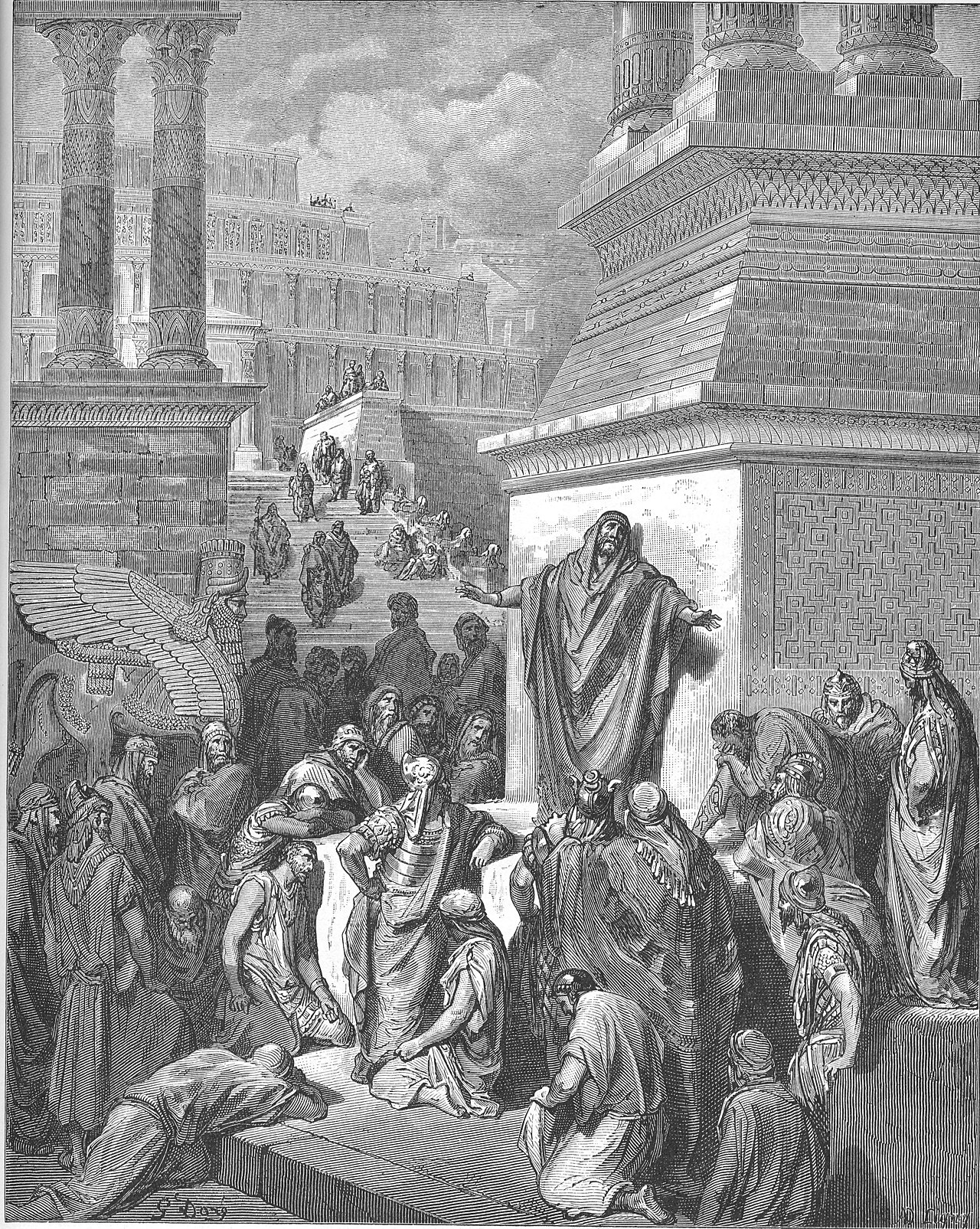
Gustave Doré, La Sainte Bible (Tours: Alfred Mame et fils, 1866). Public domain.
Summary
The great city of Assyria that repented in sackcloth at Jonah’s preaching, that Sennacherib returned to after Jerusalem was spared, and that fell in 612 BC as Nahum had said.
- Nineveh is the one Gentile city in the Old Testament that heard a prophet, repented, and was spared.
- Jonah ran from the errand because he expected God to forgive the city, and he says so himself in Jonah 4:2.
- Sennacherib besieged Jerusalem, went home to Nineveh, and was killed there by his own sons.
- Nahum calls it the city of blood and announces its end, and Babylon and Media took it in 612 BC.
- Jesus calls His three days in the earth the sign of Jonah, and names the men of Nineveh as witnesses against His own generation.
On this page
In Scripture
- Verses
- 21
- Books
- 8
Where it is
the country around it
- Coordinates
- 36.3594° N, 43.1529° Eopen the Atlas →
- Region
- Assyria
- Kind of place
- City
- Located: the gazetteer fixes one site
Not located: The Temple, Assyria. The gazetteer records no location for them, so they are not marked.
Why Nineveh matters
What has been found
the evidence, and where it is disputed
Jonah at Nineveh, and the city that turned
Jonah 3 and 4, in the order it happens
Read Jonah 3 and 4, in the order it happens
- The word comes a second timeJonah 3:1Then the word of the LORD came to Jonah a second time:
- The prophet goes to the great cityJonah 3:3This time Jonah got up and went to Nineveh, in accordance with the word of the LORD. Now Nineveh was an exceedingly great city, requiring a three-day journey.
- One sentence in the streetJonah 3:4On the first day of his journey, Jonah set out into the city and proclaimed, “Forty more days and Nineveh will be overturned!”
- The city believes GodJonah 3:5And the Ninevites believed God. They proclaimed a fast and dressed in sackcloth, from the greatest of them to the least.
- The king comes off his throneJonah 3:6When word reached the king of Nineveh, he got up from his throne, took off his royal robe, covered himself with sackcloth, and sat in ashes.
- The decree names the violenceJonah 3:8Furthermore, let both man and beast be covered with sackcloth, and have everyone call out earnestly to God. Let each one turn from his evil ways and from the violence in his hands.
- Who knows?Jonah 3:9Who knows? God may turn and relent; He may turn from His fierce anger, so that we will not perish.”
- God relentsJonah 3:10When God saw their actions—that they had turned from their evil ways—He relented from the disaster He had threatened to bring upon them.
- The prophet's anger, in his own wordsJonah 4:2So he prayed to the LORD, saying, “O LORD, is this not what I said while I was still in my own country? This is why I was so quick to flee toward Tarshish. I knew that You are a gracious and compassionate God, slow to anger, abounding in loving devotion—One who relents from sending disaster.
- The question the book ends onJonah 4:11So should I not care about the great city of Nineveh, which has more than 120,000 people who cannot tell their right hand from their left, and many cattle as well?”
Nineveh was spared here, and it was not spared forever. Nahum's oracle against the same city comes about a century and a half later, and the city fell in 612 BC.
The book of Jonah: the full studyWhat happened here, in order
in the order the canon tells it
- Nineveh built in the land of AssyriaGenesis 10:11From that land he went forth into Assyria, where he built Nineveh, Rehoboth-Ir, Calah,
- Samaria falls and Israel is carried to Assyria2 Kings 17:6In the ninth year of Hoshea, the king of Assyria captured Samaria and carried away the Israelites to Assyria, where he settled them in Halah, in Gozan by the Habor River, and in the cities of the Medes.
- Sennacherib takes the fortified cities of Judah2 Kings 18:13In the fourteenth year of Hezekiah’s reign, Sennacherib king of Assyria attacked and captured all the fortified cities of Judah.
- The boast outside Jerusalem's wall2 Kings 18:35Who among all the gods of these lands has delivered his land from my hand? How then can the LORD deliver Jerusalem from my hand?”
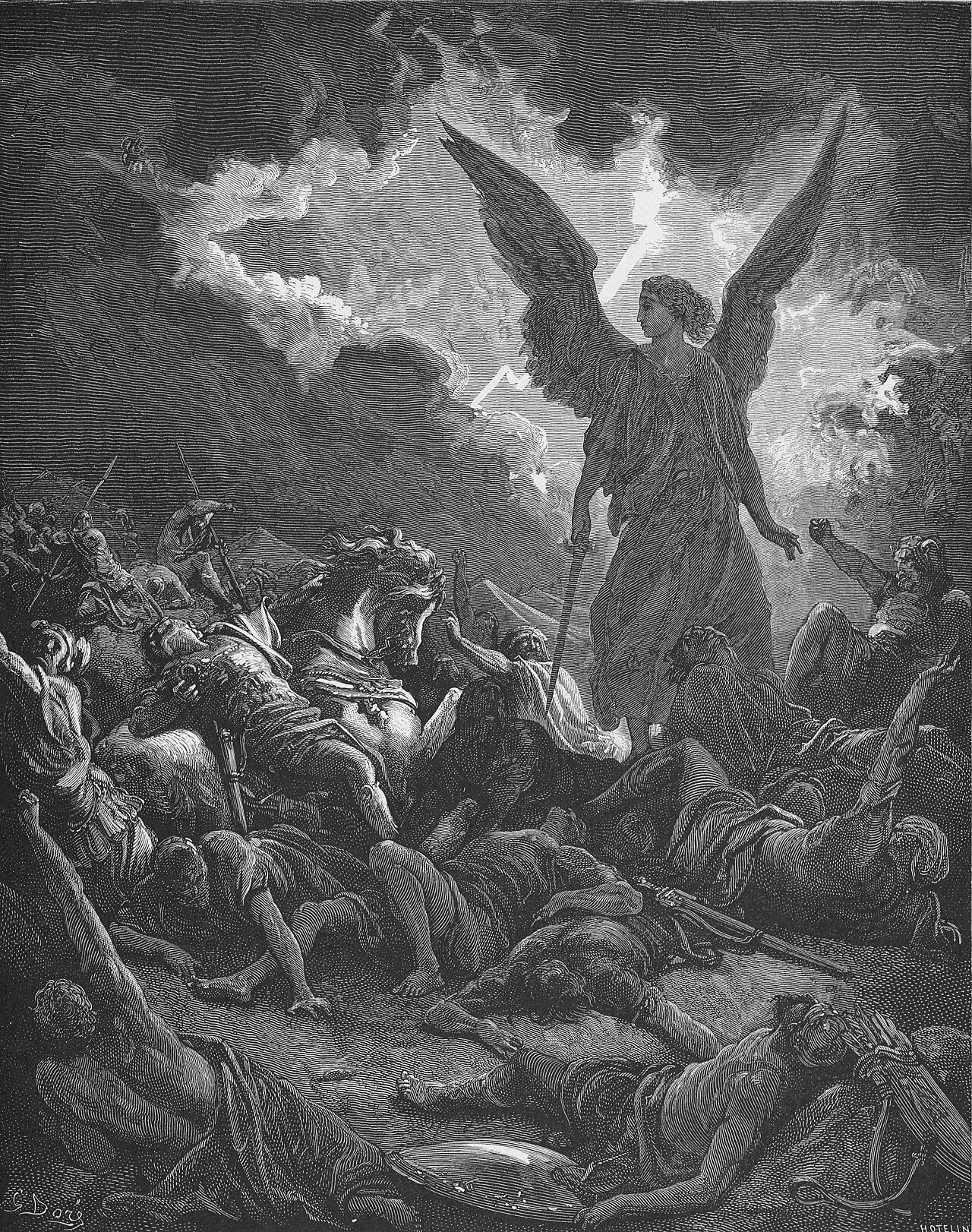
- The Assyrian camp struck in the night2 Kings 19:35And that very night the angel of the LORD went out and struck down 185,000 men in the camp of the Assyrians. When the people got up the next morning, there were all the dead bodies!
- Sennacherib goes home to Nineveh2 Kings 19:36So Sennacherib king of Assyria broke camp and withdrew. He returned to Nineveh and stayed there.
- Killed by his own sons in the temple of his god2 Kings 19:37One day, while he was worshiping in the temple of his god Nisroch, his sons Adrammelech and Sharezer put him to the sword and escaped to the land of Ararat. And his son Esar-haddon reigned in his place.
- Assyria named as the rod of God's angerIsaiah 10:5Woe to Assyria, the rod of My anger; the staff in their hands is My wrath.
- The commission to preach against the cityJonah 1:2“Get up! Go to the great city of Nineveh and preach against it, because its wickedness has come up before Me.”
- Jonah takes a ship the other wayJonah 1:3Jonah, however, got up to flee to Tarshish, away from the presence of the LORD. He went down to Joppa and found a ship bound for Tarshish. So he paid the fare and went aboard to sail for Tarshish, away from the presence of the LORD.
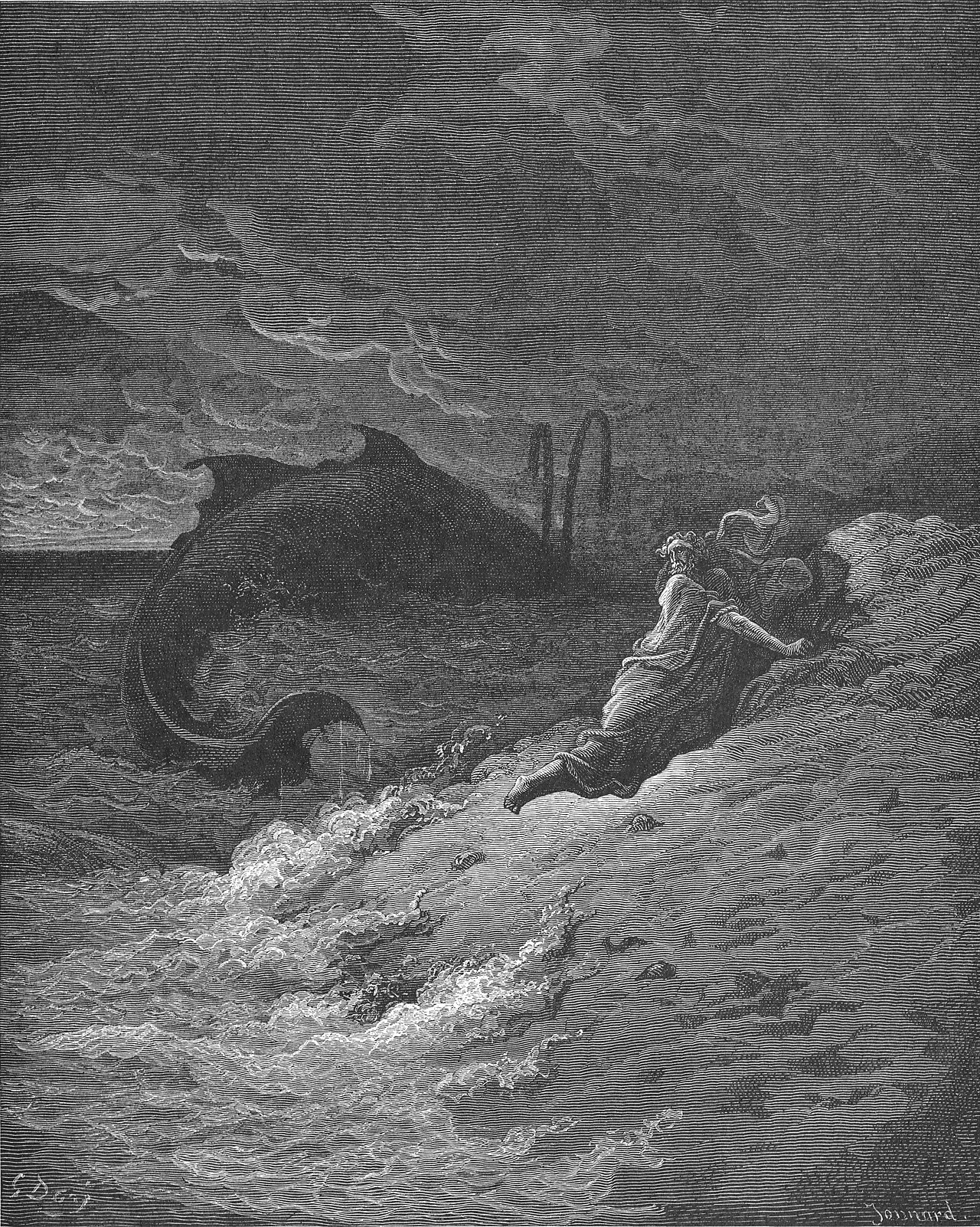
- A great fish appointed, and three days inside itJonah 1:17Now the LORD had appointed a great fish to swallow Jonah, and Jonah spent three days and three nights in the belly of the fish.
- The city believes God and calls a fastJonah 3:5And the Ninevites believed God. They proclaimed a fast and dressed in sackcloth, from the greatest of them to the least.
- Assyria called the land of NimrodMicah 5:6And they will rule the land of Assyria with the sword, and the land of Nimrod with the blade drawn. So He will deliver us when Assyria invades our land and marches into our borders.
- One oracle against one cityNahum 1:1This is the burden against Nineveh, the book of the vision of Nahum the Elkoshite:
- The river gates thrown openNahum 2:6The river gates are thrown open and the palace collapses.
- The city of bloodNahum 3:1Woe to the city of blood, full of lies, full of plunder, never without prey.
- Are you better than Thebes?Nahum 3:8Are you better than Thebes, stationed by the Nile with water around her, whose rampart was the sea, whose wall was the water?
- Nineveh to be left as dry as a desertZephaniah 2:13And He will stretch out His hand against the north and destroy Assyria; He will make Nineveh a desolation, as dry as a desert.
- Three days in the fish, three days in the earthMatthew 12:40For as Jonah was three days and three nights in the belly of the great fish, so the Son of Man will be three days and three nights in the heart of the earth.
- The men of Nineveh named as witnessesLuke 11:32The men of Nineveh will stand at the judgment with this generation and condemn it; for they repented at the preaching of Jonah, and now One greater than Jonah is here.
Where it points
The voices
each quoted from the work named
The burden - Jerome: “The word משׂא mas's'â', ‘burden’ is never placed in the title, except when the vision is heavy and full of burden and toil.” Of Nineveh - The prophecy of Nahum again is very stern and awful. Nineveh, after having “repented at the preaching of Jonah,” again fell back into the sins whereof it had repented, and added this, that, being employed by God to chasten Israel, it set itself, not to inflict the measure of God’s displeasure, but to uproot the chosen people, in whom was promised the birth of Christ .
"Now the LORD had prepared a great fish to swallow up Jonah." LXX: 'and the Lord ordered a great fish to swallow Jonah'. The Lord commanded death and the underworld to receive the prophet. To the eager jaws of death he seemed a prey: she had such joy in swallowing him, and such sadness in spitting him out. Thus happened what is written in Hosea: "I will be your death, O Death! I will be your bite, Hell!" [Hos. 13:14].
Now the Lord had (literally “And the Lord”) prepared - Jonah (as appears from his thanksgiving) was not swallowed at once, but sank to the bottom of the sea, God preserving him in life there by miracle, as he did in the fish’s belly.
4 more teachers on these versesCharles Spurgeon · John Wesley · Adam Clarke · J.C. Ryle
THIS WAS THE FORLORN HOPE of the Ninevites: “Who can tell if God will turn and repent, and turn away from his fierce anger, that we perish not?” The book of Jonah should be exceedingly comfortable to those who are despairing because of the wickedness of their times. Nineveh was a city as great in its wickedness as in its power.
That great city - Wouldest thou have me less merciful to such a goodly city, than thou art to a weed? Who cannot discern - Here are more than six-score innocents who are infants. Much cattle - Beside men, women and children who are in Nineveh, there are many other of my creatures that are not sinful, and my tender mercies are and shall be over all my works.
And flocks shall lie down in the midst of her - Nineveh was so completely destroyed, that its situation is not at present even known. The present city of Mossoul is supposed to be in the vicinity of the place where this ancient city stood. The cormorant קאת kaath; and the bittern, קפד kippod.
The beginning of this passage is one of those places which strikingly illustrate the truth of Old Testament history. Our Lord speaks of the Queen of the South as a real, true person, who had lived and died. He refers to the story of Jonah, and his miraculous preservation in the whale’s belly, as undeniable matters of fact. Let us remember this if we hear men professing to believe the writers of the New Testament, and yet sneering at the things recorded in the Old Testament as if they were fables.
Nineveh in Scripture
21 verses name it, in 8 books
Open a book to read its mentions here. Text: Berean Standard Bible.
Old TestamentNew Testamentsegment width = share of mentions
Old Testament6 books · 19 mentions
Genesis2 mentions
2 Kings1 mention
Isaiah1 mention
Jonah7 mentions
- Jonah 1:2“Get up! Go to the great city of Nineveh and preach against it, because its wickedness has come up before Me.”
- Jonah 3:2“Get up! Go to the great city of Nineveh and proclaim to it the message that I give you.”
- Jonah 3:3This time Jonah got up and went to Nineveh, in accordance with the word of the LORD. Now Nineveh was an exceedingly great city, requiring a three-day journey.
- Jonah 3:4On the first day of his journey, Jonah set out into the city and proclaimed, “Forty more days and Nineveh will be overturned!”
- Jonah 3:6When word reached the king of Nineveh, he got up from his throne, took off his royal robe, covered himself with sackcloth, and sat in ashes.
- Jonah 3:7Then he issued a proclamation in Nineveh: “By the decree of the king and his nobles: Let no man or beast, herd or flock, taste anything at all. They must not eat or drink.
- Jonah 4:11So should I not care about the great city of Nineveh, which has more than 120,000 people who cannot tell their right hand from their left, and many cattle as well?”
Nahum7 mentions
- Nahum 1:1This is the burden against Nineveh, the book of the vision of Nahum the Elkoshite:
- Nahum 1:8But with an overwhelming flood He will make an end of Nineveh and pursue His enemies into darkness.
- Nahum 1:11From you, O Nineveh, comes forth a plotter of evil against the LORD, a counselor of wickedness.
- Nahum 1:14The LORD has issued a command concerning you, O Nineveh: “There will be no descendants to carry on your name. I will cut off the carved image and cast idol from the house of your gods; I will prepare your grave, for you are contemptible.”
- Nahum 2:1One who scatters advances against you, O Nineveh. Guard the fortress! Watch the road! Brace yourselves! Summon all your strength!
- Nahum 2:8Nineveh has been like a pool of water throughout her days, but now it is draining away. “Stop! Stop!” they cry, but no one turns back.
- Nahum 3:7Then all who see you will recoil from you and say, ‘Nineveh is devastated; who will grieve for her?’ Where can I find comforters for you?”
New Testament2 books · 2 mentions
Matthew1 mention
The account
Read the account as one telling
Genesis places the founding in the generation after the flood. Genesis 10:11 says that from that land he went forth into Assyria, where he built Nineveh, and the next verse groups the city with Rehoboth-Ir, Calah and Resen. Micah later calls Assyria the land of Nimrod. Adam Clarke reports an old tradition, taken from the Greek historians rather than from Scripture, that the city was named for Ninus, and that Ninus and Nimrod were the same man.
Jonah son of Amittai is dated by the one other verse that names him. 2 Kings 14:25 places him in the reign of Jeroboam II, which puts his mission in the first half of the eighth century BC, in a stretch when Assyria was weak and Nineveh was not yet the capital. That is the setting of the preaching and the repentance told above.
Within a generation Assyria was strong again. The king of Assyria captured Samaria and carried the Israelites away, settling them in Halah, in Gozan by the Habor River, and in the cities of the Medes. Moving one conquered population out and another in was documented Assyrian policy, and Sargon II's annals claim 27,290 people taken from Samaria.
- 701 BC
In 701 BC Sennacherib came down on Judah, took its fortified cities, and sent his officers to demand Jerusalem. His spokesman asked which god had ever delivered a land out of Assyria's hand. 2 Kings 19:35 records the angel of the LORD striking the camp, and the next verse sends the king home. He returned to Nineveh and stayed there.
Sennacherib made Nineveh his capital and rebuilt it on a scale nothing else in the region matched. A wall circuit of about 12 kilometres ran around some 750 hectares, with fifteen named gates, and he recorded the work himself, including the palace he called the one without a rival. About twenty years after the campaign against Judah, in 681 BC, two of his sons killed him while he was worshiping in the temple of his god.
Under Esarhaddon and then Ashurbanipal the empire reached its widest, and Ashurbanipal gathered a library at Nineveh of tens of thousands of clay tablets, copied and catalogued from across Mesopotamia.
- 612 BC
The city fell in 612 BC. The Babylonian Chronicle records that Nabopolassar of Babylon and Cyaxares of Media joined forces, besieged Nineveh, made three assaults, took it, carried off great spoil and turned it into ruin heaps, and that the Assyrian king died in the fall. A remnant of the state held out at Harran until 610 BC, and the Egyptian march north to support that remnant is the background of Josiah's death at Megiddo.
- 663 BC
Two prophets had said it would happen. Nahum wrote after the fall of Thebes in 663 BC, which he treats as recent news, and before 612 BC. Zephaniah wrote in Josiah's reign and said the same thing in three verses. Nahum names one city in his first line and never leaves it.
Common questions
Was Jonah dead inside the fish, or alive?
Readers differ; the positions are named
Jonah prays from the belly of Sheol and says that God raised his life from the pit, and Jesus makes the three days in the fish the figure of three days in the heart of the earth. Those who read a real death take Sheol and the pit at full weight and hold that a type of the resurrection needs a real death behind it. Jerome writes that the Lord commanded death and the underworld to receive the prophet.
Those who read preservation in life point out that Jonah prayed to the LORD his God from inside the fish, that he describes his life as fading away rather than gone, and that Sheol and the pit are the ordinary language of near-death distress in the Psalms. Albert Barnes holds that God preserved him in life there by miracle. Both readings carry the same resurrection sign, and Scripture does not close the question.
Was it a whale?
No text says whale. Jonah 1:17 says a great fish, and the Greek word behind Matthew 12:40 means a large sea creature. Older English versions supplied the whale and the picture stuck.
Which creature it was is never stated. The text puts the weight on who appointed it, since the LORD had appointed a great fish to swallow Jonah.
How big was Nineveh, and what does a three-day journey mean?
Readers differ; the positions are named
Jonah 3:3 calls Nineveh an exceedingly great city, requiring a three-day journey, and readers take that three ways. The circuit reading takes it as the walk around the walls and rests on the classical figure from Diodorus of about four hundred and eighty stadia, near fifty-five miles, which is the figure John Wesley and Adam Clarke both use. The greater Nineveh reading takes it as the whole district of Genesis 10:11 to 10:12, Nineveh with Rehoboth-Ir, Calah and Resen, a triangle of towns that would take three days to cross. The diplomatic reading, argued by Donald Wiseman in 1979, takes three days as the customary length of an official visit, one day to arrive, one to do business and one to leave.
The excavated city wall runs about twelve kilometres, which is a long day's walk rather than three. The first reading needs the classical figure to work, and the other two do not.
Who are the 120,000, and how many people lived in Nineveh?
Readers differ; the positions are named
God's closing question speaks of more than 120,000 people who cannot tell their right hand from their left. On one reading the phrase means small children, so the 120,000 are the youngest part of the city and the whole population was several times that. Albert Barnes and John Wesley both read it that way, and Wesley calls them more than six-score innocents who are infants.
On the other reading the phrase describes the whole population as morally undiscerning, people who had never had the law and did not know right from wrong, so the 120,000 are the city. Estimates from the excavated area at the city's height under Sennacherib usually run near 100,000 to 150,000, which fits the second reading directly and the first only if the count is taken across the wider district.
Who was the king of Nineveh, and why is he not called king of Assyria?
Readers differ; the positions are named
Jonah 3:6 uses a title that no Assyrian king used of himself. Assyrian kings were king of Assyria, and Nineveh did not become the capital until long after Jonah's lifetime. Some read the title as that of a provincial governor of the city, which is what the words would naturally describe. Others read it as ordinary Hebrew usage for a foreign ruler named from his city, on the pattern of Ahab being called king of Samaria in 1 Kings 21:1. Critical scholarship reads it as a mark of late composition, written when the distinction no longer mattered.
If the mission falls in the reign of Jeroboam II, the Assyrian king of the day was Adad-nirari III or one of his short-reigned successors. This page names the possibilities and chooses none of them.
Nineveh was to be overturned in forty days and it was not. Was the prophecy wrong?
Jonah preaches a bare sentence of judgment with no condition attached, and God relents when the city turns. Adam Clarke answers that the threat was conditional even where the condition went unstated, which is the principle God states directly in Jeremiah 18:7 to 18:8. John Chrysostom puts it the other way round and says God preferred His own prediction to fall so that the city should not fall.
Jonah had worked the point out in advance, which is why he ran. He says in 4:2 that he knew God to be gracious and compassionate, slow to anger and quick to relent.
What is the sign of Jonah?
Jesus was asked for a sign and refused every sign but one. He said that as Jonah was three days and three nights in the belly of the great fish, so the Son of Man would be three days and three nights in the heart of the earth. The sign is the resurrection, and He said so Himself.
He put a second edge on it in the same breath. The men of Nineveh would stand at the judgment with that generation, because a pagan city turned at one prophet's sentence while One greater than Jonah stood in front of them.
Does archaeology confirm any of this?
On Sennacherib it does, closely. His palace at Nineveh gave up the Lachish reliefs, which are the Assyrian army's own picture of the siege that 2 Kings 18 reports from the other side, and the Taylor Prism carries his account of the same campaign, naming Hezekiah and the tribute. The prism records forty-six captured cities of Judah and never claims the capture of Jerusalem, which for a royal annal is a notable silence.
The fall of the city in 612 BC is recorded in the Babylonian Chronicle, and the excavated Halzi Gate carries physical evidence of the final fight. On Jonah himself there is no direct archaeological witness, and this page says so.
Where is Nineveh now, and is Jonah buried there?
The city stands as two mounds on the east bank of the Tigris opposite Mosul in northern Iraq. Kuyunjik held the palaces and Ashurbanipal's library, and Nebi Yunus lies about a kilometre south.
The southern mound carried a shrine venerated for centuries as the tomb of Jonah, first as a church and then as a mosque, which was destroyed in 2014. Tunnels dug under the ruins afterwards exposed Assyrian palace walls beneath it. The burial tradition is a tradition, with medieval rather than ancient witnesses and no inscription or object tying the mound to Jonah.
Notable art
2 verified pieces depicting Nineveh
Sources cited
- OpenBible.info Bible Geocoding: Ninevehread 2026-08-20The coordinates on this page. Used under CC-BY with attribution to OpenBible.info.
- Gustave Doré, La Sainte Bible (Tours: Alfred Mame et fils, 1866)The three engravings on this page. Public domain.
- Claudius James Rich, Narrative of a Residence in Koordistan, and on the Site of Ancient Nineveh (London: James Duncan, 1836)The first modern survey and plan of the mounds, made in 1820.
- Austen Henry Layard, Nineveh and Its Remains (London: John Murray, 1849)The excavator's account of the South-West Palace of Sennacherib and its reliefs.
- Austen Henry Layard, Discoveries in the Ruins of Nineveh and Babylon (London: John Murray, 1853)The second Layard volume, including the Lachish room.
- Hormuzd Rassam, Asshur and the Land of Nimrod (Cincinnati: Curts & Jennings, 1897)Rassam's own account of the North Palace of Ashurbanipal and the second body of tablets.
- George Smith, The Chaldean Account of Genesis (London: Sampson Low, 1876)The reading of Gilgamesh Tablet XI, announced 3 December 1872.
- Daniel David Luckenbill, The Annals of Sennacherib, Oriental Institute Publications 2 (Chicago, 1924)The prism text and the translation of the third campaign quoted on this page.
- Donald J. Wiseman, "Jonah's Nineveh", Tyndale Bulletin 30 (1979)The three days as a diplomatic convention, and the eighth-century background.
- The British Museum collection records for the Nineveh materialThe Lachish reliefs, the Taylor Prism, the Ashurbanipal library tablets and the flood tablet.
- Albert Barnes, Notes, Explanatory and Practical, on the Old and New Testaments (1832 to 1869)Public domain. The Nahum 1:1 and Jonah 1:17 notes quoted on this page.
- Adam Clarke, Commentary on the Bible (1832)Public domain. The Zephaniah 2:14 note quoted on this page, written before the site was found.
- Charles H. Spurgeon, The New Park Street Pulpit, Sermon No. 275: "Who Can Tell?"Public domain, CCEL edition.
- J.C. Ryle, Expository Thoughts on the Gospels: Matthew (1856)Public domain, CCEL edition.
- Jerome, Commentary on Jonah (c. AD 396 to 420)Public domain translation. The death and underworld reading of Jonah 1:17.
- John Wesley, Explanatory Notes upon the Old Testament (1765), and the other public-domain commentary quoted herePublic domain editions of Wesley, Matthew Henry, and Jamieson, Fausset and Brown.
Keep studying
On this page
Studies8
Doorway2
Keep this page