
2 Samuel 24:23
in 2 Samuel 24O king, Araunah gives all these to the king.” He also said to the king, “May the LORD your God accept you.”
BSB
The same verse in ASV and KJV ▾
ASV
all this, O king, doth Araunah give unto the king. And Araunah said unto the king, Jehovah thy God accept thee.
KJV
All these things did Araunah, as a king, give unto the king. And Araunah said unto the king, The Lord thy God accept thee.
⋯
This verse in 2 Samuel 24
Commentary
8 notes on this verseTherefore, the king himself offered blessed David the threshing floor and oxen for a burnt offering, but King David refused to accept them without first paying a price. This, too, was fulfilled at the coming of our Lord and Savior, for he refused to take …
This site's exposition
rear an altar unto the Lord
on 2 Samuel 24:18-23
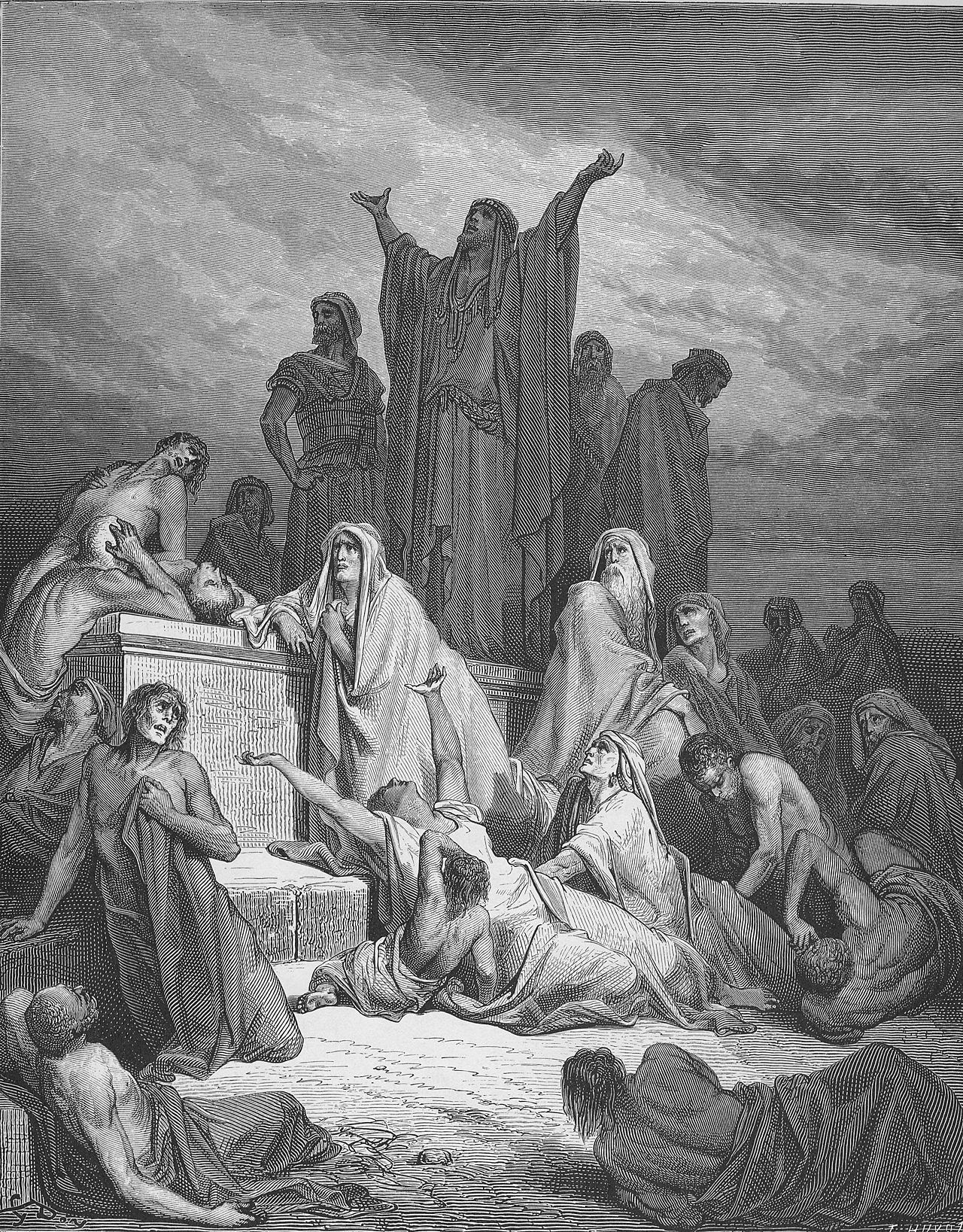
Gad returns the same day with an instruction rather than another choice, go up and build an altar on Araunah's floor. Araunah sees the king coming and bows himself to the ground, then offers the floor, the oxen for the burnt offering, and the threshing instruments for wood, refusing no part of what the king might need. Adam Clarke reads the offer as loyalty to the king, care for a people under plague, and regard for his own safety in one gesture, and Araunah closes it with a blessing, the Lord thy God accept thee.
The record, by era
The Puritans and the Awakening3 voices
); though an ordinary subject, he had the spirit of a prince. In the Hebrew it is, He gave, even the king to the king, whence it is supposed that Araunah had been king of the Jebusites in that place, or was descended from their royal family, though now a tributary to David.
quarantine:debris (2026-07-29) — leading-punctuation+unbalanced-parens
1 And again the anger of the L ORD was kindled against Israel, and he moved David against them to say, Go, number Israel and Judah. 2 For the king said to Joab the captain of the host, which was with him, Go now through all the tribes of Israel, from Dan even to Beer-sheba, and number ye the people, that I may know the number of the people.
quarantine:scripture (2026-07-29) — scripture-overlap:97%@v1-2
All these things did Araunah, as a king, give unto the king,....
The Nineteenth Century2 voices
A commentator
Albert Barnes1798–1870
Notes, Explanatory and Practical, on the Old and New Testaments (1832-1869)
Either, “the whole O king does Araunah give unto the king;” or (2) “the whole did king Araunah give to the king.” The former is preferable.
A commentator
Jamieson, Fausset & Brown1802–1910
Commentary Critical and Explanatory on the Whole Bible (1871)
All these things did Araunah, as a king, give--Indicating, as the sense is, that this man had been anciently a heathen king or chief, but was now a proselyte who still retained great property and influence in Jerusalem, and whose piety was evinced by the liberality of his offers. The words, "as a king," are taken by some to signify simply, "he gave with royal munificence."
1 more voice on this verse
The Nineteenth Century1 voice
As a king, give unto the king - Literally, All these did King Araunah give unto the king. That there could not be a king of the Jebusites on Mount Moriah, is sufficiently evident; and that there was no other king than David in the land, is equally so: the word המלך hammelech, “the king,” given here to Araunah, is wanting in the Septuagint, Syriac, and Arabic; in three of Kennicott’s and De Rossi’s MSS., and in the parallel place in Chronicles: and, it is very probable, never made a part of the text. Perhaps it should be read, All these did Arnunah give unto the king. There is, however, a difficulty here. David had taken the fortress of the Jebusites many years before; yet it is evident that Araunah was proprietor of the soil at this time. It is not clear that he was a subject of David; but he paid him respect as a neighbor and a king. This is merely possible.
The words behind it
12 Hebrew wordsEvery Hebrew word of this verse in the order it stands, with what it means and the door to its own study. The last column counts the times a word stands in the whole Bible: the rarer the word, the more the places it appears belong together.
| Hebrew | Sound | Meaning | Word study | In the Bible |
|---|---|---|---|---|
| הַכֹּ֗ל | hakol | <the> everything | H3605 → | 5413 times |
| נָתַ֛ן | natan | he gives | H5414 → | 2011 times |
| אֲרַ֥וְנָה | ʾaravnah | Araunah | H728 → | 9 times |
| הַמֶּ֖לֶךְ | hamelekh | O king | H4428 → | 2525 times |
| לַמֶּ֑לֶךְ ס | lamelekh | to the king | H4428 → | 2525 times |
| וַיֹּ֤אמֶר | vaiyomer | and he said | H559 → | 5305 times |
| אֲרַ֙וְנָה֙ | ʾaravnah | Araunah | H728 → | 9 times |
| אֶל־ | ʾel- | to | H413 → | 5510 times |
| הַמֶּ֔לֶךְ | hamelekh | the king | H4428 → | 2525 times |
| יְהוָ֥ה | yahweh | Yahweh | H3068 → | 6520 times |
| אֱלֹהֶ֖יךָ | ʾeloheikha | God your | H430 → | 2601 times |
| יִרְצֶֽךָ׃ | yirtzekha | may he accept favorably you | H7521 → |
הַכֹּ֗ל<the> everything
hakolH3605 →5413 times
נָתַ֛ןhe gives
natanH5414 →2011 times
אֲרַ֥וְנָהAraunah
ʾaravnahH728 →9 times
הַמֶּ֖לֶךְO king
hamelekhH4428 →2525 times
לַמֶּ֑לֶךְ סto the king
lamelekhH4428 →2525 times
וַיֹּ֤אמֶרand he said
vaiyomerH559 →5305 times
אֲרַ֙וְנָה֙Araunah
ʾaravnahH728 →9 times
אֶל־to
ʾel-H413 →5510 times
הַמֶּ֔לֶךְthe king
hamelekhH4428 →2525 times
יְהוָ֥הYahweh
yahwehH3068 →6520 times
אֱלֹהֶ֖יךָGod your
ʾeloheikhaH430 →2601 times
יִרְצֶֽךָ׃may he accept favorably you
yirtzekhaH7521 →
A shaded row is a word that stands 400 times or fewer in the Bible.
The walk
8 stopsEach card is a verse this one points to, and under it the verses that one points to in turn. Where several paths arrive at the same place, that place is listed first: the text keeps returning to it.
Through
Isaiah 60:7All the flocks of Kedar will be gathered to you; the rams of Nebaioth will serve you and go up on My altar with acceptance; I will adorn My glorious house.
it leads to
- Isaiah 56:7
I will bring them to My holy mountain and make them joyful in My house of prayer. Their burnt offerings and sacrifices will be accepted on My altar, for My house will be called…
- Genesis 25:13
These are the names of the sons of Ishmael in the order of their birth: Nebaioth the firstborn of Ishmael, then Kedar, Adbeel, Mibsam,
- Hebrews 13:15–16
Through Jesus, therefore, let us continually offer to God a sacrifice of praise, the fruit of lips that confess His name.
- Isaiah 56:7
Through
Psalms 45:16Your sons will succeed your fathers; you will make them princes throughout the land.
it leads to
- Revelation 5:10
You have made them to be a kingdom and priests to serve our God, and they will reign upon the earth.”
- 1 Peter 2:9
But you are a chosen people, a royal priesthood, a holy nation, a people for God’s own possession, to proclaim the virtues of Him who called you out of darkness into His marvelous light.
- Revelation 1:6
who has made us to be a kingdom, priests to His God and Father—to Him be the glory and power forever and ever! Amen.
- Revelation 5:10
Through
Hosea 8:13Though they offer sacrifices as gifts to Me, and though they eat the meat, the LORD does not accept them. Now He will remember their iniquity and punish their sins: They will return to…
it leads to
- Hosea 9:6
For even if they flee destruction, Egypt will gather them and Memphis will bury them. Their precious silver will be taken over by thistles, and thorns will overrun their tents.
- Hosea 9:9
They have deeply corrupted themselves as in the days of Gibeah; He will remember their guilt; He will punish their sins.
- Hosea 9:6
Where this verse is studied
On this page
Studies2
On this verse
On this chapter
About 2 Samuel
This page draws on Adam Clarke, Commentary on the Bible; Albert Barnes, Notes, Explanatory and Practical, on the Old and New Testaments (1832-1869); Caesarius of Arles, SERMON 122.2; Jamieson, Fausset & Brown, Commentary Critical and Explanatory on the Whole Bible; John Gill, Exposition of the Old Testament; John Gill, Exposition of the Old Testament (1748-1763) and Matthew Henry, Commentary on the Whole Bible.