
Ruth 3:2
in Ruth 3Now is not Boaz, with whose servant girls you have been working, a relative of ours? In fact, tonight he is winnowing barley on the threshing floor.
BSB
The same verse in ASV and KJV ▾
ASV
And now is not Boaz our kinsman, with whose maidens thou wast? Behold, he winnoweth barley to-night in the threshing-floor.
KJV
And now is not Boaz of our kindred, with whose maidens thou wast? Behold, he winnoweth barley to night in the threshingfloor.
⋯
This verse in Ruth 3
Commentary
10 notes on this verseHe winnoweth barley tonight - It is very likely that the winnowing of grain was effected by taking up, in a broad thin vessel or sieve, a portion of the corn, and letting it down slowly in the wind; thus the grain would, by its own weight, fall in one place, while the chaff, etc., would be carried to a distance by the wind.
This site's exposition
One day Ruth’s mother-in-law Naomi said to her
on Ruth 3:1-2
Naomi now seeks "a resting place for you", the rest she prayed over both women at 1:9, and this time she works for it. Winnowing was done in the evening, when the hill wind carried the chaff away, so the hour belongs to the harvest rather than to secrecy.
This site's exposition
tonight he is winnowing barley on the threshing floor
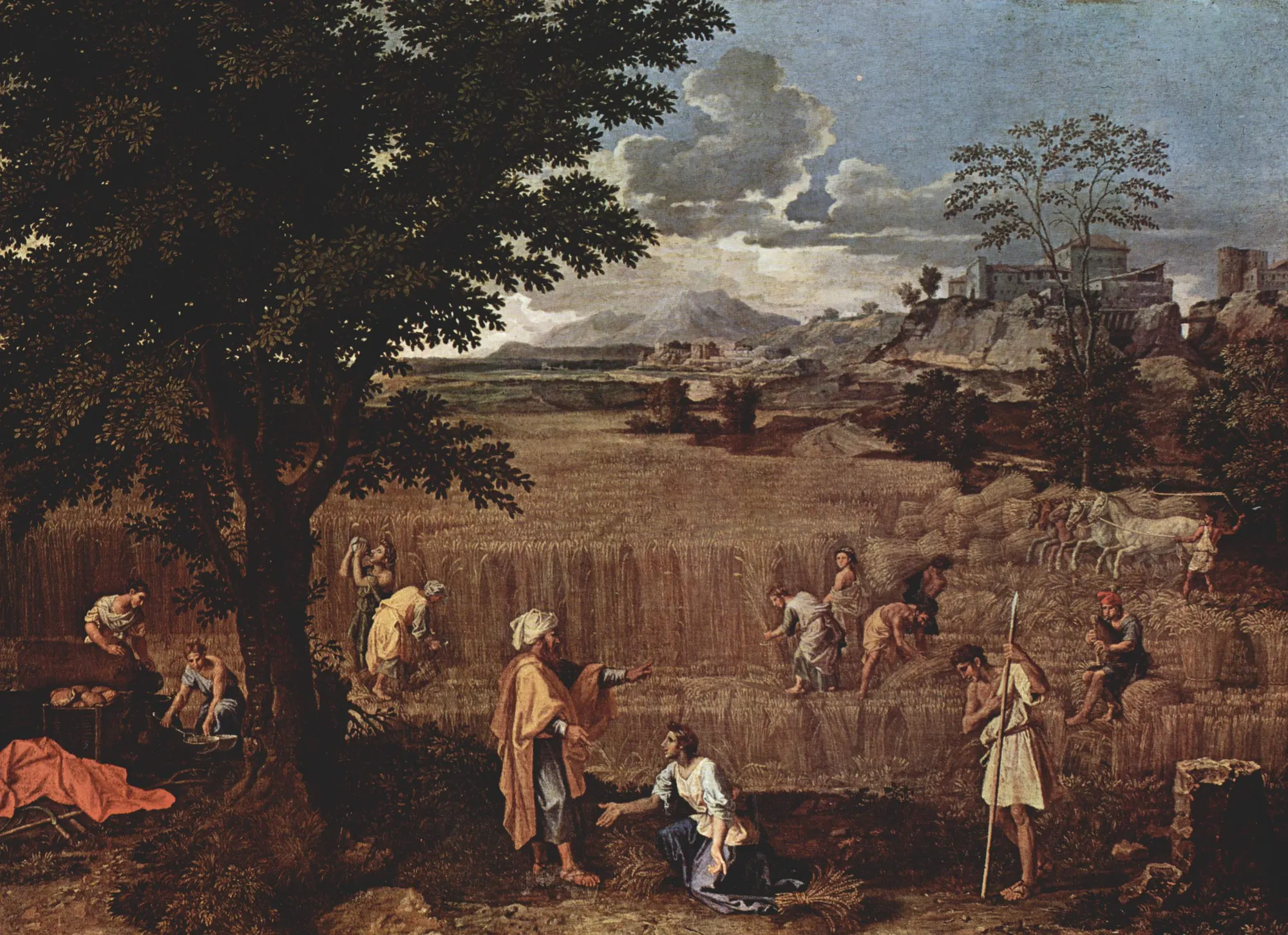
Winnowing barley meant tossing the threshed grain into the wind, so the heavy kernels fell back on the threshing floor and the chaff blew away. The wind rose in the evening, so Boaz works tonight. Naomi knows where her relative will be.
The record, by era
The Church Fathers1 voice
What does Naomi suggest to her daughter-in-law? When Ruth heard her mother-in-law saying, "Our neighbor is a true man," she was reminded of his great kindness and thought to want him [to be] married to her in law, so that she might keep up the …
The Puritans and the Awakening4 voices
As Nabal and Absalom had feasts at their sheep-shearing, so Boaz at his winnowing. Naomi thought Ruth the most proper person to do it herself; and perhaps it was the usage in that country that in this case the woman should make the demand; so much is intimated by the law, Deut. xxv.
): " Is not Boaz of our kindred, and therefore bound in conscience to take care of our affairs?" This may encourage us to lay ourselves by faith at the feet of Christ, that he is our near kinsman; having taken our nature upon him, he is bone of our bone and flesh of our flesh.
quarantine:debris (2026-07-29) — leading-punctuation+unbalanced-parens
Threshing-floor - Which was in a place covered at the top, but open elsewhere, whither Ruth might easily come. And this work of winnowing corn was usually ended with a feast.
And now is not Boaz of our kindred, with whose maidens thou wast?....
2 more voices on this verse
The Nineteenth Century2 voices
A commentator
Jamieson, Fausset & Brown1802–1910
Commentary Critical and Explanatory on the Whole Bible (1871)
The threshing-floor, which was commonly on the harvest-field, was carefully leveled with a large cylindric roller and consolidated with chalk, that weeds might not spring up, and that it might not chop with drought.
A commentator
Albert Barnes1798–1870
Notes, Explanatory and Practical, on the Old and New Testaments (1832-1869)
proposed
Behold, he winnoweth barley ... - The simple manners of Boaz and his times are here before us. This “mighty man of wealth” assists personally in the winnowing of his barley, which lies in a great heap on the floor Rth 3:15, and sleeps in the open threshing-floor to protect his grain from depredation. Tonight - For the sake of the breeze which springs up at sunset, and greatly facilitates the “cleansing” (separation) of the grain tossed up across the wind.
How the passage was read
What the Jewish commentators add
On the verses either side of this one
"A home (מנוח)": For a woman does not have rest until she is married.
This section is reception history: how the passage was read and kept in the Jewish tradition. Where a reading parts from an essential of the Christian faith, the section says so at that point.
Texts and citation data: Sefaria; each excerpt follows its version’s licence. 2 further sources are cited on this chapter that carry no English text this site may quote or only restate the verse.
The words behind it
15 Hebrew wordsEvery Hebrew word of this verse in the order it stands, with what it means and the door to its own study. The last column counts the times a word stands in the whole Bible: the rarer the word, the more the places it appears belong together.
| Hebrew | Sound | Meaning | Word study | In the Bible |
|---|---|---|---|---|
| וְעַתָּ֗ה | veatah | and therefore | H6258 → | 433 times |
| הֲלֹ֥א | halo' | ¿ not | H3808 → | 5168 times |
| בֹ֙עַז֙ | voaz | [is] Boaz | H1162 → | 24 times |
| מֹֽדַעְתָּ֔נוּ | moda'tanu | relative our | H4130 → | |
| אֲשֶׁ֥ר | ʾasher | whom | H834 → | 5497 times |
| הָיִ֖ית | hayit | you were | H1961 → | 3559 times |
| אֶת־ | ʾet- | with | H854 → | 929 times |
| נַעֲרוֹתָ֑יו | naarotav | female servants his | H5291 → | 63 times |
| הִנֵּה־ | hineh- | there! | H2009 → | 843 times |
| ה֗וּא | hu' | he | H1931 → | 1879 times |
| זֹרֶ֛ה | zoreh | [will be] winnowing | H2219 → | |
| אֶת־ | ʾet- | <obj.> | H853 → | 10935 times |
| גֹּ֥רֶן | goren | [the] threshing floor of | H1637 → | 36 times |
| הַשְּׂעֹרִ֖ים | haseorim | the barley<s> | H8184 → | 34 times |
| הַלָּֽיְלָה׃ | halayelah | this night | H3915 → | 233 times |
וְעַתָּ֗הand therefore
veatahH6258 →433 times
הֲלֹ֥א¿ not
halo'H3808 →5168 times
בֹ֙עַז֙[is] Boaz
voazH1162 →24 times
מֹֽדַעְתָּ֔נוּrelative our
moda'tanuH4130 →
אֲשֶׁ֥רwhom
ʾasherH834 →5497 times
הָיִ֖יתyou were
hayitH1961 →3559 times
אֶת־with
ʾet-H854 →929 times
נַעֲרוֹתָ֑יוfemale servants his
naarotavH5291 →63 times
הִנֵּה־there!
hineh-H2009 →843 times
ה֗וּאhe
hu'H1931 →1879 times
זֹרֶ֛ה[will be] winnowing
zorehH2219 →
אֶת־<obj.>
ʾet-H853 →10935 times
גֹּ֥רֶן[the] threshing floor of
gorenH1637 →36 times
הַשְּׂעֹרִ֖יםthe barley<s>
haseorimH8184 →34 times
הַלָּֽיְלָה׃this night
halayelahH3915 →233 times
A shaded row is a word that stands 400 times or fewer in the Bible.
The walk
8 stopsEach card is a verse this one points to, and under it the verses that one points to in turn. Where several paths arrive at the same place, that place is listed first: the text keeps returning to it.
Through
Ruth 2:8Then Boaz said to Ruth, “Listen, my daughter. Do not go and glean in another field, and do not go away from this place, but stay here close to my servant girls.
it leads to
- 2 Kings 5:13
Naaman’s servants, however, approached him and said, “My father, if the prophet had told you to do some great thing, would you not have done it? How much more, then, when he tells you,…
- Song of Solomon 1:7–8
Tell me, O one I love, where do you pasture your sheep? Where do you rest them at midday? Why should I be like a veiled woman beside the flocks of your companions?
- Matthew 10:7–11
As you go, preach this message: ‘The kingdom of heaven is near.’
- 1 Samuel 3:16
but Eli called to him and said, “Samuel, my son.” “Here I am,” answered Samuel.
- Matthew 9:2
Just then some men brought to Him a paralytic lying on a mat. When Jesus saw their faith, He said to the paralytic, “Take courage, son; your sins are forgiven.”
- 2 Kings 5:13
Through
Ruth 2:1Now Naomi had a relative on her husband’s side, a prominent man of noble character from the clan of Elimelech, whose name was Boaz.
it leads to
- Ruth 4:21
Salmon was the father of Boaz, Boaz was the father of Obed,
- Ruth 3:12
Yes, it is true that I am a kinsman-redeemer, but there is a redeemer nearer than I.
- Matthew 1:5
Salmon was the father of Boaz by Rahab, Boaz the father of Obed by Ruth, Obed the father of Jesse,
- Ruth 4:21
Where this verse is studied
About Ruth
Who and where
1 name in this verse with a page on the site.
This page draws on Adam Clarke, Commentary on the Bible; Albert Barnes, Notes, Explanatory and Practical, on the Old and New Testaments (1832-1869); Jamieson, Fausset & Brown, Commentary Critical and Explanatory on the Whole Bible; John Gill, Exposition of the Old Testament (1748-1763); John Wesley, Explanatory Notes upon the Old Testament; Matthew Henry, Commentary on the Whole Bible and Theodoret of Cyrus, QUESTIONS ON RUTH.