
Matthew 3:12
in Matthew 3His winnowing fork is in His hand to clear His threshing floor and to gather His wheat into the barn; but He will burn up the chaff with unquenchable fire.”
BSB
The same verse in ASV and KJV ▾
ASV
whose fan is in his hand, and he will thoroughly cleanse his threshing-floor; and he will gather his wheat into the garner, but the chaff he will burn up with unquenchable fire.
KJV
Whose fan is in his hand, and he will throughly purge his floor, and gather his wheat into the garner; but he will burn up the chaff with unquenchable fire.
⋯
This verse in Matthew 3
Commentary
36 notes on this verseIn the other Gospels it is, whose shoe latchet I am not worthy to loose. Here his humility, there his ministry is intended; Christ is the Bridegroom, and John is not worthy to loose the Bridegroom's shoe, that his house be not called according to the Law of Moses and the example of Ruth, The house of him that hath his shoe loosed. (Deut. 25:10.)
This site's exposition
mightier than I
on Matthew 3:11-12
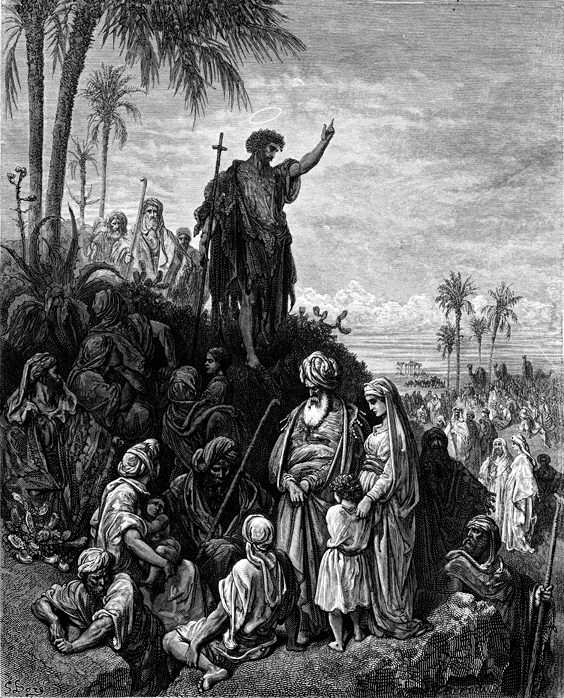
John sets his own water baptism beside a greater baptism to come, with the Holy Ghost and with fire, and confesses himself unworthy even to carry the sandals of the one who brings it, the lowest task a slave performed in that culture. The fan and the purged floor picture a harvest already separated, wheat gathered into the garner and chaff burned with a fire nothing can quench. The bench reads the fire in both halves together, the Spirit's fire that purifies at Pentecost and the fire of final judgment, since John's own hearers stood before both possibilities depending on their fruit.
The record, by era
The Church Fathers5 voices
It remains for those who have been baptized in the Holy Spirit to be consumed with the fire of judgment, for "his winnowing fan is in his hand, and he will thoroughly clean out his threshing floor and will gather his wheat into the barn; but the chaff he will burn up with unquenchable fire." The function of the fan is to separate the fruitful from the unfruitful. That the decision lies in God's hands is indicated by his splendid wheat, the ripened fruit of believers, to be stored in barns. But the chaff indicates the futility of the unprofitable and unfruitful who are fit for the fire of burning judgment.
Leaving to the Apostles the glory of bearing about the Gospel, to whose beautiful feet was due the carrying the tidings of God's peace. He marks the time of our salvation and judgment in the Lord; those who are baptized in the Holy Ghost it remains that they be consummated by the fire of judgment. The wheat, i. e. the full and perfect fruit of the believer, he declares, shall be laid up in heavenly barns; by the chaff he means the emptiness of the unfruitful.
A commentator
Philoxenus of Mabbug13 Ascetic Discourses, Discourse 1 -- Prologue · Written before 523.
proposed
And since the building itself is fixed in the ground every man can build and raise upon it whatsoever he pleaseth, until the day which shall decide is revealed, and He shall come of Whom it is said, "He holdeth His fan in His hand …
There are five points in which Christ comes after John, His birth, preaching, baptism, death, and descent into hell. A beautiful expression is that, mightier than I, because he is mere man, the other is God and man. This His floor, to wit, the Church, the Lord cleanses in this life, both when by the sentence of the Priests the bad are put out of the Church, and when they are cut off by death. The unquenchable fire is the punishment of eternal damnation; either because it never totally destroys or consumes those it has once seized on, but torments them eternally; or to distinguish it from purgatorial fire which is kindled for a time and again extinguished.
"The Lord (beholdeth and) knoweth them that are His; " and "the plant which (my heavenly Father) hath not planted, He rooteth up; " and "the first shall," as He shows, "be last; " and He carries "His fan in His hand to purge His threshing-floor." Let the chaff of a fickle faith fly off as much as it will at every blast of temptation, all the purer will be that heap of corn which shall be laid up in the garner of the Lord.
29 more voices on this verse
The Church Fathers15 voices
Seize the opportunity of unexpected felicity: that you, who sometime were in God's sight nothing but "a drop of a bucket," and "dust of the threshing-floor," and "a potter's vessel," may thenceforward become that "tree which is sown beside the waters, is perennial in leaves, bears fruit at its own time," and shall not see fire," nor "axe.
A hard and arduous thing enough, surely, is the continence for God's sake of a holy woman after her husband's decease, when Gentiles, in honour of their own Satan, endure sacerdotal offices which involve both virginity and widowhood! At Rome, for instance, they who have to do with the type of that "inextinguishable fire," keeping watch over the omens of their own (future) penalty, in company with the (old) dragon himself, are appointed on the ground of virginity.
This is that fan which even now cleanses the Lord's threshing-floor-the Church, I mean-winnowing the mixed heap of believers, and separating the grain of the martyrs from the chaff of the deniers; and this is also the ladder of which Jacob dreams, on which are seen, some mounting up to higher places, and others going down to lower.
Or, John was sent to baptize, that to such as came to his baptism he might announce the presence among them of the Lord in the flesh, as himself testifies in another place, That He might be manifested to Israel, therefore am I come to baptise with water. (John 1:31.) Because then he baptized on account of Christ, therefore to them who came to him for baptism he preached that Christ should come, signifying the eminence of His power in the words, He who cometh after me is mightier than I. Or, by the feet of Christ we may understand Christians, especially the Apostles, and other preachers, among whom was John Baptist; and the shoes are the infirmities with which he loads the preachers. These shoes all Christ's preachers wear; and John also wore them; but declares himself unworthy, that he might show the grace of Christ, and be greater than his deserts. But since no one can give a benefit more worthy than he himself is, nor to make another what himself is not, he adds, He shall baptize you with the Holy Ghost and with fire. John who is carnal cannot give spiritual baptism; he baptizes with water, which is matter; so that he baptizes matter with matter. Christ is Spirit, because He is God; the Holy Ghost is Spirit, the soul is spirit; so that Spirit with Spirit baptizes our spirit. The baptism of the Spirit profits as the Spirit enters and embraces the mind, and surrounds it as it were with an impregnable wall, not suffering fleshly lusts to prevail against it. It does not indeed prevail that the flesh should not lust, but holds the will that it should not consent with it. And as Christ is Judge, He baptizes in fire, i. e. temptation; mere man cannot baptize in fire. He alone is free to tempt, who is strong to reward. […]
In like manner also when John the Baptist was discoursing concerning the Lord, and was eager to show that in the future state He would be Judge of all, he also used the example about wheat and spake thus: Whose fan is in his hand …
A commentator
John ChrysostomHomily on the Gospel of Matthew 11 · Written in the 5th century.
proposed
Then, as having uttered the gentler part of his message, and soothed and relaxed the hearer, he again binds him up, that he may not become remiss. For such was the nature of the Jewish nation; by all encouraging things they were easily puffed up, and corrupted. Wherefore he again adduces his terrors, saying, "Whose fan is in His hand." Thus, as before he had spoken of the punishment, so here he points out the Judge likewise, and introduces the eternal vengeance. For "He will burn the chaff," saith he, "with unquenchable fire." Thou seest that He is Lord of all things, and that He is Himself the Husbandman; albeit in another place He calls His Father the same. For "My Father," saith He, "is the Husbandman." Thus, inasmuch as He had spoken of an axe, lest thou shouldest suppose that the thing needed labor, and the separation was hard to make; by another comparison he suggests the easiness of it, implying that all the world is His; since He could not punish those who were not His own. For the present, it is true, all are mingled together (for though the wheat appears gleaming through, yet it lies with the chaff, as on a threshing floor, not as in a garner), but then, great will be the separation. Where now are they by whom hell-fire is disbelieved? Since surely here are two points laid down, one, that He will baptize with the Holy Ghost, the other, that He will burn up the disobedient. If then that is credible, so is this too, assuredly. Yea, this is why the two predictions are put by him in immediate connection, that by that which hath taken place already, he might accredit the other, as yet unaccomplished. […]
A commentator
John ChrysostomHomily on the Gospel of Matthew 11 · Written in the 5th century.
proposed
For instance, to them that strip themselves of all that they have for His sake He promised to give an hundred fold in the present world, and life eternal in that which is to come; by the things already given making the future also credible. Which, as we see, John likewise hath done in this place; laying down two things, that He shall both baptize with the Holy Ghost, and burn up with unquenchable fire. Now then, if He had not baptized with the Spirit the apostles, and all every day who are willing, thou mightest have doubts concerning those other things too; but if that which seems to be greater and more difficult, and which transcends all reason, hath been done, and is done every day; how deniest thou that to be true, which is easy, and comes to pass according to reason? Thus having said, "He shall baptize with the Holy Ghost and with fire," and having thence promised great blessings; lest thou, released wholly from the former things, grow supine, he hath added the fan, and the judgment thereby declared. Thus, "think not at all," saith he, "that your baptism suffices, if ye become ordinary persons hereafter:" for we need both virtue, and plenty of that known self-restraint. Therefore as by the axe he urges them unto grace, and unto the font, so after grace he terrifies them by the fan, and the unquenchable fire. And of the one sort, those yet unbaptized, he makes no distinction, but saith in general "Every tree that bringeth not forth good fruit is hewn down," punishing all the unbelievers. Whereas after baptism He works of their faith.
A commentator
John ChrysostomHomily on the Gospel of Matthew 11 · Written in the 5th century.
proposed
Let no man then become chaff, let no one be tossed to and fro, nor lie exposed to wicked desires, blown about by them easily every way. For if thou continue wheat, though temptation be brought on thee, thou wilt suffer nothing dreadful; nay, for in the threshing floor, the wheels of the car, that are like saws, do not cut in pieces the wheat; but if thou fall away into the weakness of chaff, thou wilt both here suffer incurable ills, being smitten of all men, and there thou wilt undergo the eternal punishment. For all such persons both before that furnace become food for the irrational passions here, as chaff is for the brute animal: and there again they are material and food for the flame. Now to have said directly that He will judge men's doings, would not so effectually procure acceptance for His doctrine: but to blend with it the parable, and so establish it all, was apter to persuade the hearer, and part so discourses with them; threshing floor, and harvest, and vineyard, and wine-press, and field, and net, and fishing, and all things familiar, and among which they were busied He makes ingredients in His discourses. This kind of thing then the Baptist likewise did here, and offered an exceeding great demonstration of his words, the giving of the Spirit. For "He who hath so great power, as both to forgive sins, and to give the Spirit, much more will these things also be within His power:" so he speaks.
A commentator
John ChrysostomHomily on the Gospel of Matthew 11 · Written in the 5th century.
proposed
Therefore, knowing these things, let us use great diligence, while we are in the threshing floor; for it is possible while we are here, to change even out of chaff into wheat, even as on the other hand many from wheat have become chaff. Let us not then be supine, nor be carried about with every wind; neither let us separate ourselves from our brethren, though they seem to be small and mean; forasmuch as the wheat also compared with the chaff is less in measure, but better in nature. Look not therefore to the forms of outward pomp, for they are prepared for the fire, but to this godly humility, so firm and indissoluble, and which cannot be cut, neither is burnt by the fire. It being for their sake that He bears long with the very chaff, that by their intercourse with them they may become better. Therefore judgment is not yet, that we may be all crowned together, that from wickedness many may be converted unto virtue. Let us tremble then at hearing this parable. For indeed that fire is unquenchable. "And how," it may be said, "is it unquenchable?" Seest thou not this sun ever burning, and never quenched? didst thou not behold the bush burning, and not consumed? If then thou also desirest to escape the flame, lay up alms beforehand, and so thou wilt not even taste of that fire. For if, while here, thou wilt believe what is told thee, thou shalt not so much as see this furnace, after thy departure into that region; but if thou disbelieve it now, thou shalt know it there full well by experience, when no sort of escape is possible. Since in truth no entreaty shall avert the punishment from them who have not shown forth an upright life. For believing surely is not enough, since even the devils tremble at God, but for all that they will be punished.
A commentator
John ChrysostomHomily on the Gospel of Matthew 46 · Written in the 5th century.
proposed
What then, if the tares should remain until the end? "Then I will say to the reapers, Gather ye together first the tares, and bind them in bundles to burn them." He again reminds them of John's words, introducing Him as judge; and He saith, So long as they stand by the wheat, we must spare them, for it is possible for them even to become wheat; but when they have departed, having profited nothing, then of necessity the inexorable punishment will overtake them.
A commentator
John ChrysostomHomily on the Gospel of Matthew 11 · Written in the 5th century.
proposed
For (let me add) on account of this,-lest they should say, "Thou art alarming and pressing, and constraining us, applying an axe, and threatening us with being cut down, yet requiring produce in time of punishment,"-he hath added, to signify the ease of bearing that fruit, "I indeed baptize you with water, but He that cometh after me is mightier than I, the latchet of whose shoe I am not worthy to unloose; He shall baptize you with the Holy Ghost and with fire:" implying hereby that consideration only is needed and faith, not labors and toils; and as it is easy to be baptized, so is it easy to be converted, and to become better men. So having stirred their mind by the fear of God's judgment, and the expectation of His punishment, and by the mention of the axe, and by the loss of their ancestors, and by the bringing in of those other children, and by the double vengeance of cutting off and burning, and having by all means softened their hardness, and brought them to desire deliverance from so great evils; then he brings in what he hath to say touching Christ; and not simply, but with a declaration of His great superiority. Then in setting forth the difference between himself and Him, lest he should seem to say this out of favor, he establishes the fact by comparison of the gifts bestowed by each of them. For he did not at once say, "I am not worthy to unloose the lachet of His shoe;" but when he had first set forth the little value of his own baptism, and had shown that it hath nothing more than to lead them to repentance (for he did not say with water of remission, but of repentance), he sets forth Christ's also, which is full of the unspeakable gift. […]
A commentator
John ChrysostomHomily on the Gospel of Matthew 11 · Written in the 5th century.
proposed
Seest thou how great is the wisdom of the Baptist? how, when He Himself is preaching, He saith everything to alarm, and fill them with anxiety; but when He is sending men to Him, whatever was mild and apt to recover them: not bringing forward the axe, nor the tree that is cut down and burnt, and cast into the fire, nor the wrath to come, but remission of sins, and removing of punishment, and righteousness, and sanctification, and redemption, and adoption, and brotherhood, and a partaking of the inheritance, and an abundant supply of the Holy Ghost. For all these things he obscurely denoted, when he said, "He shall baptize you with the Holy Ghost;" at once, by the very figure of speech, declaring the abundance of the grace (for he said not, "He will give you the Holy Ghost," but "He will baptize you with the Holy Ghost"); and by the specification of fire on the other hand indicating the vehement and uncontrollable quality of His grace. Imagine only what sort of men it was meet for the hearers to become, when they considered that they were at once to be like the prophets, and like those great ones. For it was on this account, you see, that he made mention at all of fire; that he might lead them to reflect on the memory of those men. Because, of all the visions that appeared unto them, I had almost said, the more part appeared in fire; thus God discoursed with Moses in the bush, thus with all the people in the mount Sinai, thus with Ezekiel on the cherubim.
A commentator
John ChrysostomHomily on the Gospel of Matthew 11 · Written in the 5th century.
proposed
And mark again how he rouses the hearer, by putting that first which was to take place after all. For the Lamb was to be slain, and sin to be blotted out, and the enmity to be destroyed, and the burial to take place, and the resurrection, and then the Spirit to come. But none of these things doth he mention as yet, but that first which was last, and for the sake of which all the former were done, and which was fittest to proclaim His dignity; so that when the hearer should be told that he was to receive so great a Spirit he might search with himself, how and in what manner this shall be, while sin so prevails; that finding him full of thought and prepared for that lesson, he might thereupon introduce what he had to say touching the Passion, no man being any more offended, under the expectation of such a gift.
(Verse 12.) He will baptize you with the Holy Spirit and fire. His winnowing fork is in His hand, and He will thoroughly clean out His threshing floor, and gather His wheat into the barn; but He will burn up the chaff with unquenchable fire.
proclaims him to be the Judge of all, saying: Whose fan is in his hand, and he will thoroughly cleanse his threshing-floor, and will gather the wheat into his garner; but the chaff he will burn with unquenchable fire.
The Medieval Church5 voices
Therefore every tree that bringeth not forth good fruit shall be cut down, and cast into the fire, because he who here neglects to bring forth the fruit of good works finds a fire in hell prepared for him. (Hom. in Ev. vii. 3.) John baptizes not with the Spirit but with water, because he had no power to forgive sins; he washes the body with water, but not at the same time the soul with pardon of sin. (ubi sup.) Why then does he baptize who could not remit sin, but that he may preserve in all things the office of forerunner? As his birth had preceded Christ's birth, so his baptism should precede the Lord's baptism. (Mor. xxxiv. 5.) After the threshing is finished in this life, in which the grain now groans under the burden of the chaff, the fan of the last judgment shall so separate between them, that neither shall any chaff pass into the granary, nor shall the grain fall into the fire which consumes the chaff.
Or, by this sign of baptism he separates the penitent from the impenitent, and directs them to the baptism of Christ. As though he had said, I indeed am mighty to invite to repentance, He to forgive sins; I to preach the kingdom of heaven, He to bestow it; I to baptize with water, He with the Spirit. By the fan is signified the separation of a just trial; that it is in the Lord's hand, means, 'in His power,' as it is written, The Father hath committed all judgment to the Son. The cleansing of the floor will then be finally accomplished, when the Son of Man shall send His Angels, and shall gather all offences out of His kingdom. There is this difference between the chaff and the tares, that the chaff is produced of the same seed as the wheat, but the tares from one of another kind. The chaff therefore are those who enjoy the sacraments of the faith, but are not solid; the tares are those who in profession as well as in works are separated from the lot of the good.
Then he mentions the judiciary power: "His winnowing fork is in his hand." First, the judiciary power is mentioned; secondly, the effect of the judgment; thirdly, the manner of the judgment. He says, therefore, "His winnowing fork," and he employs a comparison. The Church is …
(non occ.) As in the preceding words John had explained more at length what he had shortly preached in the words, Repent ye, so now follows a more full enlargement of the words, The kingdom of heaven is at hand.
His winnowing fan is in His hand. Do not think, if you are baptized by Him and then remain an unrepentant sinner, that He will forgive you. For He also has a winnowing fan, that is, judgement and examination. He will clean His threshing floor, …
The Puritans and the Awakening4 voices
Whose fan - That is, the word of the Gospel. His floor - That is, his Church, which is now covered with a mixture of wheat and chaff. He will gather the wheat into the garner - Will lay up those who are truly good in heaven.
Whose fan is in his hand,....
His ability to distinguish, as the eternal wisdom of the Father, who sees all by a true light, and his authority to distinguish, as the Person to whom all judgment is committed, is the fan that is in his hand, Jer. xv. Now he sits as a Refiner. Observe here [1.] The visible church is Christ's floor;
The more glorious shining forth of the Sun of righteousness, immediately after: where we have, 1.
The Nineteenth Century5 voices
Whose fan is in his hand - The Romans are here termed God’s fan, as, in Mat 3:10, they were called his axe, and, in Mat 22:7, they are termed his troops or armies. The winnowing fan of the Hindoos is square, made of split bamboo; and the corn is winnowed by waving the fan backwards with both hands - “Whose fan is in his hand.” His floor - Does not this mean the land of Judea, which had been long, as it were, the threshing-floor of the Lord?
These verses describe the ministry of John the Baptist, the forerunner of our Lord Jesus Christ: it is a ministry that deserves close attention. Few preachers ever produced such effects as John the Baptist: “There went out to him Jerusalem and all Judea and all the region round about Jordan.”None ever received such praise from the great head of the church: Jesus called him “a burning and a shining light” ( John 5:35 ); the great Bishop of souls Himself declared, that “among them that are born of women there hath not risen a greater than John the Baptist.”
A commentator
Jamieson, Fausset & Brown1802–1910
Commentary Critical and Explanatory on the Whole Bible (1871)
proposed
Whose fan--winnowing fan. is in his hand--ready for use. This is no other than the preaching of the Gospel, even now beginning, the effect of which would be to separate the solid from the spiritually worthless, as wheat, by the winnowing fan, from the chaff.
These verses describe the ministry of John the Baptist, the forerunner of our Lord Jesus Christ: it is a ministry that deserves close attention. Few preachers ever produced such effects as John the Baptist: “There went out to him Jerusalem and all Judea and all the region round about Jordan.”None ever received such praise from the great head of the church: Jesus called him “a burning and a shining light” ( John 5:35 ); the great Bishop of souls Himself declared, that “among them that are born of women there hath not risen a greater than John the Baptist.” Let us then study the leading features of his ministry. John the Baptist spoke plainly about sin . He taught the absolute necessity of repentance before anyone can be saved; he preached that repentance must be proved by its “fruits”he warned men not to rest on outward privileges, or outward union with the church. This is just the teaching that we all need. We are naturally dead, and blind, and asleep in spiritual things; we are ready to content ourselves with a mere formal religion and to flatter ourselves that if we go to church we shall be saved: we need to be told that, except we “repent and are converted” we shall all perish. John the Baptist spoke plainly about our Lord Jesus Christ . He taught people that one “mightier than himself” was coming among them. He was nothing more than a servant: the coming one was the King. He himself could only baptize with water: the coming one could “baptize with the Holy Ghost,” take away sins, and would one day judge the world. This again is the very teaching that human nature requires. We need to be sent direct to Christ: we are all ready to stop short of this; we want to rest in our union with the church, our regular use of the sacraments, and our diligent attendance on an established ministry. We need to be told the absolute necessity of union with Christ himself by faith.
A commentator
Albert Barnes1798–1870
Notes, Explanatory and Practical, on the Old and New Testaments (1832-1869)
proposed
His fan - The word used here and rendered “fan” means a winnowing shovel instead. It was used for throwing the grain, after it was threshed, into the air, so that the chaff might be driven away by the wind. This mode of separating the grain from the chaff is still practiced in the East. It is not probable that the fan, as the term is now used, was known to the Orientals as an instrument for cleaning grain. See the notes at Isa 30:24. His floor - The threshing-floor was an open space, or area, in the field, usually on an elevated part of the land, Gen 50:10. It had no covering or walls. It was a space of ground 30 or 40 paces in diameter, and made smooth by rolling it or treading it hard. A high place was selected for the purpose of keeping it dry, and for the convenience of winnowing the grain by the wind. The grain was usually trodden out by oxen. Sometimes it was beaten with flails, as with us; and sometimes with a sharp threshing instrument, made to roll over the grain and to cut the straw at the same time. See the notes at Isa 41:15. Shall purge - Shall cleanse or purify. Shall remove the chaff, etc. The garner - The granary, or place to deposit the wheat. Unquenchable fire - Fire that shall not be extinguished, that will utterly consume it. By the floor, here, is represented the Jewish people. By the wheat, the righteous, or the people of God. By the chaff, the wicked. They are often represented as being driven away like chaff before the wind, Job 21:18; Psa 1:4; Isa 17:13; Hos 13:13. They are also represented as chaff which the fire consumes, Isa 5:24. This image is often used to express judgments, Isa 41:15; “Thou shall thresh the mountains and beat them small, and shalt make the hills as chaff.” By the unquenchable fire is meant the eternal suffering of the wicked in hell, 2Th 1:8-9; Mar 9:48; Mat 25:41.
The words behind it
26 Greek wordsEvery Greek word of this verse in the order it stands, with what it means and the door to its own study. The last column counts the times a word stands in the whole Bible: the rarer the word, the more the places it appears belong together.
| Greek | Sound | Meaning | Word study | In the Bible |
|---|---|---|---|---|
| οὗ | hou | whose | G3739 → | 1405 times |
| τὸ | to | <the> | G3588 → | 19766 times |
| πτύον | ptuon | winnowing fork [is] | G4425 → | |
| ἐν | en | in | G1722 → | 2738 times |
| τῇ | tea | the | G3588 → | 19766 times |
| χειρὶ | cheiri | hand | G5495 → | 175 times |
| αὐτοῦ, | autou | of Him, | G846 → | 5565 times |
| καὶ | kai | and | G2532 → | 9120 times |
| διακαθαριεῖ | diakathariei | He will clear | G1245 → | |
| τὴν | ten | the | G3588 → | 19766 times |
| ἅλωνα | halona | threshing floor | G257 → | |
| αὐτοῦ | autou | of Him | G846 → | 5565 times |
| καὶ | kai | and | G2532 → | 9120 times |
| συνάξει | sunaxei | will gather | G4863 → | 59 times |
| τὸν | ton | the | G3588 → | 19766 times |
| σῖτον | siton | wheat | G4621 → | 14 times |
| αὐτοῦ | autou | of Him | G846 → | 5565 times |
| εἰς | eis | into | G1519 → | 1755 times |
| τὴν | ten | the | G3588 → | 19766 times |
| ἀποθήκην | apotheken | barn | G596 → | 6 times |
| τὸ | to | the | G3588 → | 19766 times |
| δὲ | de | but | G1161 → | 2765 times |
| ἄχυρον | achuron | chaff | G892 → | |
| κατακαύσει | katakausei | He will burn up | G2618 → | 12 times |
| πυρὶ | puri | with fire | G4442 → | 70 times |
| ἀσβέστῳ.¶ | asbesto | unquenchable. | G762 → |
οὗwhose
houG3739 →1405 times
τὸ<the>
toG3588 →19766 times
πτύονwinnowing fork [is]
ptuonG4425 →
ἐνin
enG1722 →2738 times
τῇthe
teaG3588 →19766 times
χειρὶhand
cheiriG5495 →175 times
αὐτοῦ,of Him,
autouG846 →5565 times
καὶand
kaiG2532 →9120 times
διακαθαριεῖHe will clear
diakatharieiG1245 →
τὴνthe
tenG3588 →19766 times
ἅλωναthreshing floor
halonaG257 →
αὐτοῦof Him
autouG846 →5565 times
καὶand
kaiG2532 →9120 times
συνάξειwill gather
sunaxeiG4863 →59 times
τὸνthe
tonG3588 →19766 times
σῖτονwheat
sitonG4621 →14 times
αὐτοῦof Him
autouG846 →5565 times
εἰςinto
eisG1519 →1755 times
τὴνthe
tenG3588 →19766 times
ἀποθήκηνbarn
apothekenG596 →6 times
τὸthe
toG3588 →19766 times
δὲbut
deG1161 →2765 times
ἄχυρονchaff
achuronG892 →
κατακαύσειHe will burn up
katakauseiG2618 →12 times
πυρὶwith fire
puriG4442 →70 times
ἀσβέστῳ.¶unquenchable.
asbestoG762 →
A shaded row is a word that stands 400 times or fewer in the Bible.
The walk
8 stopsEach card is a verse this one points to, and under it the verses that one points to in turn. Where several paths arrive at the same place, that place is listed first: the text keeps returning to it.
Through
Luke 3:17His winnowing fork is in His hand to clear His threshing floor and to gather the wheat into His barn; but He will burn up the chaff with unquenchable fire.”
it leads to
- Jeremiah 15:7
I will scatter them with a winnowing fork at the gates of the land. I will bereave and destroy My people who have not turned from their ways.
Reached by 3 separate paths from here.
- Jeremiah 15:7
Through
Malachi 4:1“For behold, the day is coming, burning like a furnace, when all the arrogant and every evildoer will be stubble; the day is coming when I will set them ablaze,” says the LORD of…
it leads to
- 2 Thessalonians 1:8
in blazing fire, inflicting vengeance on those who do not know God and do not obey the gospel of our Lord Jesus.
- 2 Peter 3:7
And by that same word, the present heavens and earth are reserved for fire, being kept for the day of judgment and destruction of ungodly men.
- Malachi 3:2
But who can endure the day of His coming? And who can stand when He appears? For He will be like a refiner’s fire, like a launderer’s soap.
- 2 Thessalonians 1:8
Through
Matthew 13:30Let both grow together until the harvest. At that time I will tell the harvesters: First collect the weeds and tie them in bundles to be burned; then gather the wheat into my barn.’”
it leads to
- 1 Timothy 5:24
The sins of some men are obvious, going ahead of them to judgment; but the sins of others do not surface until later.
- 1 Corinthians 4:5
Therefore judge nothing before the appointed time; wait until the Lord comes. He will bring to light what is hidden in darkness and will expose the motives of men’s hearts. At that time each…
- John 15:6
If anyone does not remain in Me, he is like a branch that is thrown away and withers. Such branches are gathered up, thrown into the fire, and burned.
- Malachi 3:18
So you will again distinguish between the righteous and the wicked, between those who serve God and those who do not.”
- 1 Timothy 5:24
Where this verse is studied
About Matthew
This page draws on 29 works. Open the list of works
This page draws on Adam Clarke, Commentary on the Bible; Albert Barnes, Notes, Explanatory and Practical, on the Gospels; Albert Barnes, Notes, Explanatory and Practical, on the Old and New Testaments (1832-1869); Cosmas Indicopleustes, The Christian Topography, Book 7; Cosmas Indicopleustes, The Christian Topography, Book 5; Glossa Ordinaria, Catena Aurea by Aquinas; Gregory the Dialogist, Catena Aurea by Aquinas; Hilary of Poitiers, Commentary on Matthew 2.4; Hilary of Poitiers, Catena Aurea by Aquinas; J.C. Ryle, Expository Thoughts on the Gospels: Matthew; Jamieson, Fausset & Brown, Commentary Critical and Explanatory on the Whole Bible; Jerome, Catena Aurea by Aquinas; Jerome, Commentary on Matthew; John Chrysostom, Homily on the Gospel of Matthew 11; John Chrysostom, Homily on the Gospel of Matthew 46; John Gill, Exposition of the New Testament; John Gill, Exposition of the New Testament (1746-1748); John Wesley, Explanatory Notes upon the New Testament; Matthew Henry, Commentary on the Whole Bible; Philoxenus of Mabbug, 13 Ascetic Discourses, Discourse 1 -- Prologue; Pseudo-Chrysostom, Catena Aurea by Aquinas; Rabanus Maurus, Catena Aurea by Aquinas; Remigius of Rheims, Catena Aurea by Aquinas; Tertullian, The Prescription Against Heretics; Tertullian, On Repentance; Tertullian, To His Wife Book I; Tertullian, On Flight in Persecution; Theophylact of Ohrid, Commentary on Matthew and Thomas Aquinas, Commentary on Matthew.