
Matthew 3:8
in Matthew 3Produce fruit, then, in keeping with repentance.
BSB
The same verse in ASV and KJV ▾
ASV
Bring forth therefore fruit worthy of repentance:
KJV
Bring forth therefore fruits meet for repentance:
⋯
This verse in Matthew 3
Commentary
18 notes on this verseOne might say that the fruits of repentance are, by way of anticipation, faith in Christ. They are also the evangelical society that exists "in newness of life," changed from the present dullness of the letter.
This site's exposition
O generation of vipers
on Matthew 3:7-10
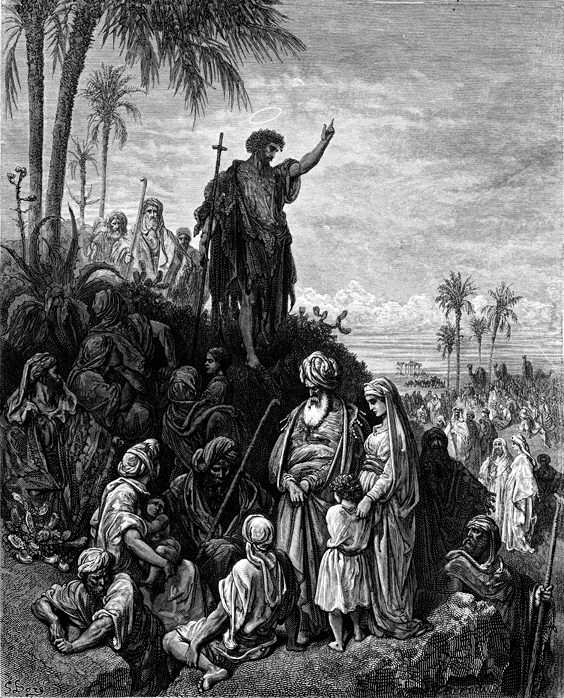
Generation of vipers is John's own name for two parties usually opposed to each other, Pharisees and Sadducees, united here only by a common presumption on descent, we have Abraham to our father. John answers that God is able of these stones to raise up children unto Abraham, a claim the bench reads as already opening the door Jesus will walk through with Gentile faith later in the book, since sonship runs on fruit rather than blood. The axe already laid unto the root and the fire already ready name a judgment poised rather than merely threatened, and bring forth fruits meet for repentance demands a changed life, not water alone.
The record, by era
The Church Fathers3 voices
He advises them to "bring forth fruit that matches repentance" and not to boast that they have Abraham as their father, for God is able to raise up children to Abraham out of stones. Indeed, succession to Abraham in the flesh is not required, but the inheritance of Abraham's faith. In this context, dignity of origin consists in examples of works. The glory of one's race lies in the imitation of faith. The devil was faithless, but Abraham was faithful. The devil was treacherous in his treatment of humanity, whereas Abraham was justified by faith. Therefore the very life and character of each person is acquired by a close relationship, so that those who are faithful to Abraham are his posterity in faith. But those who are unfaithful are changed into the devil's offspring by their unfaithfulness.
A commentator
John ChrysostomHomily on the Gospel of Matthew 10 · Written in the 5th century.
proposed
But by repentance I mean, not only to forsake our former evil deeds, but also to show forth good deeds greater than those. For, "bring forth," saith he, "fruits meet for repentance." But how shall we bring them forth? If we do the opposite things: as for instance, hast thou seized by violence the goods of others? henceforth give away even thine own. Hast thou been guilty of fornication for a long time? abstain even from thy wife for certain appointed days; exercise continence. Hast thou insulted and stricken such as were passing by? Henceforth bless them that insult thee, and do good to them that smite thee. For it sufficeth not for our health to have plucked out the dart only, but we must also apply remedies to the wound. Hast thou lived in self-indulgence, and been drunken in time past? Fast, and take care to drink water, in order to destroy the mischief that hath so grown up within thee. Hast thou beheld with unchaste eyes beauty that belonged to another? Henceforth do not so much as look upon a woman at all, that thou mayest stand in more safety. For it is said, "Depart from evil, and do good;" and again, "Make thy tongue to cease from evil, and thy lips that they speak no guile." "But tell me the good too." "Seek peace, and pursue it:" I mean not peace with man only, but also peace with God. And he hath well said, "pursue" her: for she is driven away, and cast out; she hath left the earth, and is gone to sojourn in Heaven. Yet shall we be able to bring her back again, if we will put away pride and boasting, and whatsoever things stand in her way, and will follow this temperate and frugal life.
A commentator
John ChrysostomHomily on the Gospel of Matthew 11 · Written in the 5th century.
proposed
However, he stops not at the rebuke, but introduces advice also. For, "Bring forth," says he, "fruits meet for repentance." For to flee from wickedness is not enough, but you must show forth also great virtue. For let me not have that contradictory yet ordinary case, that refraining yourselves for a little while, ye return unto the same wickedness. For we are not come for the same objects as the prophets before. Nay, the things that are now are changed, and are more exalted, forasmuch as the Judge henceforth is coming, His very self, the very Lord of the kingdom, leading unto greater self-restraint, calling us to heaven, and drawing us upward to those abodes. For this cause do I unfold the doctrine also touching hell, because both the good things and the painful are for ever. Do not therefore abide as ye are, neither bring forward the accustomed pleas, Abraham, Isaac, Jacob, the noble race of your ancestors.
The Medieval Church2 voices
But because we have already sinned, because we are entangled by the habit of evil custom, let him say what we must do in order to be able to flee from the wrath to come. There follows: "Therefore bring forth fruits worthy of repentance." In these words it should be noted that the friend of the bridegroom admonishes that not only fruits of repentance should be brought forth, but fruits worthy of repentance. For it is one thing to bring forth a fruit of repentance, another to bring forth a fruit worthy of repentance. For to speak according to fruits worthy of repentance, it must be known that whoever has committed no unlawful things, to him it is rightly granted to use lawful things; and so let him do works of piety, yet if he does not wish, he need not abandon the things that are of the world. But if anyone has fallen into the sin of fornication, or perhaps, what is more serious, into adultery, he ought to cut off from himself lawful things to the same degree that he remembers having perpetrated unlawful things. For the fruit of good work ought not to be equal for him who has sinned less and him who has sinned more, or for him who has fallen into no crimes and him who has fallen into some crimes, and him who has fallen into many. Therefore by what is said, "Bring forth fruits worthy of repentance," the conscience of each person is addressed, so that one may seek greater gains of good works through repentance to the same degree that one has brought upon oneself greater losses through sin.
(Hom. in Ev. xx. 8.) Observe, he says not merely fruits of repentance, but fruits meet for repentance. For he who has never fallen into things unlawful, is of right allowed the use of all things lawful; but if any hath fallen into sin, he ought so far to put away from him even things lawful, as far as he is conscious of having used unlawful things. It is left then to such man's conscience to seek so much the greater gains of good works by repentance, the greater loss he has brought on himself by sin.
11 more voices on this verse
The Medieval Church4 voices
Because as a preacher of truth he wished to stir them up, to bring forth fruit meet for repentance, he invites them to humility, without which no one can repent.
After mentioning these two things leading to repentance, the evangelist concludes: "Bear fruit that befits repentance." Fruit comes after the flowers in a tree, and if the fruit does not follow the flowers, that tree is nothing. For the flower of repentance appears in contrition, …
If then ye would escape this wrath, Bring forth fruits meet for repentance.
Bring forth therefore fruits worthy of repentance. Do you see what he is saying? One must not only flee from wickedness, but also bring forth fruits of virtue. For it is written, "Turn away from evil and do good" (Ps. 33:14).
The Puritans and the Awakening3 voices
Bring forth therefore fruits,.... That is, if you are truly penitent, if you have a proper sense of sin, and true repentance for it, do such works as are suitable to it, and will show the genuineness of it; for fruits meet for repentance are the same as "works meet for repentance", Act 26:20 and as a tree is known by its fruit, so repentance is known by good works; these are the fruits and effects of repentance, and which are proofs with men of the sincerity of it.
Repentance is of two sorts; that which is termed legal, and that which is styled evangelical repentance. The former (which is the same that is spoken of here) is a thorough conviction of sin. The latter is a change of heart (and consequently of life) from all sin to all holiness.
Note, Those are not worthy the name of penitents, or their privileges, who say they are sorry for their sins, and yet persist in them. They that profess repentance, as all that are baptized do, must be and act as becomes penitents, and never do any thing unbecoming a penitent sinner.
The Nineteenth Century4 voices
A commentator
Albert Barnes1798–1870
Notes, Explanatory and Practical, on the Old and New Testaments (1832-1869)
Bring forth therefore fruits ... - That is, the proper fruits of reformation; the proper evidence that you are sincere. Do not bring your cunning and dissimulation to this work; do not carry your hypocrisy into your professed repentance, but evince your sincerity by forsaking sin, and thus give evidence that this coming to Jordan to be baptized is not an act of dissimulation. No discourse could have been more appropriate or more cutting. Fruits - Conduct. See Mat 7:16-19. Meet for repentance - Fit for repentance; appropriate to it the proper expression of repentance.
These verses describe the ministry of John the Baptist, the forerunner of our Lord Jesus Christ: it is a ministry that deserves close attention. Few preachers ever produced such effects as John the Baptist: “There went out to him Jerusalem and all Judea and all the region round about Jordan.”None ever received such praise from the great head of the church: Jesus called him “a burning and a shining light” ( John 5:35 ); the great Bishop of souls Himself declared, that “among them that are born of women there hath not risen a greater than John the Baptist.”
A commentator
Jamieson, Fausset & Brown1802–1910
Commentary Critical and Explanatory on the Whole Bible (1871)
proposed
John now being gifted with a knowledge of the human heart, like a true minister of righteousness and lover of souls here directs them how to evidence and carry out their repentance, supposing it genuine; and in the following verses warns them of their danger in case it were not.
These verses describe the ministry of John the Baptist, the forerunner of our Lord Jesus Christ: it is a ministry that deserves close attention. Few preachers ever produced such effects as John the Baptist: “There went out to him Jerusalem and all Judea and all the region round about Jordan.”None ever received such praise from the great head of the church: Jesus called him “a burning and a shining light” ( John 5:35 ); the great Bishop of souls Himself declared, that “among them that are born of women there hath not risen a greater than John the Baptist.” Let us then study the leading features of his ministry. John the Baptist spoke plainly about sin . He taught the absolute necessity of repentance before anyone can be saved; he preached that repentance must be proved by its “fruits”he warned men not to rest on outward privileges, or outward union with the church. This is just the teaching that we all need. We are naturally dead, and blind, and asleep in spiritual things; we are ready to content ourselves with a mere formal religion and to flatter ourselves that if we go to church we shall be saved: we need to be told that, except we “repent and are converted” we shall all perish. John the Baptist spoke plainly about our Lord Jesus Christ . He taught people that one “mightier than himself” was coming among them. He was nothing more than a servant: the coming one was the King. He himself could only baptize with water: the coming one could “baptize with the Holy Ghost,” take away sins, and would one day judge the world. This again is the very teaching that human nature requires. We need to be sent direct to Christ: we are all ready to stop short of this; we want to rest in our union with the church, our regular use of the sacraments, and our diligent attendance on an established ministry. We need to be told the absolute necessity of union with Christ himself by faith.
How the passage was read
On Matthew 3:7-10On Matthew 3:7-10
Who the Pharisees and Sadducees were
Their first appearance in the New Testament is the place to say plainly who they were. The Pharisees were a lay renewal movement, about six thousand strong in the historian Josephus's count (Antiquities of the Jews, book 17, written about AD 93), whose program was to extend the Temple's holiness into ordinary life: the ordinary table kept as carefully as a priest's, the whole Torah kept in detail by the whole people. They held that alongside the written Torah an oral Torah had come down from Sinai teacher to teacher; the Mishnah's ethics tractate opens with that chain: “Moses received the Torah at Sinai and transmitted it to Joshua, Joshua to the elders...” (Pirkei Avot 1:1). The Sadducees were the priestly aristocracy centered on the Temple: they accepted the written Torah but rejected the oral tradition and denied the resurrection of the dead (Acts 23:8 says so directly). After the Temple fell in AD 70 the Sadducees vanished; the rabbinic Judaism that survives to this day descends from the Pharisaic side.
Two cautions keep the reader honest for every scene that follows. “Pharisee” is not a synonym for hypocrite: the movement's aim was devotion, its ranks included honest seekers (Nicodemus, Gamaliel, and Paul, who says “I am a Pharisee” in the present tense, Acts 23:6), and on the resurrection its doctrine stands with Christian confession against the Sadducees. And the Gospel collisions are arguments WITHIN first-century Judaism about how the Torah is rightly kept, not a contest between Jesus and Judaism.
This section is reception history: how the passage was read and kept in the Jewish tradition. Where a reading parts from an essential of the Christian faith, the section says so at that point.
Sources: Pirkei Avot 1:1 (the chain of tradition) · Mishnah Sanhedrin 10:1 (the resurrection affirmed as core doctrine)
The words behind it
6 Greek wordsEvery Greek word of this verse in the order it stands, with what it means and the door to its own study. The last column counts the times a word stands in the whole Bible: the rarer the word, the more the places it appears belong together.
| Greek | Sound | Meaning | Word study | In the Bible |
|---|---|---|---|---|
| ποιήσατε | poiesate | do produce | G4160 → | 569 times |
| οὖν | oun | therefore | G3767 → | 497 times |
| καρπὸν | karpon | fruit | G2590 → | 66 times |
| ἄξιον | axion | worthy | G514 → | 41 times |
| τῆς | tes | <the> | G3588 → | 19766 times |
| μετανοίας. | metanoias | of repentance. | G3341 → |
ποιήσατεdo produce
poiesateG4160 →569 times
οὖνtherefore
ounG3767 →497 times
καρπὸνfruit
karponG2590 →66 times
ἄξιονworthy
axionG514 →41 times
τῆς<the>
tesG3588 →19766 times
μετανοίας.of repentance.
metanoiasG3341 →
A shaded row is a word that stands 400 times or fewer in the Bible.
The walk
8 stopsEach card is a verse this one points to, and under it the verses that one points to in turn. Where several paths arrive at the same place, that place is listed first: the text keeps returning to it.
Through
Philippians 1:11filled with the fruit of righteousness that comes through Jesus Christ, to the glory and praise of God.
it leads to
- Hebrews 12:11
No discipline seems enjoyable at the time, but painful. Later on, however, it yields a harvest of righteousness and peace to those who have been trained by it.
- John 15:8
This is to My Father’s glory, that you bear much fruit, proving yourselves to be My disciples.
- Colossians 1:10
so that you may walk in a manner worthy of the Lord and may please Him in every way: bearing fruit in every good work, growing in the knowledge of God,
- John 15:4–5
Remain in Me, and I will remain in you. Just as no branch can bear fruit by itself unless it remains in the vine, neither can you bear fruit unless you remain in Me.
- Galatians 5:22–23
But the fruit of the Spirit is love, joy, peace, patience, kindness, goodness, faithfulness,
- Hebrews 12:11
Through
Luke 3:8Produce fruit, then, in keeping with repentance. And do not begin to say to yourselves, ‘We have Abraham as our father.’ For I tell you that out of these stones God can raise up…
it leads to
- Ezekiel 18:27–31
But if a wicked man turns from the wickedness he has committed and does what is just and right, he will save his life.
- Acts 26:20
First to those in Damascus and Jerusalem, then to everyone in the region of Judea, and then to the Gentiles, I declared that they should repent and turn to God, performing deeds worthy of…
- Ezekiel 18:27–31
Through
Acts 26:20First to those in Damascus and Jerusalem, then to everyone in the region of Judea, and then to the Gentiles, I declared that they should repent and turn to God, performing deeds worthy of…
it leads to
- Acts 3:19
Repent, then, and turn back, so that your sins may be wiped away,
- Acts 3:19
Where this verse is studied
About Matthew
This page draws on 16 works. Open the list of works
This page draws on Albert Barnes, Notes, Explanatory and Practical, on the Old and New Testaments (1832-1869); Cyril of Alexandria, FRAGMENT 20.15; Glossa Ordinaria, Catena Aurea by Aquinas; Gregory the Dialogist, Forty Gospel Homilies, Homily 20; Gregory the Dialogist, Catena Aurea by Aquinas; Hilary of Poitiers, Commentary on Matthew 2.3; J.C. Ryle, Expository Thoughts on the Gospels: Matthew; Jamieson, Fausset & Brown, Commentary Critical and Explanatory on the Whole Bible; John Chrysostom, Homily on the Gospel of Matthew 10; John Chrysostom, Homily on the Gospel of Matthew 11; John Gill, Exposition of the New Testament (1746-1748); John Wesley, Explanatory Notes upon the New Testament; Matthew Henry, Commentary on the Whole Bible; Rabanus Maurus, Catena Aurea by Aquinas; Theophylact of Ohrid, Commentary on Matthew and Thomas Aquinas, Commentary on Matthew.