
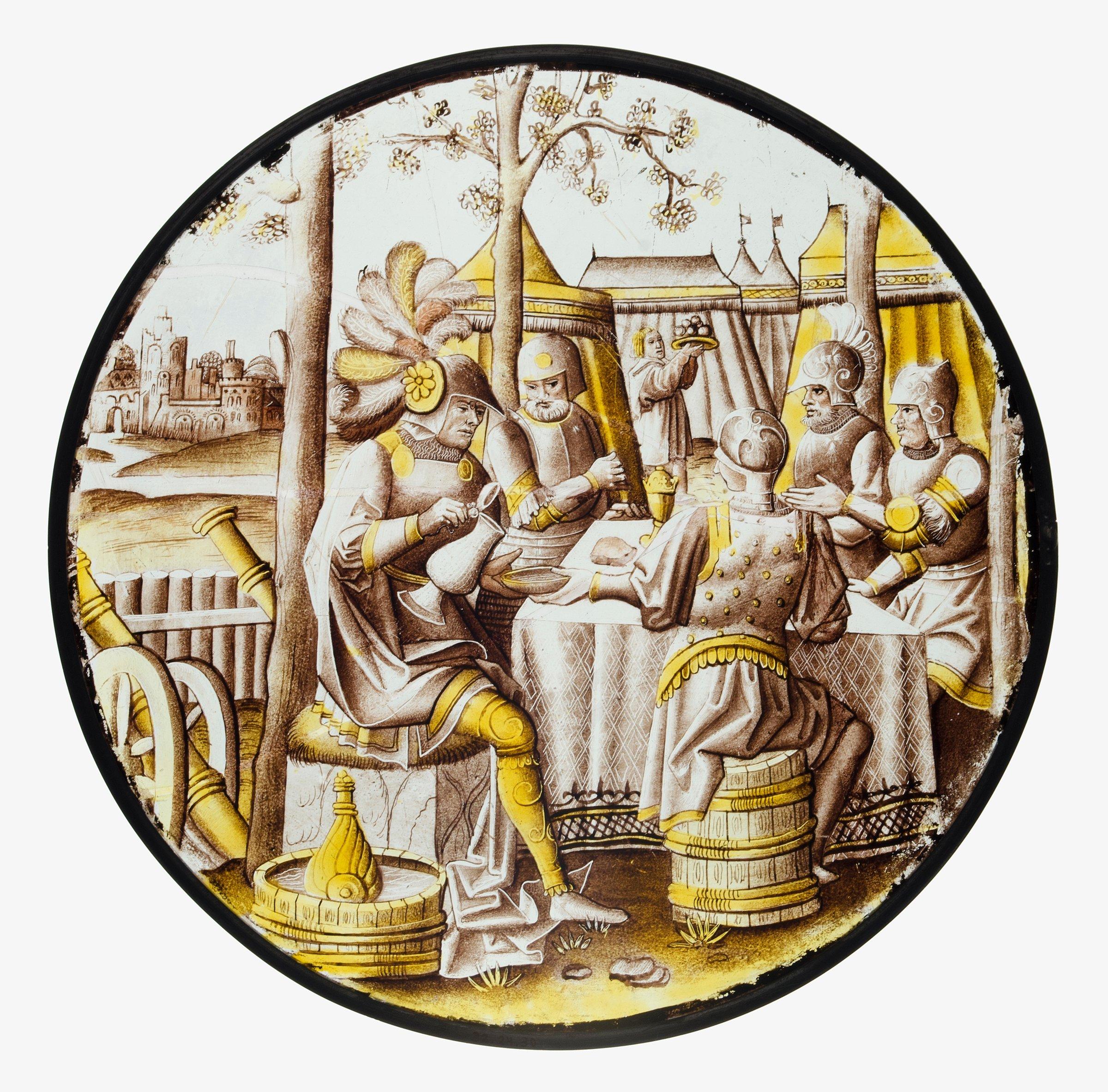
Roundel with Ben-Hadad and the Siege of Samaria, about 1525. Public domain.
2 Kings 6 and 25 · Subject · Featured Study
The Covenant Curses in the Sieges
Leviticus 26 and Deuteronomy 28 named siege and famine among the curses of a broken covenant, and 2 Kings records them at Samaria and at Jerusalem.
A mother's cry on the wall of Samaria answered a line Moses wrote.
And I will bring a sword against you to execute the vengeance of the covenant. Though you withdraw into your cities, I will send a plague among you, and you will be delivered into the hand of the enemy. When I cut off your supply of bread, ten women will bake your bread in a single oven and dole out your bread by weight, so that you will eat but not be satisfied.
- Books
- Deuteronomy, Leviticus, 2 Kings, Lamentations
- Hold in memory
- Leviticus 26:44, Daniel 9:11, Galatians 3:13
Summary
The law warned that a siege would end with parents eating their own children.
- In Samaria a mother told the king she had boiled her son and eaten him.
- In Hezekiah's day the LORD kept the king of Assyria out of Jerusalem.
- In the last siege of Jerusalem the people had no food, and mothers cooked their children.
- Readers differ on which siege the curse had in view.
The Curse of the Siege
Two chapters of the law describe the enemy, the siege and the hunger inside the walls.
Leviticus 26 sets the siege among the punishments for a broken covenant.
You will eat the flesh of your own sons and daughters.The famine reaches its last step in one line.
The LORD will bring a nation from afar, from the ends of the earth, to swoop down upon you like an eagle—a nation whose language you will not understand, a ruthless nation with no respect for the old and no pity for the young. They will eat the offspring of your livestock and the produce of your land until you are destroyed. They will leave you no grain or new wine or oil, no calves of your herds or lambs of your flocks, until they have caused you to perish. They will besiege all the cities throughout your land, until the high and fortified walls in which you trust have fallen. They will besiege all your cities throughout the land that the LORD your God has given you.These lines fit an empire far off, and readers still argue over which one Moses meant.
Then you will eat the fruit of your womb, the flesh of the sons and daughters whom the LORD your God has given you, in the siege and distress that your enemy will inflict on you.This is the line the mothers of Samaria and Jerusalem would fulfil.
The most gentle and refined woman among you, so gentle and refined she would not venture to set the sole of her foot on the ground, will begrudge the husband she embraces and her son and daughter the afterbirth that comes from between her legs and the children she bears, because she will secretly eat them for lack of anything else in the siege and distress that your enemy will inflict on you within your gates.Moses foresees the love inside a family undone by hunger.
Deuteronomy 28:53, Deuteronomy 28:56 to 57
The Curse Beside the Record
A table sets threats beside events, and a timeline marks the attacks on the two capitals.
Each mark of the siege in the curse stands again in the record of Kings and Lamentations.
| The curse | Where it is written | What the record says |
|---|---|---|
| Every walled town besieged | Deuteronomy 28:52 | Nebuchadnezzar's servants besieged Jerusalem in Jehoiachin's reign. |
| Bread doled out by weight | Leviticus 26:26 | A donkey's head sold for eighty shekels of silver in Samaria. |
| Parents eat their children | Leviticus 26:29 | A mother's case brought to the king of Israel. |
| The gentle woman eats in secret | Deuteronomy 28:56 to 57 | Compassionate women in Jerusalem cooked their own children. |
| Famine in the siege | Deuteronomy 28:51 | The city ran out of food before the wall was breached. |
| The high walls fall | Deuteronomy 28:52 | The Chaldean army broke down the walls around Jerusalem. |
Kings records three sieges that ended in famine or surrender, from the reign of Joram to the eleventh year of Zedekiah.
To scale: 3 of 3 stops dated; a bar is a span.
- Ben-hadad besieges Samariain Joram's reign, 852 to 841 BC; the text gives no yearThe famine reaches the eating of children.2 Kings 6:24
- Nebuchadnezzar's servants besiege JerusalemJehoiachin's reign, 598 to 597 BCThe king comes to the city during the siege.2 Kings 24:10 to 11
- Nebuchadnezzar besieges JerusalemZedekiah's ninth year to his eleventh; his reign ended in 586 BCFamine, the breach of the wall and the burning of the house of the LORD.2 Kings 25:1 to 10
Dates follow the reign dates of Edwin Thiele; where the text gives no year, the reign is given.
The Sieges in Kings
Three sieges in Kings and the warning read to Josiah.
Ben-hadad's siege of Samaria2 Kings 6:24 to 7:20
Then the king asked her, “What is the matter?” And she answered, “This woman said to me, ‘Give up your son, that we may eat him, and tomorrow we will eat my son.’ So we boiled my son and ate him, and the next day I said to her, ‘Give up your son, that we may eat him.’ But she had hidden her son.”A mother brings the curse of Deuteronomy 28:53 to the king as a case for judgment.
C. F. Keil, on 2 Kings 6:30, writes that in her account the curses of Leviticus 26:29 and Deuteronomy 28:53 and 57 were literally fulfilled.
Josephus retells the siege in Antiquities 9.4.4. He writes that Ben-hadad meant to take the city by famine if his engines of war failed.
Then the people went out and plundered the camp of the Arameans. It was then that a seah of fine flour sold for a shekel, and two seahs of barley sold for a shekel, according to the word of the LORD.The famine ended the next day at the price Elisha had named.
The city spared in Hezekiah's day2 Kings 19:32 to 34
So this is what the LORD says about the king of Assyria: ‘He will not enter this city or shoot an arrow into it. He will not come before it with a shield or build up a siege ramp against it. He will go back the way he came, and he will not enter this city,’ declares the LORD. ‘I will defend this city and save it for My own sake and for the sake of My servant David.’”This promise is why Jerusalem escaped the curse in Hezekiah's day.
Nebuchadnezzar's siege of Jerusalem2 Kings 25:1 to 10; Lamentations 2 and 4
So in the ninth year of Zedekiah’s reign, on the tenth day of the tenth month, Nebuchadnezzar king of Babylon marched against Jerusalem with his entire army. They encamped outside the city and built a siege wall all around it. And the city was kept under siege until King Zedekiah’s eleventh year. By the ninth day of the fourth month, the famine in the city was so severe that the people of the land had no food.The famine at the end of this siege is the one Lamentations mourns.
Look, O LORD, and consider: Whom have You ever treated like this? Should women eat their offspring, the infants they have nurtured? Should priests and prophets be killed in the sanctuary of the Lord?The poet puts the horror of the siege to God as a question.
Josiah hears the curses read2 Kings 22; 2 Chronicles 34
“Go and inquire of the LORD for me, for the people, and for all Judah concerning the words in this book that has been found. For great is the wrath of the LORD that burns against us because our fathers have not obeyed the words of this book by doing all that is written about us.”Josiah reads his own generation into the warnings he has just heard.
that this is what the LORD says: I am about to bring calamity on this place and on its people, according to all the curses written in the book that has been read in the presence of the king of Judah,The answer from the LORD ties the coming calamity to the book itself.
The Prices of the Famine in Samaria
Josephus, Rashi and the commentators read the donkey's head and the dove's dung of 2 Kings 6:25.
Albert Barnes notes that the donkey was unclean under the law and its head the worst part of it, and he reckons the quarter cab at about a pint.
Readers disagree on the dove's dung. Josephus writes that the people bought it instead of salt.
Rashi, in the Metsudah translation, reads it as fuel for cooking once the wood had run out.
Adam Clarke takes it for a kind of pulse, a chick pea, following Dr. Shaw and Bochart.
The Hebrew of the Siege and the Curse
Four Hebrew words carry the siege, the distress and the curse.
matsor (Hebrew, H4692)
A siege, or the mound of the besiegers. It stands three times in the siege lines of Deuteronomy 28, and again in 2 Kings 24:10 and 2 Kings 25:2.
matsoq (Hebrew, H4689)
A narrow place, or distress. It stands in six verses, and in four of them beside matsor: the three siege verses of Deuteronomy 28 and Jeremiah 19:9.
qelalah (Hebrew, H7045)
The curse of Deuteronomy 28:15 and Deuteronomy 28:45, and the word of the LORD's message to Josiah in 2 Kings 22:19.
alah (Hebrew, H423)
An oath that carries a curse. It names the curses of Josiah's book in 2 Chronicles 34:24 and the curse Daniel confessed in exile.
What the Text Leaves Unsaid
Kings leaves three things about the sieges unsaid.
Second Kings 6 calls the king on the wall the king of Israel and never gives his name. Josephus names him Joram.
Kings does not say what became of the son the second woman hid.
Second Kings 25 records the famine in Jerusalem and says nothing of mothers and children. Lamentations is the book that records them.
The Curse and Its Limit
Daniel confessed the curse fulfilled, and the law that wrote the curse also promised that God would keep His covenant.
All Israel has transgressed Your law and turned away, refusing to obey Your voice; so the oath and the curse written in the Law of Moses the servant of God has been poured out on us, because we have sinned against You. You have carried out the words spoken against us and against our rulers by bringing upon us a great disaster. For under all of heaven, nothing has ever been done like what has been done to Jerusalem.In exile Daniel traces Jerusalem's ruin to the law Moses wrote.
Yet in spite of this, when they are in the land of their enemies, I will not reject or despise them so as to destroy them and break My covenant with them; for I am the LORD their God. But for their sake I will remember the covenant with their fathers, whom I brought out of the land of Egypt in the sight of the nations, that I might be their God. I am the LORD.”The same chapter that threatens the siege sets a limit on the punishment.
Two Voices on the Siege and Its Lesson
Thomas Aquinas in the thirteenth century and Matthew Henry in the eighteenth read the famine and the curse.
Thomas Aquinas (died 1274)
Thomas Aquinas reads the mothers of Lamentations 4:10 as the measure of the famine.
“Here is considered the immense hunger of mothers, who eat their own children, through an excessive hunger. As said above in Chapter 2:20: ‘Should women eat their offspring, the children of their tender care?’”
Thomas Aquinas · Commentary on Lamentations · on Lamentations 4:10Patristic
Matthew Henry (1662 to 1714)
Matthew Henry draws the lesson of Daniel's prayer.
“Note, It contributes very much to our profiting by the judgments of God's hand to observe how exactly they agree with the judgments of his mouth. He aggravates the calamities they were in, lest they should seem, having been long used to them, to make light of them, and so to lose the benefit of the chastening of the Lord by despising it.”
Matthew Henry · Commentary on the Whole Bible · on Daniel 9:11Puritan
Which Siege the Curse Foretold
Three readings of Deuteronomy 28:49 to 57, each with its holders and the objection to it.
Three sieges: Samaria, Babylon and RomeAlbert Barnes; John Gill
Albert Barnes, on 2 Kings 6:29, says the threat was fulfilled here probably for the first time, again when Nebuchadnezzar besieged Jerusalem, and a third time when Titus did.
John Gill, on 2 Kings 6:29, says the threat of Deuteronomy 28:53 began to be accomplished at Samaria.
The objection is the enemy of Deuteronomy 28:49, a nation from the ends of the earth. Ben-hadad reigned in Damascus.
Rome above allAdam Clarke; Jamieson, Fausset and Brown
Adam Clarke reads the nation from afar as the Romans, the eagle as the emblem on their standards and the strange tongue as Latin. Jamieson, Fausset and Brown also point to the eagle on the Roman standards.
On Deuteronomy 28:56 Clarke cites a woman named Mary in the Roman siege. Josephus tells her act in The Wars of the Jews 6.3.4.
The objection is that the prophets give the same marks to Babylon. Jeremiah 5:15 calls it a distant nation whose language Israel does not know, and Habakkuk 1:8 uses the eagle's word for the Chaldeans.
Fulfilled within Scripture's own recordMatthew Henry; C. F. Keil
Matthew Henry, on Deuteronomy 28:56 to 57, says the threat was fulfilled to the letter more than once: at the siege of Samaria, and in the siege of Jerusalem by the Babylonians. Keil, on 2 Kings 25:3, reads the famine of that siege as proof that the warnings of Leviticus 26:29 and Deuteronomy 28:53 to 57 were true.
Jeremiah 19:9 foretold the act in the words of the curse, and Lamentations 4:19 calls the pursuers swifter than eagles.
The objection is a later fulfilment. Barnes, on Lamentations 4:10, says what the verse states actually occurred during the siege of Jerusalem by Titus.
Books to Read Next
Three works on the sieges, each free to read.
Antiquities of the Jews
Flavius Josephus, translated by William Whiston · 1737
Josephus retells Ben-hadad's siege of Samaria and the famine in Book 9.
Read it at Project GutenbergThe Wars of the Jews
Josephus, in Whiston's translation · 1737
Josephus tells the famine of the Roman siege of Jerusalem in Book 6.
Read it at Project GutenbergBiblical Commentary on the Old Testament: The Books of the Kings
C. F. Keil, translated by James Martin · 1872
Keil reads the famines of 2 Kings 6 and 25 against the curses of Leviticus 26 and Deuteronomy 28.
Read it at the Internet ArchiveRedeemed From the Curse
Christ redeemed us from the curse of the law by becoming a curse for us. For it is written: “Cursed is everyone who is hung on a tree.”Paul places the curse of the law on Christ at the cross.
The reader is asked to take God's warnings as seriously as His promises.
Sources
Scripture is the Berean Standard Bible.
- The Hebrew words of the siege and the curse, STEP Bible tagged text (CC BY 4.0), with Strong's lexicon.
- The site's kings table, on Edwin R. Thiele's reign dates.
- C. F. Keil, Biblical Commentary on the Old Testament: The Books of the Kings, translated by James Martin, T. and T. Clark, 1872, pages 328 and 512.
- Flavius Josephus, Antiquities of the Jews 9.4.4, translated by William Whiston.
- Flavius Josephus, The Wars of the Jews 6.3.4, translated by William Whiston.
- Rashi on 2 Kings 6:25, The Metsudah Tanach series, Lakewood, N.J., CC-BY, via Sefaria.
- Albert Barnes, Notes, Explanatory and Practical, on the Old and New Testaments, 1832 to 1869.
- John Gill, Exposition of the Old Testament, 1748 to 1763.
- Adam Clarke, Commentary on the Bible, 1832.
- Jamieson, Fausset and Brown, Commentary Critical and Explanatory on the Whole Bible, 1871.
- Matthew Henry, Commentary on the Whole Bible, 1710.
- Thomas Aquinas, Commentary on Lamentations.
Keep Studying
Read it4
Studies9
People and groups6