
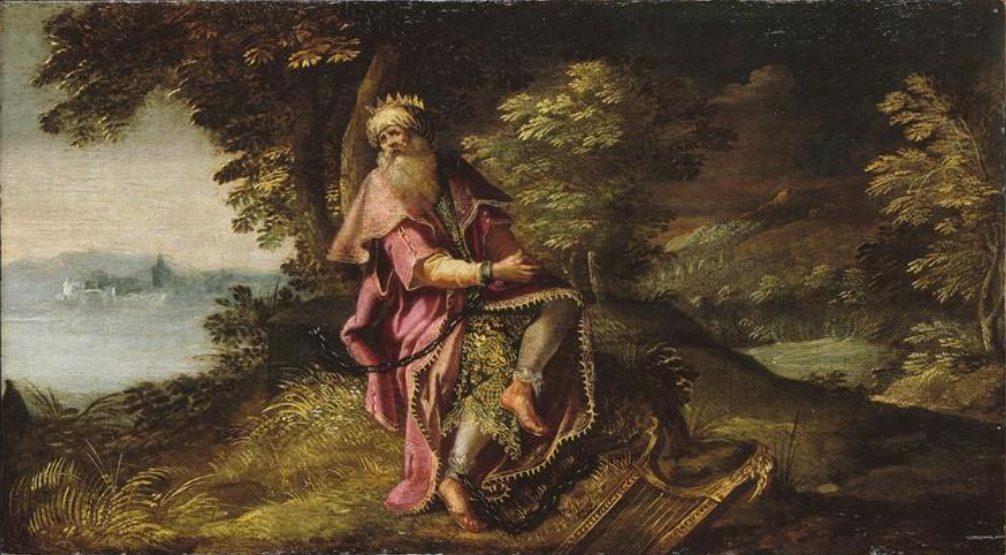
Maerten de Vos, King Manasseh in Exile, 1550 to 1603. Public domain.
2 Kings 21 and 2 Chronicles 33 · Person · Featured Study
Manasseh
Manasseh son of Hezekiah became king of Judah at twelve and reigned fifty-five years in Jerusalem.
And in his distress, Manasseh sought the favor of the LORD his God and earnestly humbled himself before the God of his fathers.
- Family
- father: Hezekiah; mother: Hephzibah; son: Amon; grandson: Josiah
- Places
- Jerusalem, Babylon
- First named
- 2 Kings 20:21 “…his fathers, and his son Manasseh reigned in…”
- Last named
- Matthew 1:10 “Hezekiah was the father of Manasseh, Manasseh the…”
Manasseh undid his father's reform, and Chronicles says the LORD heard him in chains.
Summary
Manasseh rebuilt the high places his father had destroyed, set altars to the host of heaven in the temple courts and shed much innocent blood. Kings tells only this, and Chronicles adds a captivity, a prayer and a return.
- Kings alone names his mother, Hephzibah.
- The text names no son of his but Amon.
- His grandson Josiah tore down the altars he had set in the temple courts.
Where Manasseh Stands in Scripture
His reign is told in 2 Kings 21 and 2 Chronicles 33.
Manasseh is first named at his father Hezekiah's death. Kings tells his reign in eighteen verses, and Chronicles in twenty.
Kings names him again at the fall of Judah, and Jeremiah names him in a word of judgment.
Manasseh was twelve years old when he became king, and he reigned in Jerusalem fifty-five years. His mother’s name was Hephzibah.The same words open 2 Chronicles 33.
His Life, Turn by Turn
His reign runs from his father's death to his burial in the garden of Uzza.
His turns run from the temple courts to Babylon and back.
- Becomes king at twelveJerusalem2 Kings 21:1
- Rebuilds the high places his father destroyedJudah2 Kings 21:3
- Builds altars to the host of heavenboth courts of the temple2 Kings 21:5
- Sacrifices his sons in the firethe Valley of Hinnom2 Chronicles 33:6
- Sets the carved Asherah pole in the templethe house of the LORD2 Kings 21:7
- The LORD speaks through the prophets against JerusalemJerusalem2 Kings 21:10 to 12
- Fills Jerusalem with innocent bloodJerusalem2 Kings 21:16
- Taken with a hook and bronze shacklesBabylon2 Chronicles 33:11
- Humbles himself and praysBabylon2 Chronicles 33:12
- Brought back to his kingdomJerusalem2 Chronicles 33:13
- Rebuilds the outer wall of the City of DavidJerusalem2 Chronicles 33:14
- Removes the foreign gods and restores the LORD's altarthe house of the LORD2 Chronicles 33:15 to 16
- Buried in his palace gardenthe garden of Uzza2 Kings 21:18
Thirteen turns of his life, each with its verse. Turns eight to twelve are told in Chronicles alone.
Fills Jerusalem with innocent blood, Taken with a hook and bronze shackles, Humbles himself and prays, Brought back to his kingdom, Rebuilds the outer wall of the City of David, Removes the foreign gods and restores the LORD's altar, Buried in his palace garden
Two Accounts of One Reign
Both books open his reign with the same verdict.
Kings tells only the evil of his reign and the judgment it brought. Chronicles tells the same evil, then his captivity, his prayer and his return.
The undoing of his father's reform2 Kings 21:2 to 9 and Matthew Henry
He raised altars for Baal and made an Asherah pole, as Ahab of Israel had done.
But the people did not listen and Manasseh led them astray, so that they did greater evil than the nations that the LORD had destroyed before the Israelites.Chronicles gives the same verdict in 2 Chronicles 33:9.
Matthew Henry wrote on the son of a reforming king.
“That it is no new thing, but a very sad thing, for the children of godly parents to turn aside from that good way of God in which they have been trained. Parents may give many good things to their children, but they cannot give them grace. Corruptions in worship are such diseases of the church as it is very apt to relapse into again even when they seem to be cured.”
Matthew Henry · Commentary on the Whole Bible · on 2 Chronicles 33:10Puritan
The word of the prophets2 Kings 21:10 to 16
The LORD spoke through His servants the prophets against Jerusalem and Judah, because Manasseh had acted more wickedly than the Amorites.
I will stretch out over Jerusalem the measuring line used against Samaria and the plumb line used against the house of Ahab, and I will wipe out Jerusalem as one wipes out a bowl—wiping it and turning it upside down.Samaria and the house of Ahab had already fallen under that line.
The hook and the shackles2 Chronicles 33:10 to 13
Then Assyria's commanders captured him.
And the LORD spoke to Manasseh and his people, but they did not listen.Kings tells this warning through the prophets in 2 Kings 21:10.
The return2 Chronicles 33:14 to 17
Back in Jerusalem he strengthened the city and stationed commanders in the fortified cities of Judah. He threw his idols and altars out of the city.
Nevertheless, the people still sacrificed at the high places, but only to the LORD their God.Josiah later desecrated the high places, 2 Kings 23:8.
The sin that outlived himJeremiah 15:4 and Matthew Henry
Jeremiah heard the LORD name Manasseh son of Hezekiah in a word of judgment on Jerusalem.
I will make them a horror to all the kingdoms of the earth because of what Manasseh son of Hezekiah king of Judah did in Jerusalem.In Jeremiah 15:1 the LORD says His heart would not go out to this people even if Moses and Samuel stood before Him.
Matthew Henry drew a lesson on judgment delayed.
“The greatest part of a generation was worn off since Manasseh's time, yet his sin is brought into the account; as in Jerusalem's last ruin God brought upon it all the righteous blood shed on the earth, to show how heavy the guilt of blood will light and lie somewhere, sooner or later, and that reprieves are not pardons.”
Matthew Henry · Commentary on the Whole Bible · on Jeremiah 15:4Puritan
A King Under Assyria
An Assyrian list of twenty-two kings names Manasseh of Judah.
Chronicles says the commanders of the king of Assyria took him, and it does not name that king.
C. F. Keil cites Duncker's report that Esarhaddon named twenty-two kings of Syria who obeyed him. Minasi of Judah stands among them.
The Circle of Manasseh
The tree sets him among four of his family.
He stood between two reforming kings, his father and his grandson.
The Places of His Reign
Six places mark his reign, from the temple courts to Babylon.
Manasseh's idols stood in Jerusalem, and he was taken in chains to Babylon.
- 1Jerusalem, The city named in the prophets' word of judgment. 2 Kings 21:12
- 2The two temple courts, The courts Josiah later cleared of his altars. 2 Kings 23:12
- 3The Valley of Hinnom, The valley where Josiah later defiled Topheth. 2 Kings 23:10
- 4The hill of Ophel, The hill his new wall went around. 2 Chronicles 33:14
- 5The garden of Uzza, The garden where Amon too was buried. 2 Kings 21:26
- 6Babylon, The city of his captivity. 2 Chronicles 33:11
Not placed: The two temple courts (2), The Valley of Hinnom (3), The hill of Ophel (4), The garden of Uzza (5).
The coasts and rivers are simplified; each place stands at its place page's coordinates.
Babylon alone of the six lies outside Judah.
Questions His Life Raises
Two questions about his altars and his captivity have answers from C. F. Keil.
Did Manasseh remove his altars, or did Josiah?2 Chronicles 33:15 and 2 Kings 23:12
He pulled down the altars that the kings of Judah had set up on the roof near the upper chamber of Ahaz, and the altars that Manasseh had set up in the two courtyards of the house of the LORD. The king pulverized them there and threw their dust into the Kidron Valley.Chronicles says Manasseh had already removed these altars.
How long was he held in Babylon?2 Chronicles 33:1 to 13 and Keil
The text gives no length. C. F. Keil reasons that the captivity was short, since both books give fifty-five years for his reign with no break.
What the Text Leaves Unsaid
The text leaves three things about him untold.
Neither book names the children he sacrificed.
It does not name the prophets who spoke against him in Kings.
It does not say how old he was when he was taken to Babylon.
Then Manasseh Knew
Chronicles closes his captivity with what he came to know.
The king who had served the host of heaven came back to his kingdom knowing the LORD.
And when he prayed to Him, the LORD received his plea and heard his petition; so He brought him back to Jerusalem and to his kingdom. Then Manasseh knew that the LORD is God.His son Amon did not humble himself as his father had done.
Hezekiah was the father of Manasseh, Manasseh the father of Amon, Amon the father of Josiah,Matthew's line runs through him to Josiah and the exile.
Voices on Manasseh
One voice of the early church is given on his turning.
Jerome (died 420)
LETTER 77.4
Jerome set the king beside two others who turned and were heard.
“O happy penitence which has drawn down upon itself the eyes of God, and which has by confessing its error changed the sentence of God's anger! The same conduct is in the Chronicles attributed to Manasseh, and in the book of the prophet Jonah to Nineveh, and in the gospel to the publican. The first of these not only was allowed to obtain forgiveness but also recovered his kingdom, the second broke the force of God's impending wrath, while the third, striking his breast with his hands, ‘would not lift up so much as his eyes to heaven.’”
on 2 Chronicles 33:12 to 13Patristic
Did the Captivity in Babylon Happen?
Two readings weigh the captivity Chronicles tells.
As for the rest of the acts of Manasseh, along with all his accomplishments and the sin that he committed, are they not written in the Book of the Chronicles of the Kings of Judah?A history Kings leaves outKeil, with Bertheau, Ewald, Movers and Thenius
C. F. Keil holds the captivity raised above every doubt by its agreement with records outside the Bible in fact and in time. He reports that Bertheau, Ewald, Movers and Thenius also took it as history under Esarhaddon.
Julius Wellhausen answers that an inscription showing Manasseh paying tribute to Esarhaddon proves only that he kept his throne as a tributary.
A lesson told as historyJulius Wellhausen
Julius Wellhausen holds the captivity unhistorical. He reads it as the Chronicler's way to punish the worst king and still explain his long reign.
He cites the silence of Kings and Jeremiah 15:4, which lays Judah's ruin on Manasseh as though his guilt had never been borne.
Against this stands the reading of C. F. Keil, and of Bertheau, Ewald and Movers before him.
Books to Read Next
Both works are in the public domain, and each has a free copy to read.
The Books of the Chronicles
C. F. Keil · 1872
Keil defends the captivity and discusses the altars in his notes on 2 Chronicles 33.
Read at the Internet ArchiveProlegomena to the History of Israel
Julius Wellhausen · 1883
Wellhausen argues against the captivity in his chapter on Chronicles.
Read at Project GutenbergThe LORD Received His Plea
Chronicles remembers a king in shackles who humbled himself, and a God who heard him.
but he did not humble himself before the LORD as his father Manasseh had done; instead, Amon increased his guilt.Chronicles measures the next king by this turning.
Sources
Scripture is the Berean Standard Bible.
- C. F. Keil, The Books of the Chronicles, translated by Andrew Harper, T. and T. Clark, 1872, pp. 482 to 483 and 487 to 488.
- Julius Wellhausen, Prolegomena to the History of Israel (Berlin, 1883), translated by J. Sutherland Black and Allan Menzies, chapter 6, section 2, part 3.
- Matthew Henry, Commentary on the Whole Bible, 1710, on 2 Chronicles 33:10 and Jeremiah 15:4.
- Jerome, Letter 77, section 4.
Keep Studying
Studies5
People and groups8