
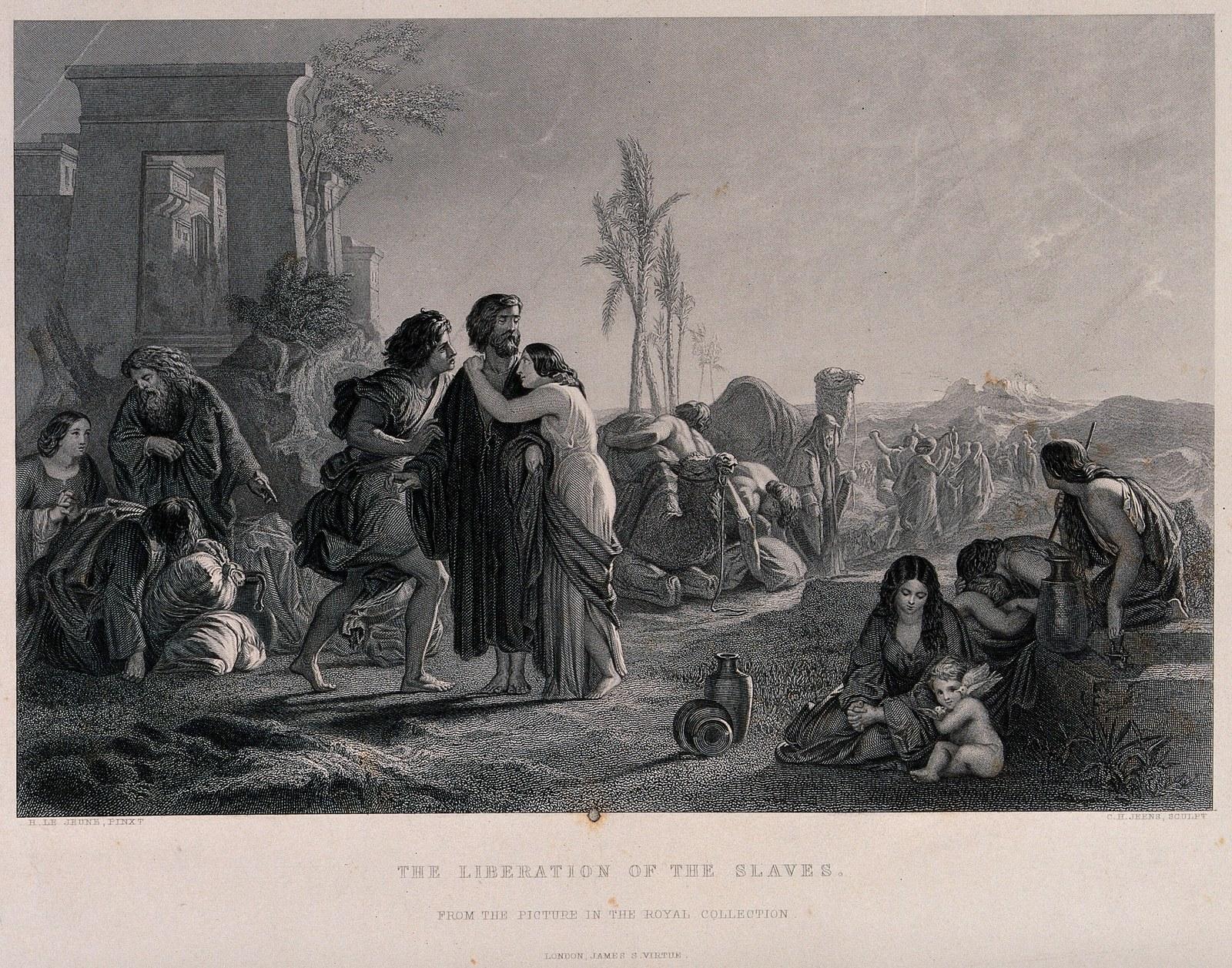
Henry Le Jeune, The Liberation of the Slaves, 1847. Public domain.
Jeremiah 34:8 to 22 · Story · Featured Study
The Release of the Slaves and the Covenant Between the Pieces
Jeremiah 34:8 to 22 records a covenant of release that King Zedekiah made and the people broke.
And those who have transgressed My covenant and have not fulfilled the terms of the covenant they made before Me, I will treat like the calf they cut in two in order to pass between its pieces.
- Where
- Jerusalem
- Who
- Zedekiah, Jeremiah
- When
- The Babylonian army was besieging Jerusalem in the reign of Zedekiah
Judah's owners freed their slaves under oath, then forced them back into slavery.
Summary
Babylon's army had Jerusalem under siege. King Zedekiah and the people made a covenant to free their Hebrew slaves. Then they took the slaves back. The LORD answered through Jeremiah with a freedom of His own: freedom to the sword, plague and famine.
- The LORD said He would treat them like the calf they cut in two (Jeremiah 34:18).
- The law they broke set a Hebrew slave free after six years of work.
- Commentators give three reasons for the release.
The Covenant of Release
The whole city bound itself by oath to release its Hebrew servants.
After King Zedekiah had made a covenant with all the people in Jerusalem to proclaim liberty, the word came to Jeremiah from the LORD that each man should free his Hebrew slaves, both male and female, and no one should hold his fellow Jew in bondage. So all the officials and all the people who entered into this covenant agreed that they would free their menservants and maidservants and no longer hold them in bondage. They obeyed and released them,Because the whole city swore, the reversal was the breach of all.
but later they changed their minds and took back the menservants and maidservants they had freed, and they forced them to become slaves again.This reversal is the sin the rest of the chapter answers.
Recently you repented and did what pleased Me; each of you proclaimed freedom for his neighbor. You made a covenant before Me in the house that bears My Name. But now you have changed your minds and profaned My name. Each of you has taken back the menservants and maidservants whom you had set at liberty to go wherever they wanted, and you have again forced them to be your slaves.This verdict is the ground of the sentence in Jeremiah 34:17.
From Release to Sentence
The steps run from the siege to the LORD's sentence on the covenant breakers.
Both the release and the reversal happened during the Babylonian siege of Jerusalem.
- Babylon's army fights against Jerusalem, Lachish and AzekahThe siegeJeremiah 34:7
- Zedekiah makes a covenant with the people to proclaim libertyJerusalem, under siegeJeremiah 34:8
- The owners obey and let them goJerusalem, under siegeJeremiah 34:10
- Pharaoh's army marches, and the Chaldeans withdrawThe siege liftedJeremiah 37:5
- The owners take the slaves backThe siege liftedJeremiah 34:11
- The LORD proclaims freedom to sword, plague and famineThe word to JeremiahJeremiah 34:17
- The LORD will bring the army back to burn the cityThe word to JeremiahJeremiah 34:22
The steps of Jeremiah 34 and 37 in order, each with its verse.
The Law They Broke
The answer of Jeremiah 34:13 to 14 rests on a law of Exodus and Deuteronomy.
“This is what the LORD, the God of Israel, says: I made a covenant with your forefathers when I brought them out of the land of Egypt, out of the house of slavery, saying: Every seventh year, each of you must free his Hebrew brother who has sold himself to you. He may serve you six years, but then you must let him go free. But your fathers did not listen or incline their ear.The LORD's answer begins from the law itself.
If you buy a Hebrew servant, he is to serve you for six years. But in the seventh year, he shall go free without paying anything.Jeremiah 34:14 takes up this law from the exodus covenant.
If a fellow Hebrew, a man or a woman, is sold to you and serves you six years, then in the seventh year you must set him free.Moses repeats the law to the generation entering the land.
The Cambridge Bible notes that Exodus 21:2 names a male slave and that Deuteronomy 15:12 extends the release to women.
The Calf Cut in Two
The people sealed their covenant by walking between the halves of a calf, an old rite of oath.
The officials of Judah and Jerusalem, the court officials, the priests, and all the people of the land who passed between the pieces of the calf, I will deliver into the hands of their enemies who seek their lives. Their corpses will become food for the birds of the air and the beasts of the earth.The LORD names every rank of the people who took part in the rite.
Barnes' Notes on Jeremiah 34:18 says the Jews spoke of cutting a covenant because the parties cut a calf in two and passed between the pieces.
Adam Clarke called it the ancient and most solemn way of making a covenant. The Cambridge Bible points to Genesis 15:10 for a ceremony of this kind.
When the sun had set and darkness had fallen, behold, a smoking firepot and a flaming torch appeared and passed between the halves of the carcasses.In Genesis 15 the fire of the LORD's presence passed between the halves.
A treaty of the Assyrian king Ashur-nerari V with Mati'-ilu used a spring lamb. Its words say the lamb's head is the head of Mati'-ilu, cut off if he breaks the oath.
Read The Covenant of the Pieces, the rite of Genesis 15, with John Wesley on it
A Freedom to the Sword
The LORD answered the broken release with the same word for liberty, turned against the city.
Therefore this is what the LORD says: You have not obeyed Me; you have not proclaimed freedom, each man for his brother and for his neighbor. So now I proclaim freedom for you, declares the LORD—freedom to fall by sword, by plague, and by famine! I will make you a horror to all the kingdoms of the earth.The word of release becomes the sentence.
The Hebrew word for liberty in this chapter is deror, release. The Brown-Driver-Briggs lexicon calls its use in Jeremiah 34:17 ironic: liberty to be destroyed by sword, pestilence and famine.
Read Jubilee, the year deror was first proclaimed, with Basil of Caesarea on it
Voices on the Broken Release
Jerome and Matthew Henry wrote on the law of release and its breaking.
Jerome (died 420)
AGAINST JOVINIAN 2.25
Jerome, in Against Jovinian, read the seventh-year release as a picture of the age to come.
“We read that every Hebrew keeps the same Passover, and that in the seventh year every prisoner is set free, and that at Jubilee, that is, the fiftieth year, every possession returns to its owner. All this refers not to the present but to the future. For being in bondage during the six days of this world, on the seventh day, the true and eternal sabbath, we shall be free. If we wish to be free, we will be free even while still in bondage in the world.”
on Exodus 21:2Patristic
Matthew Henry (1662 to 1714)
Commentary on the Whole Bible
Matthew Henry named what moved the owners to break the law.
“And this is called a covenant; for our performance of the duty required is the condition of the continuance of the favours God has bestowed. This law they and their fathers had broken. Their worldly profit swayed more with them than God's command or covenant.”
on Jeremiah 34:13Puritan
Why Was the Release Made?
Jeremiah 34 names no year for the covenant, and readers explain its occasion in different ways.
A measure taken under siegeThe Cambridge Bible; Barnes' Notes; Keil and Delitzsch
The Cambridge Bible holds that the danger of the siege moved Zedekiah, since freed slaves would more readily help their masters defend the city.
Barnes' Notes says the Egyptians then advanced and Nebuchadnezzar withdrew to meet them. Keil and Delitzsch say the promise was revoked after the Chaldeans departed.
The objection: the LORD's answer in verses 13 and 14 treats the release as obedience to the law of the seventh year.
A release in a sabbatical yearJamieson, Fausset and Brown; the Brown-Driver-Briggs lexicon
“The last year of Zedekiah was the sabbatical year. How just the retribution, that they who, against God's law and their own covenant, enslaved their brethren, should be doomed to bondage themselves: and that the bond-servants should enjoy the sabbatical freedom at the hands of the foe (Jer 52:16) which their own countrymen denied them!”
Jamieson, Fausset & Brown · Commentary Critical and Explanatory on the Whole Bible · on Jeremiah 34:13Reformed
The Brown-Driver-Briggs lexicon also ties the deror of Jeremiah 34 to the sabbatical year.
The objection: the law counts each servant's own six years, so it sets no single year of release for every slave at once.
A release owed and then withheldAdam Clarke
Adam Clarke, on Jeremiah 34:11, held that the owners agreed to free their slaves at the end of the seventh year. When the year ended, they recalled their promise and kept their servants.
The objection: Jeremiah 34:10 says the owners obeyed and released them before taking them back.
Liberty to the Captives
Judah's covenant of release was broken while Jerusalem still stood. In the synagogue at Nazareth Jesus read Isaiah's promise of liberty to the captives and said it was fulfilled.
“The Spirit of the Lord is on Me, because He has anointed Me to preach good news to the poor. He has sent Me to proclaim liberty to the captives and recovery of sight to the blind, to release the oppressed,Jesus read Isaiah 61:1, where the same word for liberty stands.
Read The New Covenant, Jeremiah's promise of a covenant that would not be broken
Sources
Scripture is the Berean Standard Bible.
- Ellicott's Commentary for English Readers on Jeremiah 34:18; Barnes' Notes on Jeremiah 34:8 and 34:18; the Cambridge Bible for Schools and Colleges on Jeremiah 34:8 and 34:18; Keil and Delitzsch, Biblical Commentary on the Old Testament, on Jeremiah 34:8 to 11.
- Francis Brown, S. R. Driver and Charles A. Briggs, A Hebrew and English Lexicon of the Old Testament, entry deror (Strong's H1865)
- The treaty of Ashur-nerari V with Mati'-ilu, SAA 2 2, column i, ed. S. Parpola and K. Watanabe, Neo-Assyrian Treaties and Loyalty Oaths, 1988.
- Jerome, Against Jovinian 2.25; Matthew Henry, Commentary on the Whole Bible (1710); Adam Clarke, Commentary on the Bible (1832); Jamieson, Fausset and Brown (1871)
- C. H. Jeens after Henry Le Jeune, The Liberation of the Slaves, engraving after the picture in the Royal Collection, London, James S. Virtue, Wellcome Collection, Public Domain Mark.
Keep Studying
Read it4
People and groups3
Places1
Words1
Doctrines8
Subjects3
Go further2