
2 Kings 25:7
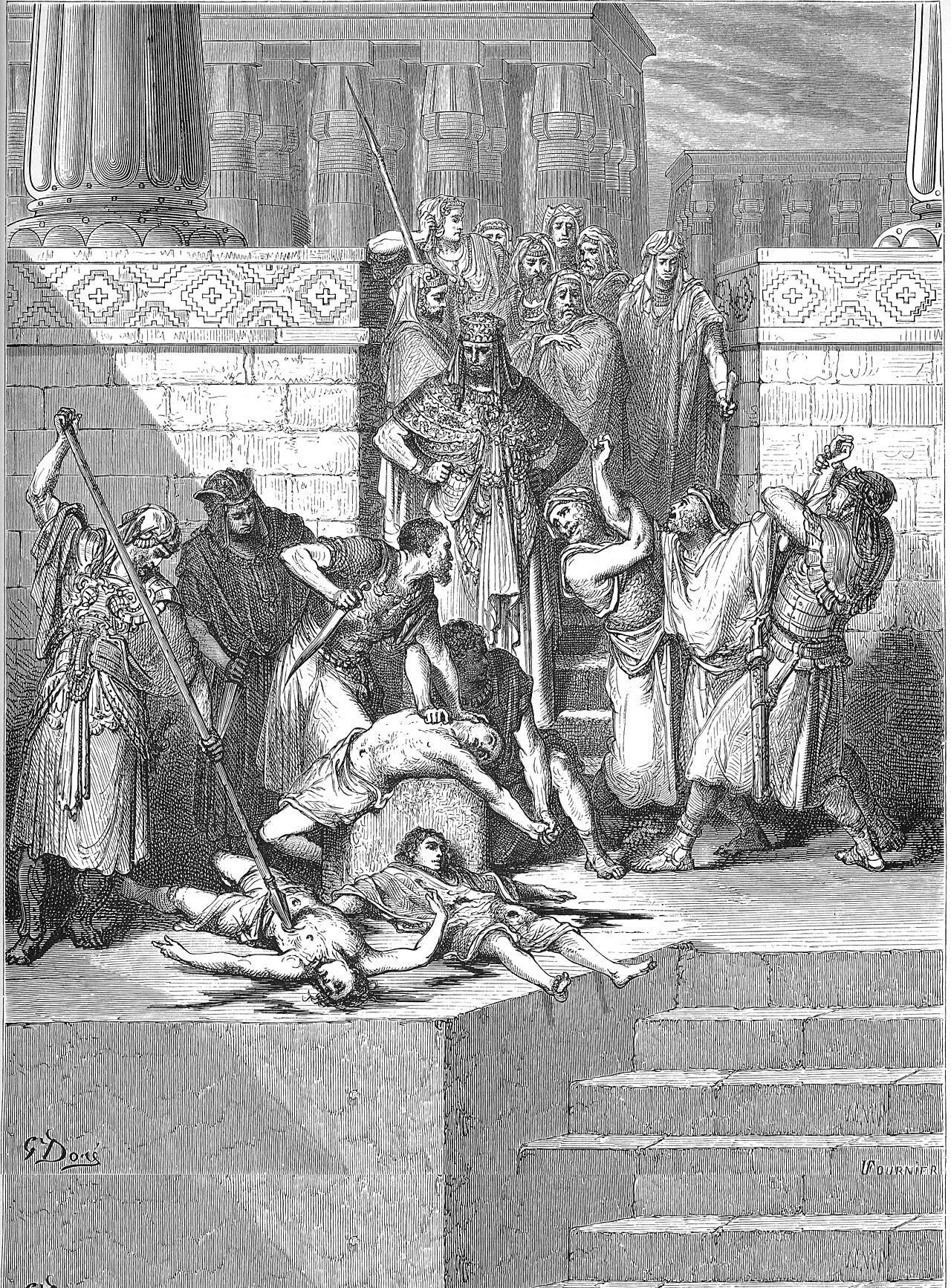
in 2 Kings 25And they slaughtered the sons of Zedekiah before his eyes. Then they put out his eyes, bound him with bronze shackles, and took him to Babylon.
BSB
The same verse in ASV and KJV ▾
ASV
And they slew the sons of Zedekiah before his eyes, and put out the eyes of Zedekiah, and bound him in fetters, and carried him to Babylon.
KJV
And they slew the sons of Zedekiah before his eyes, and put out the eyes of Zedekiah, and bound him with fetters of brass, and carried him to Babylon.
⋯
This verse in 2 Kings 25
Commentary
5 notes on this verseA commentator
Albert Barnes1798–1870
Notes, Explanatory and Practical, on the Old and New Testaments (1832-1869)
Before his eyes - This refinement of cruelty seems to have especially shocked the Jews, whose manners were less barbarous than those of most Orientals. It is noted by Jeremiah in two places Jer 39:6; Jer 52:10. And put out the eyes of Zedekiah - Blinding has always been among the most common of secondary punishments in the East (compare Jdg 16:2 l). The blinding of Zedekiah reconciled in a very remarkable way prophecies, apparently contradictory, which had been made concerning him. Jeremiah had prophesied distinctly that he would be carried to Babylon Jer 32:5; Jer 34:
This site's exposition
they pronounced judgment on him
on 2 Kings 25:6-7
They "slaughtered the sons of Zedekiah before his eyes," then "put out his eyes," an order that fulfils two prophecies. Jeremiah 32:4 said he would see the king of Babylon with his own eyes. Ezekiel 12:13 said he would be brought to Babylon and not see it.
This site's exposition
bound him with bronze shackles
John Wesley reads the slaughter of the sons of Zedekiah before his eyes as Babylon's declaration that his kingdom was ended. Albert Barnes notes that Jeremiah records it twice. Jeremiah 52:11 adds that the king of Babylon kept him in custody until he died.
The record, by era
The Church Fathers1 voice
What think you of Nebuchadnezzar? Have you not heard from Scripture that he was bloodthirsty, fierce, with the disposition of a lion? Have you not heard that he disinterred the kings? Have you not heard that he brought the people away into captivity? Have you not heard that he put the king's sons to the sword before Zedekiah's eyes and then blinded him? Have you not heard that he shattered the cherubim?
The Puritans and the Awakening1 voice
Slew, &c. - Tho' they were but children, that this spectacle, the last he was to behold, might leave a remaining impression of grief and horror upon his spirit. And in slaying his sons they in effect declared, that the kingdom was no more, and that he nor any of his breed were fit to be trusted: therefore not fit to live.
The words behind it
13 Hebrew wordsEvery Hebrew word of this verse in the order it stands, with what it means and the door to its own study. The last column counts the times a word stands in the whole Bible: the rarer the word, the more the places it appears belong together.
| Hebrew | Sound | Meaning | Word study | In the Bible |
|---|---|---|---|---|
| וְאֶת־ | veet | and <obj.> | H853 → | 10935 times |
| בְּנֵי֙ | benei | [the] sons of | H1121 → | 4930 times |
| צִדְקִיָּ֔הוּ | tzidkiyahu | Zedekiah | H6667 → | 63 times |
| שָׁחֲט֖וּ | shachatu | they slaughtered | H7819 → | 81 times |
| לְעֵינָ֑יו | leeinav | to eyes his | H5869 → | 887 times |
| וְאֶת־ | veet | and <obj.> | H853 → | 10935 times |
| עֵינֵ֤י | ʾeinei | [the] eyes of | H5869 → | 887 times |
| צִדְקִיָּ֙הוּ֙ | tzidkiyahu | Zedekiah | H6667 → | 63 times |
| עִוֵּ֔ר | ʾiver | he made blind | H5786 → | |
| וַיַּאַסְרֵ֙הוּ֙ | vaiyaasrehu | and he bound him | H631 → | 72 times |
| בַֽנְחֻשְׁתַּ֔יִם | vanchushtayim | with <the> bronze fetters | H5178 → | 140 times |
| וַיְבִאֵ֖הוּ | vayviehu | and he brought him | H935 → | 2568 times |
| בָּבֶֽל׃ ס | bavel | Babylon | H894 → | 262 times |
וְאֶת־and <obj.>
veetH853 →10935 times
בְּנֵי֙[the] sons of
beneiH1121 →4930 times
צִדְקִיָּ֔הוּZedekiah
tzidkiyahuH6667 →63 times
שָׁחֲט֖וּthey slaughtered
shachatuH7819 →81 times
לְעֵינָ֑יוto eyes his
leeinavH5869 →887 times
וְאֶת־and <obj.>
veetH853 →10935 times
עֵינֵ֤י[the] eyes of
ʾeineiH5869 →887 times
צִדְקִיָּ֙הוּ֙Zedekiah
tzidkiyahuH6667 →63 times
עִוֵּ֔רhe made blind
ʾiverH5786 →
וַיַּאַסְרֵ֙הוּ֙and he bound him
vaiyaasrehuH631 →72 times
בַֽנְחֻשְׁתַּ֔יִםwith <the> bronze fetters
vanchushtayimH5178 →140 times
וַיְבִאֵ֖הוּand he brought him
vayviehuH935 →2568 times
בָּבֶֽל׃ סBabylon
bavelH894 →262 times
A shaded row is a word that stands 400 times or fewer in the Bible.
The walk
8 stopsEach card is a verse this one points to, and under it the verses that one points to in turn. Where several paths arrive at the same place, that place is listed first: the text keeps returning to it.
Through
Judges 16:21Then the Philistines seized him, gouged out his eyes, and brought him down to Gaza, where he was bound with bronze shackles and forced to grind grain in the prison.
it leads to
- Proverbs 2:19
None who go to her return or negotiate the paths of life.
- Proverbs 14:14
The backslider in heart receives the fill of his own ways, but a good man is rewarded for his ways.
- Isaiah 47:2
Take millstones and grind flour; remove your veil; strip off your skirt, bare your thigh, and wade through the streams.
- Matthew 24:41
Two women will be grinding at the mill: one will be taken and the other left.
- Exodus 11:5
and every firstborn son in the land of Egypt will die, from the firstborn of Pharaoh who sits on his throne, to the firstborn of the servant girl behind the hand mill, as well…
- Proverbs 2:19
Through
Ezekiel 7:27The king will mourn, the prince will be clothed with despair, and the hands of the people of the land will tremble. I will deal with them according to their conduct, and I will…
it leads to
- Ezekiel 18:30
Therefore, O house of Israel, I will judge you, each according to his ways, declares the Lord GOD. Repent and turn from all your transgressions, so that your iniquity will not become your downfall.
- Ezekiel 7:4–8
I will not look on you with pity, nor will I spare you, but I will punish you for your ways and for the abominations among you. Then you will know that I am…
- Ezekiel 17:15–21
But this king rebelled against Babylon by sending his envoys to Egypt to ask for horses and a large army. Will he flourish? Will the one who does such things escape? Can he break…
- Ezekiel 18:30
Where this verse is studied
On this page
About 2 Kings
Who and where
2 names in this verse with a page on the site.
- PersonExileZedekiahJudah's last king, who broke his oath to Babylon against Jeremiah's word; his sons slain before his eyes at Riblah, and the city a…
- PlaceBabil Governorate (archaeological site)BabylonAncient Mesopotamian city and imperial capital; site of the Israelite exile and a recurring biblical symbol of worldly power.
This page draws on Albert Barnes, Notes, Explanatory and Practical, on the Old and New Testaments (1832-1869); Cyril of Jerusalem, Catechetical Lecture 2:17-19; John Wesley, Explanatory Notes upon the Old Testament and Matthew Henry, Commentary on the Whole Bible.