
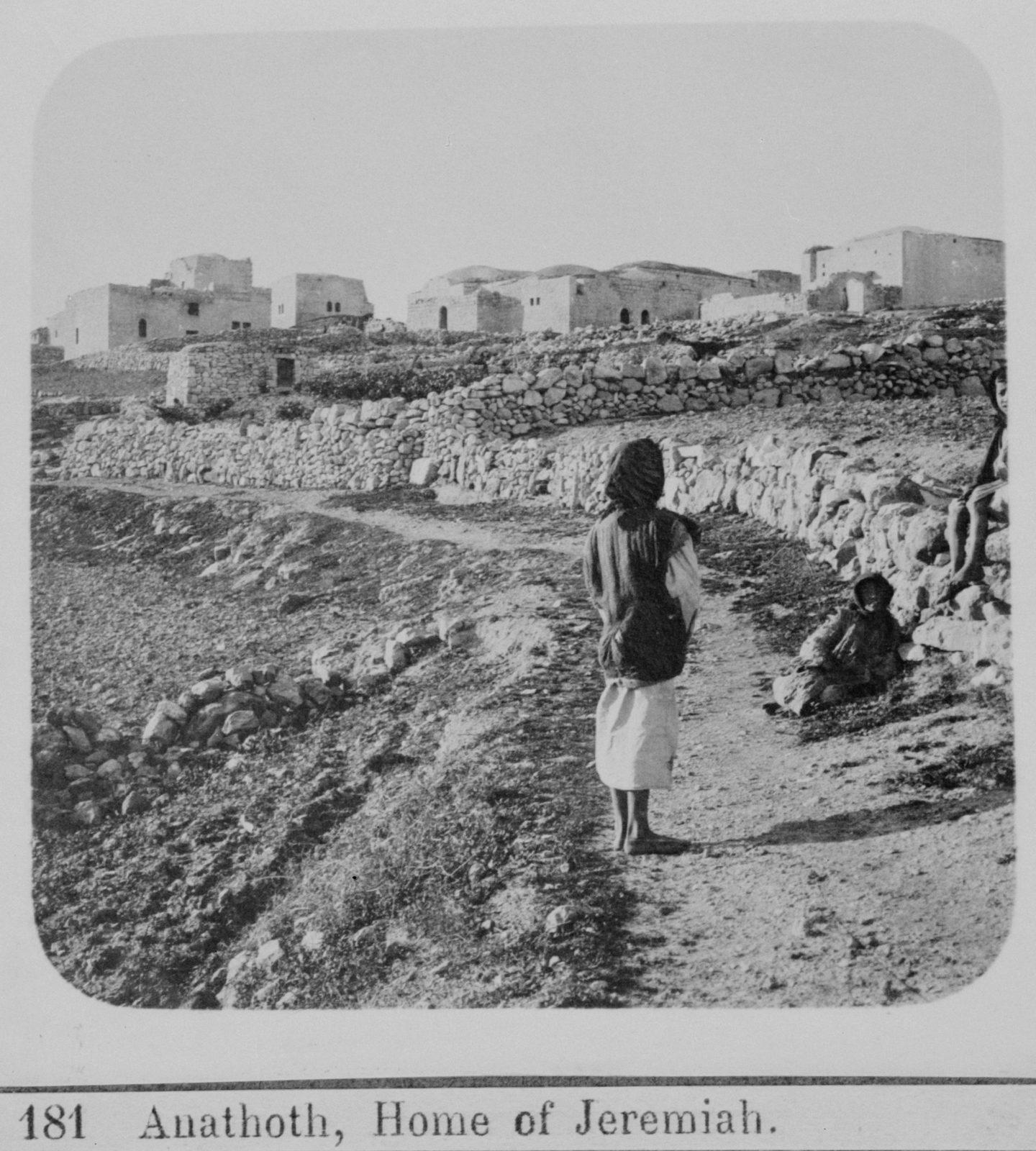
Unknown photographer, The village of Anathoth, 1900. Public domain.
Jeremiah 32, 36 and 38 · Subject · Featured Study
Deeds, Seals and Clay Impressions of Jeremiah's Jerusalem
Jeremiah 32 tells how a deed of sale was written and kept, and seal impressions from Jerusalem name men of Jeremiah's book.
Jeremiah bought a field at Anathoth while the army of Babylon besieged Jerusalem.
Then, as the LORD had said, my cousin Hanamel came to me in the courtyard of the guard and urged me, ‘Please buy my field in Anathoth in the land of Benjamin, for you own the right of inheritance and redemption. Buy it for yourself.’” Then I knew that this was the word of the LORD.
- Book
- Jeremiah
- Hold in memory
- Jeremiah 32:14
Summary
A deed of purchase was written in two copies and kept in a clay jar. Lumps of clay pressed with seals show how such documents were closed.
- Three seal impressions found in the City of David carry names that Jeremiah 36 to 38 also gives.
- A fourth, bought from a dealer, carries the name of Baruch son of Neriah.
- Scholars disagree about whether that fourth one is genuine.
A Field Bought in a Siege
In the tenth year of Zedekiah, Jeremiah was held in the courtyard of the guard.
Behold! Hanamel, the son of your uncle Shallum, is coming to you to say, ‘Buy for yourself my field in Anathoth, for you have the right of redemption to buy it.’The Purchase in Order
Jeremiah tells the sale in his own voice, step by step.
The sale runs from the silver on the scales to the deed in a clay jar.
- Jeremiah 32:9He weighs out seventeen shekels of silver for the field.Jeremiah 32:9
- Jeremiah 32:10He signs and seals the deed before witnesses.Jeremiah 32:10
- Jeremiah 32:11He takes the sealed copy with its terms and the open copy.Jeremiah 32:11
- Jeremiah 32:12He gives the deed to Baruch in front of Hanamel, the witnesses and the Jews in the courtyard.Jeremiah 32:12
- Jeremiah 32:14Baruch is to put both copies in a clay jar to keep them for a long time.Jeremiah 32:14
Five steps in order, each with its verse.
Names in Clay
A bulla is a small lump of clay pressed with a seal, used as a kind of signature on a rolled document.
H. Shanks, writing in Biblical Archaeology Review in 1987, notes that the back of a bulla often carries the print of the papyrus it closed. The fire that burned the documents baked the clay and kept it.
Three impressions dug in the City of David carry names from Jeremiah 36 to 38, and a fourth, bought from a dealer, is disputed.
| The impression reads | Where it came from | The man in Jeremiah | How firm the match is |
|---|---|---|---|
| Belonging to Gemaryahu son of Shaphan | The House of the Bullae in the City of David, dug by Yigal Shiloh, with 50 other bullae | Gemariah son of Shaphan the scribe | The Posen Library editors say he may be the scribe of that name. |
| Belonging to Yehuchal son of Shelemiyahu son of Shovi | The Large Stone Structure in the City of David, dug by E. Mazar | Jucal son of Shelemiah | Biblical Archaeology Review (2015) sets the name beside the official who urged Jeremiah's death. |
| Gedaliah son of Pashhur | The City of David, found by Mazar in 2008, a few metres from the Yehuchal impression | Gedaliah son of Pashhur | The same article sets this name beside the same verse. |
| Belonging to Berakhyahu son of Neriyahu the scribe | An antiquities shop in East Jerusalem, 1975 | Baruch son of Neriah | Disputed |
If the Shaphan of Jeremiah 26, 29 and 36 is Josiah's scribe, three of his sons and two grandsons stand near Jeremiah.
Generation 1
- ShaphanThe scribe Josiah sent to the house of the LORD
Generation 2
Generation 3
Ellicott's Commentary takes him for one man. The Cambridge Bible does so in Jeremiah 36 and calls it probable in Jeremiah 29, and Keil and Delitzsch say perhaps.
Two Copies of One Deed
The commentators explain why a deed was written twice and why one copy was closed up.
Keil and Delitzsch explain that one copy was sealed up and one left open. If the open copy was lost or damaged, a perfect original would still exist in the sealed one.
The Cambridge Bible explains sealed here as closed up, and it calls the two copies the two parts of a whole. If the sale was disputed, the closed copy was broken open in front of witnesses.
It adds that earthen jars holding such duplicate contracts had been dug up at Nippur. The Pulpit Commentary says the jar kept the deed from damp.
A Jar for a Long Time
The purchase was a sign about the land, and the jar was a sign about the wait.
Ellicott's Commentary reads the jar as a sign that the people were not to expect a speedy deliverance.
After the sale Jeremiah prayed, and he set the siege ramps against the city beside the LORD's command to buy the field (Jeremiah 32:24 to 25).
“Oh, Lord GOD! You have made the heavens and the earth by Your great power and outstretched arm. Nothing is too difficult for You!Matthew Henry on the Purchase
Henry wrote on the field that Jeremiah bought and could not go to see.
Matthew Henry (1662 to 1714)
“This is mentioned to reconcile Jeremiah to his new purchase. Though he had bought a piece of ground and could not go to see it, yet he must believe that this was the pledge of many a purchase, and those but faint resemblances of the purchased possessions in the heavenly Canaan, reserved for all those who have God's fear in their hearts and do not depart from him.”
Matthew Henry · Commentary on the Whole Bible · on Jeremiah 32:43 to 44Puritan
The Baruch Bulla Weighed
The impression naming Berakhyahu son of Neriyahu has been read as Baruch's own and as a modern forgery.
N. Avigad published the bulla in 1986, and Y. Goren and E. Arie studied its clay in 2014.
| Reading | Held by | Work |
|---|---|---|
| The seal of Baruch, Jeremiah's scribe | N. Avigad | Hebrew Bullae from the Time of Jeremiah (1986) |
| A modern forgery | Y. Goren and E. Arie | The Authenticity of the Bullae of Berekhyahu Son of Neriyahu the Scribe, Bulletin of the American Schools of Oriental Research 372 (2014) |
The case for Baruch's seal1 paragraph
Avigad identified the man named on the bulla with Baruch son of Neriah, Jeremiah's scribe, in his book on the bullae of Jeremiah's time.
The case for a forgery1 paragraph
Goren and Arie studied the clay of this bulla and of a second one with the same name, and concluded that both were made in modern times. H. Shanks reported in 1987 that the hoard first appeared in a dealer's shop, so no dig records where it lay.
Books to Read Next
Two older commentaries explain the deed verse by verse.
Biblical Commentary on the Old Testament: Jeremiah
Carl Friedrich Keil and Franz Delitzsch · 1857 to 1878
It explains the two copies, the witnesses and the jar.
Read it free at BibleHubNotes, Explanatory and Practical, on the Old and New Testaments
Albert Barnes · 1832 to 1869
Barnes explains the price of the field and the terms written in the deed.
Read it free at BibleHubDeeds Will Be Signed Again
The chapter ends with deeds signed across Benjamin and Judah.
The prisoner's single purchase stood as a pledge for a whole land of sales.
Fields will be purchased with silver, and deeds will be signed, sealed, and witnessed in the land of Benjamin, in the areas surrounding Jerusalem, and in the cities of Judah—the cities of the hill country, the foothills, and the Negev—because I will restore them from captivity, declares the LORD.”Sources
Scripture is the Berean Standard Bible.
- Carl Friedrich Keil and Franz Delitzsch, Biblical Commentary on the Old Testament (1857 to 1878), on Jeremiah 29:3 and 32:11 to 14; public domain.
- The Cambridge Bible for Schools and Colleges, on Jeremiah 29:3, 32:10 to 11 and 36:10; public domain.
- The Pulpit Commentary, on Jeremiah 32:10 to 14; public domain.
- Ellicott's Commentary for English Readers, on Jeremiah 32:14 and 36:10; public domain.
- Albert Barnes, Notes, Explanatory and Practical (1832 to 1869), on Jeremiah 32:9 to 10.
- H. Shanks, Jeremiah's Scribe and Confidant Speaks from a Hoard of Clay Bullae, Biblical Archaeology Review 13:5 (1987), cite-only.
- T. Schneider, Six Biblical Signatures, Biblical Archaeology Review 17:4 (1991), cite-only, for the Gemaryahu reading and its find.
- The Posen Library of Jewish Culture and Civilization, volume 1 (2021), Four Bullas from the City of David, citing Avigad and Sass, Corpus of West Semitic Stamp Seals (1997)
- Seals of Jeremiah's Captors Who Urged Imprisonment, Biblical Archaeology Review (September and October 2015), cite-only.
- E. Mazar, Did I Find King David's Palace?, Biblical Archaeology Review, for the Yehuchal reading, cite-only.
- Arutz Sheva news report on the Gedaliah son of Pashhur bulla, 3 August 2008.
- Y. Goren and E. Arie, The Authenticity of the Bullae of Berekhyahu Son of Neriyahu the Scribe, Bulletin of the American Schools of Oriental Research 372 (2014) 147 to 158, cite-only.
- N. Avigad, Hebrew Bullae from the Time of Jeremiah (1986), cite-only.
- Matthew Henry, Commentary on the Whole Bible (1710), on Jeremiah 32:43 to 44.
Keep Studying
Read it4
Doctrines1
People and groups4
Places1
Symbols2