
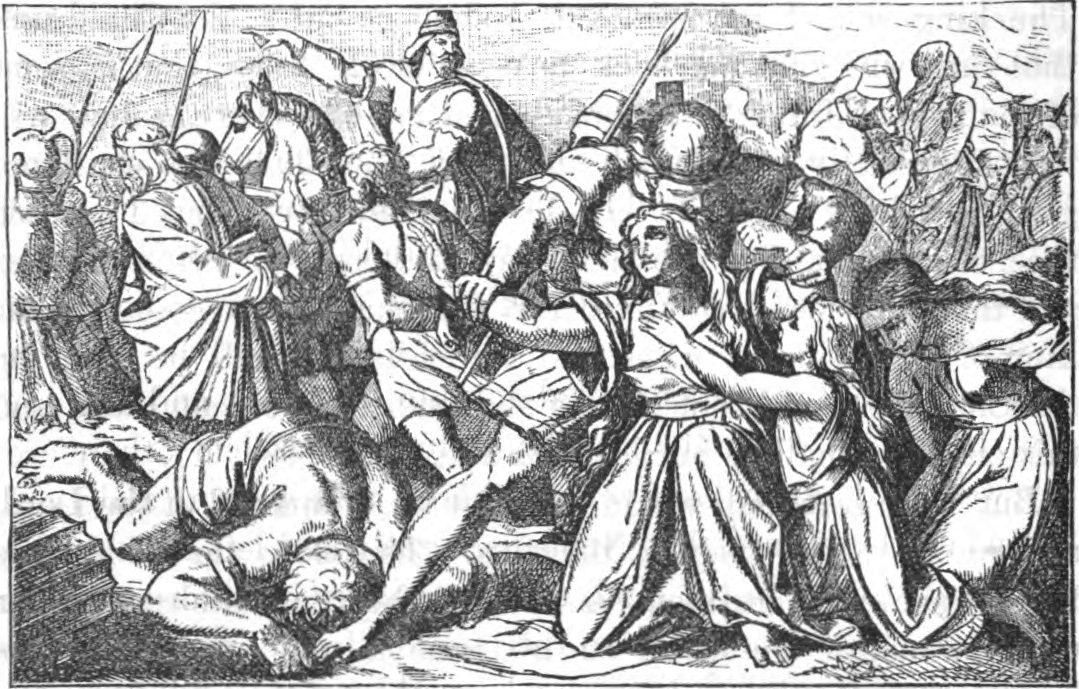
Unknown engraver, Zedekiah and the people of Judah carried captive, 1873. Public domain.
Ezekiel 21 · Subject · Featured Study
Until He Comes Whose Right It Is
Ezekiel 21:25 to 27 is the sentence on Zedekiah, the last king of Judah, and the promise of a rightful heir.
A ruin, a ruin, I will make it a ruin! And it will not be restored until the arrival of Him to whom it belongs, to whom I have assigned the right of judgment.’
- Book
- Ezekiel
- Hold in memory
- Ezekiel 21:27
The King James Version says overturn three times in one verse.
Summary
The oracle ends a reign but keeps the hope of David's line.
- The Pulpit Commentary calls Ezekiel 21:27 Ezekiel's first clear hope of a personal Messiah.
- Ellicott finds the rights of priest and king joined in the Messiah, as Zechariah 6:12 to 13 foretells.
- Keil and Delitzsch hold that even the overthrow will not last.
The Profane Prince
The oracle turns from the sword of Babylon to Zedekiah, the king who broke his oath.
And you, O profane and wicked prince of Israel, the day has come for your final punishment.’ This is what the Lord GOD says: ‘Remove the turban, and take off the crown. Things will not remain as they are: Exalt the lowly and bring low the exalted.John Wesley reads the day that has come as the day of sorrow and punishment, which ends both the king and the kingdom.
The Right to Rule
Six texts trace the throne of Judah from Jacob's blessing to the promise of David's heir.
The scepter passes to Judah and to Zedekiah, is lost with him, and is promised to David's heir.
- What it adds
- the scepter will not depart from Judah until Shiloh comes
- What it adds
- the king of Babylon renames Mattaniah and sets him on the throne
- What it adds
- Zedekiah sends to Egypt for horses and an army
- What it adds
- Zedekiah is blinded and taken in shackles to Babylon
- What it adds
- My servant David will be a prince among them
- What it adds
- My servant David will be king over them
Jacob's blessing stands in Genesis, and the last two links in Ezekiel.
The Lowly Raised Up
The sentence on Zedekiah raises someone low, and the commentators name him in three ways.
Three commentaries name three different ones raised up.
| Commentary | The one raised up |
|---|---|
| John Wesley | Jeconiah |
| Adam Clarke | Gedaliah, who governs Judea |
| The Cambridge Bible | The humble, at the last |
The End of Zedekiah
The king of Babylon chose the road to Jerusalem by omens.
For the king of Babylon stands at the fork in the road, at the junction of the two roads, to seek an omen: He shakes the arrows, he consults the idols, he examines the liver.The Pulpit Commentary says Zedekiah proved unfaithful both to the LORD and to the Chaldean king.
To Whom It Belongs
The oracle's last line reads differently in the two translations.
The Pulpit Commentary calls the threefold word in verse 27 a Hebrew way of stressing the sentence. The King James Version reads "I will overturn, overturn, overturn, it."
It goes on "until he come whose right it is," where the Berean text reads "to whom it belongs."
Keil and Delitzsch, Ellicott and Barnes' Notes all name the one to whom the right belongs as the Messiah.
Henry on Zedekiah
Matthew Henry gave his verdict on the last king of Judah.
Matthew Henry (1662 to 1714)
His note answers whether Zedekiah was the worst of the kings.
“He was not so bad as some of his predecessors, and yet bad enough to merit his character. He was himself profane, lost to every thing that is virtuous and sacred. And he was wicked, as he promoted sin among his people; he sinned, and made Israel to sin.”
Matthew Henry · Commentary on the Whole Bible · on Ezekiel 21:25Puritan
The Readings Weighed
Three questions about the oracle divide the commentators.
Do the priesthood and the kingship end together?Keil and Delitzsch; Ellicott; Barnes' Notes; the Cambridge Bible; John Wesley
Keil and Delitzsch read the turban as the high priest's tiara, a word Ezekiel took from the books of Moses, and the crown as the king's. They call the words a sentence of death on the rule of priest and king. Ellicott and Barnes' Notes take the same view.
The Cambridge Bible answers that the passage speaks of the royal house alone, which loses its crown. John Wesley reads the turban as the royal headdress the king wore each day.
Who is the rightful heir in Ezekiel's day?Barnes' Notes; Keil and Delitzsch
Keil and Delitzsch answer that the Hebrew word behind right, mishpat, means the right that belongs to God and is entrusted to the earthly ruler, and no heir's claim.
Is the prince called profane or slain?Adam Clarke; Keil and Delitzsch; the Cambridge Bible
Adam Clarke keeps the word profane and says Zedekiah is called so because he had broken his oath.
Keil and Delitzsch reply that the word means pierced or slain, and the Cambridge Bible allows that it may mean slain.
Books to Read Next
Two older commentaries read the oracle against Zedekiah verse by verse.
Biblical Commentary on the Old Testament
Carl Friedrich Keil and Franz Delitzsch · 1857 to 1878
The commentary explains the Hebrew of the turban, the ruin and the right.
Read it free at BibleHubCommentary on the Whole Bible
Matthew Henry · 1710
Henry reads the oracle as comfort for those who feared the promise to David would fail.
Read it free at BibleHubThe Throne of His Father David
Luke gives the angel's promise to Mary about her son's kingdom.
He will be great and will be called the Son of the Most High. The Lord God will give Him the throne of His father David, and He will reign over the house of Jacob forever. His kingdom will never end!”Sources
Scripture is the Berean Standard Bible.
- The King James Version, Ezekiel 21:26 to 27.
- Carl Friedrich Keil and Franz Delitzsch, Biblical Commentary on the Old Testament (1857 to 1878), on Ezekiel 21; public domain.
- The Cambridge Bible for Schools and Colleges, on Ezekiel 21; public domain.
- The Pulpit Commentary, on Ezekiel 21; public domain.
- Ellicott's Commentary for English Readers, on Ezekiel 21; public domain.
- Barnes' Notes on the Bible, on Ezekiel 21, as BibleHub prints it; public domain.
- The commentators' notes on Ezekiel 21:25 to 27.
- John Wesley, Explanatory Notes upon the Old Testament (1765), on Ezekiel 21:25 to 26.
- Adam Clarke, Commentary on the Bible, on Ezekiel 21:25 to 26.
- Jerome, Commentary on Ezekiel, on Ezekiel 1:1.
- Matthew Henry, Commentary on the Whole Bible (1710), on Ezekiel 21:25.
Keep Studying
Read it3
Studies4
People and groups5
Symbols1
Subjects1