
Judges 16:19
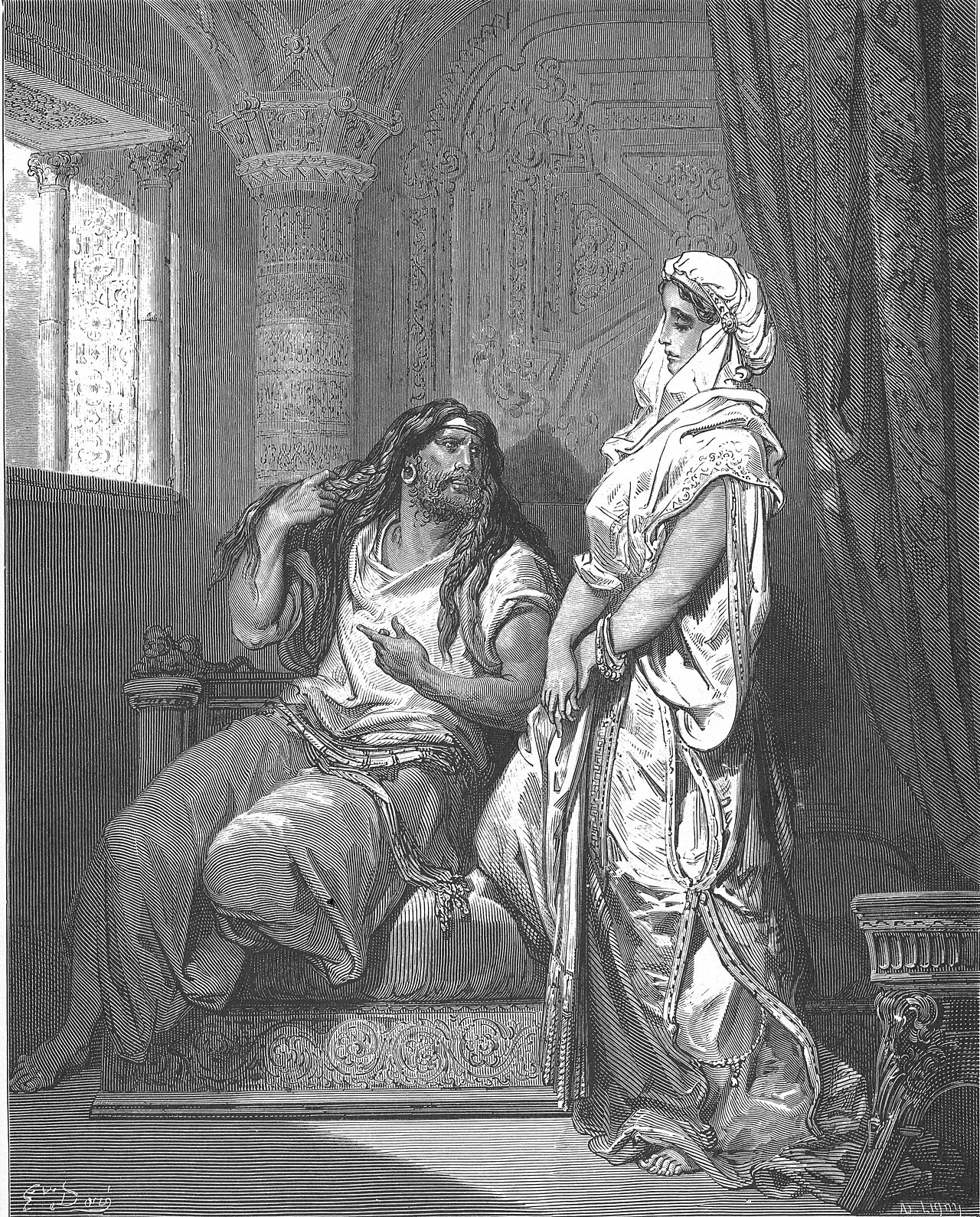
in Judges 16And having lulled him to sleep on her lap, she called a man to shave off the seven braids of his head. In this way she began to subdue him, and his strength left him.
BSB
The same verse in ASV and KJV ▾
ASV
And she made him sleep upon her knees; and she called for a man, and shaved off the seven locks of his head; and she began to afflict him, and his strength went from him.
KJV
And she made him sleep upon her knees; and she called for a man, and she caused him to shave off the seven locks of his head; and she began to afflict him, and his strength went from him.
⋯
This verse in Judges 16
Commentary
8 notes on this verseBut the one who has taken root as "a fruitful olive tree in the house of God" composes those words against the tyrant which we have heard in the psalm, saying, "Why do you glory in evil, you who are mighty in iniquity," whose "tongue" is "like a sharp razor." It was by means of these two things that [Samson] was led off, after [Delilah] had removed the beauty of his hair and cut off the "seven locks of curls" in which our strength lies.
This site's exposition
bringing the money in their hands
on Judges 16:18-19
The lords come up themselves this time, “bringing the money in their hands”, which the earlier attempts never mention. She calls a man to shave Samson while he sleeps on her lap, so a hired hand ends the vow while he is asleep. The word subdue has run through the bargain since verse 5, and verse 19 says “she began to subdue him”, the errand finished.
This site's exposition
having lulled him to sleep on her lap
Jamieson, Fausset and Brown note that the Hebrew verb for shaving is sometimes the word for shearing sheep. Adam Clarke reads she began to subdue him as Delilah testing his weakness with taunts before she called the Philistines. His strength had already gone.
The record, by era
The Church Fathers1 voice
Now what does it mean that Samson possessed strength in his hair? Notice this carefully, too, brothers. He did not have strength in his hand, his foot, his chest, not even in his head, but in his hair. What is hair? If we perceive it, …
The Puritans and the Awakening2 voices
And she made him sleep upon her knees,....
I think we may suppose that if this ill turn had been done to him in his sleep by some spiteful body, without his being himself accessory to it, as he was here, it would not have had this strange effect upon him; but it was his own wickedness that corrected him. It was his iniquity, else it would not have been so much his infelicity.
The Nineteenth Century2 voices
She began to affect him - She had probably tied his hands slyly, while he was asleep, and after having cut off his hair, she began to insult him before she called the Philistines, to try whether he were really reduced to a state of weakness.
A commentator
Jamieson, Fausset & Brown1802–1910
Commentary Critical and Explanatory on the Whole Bible (1871)
proposed
she called for a man, and she caused him to shave off the seven locks of his head--It is uncertain, however, whether the ancient Hebrews cut off the hair to the same extent as Orientals now. The word employed is sometimes the same as that for shearing sheep, and therefore the instrument might be only scissors.
quarantine:debris (2026-07-29) — starts-lowercase
How the passage was read
What the Jewish commentators add
On the verses either side of this one
Delilah saw that he had confided to her. One instinctively recognizes the truth. 2 Sotah,:b
This section is reception history: how the passage was read and kept in the Jewish tradition. Where a reading parts from an essential of the Christian faith, the section says so at that point.
Texts and citation data: Sefaria; each excerpt follows its version’s licence. 5 further sources are cited on this chapter that carry no English text this site may quote or only restate the verse.
The words behind it
15 Hebrew wordsEvery Hebrew word of this verse in the order it stands, with what it means and the door to its own study. The last column counts the times a word stands in the whole Bible: the rarer the word, the more the places it appears belong together.
| Hebrew | Sound | Meaning | Word study | In the Bible |
|---|---|---|---|---|
| וַתְּיַשְּׁנֵ֙הוּ֙ | vateyashenehu | and she made sleep him | H3462 → | |
| עַל־ | ʾal- | on | H5921 → | 5755 times |
| בִּרְכֶּ֔יהָ | birkeiha | knees her | H1290 → | 25 times |
| וַתִּקְרָ֣א | vatikra' | and she summoned | H7121 → | 733 times |
| לָאִ֔ישׁ | laish | <to> the man | H376 → | 1663 times |
| וַתְּגַלַּ֕ח | vategalach | and she shaved off | H1548 → | 23 times |
| אֶת־ | ʾet- | <obj.> | H853 → | 10935 times |
| שֶׁ֖בַע | sheva' | seven | H7651 → | 394 times |
| מַחְלְפ֣וֹת | machlefot | [the] plaits of | H4253 → | |
| רֹאשׁ֑וֹ | rosho | head his | H7218 → | 599 times |
| וַתָּ֙חֶל֙ | vatachel | and she began | H2490 → | 143 times |
| לְעַנּוֹת֔וֹ | leanoto | to humble him | H6031 → | 82 times |
| וַיָּ֥סַר | vaiyasar | and it departed | H5493 → | 299 times |
| כֹּח֖וֹ | kocho | strength his | H3581 → | 126 times |
| מֵעָלָֽיו׃ | mealav | from on <the> him | H5921 → | 5755 times |
וַתְּיַשְּׁנֵ֙הוּ֙and she made sleep him
vateyashenehuH3462 →
עַל־on
ʾal-H5921 →5755 times
בִּרְכֶּ֔יהָknees her
birkeihaH1290 →25 times
וַתִּקְרָ֣אand she summoned
vatikra'H7121 →733 times
לָאִ֔ישׁ<to> the man
laishH376 →1663 times
וַתְּגַלַּ֕חand she shaved off
vategalachH1548 →23 times
אֶת־<obj.>
ʾet-H853 →10935 times
שֶׁ֖בַעseven
sheva'H7651 →394 times
מַחְלְפ֣וֹת[the] plaits of
machlefotH4253 →
רֹאשׁ֑וֹhead his
roshoH7218 →599 times
וַתָּ֙חֶל֙and she began
vatachelH2490 →143 times
לְעַנּוֹת֔וֹto humble him
leanotoH6031 →82 times
וַיָּ֥סַרand it departed
vaiyasarH5493 →299 times
כֹּח֖וֹstrength his
kochoH3581 →126 times
מֵעָלָֽיו׃from on <the> him
mealavH5921 →5755 times
A shaded row is a word that stands 400 times or fewer in the Bible.
The walk
5 stopsEach card is a verse this one points to, and under it the verses that one points to in turn. Where several paths arrive at the same place, that place is listed first: the text keeps returning to it.
Through
Ecclesiastes 7:26And I find more bitter than death the woman who is a snare, whose heart is a net, and whose hands are chains. The man who pleases God escapes her, but the sinner is…
it leads to
- Proverbs 22:14
The mouth of an adulteress is a deep pit; he who is under the wrath of the LORD will fall into it.
- Proverbs 5:3–5
Though the lips of the forbidden woman drip honey and her speech is smoother than oil,
- Proverbs 2:16
It will rescue you from the forbidden woman, from the stranger with seductive words
- Ecclesiastes 2:26
To the man who is pleasing in His sight, He gives wisdom and knowledge and joy, but to the sinner He assigns the task of gathering and accumulating that which he will hand over…
- Proverbs 2:18–19
For her house sinks down to death, and her tracks to the departed spirits.
- Proverbs 22:14
About Judges
This page draws on Adam Clarke, Commentary on the Bible; Caesarius of Arles, SERMON 118.6; Gregory of Nyssa, ON THE INSCRIPTIONS OF THE PSALMS 2.13.183; Jamieson, Fausset & Brown, Commentary Critical and Explanatory on the Whole Bible; John Gill, Exposition of the Old Testament; John Gill, Exposition of the Old Testament (1748-1763) and Matthew Henry, Commentary on the Whole Bible.