
Judges 14:9
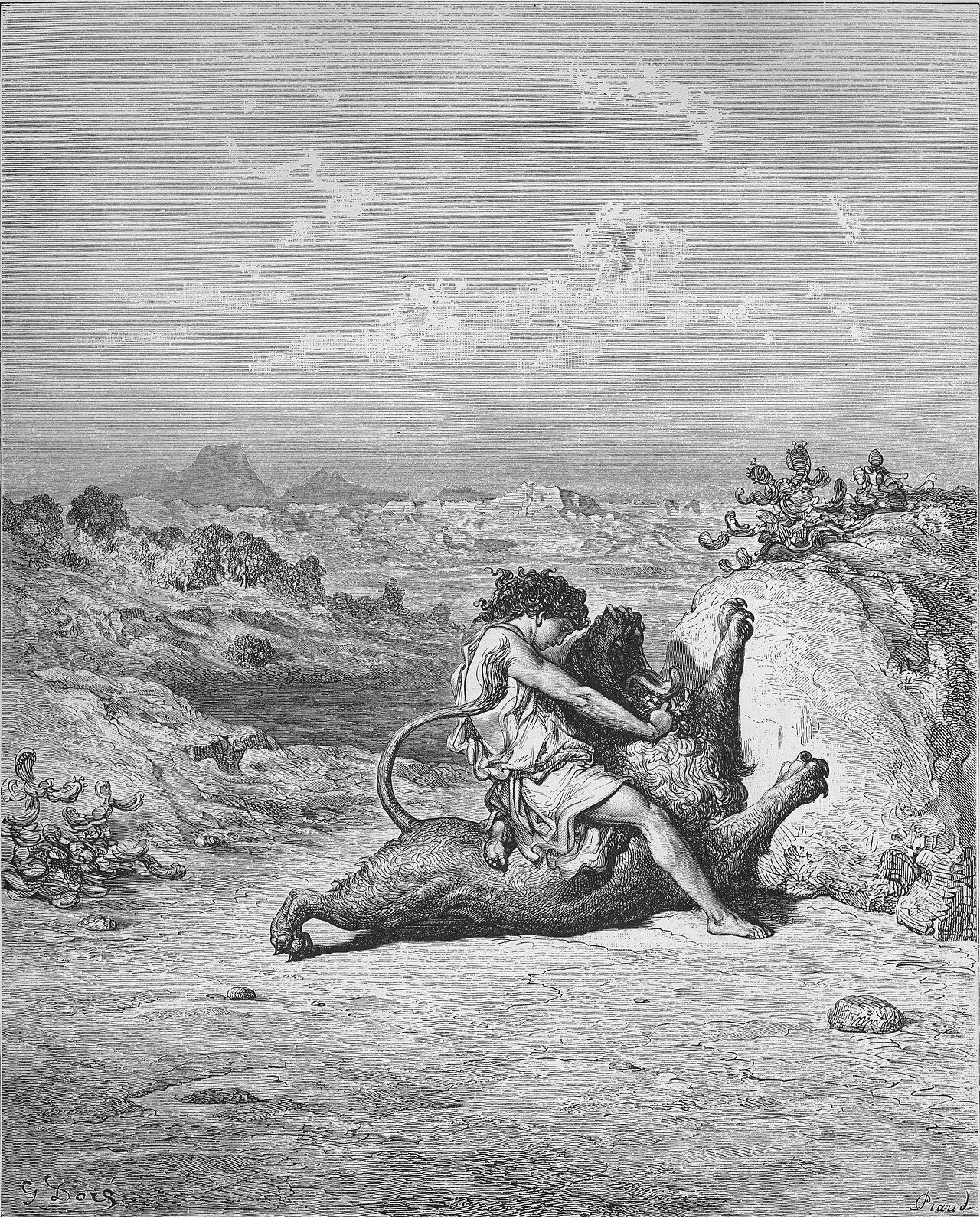
in Judges 14So he scooped some honey into his hands and ate it as he went along. And when he returned to his father and mother, he gave some to them and they ate it. But he did not tell them that he had taken the honey from the lion’s carcass.
BSB
The same verse in ASV and KJV ▾
ASV
And he took it into his hands, and went on, eating as he went; and he came to his father and mother, and gave unto them, and they did eat: but he told them not that he had taken the honey out of the body of the lion.
KJV
And he took thereof in his hands, and went on eating, and came to his father and mother, and he gave them, and they did eat: but he told not them that he had taken the honey out of the carcase of the lion.
⋯
This verse in Judges 14
Commentary
8 notes on this verseIT was a singular circumstance that a man unarmed should have slain a lion in the prime of its vigor and yet, more strange that a swarm of bees should have taken possession of the dried carcass and have filled it with their honey. In that country, what with beasts, birds, insects and the dry heat, a dead body is soon cleansed from all corruption and the bones are clean and white. Still, the killing of the lion and the finding of the honey make up a remarkable story.
This site's exposition
spoke to the woman
on Judges 14:7-9
Numbers 6:6 keeps a Nazirite from any dead body. Samson leaves the road to see “the lion’s carcass”, takes its honey and gives some to his parents without saying where it came from. Adam Clarke reads the interval as about a year, the usual space between betrothal and wedding.
This site's exposition
he scooped some honey into his hands
Matthew Henry notes that honey was one of the goods of a land said to flow with milk and honey. Charles Spurgeon preached this verse as Hands Full of Honey. Samson gave the honey to the father and mother who had opposed the marriage.
The record, by era
The Church Fathers1 voice
On his returning by the same road he found an honeycomb in the belly of the lion, and carried it off as a gift to the maiden and her parents; for such gifts befit a bride. And having first tasted the honey, he gave them the comb to eat, but was silent as to whence it came.
The Puritans and the Awakening2 voices
And he took thereof in his hands, and went on eating,....
There he found the carcase of the lion; the birds or beasts of prey, it is likely, had eaten the flesh, and in the skeleton a swarm of bees had knit, and made a hive of it, and had not been idle, but had there laid up a good stock of honey, which was one of the staple commodities of Canaan; such plenty there was of it that the land is said to flow with milk and honey.
The Nineteenth Century2 voices
A commentator
Jamieson, Fausset & Brown1802–1910
Commentary Critical and Explanatory on the Whole Bible (1871)
proposed
a young lion--Hebrew, a lion in the pride of his youthful prime. The wild mountain passes of Judah were the lairs of savage beasts; and most or all the "lions" of Scripture occur in that wild country.
quarantine:debris (2026-07-29) — starts-lowercase
IT was a singular circumstance that a man unarmed should have slain a lion in the prime of its vigor and yet, more strange that a swarm of bees should have taken possession of the dried carcass and have filled it with their honey. In that country, what with beasts, birds, insects and the dry heat, a dead body is soon cleansed from all corruption and the bones are clean and white. Still, the killing of the lion and the finding of the honey make up a remarkable story. These singular circumstances became, afterwards, the subject of a riddle—but with that riddle we have no concern at this time. Samson, himself, is a riddle! He was not only a riddle-maker, but he was, himself, an enigma very difficult to explain. With his personal character I have, at this time, little or nothing to do. We are not, today, resting at the house of "Gains, my host," where the pilgrims amused themselves with a dish of nuts after dinner, but we are on the march and must attend to the more important matter of refreshing and inspiriting those who are in our company. Neither are we going to discuss difficulties, but as Samson took the honey without being stung, so would we gain instruction without debate. We have, in these days, so much to do that we must make practical use of every incident that comes before us in the Word of God. My one design is to cheer the desponding and stir up all God's people to greater diligence in His service. I conceive that the text may legitimately be employed for this purpose. By the help of the Divine Spirit, even after this lapse of time, we may find honey in the lion! The particular part of the incident which is recorded in these two verses appears to have been passed over by those who have written upon Samson's life—I suppose it appeared to be too inconceivable.
How the passage was read
What the Jewish commentators add
On the verses either side of this one
His father descended to discuss the woman. With regard to the woman.
This section is reception history: how the passage was read and kept in the Jewish tradition. Where a reading parts from an essential of the Christian faith, the section says so at that point.
Texts and citation data: Sefaria; each excerpt follows its version’s licence. 4 further sources are cited on this chapter that carry no English text this site may quote or only restate the verse.
The words behind it
22 Hebrew wordsEvery Hebrew word of this verse in the order it stands, with what it means and the door to its own study. The last column counts the times a word stands in the whole Bible: the rarer the word, the more the places it appears belong together.
| Hebrew | Sound | Meaning | Word study | In the Bible |
|---|---|---|---|---|
| וַיִּרְדֵּ֣הוּ | vaiyirdehu | and he scraped out it | H7287 → | |
| אֶל־ | ʾel- | into | H413 → | 5510 times |
| כַּפָּ֗יו | kapav | palms his | H3709 → | 192 times |
| וַיֵּ֤לֶךְ | vaiyelekh | and he went | H1980 → | 1546 times |
| הָלוֹךְ֙ | halokh | continuously <to go> | H1980 → | 1546 times |
| וְאָכֹ֔ל | veakhol | and eating | H398 → | 810 times |
| וַיֵּ֙לֶךְ֙ | vaiyelekh | and he came | H1980 → | 1546 times |
| אֶל־ | ʾel- | to | H413 → | 5510 times |
| אָבִ֣יו | ʾaviv | father his | H1 → | 1212 times |
| וְאֶל־ | veel- | and to | H413 → | 5510 times |
| אִמּ֔וֹ | ʾimo | mother his | H517 → | 220 times |
| וַיִּתֵּ֥ן | vaiyiten | and he gave | H5414 → | 2011 times |
| לָהֶ֖ם | lahem | to <the> them | ||
| וַיֹּאכֵ֑לוּ | vaiyokhelu | and they ate | H398 → | 810 times |
| וְלֹֽא־ | velo'- | and not | H3808 → | 5168 times |
| הִגִּ֣יד | higid | he told | H5046 → | 370 times |
| לָהֶ֔ם | lahem | to <the> them | ||
| כִּ֛י | ki | that | H3588 → | 4482 times |
| מִגְּוִיַּ֥ת | migeviyat | from [the] carcass of | H1472 → | |
| הָאַרְיֵ֖ה | haaryeh | the lion | H738 → | 80 times |
| רָדָ֥ה | radah | he had scraped out | H7287 → | |
| הַדְּבָֽשׁ׃ | hadevash | the honey | H1706 → | 54 times |
וַיִּרְדֵּ֣הוּand he scraped out it
vaiyirdehuH7287 →
אֶל־into
ʾel-H413 →5510 times
כַּפָּ֗יוpalms his
kapavH3709 →192 times
וַיֵּ֤לֶךְand he went
vaiyelekhH1980 →1546 times
הָלוֹךְ֙continuously <to go>
halokhH1980 →1546 times
וְאָכֹ֔לand eating
veakholH398 →810 times
וַיֵּ֙לֶךְ֙and he came
vaiyelekhH1980 →1546 times
אֶל־to
ʾel-H413 →5510 times
אָבִ֣יוfather his
ʾavivH1 →1212 times
וְאֶל־and to
veel-H413 →5510 times
אִמּ֔וֹmother his
ʾimoH517 →220 times
וַיִּתֵּ֥ןand he gave
vaiyitenH5414 →2011 times
לָהֶ֖םto <the> them
lahem
וַיֹּאכֵ֑לוּand they ate
vaiyokheluH398 →810 times
וְלֹֽא־and not
velo'-H3808 →5168 times
הִגִּ֣ידhe told
higidH5046 →370 times
לָהֶ֔םto <the> them
lahem
כִּ֛יthat
kiH3588 →4482 times
מִגְּוִיַּ֥תfrom [the] carcass of
migeviyatH1472 →
הָאַרְיֵ֖הthe lion
haaryehH738 →80 times
רָדָ֥הhe had scraped out
radahH7287 →
הַדְּבָֽשׁ׃the honey
hadevashH1706 →54 times
A shaded row is a word that stands 400 times or fewer in the Bible.
The walk
5 stopsEach card is a verse this one points to, and under it the verses that one points to in turn. Where several paths arrive at the same place, that place is listed first: the text keeps returning to it.
Through
Proverbs 25:15Through patience a ruler can be persuaded, and a gentle tongue can break a bone.
it leads to
- Proverbs 15:1
A gentle answer turns away wrath, but a harsh word stirs up anger.
- Ecclesiastes 10:4
If the ruler’s temper flares against you, do not abandon your post, for calmness lays great offenses to rest.
- Proverbs 16:14
The wrath of a king is a messenger of death, but a wise man will pacify it.
- Genesis 32:4–21
He instructed them, “You are to say to my master Esau, ‘Your servant Jacob says: I have been staying with Laban and have remained there until now.
- 1 Samuel 25:14
Meanwhile, one of Nabal’s young men informed Nabal’s wife Abigail, “Look, David sent messengers from the wilderness to greet our master, but he scolded them.
- Proverbs 15:1
Where this verse is studied
On this page
About Judges
This page draws on Adam Clarke, Commentary on the Bible; Ambrose of Milan, Letter 19.14; Charles Spurgeon, The Metropolitan Tabernacle Pulpit, Sermon No. 1703: “Hands Full of Honey” (lightly modernized text, CCEL edition); Charles Spurgeon, The Metropolitan Tabernacle Pulpit, Sermon No. 1703: “Hands Full of Honey”; Jamieson, Fausset & Brown, Commentary Critical and Explanatory on the Whole Bible; John Gill, Exposition of the Old Testament; John Gill, Exposition of the Old Testament (1748-1763) and Matthew Henry, Commentary on the Whole Bible.