
Judges 16:4
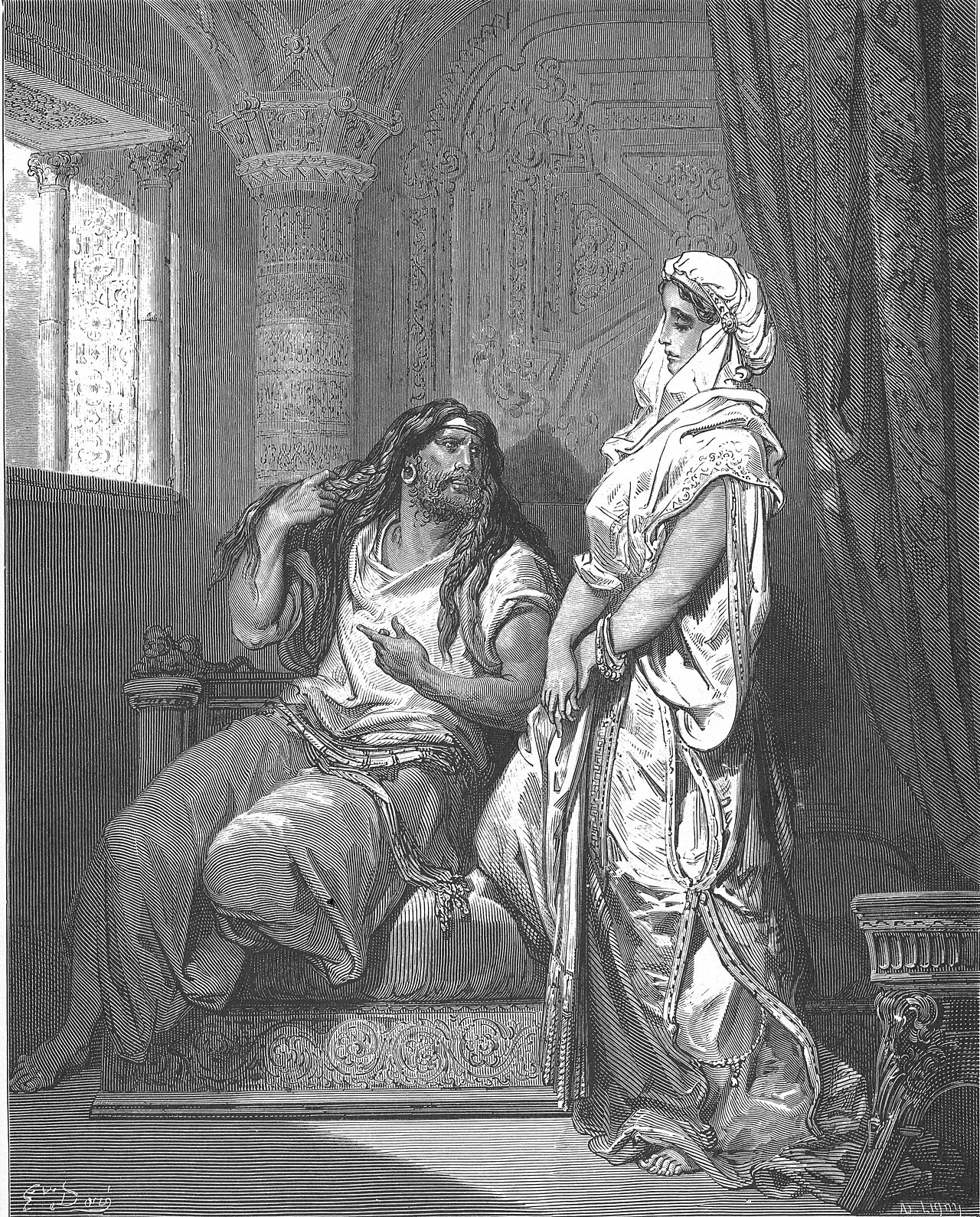
in Judges 16Some time later, Samson fell in love with a woman in the Valley of Sorek, whose name was Delilah.
BSB
The same verse in ASV and KJV ▾
ASV
And it came to pass afterward, that he loved a woman in the valley of Sorek, whose name was Delilah.
KJV
And it came to pass afterward, that he loved a woman in the valley of Sorek, whose name was Delilah.
⋯
This verse in Judges 16
Commentary
11 notes on this verseHe loved a woman in the valley of Sorek - Some think Samson took this woman for his wife; others, that he had her as a concubine. It appears she was a Philistine; and however strong his love was for her, she seems to have had none for him. He always matched improperly, and he was cursed in all his matches. Where the valley or brook of Sorek was, is not easy to be ascertained. Eusebius and Jerome say it lay southward of Eleutheropolis; but where was Eleutheropolis?
This site's exposition
in the valley of Sorek
on Judges 16:4-5
Delilah is the only woman in the Samson account given a name, since his mother, the woman of Timnath and the woman of verse 1 all go unnamed. This is the first time the text says Samson loved anyone, and it says nothing of her loving him. The word the lords give her, entice, is the word used against the woman of Timnath at 14:15, where the lever was fire rather than money. Eleven hundred pieces of silver apiece is the fee, and the same sum turns up once more in Scripture, at Judges 17:2-3, as the money Micah took from his mother.
The record, by era
The Church Fathers2 voices
Overcome by love of money, Achan led to destruction all the people of the fathers. So Joshua the son of Nun, who could stay the sun from setting, could not stay the love of money in people from creeping on. At the sound of his voice the sun stood still, but love of money stayed not. When the sun stood still, Joshua completed his triumph, but when love of money went on, he almost lost the victory.Why? Did not the woman Delilah's love of money deceive Samson, the bravest man of all?
But now his licence transgressed the limits not only of his paternal territory, but of good morals, such as ancient discipline had prescribed, and this brought upon him destruction in the end. For although he had experienced in his first marriage the treachery of a foreign wife, and ought to have avoided it in future, he did not shun connecting himself with the harlot Delilah, and by his passionate love of her opened a way for the craft of his enemies to assail him. For the Philistines came up to her, and promised each of them to give her eleven hundred pieces of silver if she would disclose to them wherein his assurance of strength lay, that by means of this knowledge they might entrap and take him.
The Medieval Church1 voice
Why was the mighty man Samson rejected by God, he who was set apart and consecrated to God while still in the womb; whose birth was announced by an angel, like John, the son of Zacharias; who was granted great power and worked great wonders …
The Puritans and the Awakening2 voices
But first, it is probable, that Samson had in some measure repented of his sin, and begged of God pardon and assistance. 2.This singular strength and courage was not in itself a grace, but a gift, and it was such a gift as did not so much depend on the disposition of his mind, but on the right ordering of his body, by the rule given to him, and others of that order.
Loved - Probably as an harlot: because the dreadful punishment now inflicted upon Samson for this sin, whom God spared for the first offense, is an intimation, that this sin was not inferior to the former.
4 more voices on this verse
The Puritans and the Awakening2 voices
And it came to pass afterwards, that he loved a woman in the valley of Sorek,....
Some think she was his wife, but then he would have had her home to his own house; others that he courted her to make her his wife; but there is too much reason to suspect that it was a sinful affection he had for her, and that he lived in uncleanness with her.
The Nineteenth Century2 voices
A commentator
Jamieson, Fausset & Brown1802–1910
Commentary Critical and Explanatory on the Whole Bible (1871)
proposed
he loved a woman in the valley of Sorek--The location of this place is not known, nor can the character of Delilah be clearly ascertained. Her abode, her mercenary character, and her heartless blandishments afford too much reason to believe she was a profligate woman.
quarantine:debris (2026-07-29) — starts-lowercase
A commentator
Albert Barnes1798–1870
Notes, Explanatory and Practical, on the Old and New Testaments (1832-1869)
proposed
A village to the north of Eleutheropolis, called Caphar-Sotek, was still existing in the time of Eusebius, near Zorah.
The words behind it
9 Hebrew wordsEvery Hebrew word of this verse in the order it stands, with what it means and the door to its own study. The last column counts the times a word stands in the whole Bible: the rarer the word, the more the places it appears belong together.
| Hebrew | Sound | Meaning | Word study | In the Bible |
|---|---|---|---|---|
| וַֽיְהִי֙ | vayhi | and it was | H1961 → | 3559 times |
| אַחֲרֵי־ | ʾacharei- | after | H310 → | 715 times |
| כֵ֔ן | khen | thus | H3651 → | 771 times |
| וַיֶּאֱהַ֥ב | vaiyeehav | and he loved | H157 → | 211 times |
| אִשָּׁ֖ה | ʾishah | a woman | H802 → | 781 times |
| בְּנַ֣חַל | benachal | in [the] valley of | H5158 → | 141 times |
| שֹׂרֵ֑ק | sorek | Sorek | H7796 → | |
| וּשְׁמָ֖הּ | ushemah | and name her | H8034 → | 864 times |
| דְּלִילָֽה׃ | delilah | [was] Delilah | H1807 → | 6 times |
וַֽיְהִי֙and it was
vayhiH1961 →3559 times
אַחֲרֵי־after
ʾacharei-H310 →715 times
כֵ֔ןthus
khenH3651 →771 times
וַיֶּאֱהַ֥בand he loved
vaiyeehavH157 →211 times
אִשָּׁ֖הa woman
ʾishahH802 →781 times
בְּנַ֣חַלin [the] valley of
benachalH5158 →141 times
שֹׂרֵ֑קSorek
sorekH7796 →
וּשְׁמָ֖הּand name her
ushemahH8034 →864 times
דְּלִילָֽה׃[was] Delilah
delilahH1807 →6 times
A shaded row is a word that stands 400 times or fewer in the Bible.
The walk
8 stopsEach card is a verse this one points to, and under it the verses that one points to in turn. Where several paths arrive at the same place, that place is listed first: the text keeps returning to it.
Through
Proverbs 26:11As a dog returns to its vomit, so a fool repeats his folly.
it leads to
- 2 Peter 2:22
Of them the proverbs are true: “A dog returns to its vomit,” and, “A sow that is washed goes back to her wallowing in the mud.”
- Matthew 12:45
Then it goes and brings with it seven other spirits more wicked than itself, and they go in and dwell there; and the final plight of that man is worse than the first. So…
- Exodus 8:15
When Pharaoh saw that there was relief, however, he hardened his heart and would not listen to Moses and Aaron, just as the LORD had said.
- 2 Peter 2:22
Through
Proverbs 22:14The mouth of an adulteress is a deep pit; he who is under the wrath of the LORD will fall into it.
it leads to
- Ecclesiastes 7:26
And I find more bitter than death the woman who is a snare, whose heart is a net, and whose hands are chains. The man who pleases God escapes her, but the sinner is…
Reached by 2 separate paths from here.
- Ecclesiastes 7:26
Through
1 Corinthians 10:6These things took place as examples to keep us from craving evil things as they did.
it leads to
- Jude 1:7
In like manner, Sodom and Gomorrah and the cities around them, who indulged in sexual immorality and pursued strange flesh, are on display as an example of those who sustain the punishment of eternal…
- 2 Peter 2:6
if He condemned the cities of Sodom and Gomorrah to destruction, reducing them to ashes as an example of what is coming on the ungodly;
- 1 Corinthians 10:11
Now these things happened to them as examples and were written down as warnings for us, on whom the fulfillment of the ages has come.
- Hebrews 4:11
Let us, therefore, make every effort to enter that rest, so that no one will fall by following the same pattern of disobedience.
- Jude 1:7
About Judges
Who and where
1 name in this verse with a page on the site.
This page draws on 10 works. Open the list of works
This page draws on Adam Clarke, Commentary on the Bible; Albert Barnes, Notes, Explanatory and Practical, on the Old and New Testaments (1832-1869); Ambrose of Milan, On the Duties of the Clergy 2.26.130-32; Ambrose of Milan, Letter 19; Isaac of Nineveh, ASCETICAL HOMILIES 10; Jamieson, Fausset & Brown, Commentary Critical and Explanatory on the Whole Bible; John Gill, Exposition of the Old Testament (1748-1763); John Wesley, Explanatory Notes upon the Old Testament; Keil and Delitzsch, Biblical Commentary on the Old Testament: Joshua, Judges, Ruth and Matthew Henry, Commentary on the Whole Bible.