
John 4:8
in John 4(His disciples had gone into the town to buy food.)
BSB
The same verse in ASV and KJV ▾
ASV
For his disciples were gone away into the city to buy food.
KJV
(For his disciples were gone away unto the city to buy meat.)
⋯
This verse in John 4
Commentary
15 notes on this verseFor his disciples were gone away,.... This is related, not so much to give a reason why Christ asked the woman for water, because his disciples were not present, to minister to him; but rather to show, that Christ took the opportunity, in their absence, to converse with her; partly to avoid the scandal and offence they might take, at his conversation with her, being a Samaritan; as it appears to have been astonishing to them, when they found him talking with her, Joh 4:
This site's exposition
Give Me a drink
on John 4:7-9
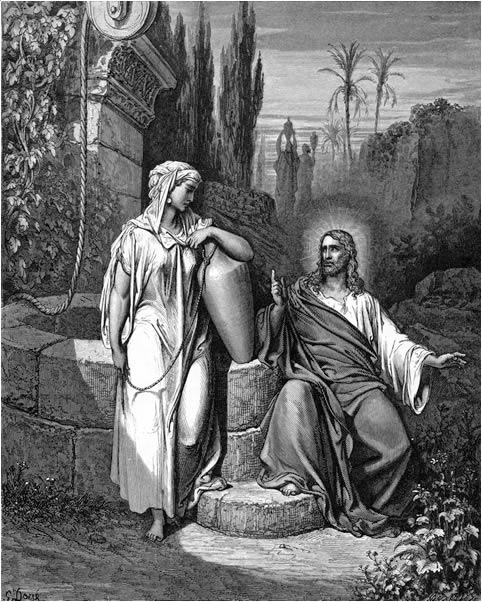
Women drew water in the cool of the morning and the evening, and this one comes alone at noon. Jesus asks her for a drink, crossing the line a Jewish man kept from a Samaritan and from a woman alone. Jews and Samaritans kept apart.
The record, by era
The Church Fathers5 voices
A commentator
Ephrem the SyrianCOMMENTARY ON TATIAN'S DIATESSARON 12.16 · Written before 373.
proposed
Our Lord came to the spring of water like a hunter. He asked for water in order to give water, with water as a pretext. He sought something to drink, like a thirsty person, so that the way could be opened for him to quench …
"Jesus therefore, being wearied with His journey, sat thus by the well; and it was about the sixth hour. There cometh a woman of Samaria to draw water. Jesus saith unto her, Give Me to drink. For His disciples were gone away into the city to buy meat." Hence we learn His activity in journeying, His carelessness about food, and how He treated it as a matter of minor importance. And so the disciples were taught to use the like disposition themselves; for they took with them no provisions for the road. And this another Evangelist declares, saying, that when He spake to them concerning "the leaven of the Pharisees," they thought that it was because they carried no bread; and when he introduces them plucking the ears of corn, and eating, and when he saith that Jesus came to the fig-tree by reason of hunger, it is for nothing else but only to instruct us by all these to despise the belly, and not to deem that its service is anxiously to be attended to.
And in this place it is not His laboriousness alone that is shown, but also His freedom from pride; not merely by His being tired, nor by His sitting by the way-side, but by His having been left alone, and His disciples having been separated from Him. And yet it was in His power, if He had willed it, either not to have sent them all away, or when they departed to have had other ministers. But He would not; for so He accustomed His disciples to tread all pride beneath their feet.
Seest thou that His sitting was because of weariness? because of the heat? because of his waiting for His disciples? He knew, indeed, what should take place among the Samaritans, but it was not for this that He came principally; yet, though He came not for this, it behooved not to reject the woman who came to Him, when she manifested such a desire to learn. The Jews, when He was even coming to them, drove Him away; they of the Gentiles, when He was proceeding in another direction, drew Him to them. They envied, these believed on Him. They were angry with, these revered and worshiped Him. What then? Was He to overlook the salvation of so many, to send away such noble zeal? This would have been unworthy of His lovingkindness. Therefore He ordered all the matter in hand with the Wisdom which became Him. He sat resting His body and cooling It by the fountain; for it was the very middle of the day, as the Evangelist has declared, when he says, "It was about the sixth hour."
"There cometh a woman of Samaria to draw water." Observe how he declareth that the woman came forth for another purpose, in every way silencing the shameless gainsaying of the Jews, that none might say that He acted in opposition to His own command, bidding His disciples not to enter into any city of the Samaritans, yet conversing with Samaritans. And therefore the Evangelist has put, "For His disciples were gone away into the city to buy meat." Bringing in many reasons for His conversation with her.
8 more voices on this verse
The Medieval Church3 voices
"But His disciples had gone into the city to buy food." He rightly says "to buy," not to seek gratuitously, because there was no one there who would give: whence it is said in Luke 9: "The disciples entered into a city of the Samaritans, …
Christ had the opportunity to ask this of the woman because his disciples, whom he would have asked for the water, were not there, thus the Evangelist says, His disciples had gone to the town. Here we might notice three things about Christ. First, his …
Note, if you will, the Lord's modesty here as well. He remains alone by the road while the disciples have gone off to the city to buy food. They considered the needs of the stomach so secondary that at a time when nearly everyone had …
The Puritans and the Awakening1 voice
This woman's meeting with Christ at the well may remind us of the stories of Rebekah, Rachel, and Jethro's daughter, who all met with husbands, good husbands, no worse than Isaac, Jacob, and Moses, when they came to the wells for water. Thirdly, How the preventing grace of God sometimes brings people unexpectedly under the means of conversion and salvation.
The Nineteenth Century3 voices
A commentator
Jamieson, Fausset & Brown1802–1910
Commentary Critical and Explanatory on the Whole Bible (1871)
But with all that is human, how much also of the divine have we here, both blended in one glorious manifestation of the majesty, grace, pity, patience with which "the Lord" imparts light and life to this unlikeliest of strangers, standing midway between Jews and heathens. the sixth hour--noonday, reckoning from six A.M.
A commentator
J.C. Ryle1816–1900
Expository Thoughts on the Gospels: John (lightly modernized text, Grace Gems edition) (1869)
proposed
Conversation With a Samaritan Woman But he had to pass through Samaria. Now he came to a Samaritan town called Sychar, near the plot of land that Jacob had given to his son Joseph. Jacob’s well was there, so Jesus, since he was tired from the journey, sat right down beside the well. It was about noon. A Samaritan woman came to draw water. Jesus said to her, "Give me some water to drink." (For his disciples had gone off into the town to buy supplies.)
A commentator
J.C. Ryle1816–1900
Expository Thoughts on the Gospels: John (lightly modernized text, Grace Gems edition) (1869)
proposed
Conversation With a Samaritan Woman But he had to pass through Samaria. Now he came to a Samaritan town called Sychar, near the plot of land that Jacob had given to his son Joseph. Jacob’s well was there, so Jesus, since he was tired from the journey, sat right down beside the well. It was about noon. A Samaritan woman came to draw water. Jesus said to her, "Give me some water to drink." (For his disciples had gone off into the town to buy supplies.) So the Samaritan woman said to him, "How can you—a Jew—ask me, a Samaritan woman, for water to drink?" (For Jews use nothing in common with Samaritans.) Jesus answered her, "If you had known the gift of God and who it is who said to you, ‘Give me some water to drink,’ you would have asked him, and he would have given you living water." "Sir," the woman said to him, "you have no bucket and the well is deep; where then do you get this living water? Surely you’re not greater than our ancestor Jacob, are you? For he gave us this well and drank from it himself, along with his sons and his livestock." Jesus replied, "Everyone who drinks some of this water will be thirsty again. But whoever drinks some of the water that I will give him will never be thirsty again, but the water that I will give him will become in him a fountain of water springing up to eternal life." The woman said to him, "Sir, give me this water, so that I will not be thirsty or have to come here to draw water." He said to her, "Go call your husband and come back here." The woman replied, "I have no husband." Jesus said to her, "Right you are when you said, ‘I have no husband,’ for you have had five husbands and the man you are living with now is not your husband. This you said truthfully!" The woman said to him, "Sir, I see that you are a prophet.
Modern Voices1 voice
In John 4, Jesus' encounter with the Samaritan woman is itself a Purim-style reversal the rejected becomes chosen, the overlooked becomes entrusted, and the outsider becomes the first to hear a clear declaration of Messiah.
The words behind it
11 Greek wordsEvery Greek word of this verse in the order it stands, with what it means and the door to its own study. The last column counts the times a word stands in the whole Bible: the rarer the word, the more the places it appears belong together.
| Greek | Sound | Meaning | Word study | In the Bible |
|---|---|---|---|---|
| οἱ | hoi | <the> | G3588 → | 19766 times |
| γὰρ | gar | For | G1063 → | 1039 times |
| μαθηταὶ | mathetai | the disciples | G3101 → | 260 times |
| αὐτοῦ | autou | of Him | G846 → | 5565 times |
| ἀπεληλύθεισαν | apelelutheisan | had gone away | G565 → | 115 times |
| εἰς | eis | into | G1519 → | 1755 times |
| τὴν | ten | the | G3588 → | 19766 times |
| πόλιν | polin | city | G4172 → | 163 times |
| ἵνα | ina | that | G2443 → | 668 times |
| τροφὰς | trophas | food | G5160 → | |
| ἀγοράσωσιν. | agorasosin | they may buy. | G59 → | 30 times |
οἱ<the>
hoiG3588 →19766 times
γὰρFor
garG1063 →1039 times
μαθηταὶthe disciples
mathetaiG3101 →260 times
αὐτοῦof Him
autouG846 →5565 times
ἀπεληλύθεισανhad gone away
apelelutheisanG565 →115 times
εἰςinto
eisG1519 →1755 times
τὴνthe
tenG3588 →19766 times
πόλινcity
polinG4172 →163 times
ἵναthat
inaG2443 →668 times
τροφὰςfood
trophasG5160 →
ἀγοράσωσιν.they may buy.
agorasosinG59 →30 times
A shaded row is a word that stands 400 times or fewer in the Bible.
The walk
8 stopsEach card is a verse this one points to, and under it the verses that one points to in turn. Where several paths arrive at the same place, that place is listed first: the text keeps returning to it.
Through
John 4:5So He came to a town of Samaria called Sychar, near the plot of ground that Jacob had given to his son Joseph.
it leads to
- Joshua 24:32
And the bones of Joseph, which the Israelites had brought up out of Egypt, were buried at Shechem in the plot of land that Jacob had purchased from the sons of Hamor, Shechem’s father,…
- Genesis 33:19
And the plot of ground where he pitched his tent, he purchased from the sons of Hamor, Shechem’s father, for a hundred pieces of silver.
- Genesis 48:22
And to you, as one who is above your brothers, I give the ridge of land that I took from the Amorites with my sword and bow.”
- Joshua 24:32
Through
Luke 9:13But Jesus told them, “You give them something to eat.” “We have only five loaves of bread and two fish,” they answered, “unless we go and buy food for all these people.”
it leads to
- Proverbs 11:24–25
One gives freely, yet gains even more; another withholds what is right, only to become poor.
- John 6:5–9
When Jesus looked up and saw a large crowd coming toward Him, He said to Philip, “Where can we buy bread for these people to eat?”
- 2 Kings 4:42–43
Now a man from Baal-shalishah came to the man of God with a sack of twenty loaves of barley bread from the first ripe grain. “Give it to the people to eat,” said Elisha.
- Mark 6:37–38
But Jesus told them, “You give them something to eat.” They asked Him, “Should we go out and spend two hundred denarii to give all of them bread to eat?”
- Proverbs 11:24–25
Through
John 4:39Many of the Samaritans from that town believed in Jesus because of the woman’s testimony, “He told me everything I ever did.”
it leads to
- John 4:29
“Come, see a man who told me everything I ever did. Could this be the Christ?”
- John 4:29
Where this verse is studied
About John
This page draws on 12 works. Open the list of works
This page draws on Albert Barnes, Notes, Explanatory and Practical, on the Gospels; Bonaventure, Commentary on John, Chapter 4; Ephrem the Syrian, COMMENTARY ON TATIAN'S DIATESSARON 12.16; J.C. Ryle, Expository Thoughts on the Gospels: John (lightly modernized text, Grace Gems edition); Jamieson, Fausset & Brown, Commentary Critical and Explanatory on the Whole Bible; Jane Hamon, PURIM – A TIME FOR REVERSALS!!; John Chrysostom, Homily on the Gospel of John 31; John Gill, Exposition of the New Testament (1746-1748); John Lightfoot, Horae Hebraicae et Talmudicae on John; Matthew Henry, Commentary on the Whole Bible; Theophylact of Ohrid, Commentary on John and Thomas Aquinas, Commentary on John.