
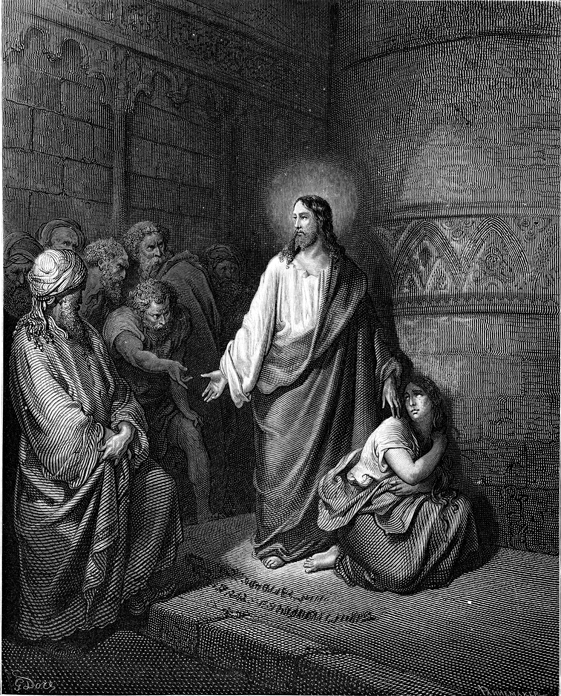
Johnchapter 8
59 verses · John, by tradition · AD 85 to 95 · The Gospels
Once again, Jesus spoke to the people and said, “I am the light of the world. Whoever follows Me will never walk in the darkness, but will have the light of life.”
Introduction
John, by tradition, The Gospels, John Overview.
John wrote this chapter for readers who had to answer the claim that descent from Abraham was enough. Most of it is a sharp exchange in the temple between Jesus and hearers who begin by believing Him and end by picking up stones. The talk turns on light and darkness, freedom and slavery, and fathers and sons. Listen for the words I am, which return at the key points and carry more each time. Notice too the account at the opening, which many Bibles set in brackets. Read it as the most direct argument about Jesus' identity in the Gospel.
Context
- Who
- Readers who traced everything they were to Abraham
- What
- The account of the woman caught in adultery, Jesus' claim to be the light of the world, and the dispute over Abraham, freedom and His own eternal being.
- Where
- The temple courts in Jerusalem, in the treasury where the offering boxes stood.
- When
- The days after the Feast of Tabernacles, about AD 29.
- Why
- To state Jesus' claim to be the light and the one who existed before Abraham, and to show the unbelief that meets it.
Historical context
The account of the woman caught in adultery, which many Bibles print here, is missing from the oldest and best Greek manuscripts, and some later copies place it elsewhere in John or in Luke. Careful readers name that openly. Many also judge that the story itself has the ring of something remembered and true, whatever its place in the text, and Bibles keep it, usually with a note, which is the honest way to handle it.
Show the rest of the historical context, 3 more paragraphs
The setting of the main discourse is stated exactly: he spoke these words in the treasury. That was in the Court of the Women, where the collection chests stood and where the great lampstands of Tabernacles had just been burning. Saying I am the light of the world in that spot, days after the lamps were extinguished, was placing himself where the light had been.
The argument about witnesses is legal again. Jewish law required two witnesses for a claim to stand, and Jesus names himself and the Father as the two, which either dissolves the rule or claims something enormous, and his hearers understood which.
The stones at the end were available because the temple was a building site. Herod's project was still under construction and would be for another thirty years, so dressed and undressed stone lay in the courts. Picking one up took no searching.
Significance
The whole confrontation runs on descent. They say Abraham is our father; he answers that if they were Abraham's children they would do what Abraham did. For a people whose ancestry was their standing before God, this was the sharpest thing that could be said.
Show the rest of the significance, 1 more paragraph
It ends with a sentence that decided everything: before Abraham was, I am. That is not a claim to age. It is the divine name from the burning bush, and the immediate attempt to stone him shows nobody in the courtyard misheard it.
The heads below are this chapter's scenes. The numbered points under each are its verses.
Caught in Adultery: He Stoops and Writes on the Ground
John 8:1-2
went to the Mount of Olives: Jesus went to the Mount of Olives, the slope He lodged on through that week, as Luke 21:37 records. Early in the morning He was back in the temple courts, and the people came to Him there. He sat down to teach, the teacher's posture in that world.
John 8:1
“Mount of Olives - The mountain about a mile directly east of Jerusalem. See the notes at Mat 21:1. This was the place in which he probably often passed the night when attending the feasts at Jerusalem. The Garden of Gethsemane, to which he was accustomed to resort Joh 18:2, was on the western side of that mountain, and Bethany, the abode of Martha and Mary, on its east side, Joh 11:1.”
2 more voices on this verseWhat preachers and commentators have said about this verse, in their own words.
John 8:1
“And he [Papias] relates another story of a woman, who was accused of many sins before the Lord, which is contained in the Gospel according to the Hebrews. These things we have thought it necessary to observe in addition to what has been already stated.”
Eusebius of Caesarea · written before 339 · Church History (Book III), Chapter 39, Section 16patristic
John 8:1
“The narrative which begins the eighth chapter of John's Gospel is of a rather peculiar character. In some respects it stands alone. There is nothing quite like it in the whole range of the four Gospels. In every age some scrupulous minds have stumbled at the passage, and have doubted whether it was ever written by John at all. But the justice of such scruples is a point that cannot easily be proved.”
He sat down to teach them: Henry marks the hour: early in the morning, after a day of teaching and dispute, He is back at work in the temple courts. He calls Christ a constant preacher, in season and out of season. The accusers come into that gathered crowd.
John 8:2
“What a diligent preacher Christ was: Early in the morning he came again, and taught. Though he had been teaching the day before, he taught again to-day. Christ was a constant preacher, in season and out of season.”
Matthew Henry · Commentary on the Whole Bible (1707-1721)puritan
John 8:3-4
a woman caught in adultery: The scribes and Pharisees set a woman caught in adultery in front of everyone. Caught in the act means there were witnesses, and the law they quote condemns the man with her at Leviticus 20:10 and Deuteronomy 22:22. The man is nowhere in the scene.
John 8:3
“But while these kind and simple persons are full of admiration at our Lord's discourse, the Scribes and Pharisees put questions to Him, not for the sake of instruction, but only to entangle the truth in their nets: And the Scribes and Pharisees brought unto Him a woman taken in adultery; and when they had set her in the midst, they say unto Him, Master, this woman was taken in adultery, in the very act.”
Alcuin of York · written before 804 · Catena Aurea by Aquinaspatristic
3 more voices on this verse
John 8:3
“But as it has always been received by the Latin Churches, and is found in many old Greek manuscripts, and contains nothing unworthy of an Apostolic Spirit, there is no reason why we should refuse to apply it to our advantage. When the Evangelist says that the scribes brought to him a woman, he means that it was done by an agreement among them, in order to lay traps for Christ.”
John Calvin · Commentaries (1554)reformed
John 8:3
“A woman taken in adultery - Some of the popish writers say that her name was Susanna; that she was espoused to an old decrepid man, named Manasseh; that she died a saint in Spain, whither she had followed St. James. These accounts the judicious Calmet properly terms fables. It is allowed that adultery was exceedingly common at this time, so common that they had ceased to put the law in force against it.”
Adam Clarke · Commentary on the Bible (1810-1826)evangelical
John 8:3
“Note, Those whose cause is brought before our Lord Jesus will never have occasion to remove it into any other court, for he is the refuge of penitents. The law which accuses us, and calls for judgment against us, is by the gospel of Christ made to withdraw; its demands are answered, and its clamours silenced, by the blood of Jesus.”
Matthew Henry · Commentary on the Whole Bible (1707-1721)puritan
caught in the act of adultery: Bonaventure says calling Jesus Teacher was flattery to hide their aim, and he cites Chrysostom: they call Him Master whose disciples they will not be. Gill says the law asked for two witnesses to a woman caught in the act. They say it to test Him.
John 8:4
“They say unto him, Master,.... They applied to him in a handsome and respectful manner, the better to cover their ill design: this woman was taken in adultery; by two persons at least, who could be witnesses of it; otherwise the accusation was not legal; see Deu 19:15; though in the case of a wife suspected of adultery, they admitted a single witness as valid (f): in the very act; or "in the theft itself", for adultery is a theft; it is an unlawful use of another's property; see this word used in the same sense, in Heliodor, l.”
John 8:5-6
Moses commanded us to stone such a woman: The question sets a trap with two jaws, and John says they asked it to have a basis for accusing Him. Rome kept the power of execution. A call to stone her puts Him against the governor, and a call to release her puts Him against Moses.
John 8:5
“Moses hath commanded us to stone such - If they spoke accurately, this must have been a woman, who, having been betrothed to a husband, had been guilty of this crime before the marriage was completed; for such only Moses commanded to be stoned. He commanded indeed that other adulteresses should be put to death; but the manner of death was not specified.”
John Wesley · Explanatory Notes upon the New Testament (1755)evangelical
2 more voices on this verse
John 8:5
“Moses in the law ... - The punishment of adultery commanded by Moses was death, Lev 20:10; Deu 22:22. The particular manner of the death was not specified in the law. The Jews had themselves, in the time of Christ, determined that it should be by stoning. See this described in the notes at Mat 21:35, Mat 21:44. The punishment for adultery varied. In some cases it was strangling. In the time of Ezekiel Eze 16:38-40 it was stoning and being thrust through with a sword.”
John 8:5
The Scribes and Pharisees kept accusing her and kept earnestly pressing the case, for they wished to stone her to death, according to the law. "But Jesus, stooping down, began to write with his finger on the ground," the sins, to be sure, of those who were making the accusation, as well as the sins of all mortal beings according to what is written in the prophet, "Those who depart from you shall be written in the earth."
Jerome · written before 420 · Against the Pelagians 2.17patristic
write on the ground with His finger: What Jesus wrote on the ground is unknown; Wesley says it may have been the words He spoke when they continued to question Him. Wesley says the silence woke their consciences.
John 8:6
“That they might have to accuse him - Had our Lord condemned the woman to death, they might have accused him to Pilate, as arrogating to himself the power of life and death, which the Romans had taken away from the Jews; besides, the Roman laws did not condemn an adulteress to be put to death. On the other hand, if he had said she should not be put to death, they might have represented him to the people as one who decided contrary to the law, and favored the crime of which the woman was accused.”
Adam Clarke · Commentary on the Bible (1810-1826)evangelical
2 more voices on this verse
John 8:6
“Christ once in the New: perhaps the words which he afterward spoke, when they continued asking him. By this silent action, he, 1, fixed their wandering, hurrying thoughts, in order to awaken their consciences: and, 2, signified that he was not then come to condemn but to save the world.”
John Wesley · Explanatory Notes upon the New Testament (1755)evangelical
John 8:6
“Others this, The earth accuses the earth, but the judgment is mine. Christ by this teaches us to be slow to speak when difficult cases are proposed to us, not quickly to shoot our bolt; and when provocations are given us, or we are bantered, to pause and consider before we reply; think twice before we speak once: The heart of the wise studies to answer.”
Matthew Henry · Commentary on the Whole Bible (1707-1721)puritan
John 8:7-8
Deuteronomy 17:7 put the first stone in the witnesses' hands. He keeps that procedure and adds one condition, that the man who throws it be without sin among them. He bent down and wrote a second time, and the pause gives them room to leave.
John 8:7
For he that does not judge himself first, is ignorant what to judge right in another; and if perchance he did know by the hearing what to judge right, yet he is not able to judge rightly the merits of another, who has no rule of judging supplied him by the consciousness of his own innocence. Hence it is that it is said to certain persons dealing deceitfully, when they brought an adulteress to receive punishment; "He that is without sin among you, let him first cast a stone at her."
Gregory the Dialogist · written before 604 · Morals on the Book of Job 14.29.34patristic
2 more voices on this verse
John 8:7
“He that is without sin--not meaning sinless altogether; nor yet, guiltless of a literal breach of the Seventh Commandment; but probably, he whose conscience acquits him of any such sin. cast a stone--"the stone," meaning the first one (De 17:7).”
Jamieson, Fausset & Brown · Commentary Critical and Explanatory on the Whole Bible (1871)reformed
John 8:7
“They continued asking him - They pressed the question upon him. They were determined to extort an answer from him, and showed a perseverance in evil which has been unhappily often imitated. Is without sin - That is, without this particular sin; he who has not himself been guilty of this very crime - for in this place the connection evidently demands this meaning.”
again He bent down: When He bent down again and wrote, Alcuin says His eyes were on the ground and the men had room to go away. He takes a lesson for anyone who would condemn a brother. Each should ask, before and after, whether he has the same sin.
John 8:8
“This is like our Lord; while His eyes are fixed, and He seems attending to something else, He gives the bystanders an opportunity of retiring: a tacit admonition to us to consider always both before we condemn a brother for a sin, and after we have punished him, whether we are not guilty ourselves of the same fault, or others as bad.”
Alcuin of York · written before 804 · Catena Aurea by Aquinaspatristic
John 8:9-11
one by one, beginning with the older ones: They leave one by one, the older ones first, until Jesus and the woman are alone. Neither do I condemn you sets her free of the sentence, and go and sin no more puts her under a charge. Both words are spoken to her together.
John 8:9
“Beginning at the eldest - Or the elders. Jesus was left alone -By all those scribes and Pharisees who proposed the question. But many others remained, to whom our Lord directed his discourse presently after.”
John Wesley · Explanatory Notes upon the New Testament (1755)evangelical
where are your accusers?: Barnes draws a line between accusing and condemning: they had brought the charge, but none took the step of judgment by casting a stone. Henry notes that the one man there without sin, who could have thrown first, is the one who shows mercy. Bonaventure sees mercy running with justice.
John 8:10
“Hath no man condemned thee? - Jesus had directed them, if innocent, to cast a stone, thus to condemn her, or to use the power which he gave them to condemn her. No one of them had done that. They had accused her, but they had not proceeded to the act expressive of judicial condemnation.”
1 more voice on this verse
John 8:10
“Christ was without sin, and might cast the first stone; but though none more severe than he against sin, for he is infinitely just and holy, none more compassionate than he to sinners, for he is infinitely gracious and merciful, and this poor malefactor finds him so, now that she stands upon her deliverance.”
Matthew Henry · Commentary on the Whole Bible (1707-1721)puritan
Barnes and Gill say when Jesus said neither do I condemn you, He passed no sentence of death, for He held no office as judge. The Apostolic Constitutions tell the story beside the woman who had sinned and loved much. They call Jesus the Searcher of hearts.
John 8:11
He says also to another, a woman that was a sinner: "Thy sins, which are many, are forgiven, for thou lovest much." And when the elders had set another woman which had sinned before Him, and had left the sentence to Him, and were gone out, our Lord, the Searcher of the hearts, inquiring of her whether the elders had condemned her, and being answered No, He said unto her: "Go thy way therefore, for neither do I condemn thee."
Apostolic Constitutions · written before 380 · Constitutions of the Holy Apostles Book 2patristic
2 more voices on this verse
John 8:11
“11 She said, No man, Lord. And Jesus said unto her, Neither do I condemn thee: go, and sin no more. Though Christ was basely abused in the foregoing chapter, both by the rulers and by the people, yet here we have him still at Jerusalem, still in the temple.”
Matthew Henry · Commentary on the Whole Bible (1707-1721)puritan
John 8:11
“Neither do I condemn thee - This is evidently to be taken in the sense of judicial condemnation, or of passing sentence as a magistrate, for this was what they had arraigned her for. It was not to obtain his opinion about adultery, but to obtain the condemnation of the woman. As he claimed no civil authority, he said that he did not exercise it, and should not condemn her to die. In this sense the word is used in the previous verse, and this is the only sense which the passage demands.”
I Am the Light of the World
The Feast of Tabernacles lit great lamps in the temple court, and their light was said to reach the whole city. Jesus says I am the light of the world in that court, days after the lamps went out. Chapter 9 acts the claim out on a blind man.
John 8:12
“Then spake Jesus again unto them - Allowing the story about the woman taken in adultery to be authentic, and to stand here in its proper place, we may consider that our Lord, having begun to teach the people in the temple, was interrupted by the introduction of this woman by the scribes and Pharisees; and now, having dismissed them and the woman also, he resumes his discourse. I am the light of the world - The fountain whence an intellectual light and spiritual understanding proceed: without me all is darkness, misery, and death.”
Adam Clarke · Commentary on the Bible (1810-1826)evangelical
3 more voices on this verse
John 8:12
“The visible light of the world is the sun, and Christ is the Sun of righteousness. One sun enlightens the whole world, so does one Christ, and there needs no more. Christ in calling himself the light expresses, (1.) What he is in himself--most excellent and glorious.”
Matthew Henry · Commentary on the Whole Bible (1707-1721)puritan
John 8:12
“OUR Lord did not speak in this way at the beginning of His ministry. He did not thus bear witness to Himself, saying, "I am the light of the world." But it was befitting on this occasion, when the people before Him had already received sufficient evidence from other quarters. John the Baptist, whom all men counted for a Prophet, had testified that Christ was the true Light of God which lights every man that comes into the world.”
Charles Spurgeon · written before 1892 · The Metropolitan Tabernacle Pulpit, Sermon No. 3534: “The Light of the World” (lightly modernized text, CCEL edition)Particular Baptist
John 8:12
“In "the treasury" where it was spoken (see on Joh 8:20) stood two colossal golden lamp-stands, on which hung a multitude of lamps, lighted after the evening sacrifice (probably every evening during the feast of tabernacles), diffusing their brilliancy, it is said, over all the city.”
Jamieson, Fausset & Brown · Commentary Critical and Explanatory on the Whole Bible (1871)reformed
ConnectionsExodus 25:31
John 8:13-14
The Pharisees raise a rule of evidence, that a man's testimony about himself carries no weight alone. Jesus answers from what He knows, where He came from and where He is going, and no witness in that court could say as much. The second witness comes at verse 18.
John 8:13
“Dull and slow is the Pharisee, and most hardly led unto the power of seeing the Godhead of the Lord: he errs again by reason of the flesh, and imagines nought beyond what he sees. For while seeing that He uses utterances beyond man and hearing words most God-befitting, he yet conceives of bare man, not looking to the illustriousness of the Godhead nor opening the eye of his understanding to look at Emmanuel.”
Cyril of Alexandria · written before 444 · Commentary on the Gospel of John, Book 5patristic
1 more voice on this verse
John 8:13
“Thou bearest record of thyself - Thou art a witness for thyself, or in thy own case. See Joh 5:31. The law required two witnesses in a criminal case, and they alleged that as the only evidence which Jesus had was his own assertion, it could not be entitled to belief. Is not true - Is not worthy of belief, or is not substantiated by sufficient evidence.”
I know where I came from: Cyril answers the charge of self-praise: one who declares his own nature tells what he is, and a fair hearer will not call that boasting. Clarke fills out the two ends of the path, from God and back to God. They know neither end of it.
John 8:14
“I know whence I came - I came from God, and am going to God, and can neither do nor say any thing but what leads to and glorifies him.”
Adam Clarke · Commentary on the Bible (1810-1826)evangelical
1 more voice on this verse
John 8:14
“On Christ saying that He is what He is by Nature and truly (for He openly declared, I am the Light of the world) the multitude of the Pharisees unrecking of danger deemed that He spake falsely. For in their exceeding folly they knew not that when some set forth their own nature and tell what is essentially inherent in them, we shall not, if we think aright, suppose that they do so out of boasting, nor shall we say that they are bent on hunting vain-glory, but rather that they declare what they really are.”
Cyril of Alexandria · written before 444 · Commentary on the Gospel of John, Book 5patristic
John 8:15-16
You judge according to the flesh: means judging by what shows, a hometown and a trade. I judge no one stands beside a judgment He does give, and when He judges the Father who sent Him is in it with Him. The two never judge apart.
John 8:15
“After the flesh - According to appearance; according to your carnal and corrupt mode; not according to the spiritual nature of the doctrines. By your preconceived opinions and prejudices you are determined not to believe that I am the Messiah. I judge no man - Jesus came not to condemn the world, Joh 3:17. They were in the habit of judging rashly and harshly of all; but this was not the purpose or disposition of the Saviour.”
1 more voice on this verse
John 8:15
“Or, " I judge no man, " that is, "not now in my first coming, that is deferred till I come again," ch. iii. Prima dispensatio Christi medicinalis est, non judicialis--The first coming of Christ was for the purpose of administering, not justice, but medicine.”
Matthew Henry · Commentary on the Whole Bible (1707-1721)puritan
I am not alone: Wesley explains: the Son took human nature without leaving the Father, as God does not leave heaven when He is said to come down. Cyril answers those who opposed the Church's teaching and read the verse to mean the Son judges rightly only with the Father's help.
John 8:16
"Doth then," will haply one say of those who think contrary to the doctrines of the Church, "the Son know how to judge aright, only for this reason, that the Father is with Him when He does so? This being so (and that in truth) what yet hinders from saying that the Son is in a way directed unto uprightness through the Will of the Father, not possessing this in perfectness, nor able of Himself to act irreproachably?" What then shall WE too respond to their words?
Cyril of Alexandria · written before 444 · Commentary on the Gospel of John, Book 5patristic
1 more voice on this verse
John 8:16
“And though the Son came from the Father, to assume human nature, and perform his office as the Messiah upon earth, as God is sometimes said to come from heaven, for particular manifestations of himself; yet Christ did not leave the Father, nor the Father leave him, any more than God leaves heaven when he is said to come down to the earth.”
John Wesley · Explanatory Notes upon the New Testament (1755)evangelical
John 8:17-18
the testimony of two men is valid: The rule of two witnesses comes from Deuteronomy 19:15, and He takes it up as their own law. He names the two, Himself and the Father who sent Him, and that second witness is the one they have been asking for. The Father testifies through the works, at 5:36.
John 8:17
“In your law - Deu 17:6; Deu 19:15. Compare Mat 18:16. This related to cases in which the life of an individual was involved. Jesus says that if, in such a case, the testimony of two men were sufficient to establish a fact, his own testimony and that of his Father ought to be esteemed ample evidence in the case of religious doctrine. Two men - If two men could confirm a case, the evidence of Jesus and of God ought not to be deemed insufficient. Is true - In Deuteronomy, “established.” This means the same thing.”
1 more voice on this verse
John 8:17
“That the testimony of two men is true. Not as if it were always true in itself, for many a time hand has been joined in hand to bear a false testimony, 1 Kings xxi. But it is allowed as sufficient evidence upon which to ground a verdict ( verum dictum ), and if nothing appear to the contrary it is taken for granted to be true.”
Matthew Henry · Commentary on the Whole Bible (1707-1721)puritan
the Father, who sent Me, also testifies: Barnes explains that a man's word for himself is barred because he has an interest, yet a life of self-denial can give it weight. Henry reads the two witnesses as two distinct persons who are one in power and glory. Theophylact sees equal authority.
John 8:18
“I am one that bear witness of myself - In human courts a man is not allowed to bear witness of himself, because he has a personal interest in the case, and the court could have no proof of the impartiality of the evidence; but in the case of Jesus it was otherwise. When one has no party ends to serve; when he is willing to deny himself; when he makes great sacrifices; and when, by his life, he gives every evidence of sincerity, his own testimony may be admitted in evidence of his motives and designs.”
1 more voice on this verse
John 8:18
“Now this proves not only that the Father and the Son are two distinct persons (for their respective testimonies are here spoken of as the testimonies of two several persons), but that these two are one, not only one in their testimony, but equal in power and glory, and therefore the same in substance.”
Matthew Henry · Commentary on the Whole Bible (1707-1721)puritan
Where is Your Father asks for the second witness to be produced, and they are thinking of a man who could be pointed at. Knowing the Son and knowing the Father come together, and one is never held without the other. He says it again to Philip at 14:9.
John 8:19
“For they who indeed suppose Christ to be of Joseph, or of fornication, and who know not that the Word beamed forth of God the Father, how will they not with reason hear, Neither Me do ye know nor My Father? For if they had known the Word that beamed forth of God the Father, and was for our sakes made in the flesh, according to the Divine Scripture, they would have known Him too Who begat Him.”
Cyril of Alexandria · written before 444 · Commentary on the Gospel of John, Book 5patristic
1 more voice on this verse
John 8:19
“Then said they unto him, where is thy Father?.... The Persic version adds, "show him unto us": produce this witness boasted of, let us see him; this they said in a sneering, taunting, and insulting manner; where is thy Father? what! he is in Galilee; fetch him from thence; it is Joseph the carpenter you mean; a goodly witness indeed!”
near the treasury: The treasury stood in the Court of the Women, where the collection chests lined the wall. He spoke in the most open part of the temple courts, where an arrest would have been simple, and no one seized Him. His hour, first named at 2:4, had not yet come.
John 8:20
“These words spake Jesus in the treasury--a division, so called, of the fore court of the temple, part of the court of the women [JOSEPHUS, Antiquities, 19.6.2, &c.], which may confirm the genuineness of Joh 8:2-11, as the place where the woman was brought. no man laid hands on him, &c.--(See on Joh 7:30).”
Jamieson, Fausset & Brown · Commentary Critical and Explanatory on the Whole Bible (1871)reformed
1 more voice on this verse
John 8:20
“The treasury - Lightfoot observes, from the rabbins, that the treasury was in what was called the court of the women - that there were thirteen chests in it; in the thirteenth only the women were permitted to put their offerings. Probably the other twelve were placed there in reference to the twelve tribes; each perhaps inscribed with the name of one of Jacob’s twelve sons. It seems that our Lord sometimes sat in this court to teach the people.”
Adam Clarke · Commentary on the Bible (1810-1826)evangelical
Ye Shall Die in Your Sins Except Ye Believe
John 8:21-22
you will die in your sin: I am going away opens a warning about time. They will look for Him and die in their sin, seeking Him after the door has shut. The same words go to the disciples at 13:33, where they mean a parting for a season.
John 8:21
“I go my way - See the notes at Joh 7:33. Ye shall die in your sins - That is, you will seek the Messiah; you will desire his coming, but the Messiah that you expect will not come; and, as you have rejected me, and there is no other Saviour, you must die in your sins. You will die unpardoned, and as you did not seek me where you might find me, you cannot come where I shall be. Observe: 1. All those who reject the Lord Jesus must die unforgiven.”
2 more voices on this verse
John 8:21
“Someone might say to this, "If He said this to those persisting in unbelief, how can He say to such, 'You will seek me'?" For often seeking Jesus is good, somehow the same as seeking the Word and truth and wisdom.”
Origen of Alexandria · written before 253 · Commentary on the Gospel of John, Book 19patristic
John 8:21
“Christ's departure from them: I go my way, that is, "It shall not be long before I go; you need not take so much pains to drive me from you, I shall go of myself." They said to him, Depart from us, we desire not the knowledge of thy ways; and he takes them at their word; but woe to those from whom Christ departs. Ichabod, the glory is gone, our defence is departed, when Christ goes.”
Matthew Henry · Commentary on the Whole Bible (1707-1721)puritan
Clarke tracks the misunderstanding across two chapters. At 7:35 a like saying made them guess He would go to the Jews scattered among the Greeks. Now they see that He speaks of His death, and they sneer that it must be by His own hand.
John 8:22
“Will he kill himself? - They now understood that he spoke concerning his death; but before, Joh 7:35, they thought he spoke of going to some of the Grecian provinces, to preach to the dispersed Jews.”
Adam Clarke · Commentary on the Bible (1810-1826)evangelical
John 8:23-24
You are from below and I am from above names two origins, and everything else in the chapter runs from it. I am He translates ego eimi, which stands with nothing after it. The same words return at verses 28 and 58, where life and death hang on them.
John 8:23
“Here he clearly shows what he means by "above" and "below." The Pharisees would have understood what he said in a bodily way, thinking the "above" and "below" were localities. That is why our Lord clarifies what he had previously said so obscurely. For he says, "You are of this world," that is, from beneath; "I am not of this world," speaking of what is from above. For God surpasses all that is created.”
Cyril of Alexandria · written before 444 · Commentary on the Gospel of John, Book 5patristic
1 more voice on this verse
John 8:23
“Ye are from beneath - The expression from bequeath, here, is opposed to the phrase from above. It means, You are of the earth, or are influenced by earthly, sensual, and corrupt passions. You are governed by the lowest and vilest views and feelings, such as are opposed to heaven, and such as have their origin in earth or in hell. I am from above - From heaven. My views are heavenly, and my words should have been so interpreted. Ye are of this world - You think and act like the corrupt men of this world.”
unless you believe that I am He: Origen turns the warning around: whoever does not die in his sins has believed, and whoever dies in them has not believed in truth. For him faith without works is dead. Verse 21 spoke of sin in the singular, and here the word is plural.
John 8:24
“Now, if the one who does not believe that Jesus is the Christ will die in his sins, it is clear that the one who does not die in his sins has believed in the Christ. But he who dies in his sins, even if he says that he believes in the Christ, has not believed in him so far as truth is concerned. And if faith is mentioned but it lacks works, such faith is dead. … For one who believes in [Christ's] justice does not do injustice.”
Origen of Alexandria · written before 253 · Commentary on the Gospel of John 19.152, 155, 158patristic
John 8:25-26
Who are You is the question this Gospel was written to answer, and His reply points to what He has told them from the beginning. He says only what He heard from the One who sent Him, and that One is truthful.
Jamieson, Fausset and Brown say He could say and judge much, yet He speaks only the message the Father gave Him. They suggest the judging may wait for the Spirit's work in John 16:8. Wesley adds that the One who sent Him is truthful whether they believe or not.
John 8:26
“I have many things to say and to judge of you - I have much to say concerning your inexcusable unbelief: but he that sent me is true - Whether ye believe or no.”
John Wesley · Explanatory Notes upon the New Testament (1755)evangelical
2 more voices on this verse
John 8:26
“I have many things to say and to judge of you; but he that sent me is true, &c.--that is, I could, and at the fitting time, will say and judge many things of you (referring perhaps to the work of the Spirit which is for judgment as well as salvation, Joh 16:8), but what I do say is just the message My Father hath given Me to deliver.”
Jamieson, Fausset & Brown · Commentary Critical and Explanatory on the Whole Bible (1871)reformed
John 8:26
“I have many things to say and to judge of you - Or, to speak and to condemn, etc. I could speedily expose all your iniquities - your pride and ambition, your hypocrisy and irreligion, your hatred to the light, and your malice against the truth, together with the present obstinate unbelief of your hearts, and show that these are the reasons why I say you will die in your sins; but these will appear in their true light: when, after you have crucified me, the judgments of God shall descend upon and consume you.”
Adam Clarke · Commentary on the Bible (1810-1826)evangelical
John 8:27-29
They did not understand: that the Father was His subject. The lifting up of the Son of Man points to the cross, and 3:14 has already tied it to the bronze serpent of Numbers 21. There they will know who He is, and He always does what pleases the Father.
John 8:27
“They understood not that he spake to them of the Father. That sent him, and who was true and faithful to all he had said, whether in a way of promise, or threatening; such was their stupidity, that they did not know that he meant God the Father by him that sent him, so deriving his mission and doctrine from him; their hearts were made fat, and hardened, and their eyes were blinded. The Vulgate Latin version reads, "they did not know that he said, God was his Father"; and so Beza's most ancient copy, and another exemplar of his.”
1 more voice on this verse
John 8:27
“They understood not - They knew not, or they were unwilling to receive him as a messenger from God. They doubtless understood that he meant to speak of God, but they were unwilling to acknowledge that he really came from God.”
lifted up the Son of Man: Jamieson, Fausset and Brown call this His plainest public hint so far of how He would die and who would kill Him. Clarke says lifted up was a Jewish idiom for dying.
John 8:28
“And of Myself I do nothing, but as the Father taught Me, I speak these words. CHAPTER V. That not inferior in Might and Wisdom to God the Father is the Son, yea rather His very Wisdom and Might. He speaketh in more human wise, in that the Jews could not otherwise understand, nor endure to hear from Him unvailed things God-befitting. For on these matters are they found hurling stones at Him, and setting it down as blasphemy, that being Man, He made Himself God.”
Cyril of Alexandria · written before 444 · Commentary on the Gospel of John, Book 5patristic
2 more voices on this verse
John 8:28
“When ye have lifted up the Son of man--The plainest intimation He had yet given in public of the manner and the authors of His death. then shall ye know that I am he, &c.--that is, find out, or have sufficient evidence, how true was all He said, though they would be far from owning it.”
Jamieson, Fausset & Brown · Commentary Critical and Explanatory on the Whole Bible (1871)reformed
John 8:28
“When ye have lifted up - When ye have crucified me, and thus filled up the measure of your iniquities, ye shall know that I am the Christ, by the signs that shall follow; and ye shall know that what I spoke is true, by the judgments that shall follow. To be lifted up, is a common mode of expression, among the Jewish writers, for to die, or to be killed.”
Adam Clarke · Commentary on the Bible (1810-1826)evangelical
He has not left Me alone: Barnes reads the verse against men who had rejected Him, and he ties doing what pleases the Father to the voice at His baptism. Cyril goes further: the Son is Himself the living counsel and will of the Father. His obedience shows what is in God.
John 8:29
“Is with me - In working miracles, etc. Hath not left me alone - Though men had forsaken and rejected him, yet God attended him. Those things that please him - See Mat 3:17; “This is my beloved Son, in whom I am well pleased,” Php 2:8; Isa 53:10-12; 2Pe 1:17; Luk 3:22; Mat 17:5. His undertaking the work of redemption was pleasing to God, and he had the consciousness that in executing it he did those things which God approved.”
1 more voice on this verse
John 8:29
“Herein He shows clearly that He interprets the Counsel of God the Father, Himself having none other than is in Him (how could He? for He is Himself the Living and Hypostatic Counsel and Will of Him Who begat Him, as is said in the Book of the Psalms by one of the Saints, In Thy Counsel Thou guidedst me, and again, Lord by Thy Will Thou gavest might to my beauty : for in Christ are all good things to them that love Him) but as bringing forth unto our knowledge the things that are in God the Father.”
Cyril of Alexandria · written before 444 · Commentary on the Gospel of John, Book 5patristic
John 8:30-32
many believed in Him: , and the next sentence tests what that belief is worth. Continuing in His word is the mark He gives, so a disciple is known over time. The truth will set you free, and verse 34 names sin as the slavery He means.
John 8:30
“As he spake these words, many believed on him - The same sun that hardens the clay softens the wax. This discourse, which proved the savor of death unto death to the obstinate Pharisees, became the savor of life unto life to many of the simple-hearted people.”
Adam Clarke · Commentary on the Bible (1810-1826)evangelical
The Truth Shall Make You Free
Barnes says the Jews who had believed Him did so after one discourse. So Jesus tells them to continue in His word before they trust their feelings. Cyril asks for a settled mind that holds to its choice.
John 8:31
“If ye continue in my word - If you continue to obey my commandments and to receive my doctrines. Then are ye ... - This is the true test of Christian character. Joh 14:21; “he that hath my commandments and keepeth them, he it is that loveth me.” See Joh 2:4; Joh 3:24; 2Jn 1:6. In this place Jesus cautions them against too much confidence from their present feelings. They were just converted - converted by a single sermon. They had had no time to test their faith.”
2 more voices on this verse
John 8:31
“By a practiced abiding in his words we come to know the truth and the truth does, sure enough, make us free.”
Dallas Willard · Why Bother With Discipleship? (in The Great Omission) (2006)Southern Baptist heritage
John 8:31
“He demandeth of those who believe a disposition established and fixed and prepared for the abode of that good which they had once chosen. And this is faith in Him. For wavering shows utter senselessness and unprofit, seeing that A double minded man is unstable in all his ways, as it is written: but to press forward firmly to have hold of what is profitable, is indeed wise and most useful.”
Cyril of Alexandria · written before 444 · Commentary on the Gospel of John, Book 5patristic
Clarke cites a Jewish saying that only one who studies the law is free, and places true freedom where the power of sin is broken. Cyril names the truth as Christ Himself, to whom the law's shadows lead. For both the freedom is release from sin.
John 8:32
“This saying of Jesus persuades those who believe to leave behind worship that is according to the law. It teaches us that the shadow [i.e., the law] is our guide to the knowledge of him and that, leaving the types and figures behind, we should go resolutely forward to the truth itself, which is Christ the giver of true freedom, who is also our Redeemer.…And so, true salvation is not in the ordinances of the law, nor will anyone win the thrice-longed for freedom from sin by observing the law.”
Cyril of Alexandria · written before 444 · Commentary on the Gospel of John, Book 5patristic
We are Abraham's descendants is the ground they stand on. Never been slaves to anyone passes over Egypt, Babylon, and the Roman soldiers in the city that day. They heard an offer about sin and answered about national liberty.
John 8:33
“They answered him - Not those who believed on him, but some who stood by and heard him. We be Abraham’s seed - We are the children or descendants of Abraham. Abraham was not a slave, and they pretended that they were his real descendants, inheriting his freedom as well as his spirit. They meant that they were the direct descendants of Abraham by Isaac, his heir. Ishmael, also Abraham’s son, was the son of a bondwoman Gal 4:21-23, but they were descended in a direct line from the acknowledged heir of Abraham.”
1 more voice on this verse
John 8:33
“They laugh at the promise of our Saviour, rather they even take it ill, as though they were insulted. For that which has no share at all of bondage, how will it need (he says) of One Who calls us unto freedom, and Who gives us a something over and above what is in us already.”
Cyril of Alexandria · written before 444 · Commentary on the Gospel of John, Book 5patristic
John 8:34-36
everyone who sins is a slave to sin: Sin makes a slave of the man who sins, and the bondage sits inside him. The picture comes from a household, where a slave can be sold away and a son keeps his place forever. The Son of that house is the one who can free a slave in it.
John 8:34
“He does not call mammon Lord when He says, "Ye cannot serve two masters; "but He teaches His disciples who serve God, not to be subject to mammon, nor to be ruled by it. For He says, "He that committeth sin is the slave of sin." Inasmuch, then, as He terms those "the slaves of sin" who serve sin, but does not certainly call sin itself God, thus also He terms those who serve mammon "the slaves of mammon," not calling mammon God.”
Irenaeus · written before 202 · Against Heresies Book IIIpatristic
2 more voices on this verse
John 8:34
“Whosoever committeth sin is the servant of sin - Or, δουλος εστι, etc., is the slave of sin. This was the slavery of which Christ spoke; and deliverance from it, was the liberty which he promised.”
Adam Clarke · Commentary on the Bible (1810-1826)evangelical
John 8:34
“Whosoever committeth sin--that is, liveth in the commission of it--(Compare 1Jo 3:8; Mt 7:23). is the servant of sin--that is, the bond-servant, or slave of it; for the question is not about free service, but who are in bondage.”
Jamieson, Fausset & Brown · Commentary Critical and Explanatory on the Whole Bible (1871)reformed
a son belongs to it forever: Wesley hears an echo of Abraham's own house, where the slave was sent away and the son stayed. That fits a crowd boasting of Abraham. Barnes adds the law of inheritance: the son is the heir, and an heir cannot be sold or turned out as a servant can.
John 8:35
“The servant abideth not ... - The servant does not, of course, remain forever, or until his death. with his master. If he is disobedient and wicked, the master sells him or turns him away. He is not the heir, and may at any time be expelled from the house of his master. But a son is the heir. He cannot be in this manner cast off or sold. He is privileged with the right of remaining in the family. This takes place in common life.”
1 more voice on this verse
John 8:35
“And the slave abideth not in the house - All sinners shall be cast out of God's house, as the slave was out of Abraham's: but I, the Son, abide therein forever.”
John Wesley · Explanatory Notes upon the New Testament (1755)evangelical
you will be free indeed: Gill finds a background in Roman custom, where a son could free the slaves born in his house after his father's death. Irenaeus uses the verse against those who called Jesus a mere man, since only the Son gives this liberty. Wesley says the freed abide in God's house forever.
John 8:36
But again, those who assert that He was simply a mere man, begotten by Joseph, remaining in the bondage of the old disobedience, are in a state of death having been not as yet joined to the Word of God the Father, nor receiving liberty through the Son, as He does Himself declare: "If the Son shall make you free, ye shall be free indeed."
Irenaeus · written before 202 · Against Heresies Book IIIpatristic
3 more voices on this verse
John 8:36
“If the Son ... - The Son of God - heir of all things - who is forever with God, and who has therefore the right and power to liberate men from their thraldom. Shall make you free - Shall deliver you from the bondage and dominion of sin. Free indeed - Truly and really free. You shall be blessed with the most valuable freedom; not from the chains and oppressions of earthly masters and monarchs, but from the bondage of sin.”
John 8:36
“If the Son therefore shall make you free,.... Alluding to the custom of adoption by the sons or brethren in the family, which obtained in Greece, called αδελφοθεσια, "the adoption of brethren", as Grotius, and others have observed; or rather to a custom among the Romans, of a son's making free after his Father's death, such as were born slaves in his house.”
John 8:36
“If I therefore make you free, ye - shall partake of the same privilege: being made free from all guilt and sin, ye shall abide in the house of God forever.”
John Wesley · Explanatory Notes upon the New Testament (1755)evangelical
John 8:37-38
My word has no place within you: He grants the descent freely. The charge comes in the same sentence, that they are trying to kill Him, because His word has no place within them. He then sets two fathers side by side, and the second goes unnamed until verse 44.
John 8:37
“I know that ye are Abraham's offspring - As to the other branch of your objection, I know that, ye are Abraham's offspring, after the flesh; but not in a spiritual sense. Ye are not followers of the faith of Abraham: my word hath no place in your hearts.”
John Wesley · Explanatory Notes upon the New Testament (1755)evangelical
1 more voice on this verse
John 8:37
“I know that ye are Abraham's seed,.... In answer to the other part of the Jews' objection to Christ, and in favour of themselves, Christ owns that they were the natural seed of Abraham; for truth must be allowed to an adversary.”
Clarke preferred the manuscripts that read heard for the second clause, as the BSB does. So Jesus speaks of what He has seen and they act on what they have heard. Spurgeon grounds that seeing in His presence with the Father before the worlds were made.
John 8:38
“I speak that which I have seen - I speak nothing but that unchangeable, eternal truth which I have received from the bosom of God. Ye do that which ye have seen - Instead of ἑωρακατε, ye have seen, I think we should read ηκουσατε, ye have heard, on the authority of BCKL, fifteen others; Coptic, Ethiopic, Armenian, later Syriac in the margin, Gothic, one copy of the Itala; Origen, Cyril, and Chrysostom.”
Adam Clarke · Commentary on the Bible (1810-1826)evangelical
1 more voice on this verse
John 8:38
“THESE were the words of Christ to those who beset Him round about with angry eyes and cruel tongues. Our Lord declared that He had been with His Father before He spoke with those wicked Jews. And, indeed, He had been, for He was with the Father before the worlds were formed. He saw all that the Father did and He helped in doing it—"Without Him was not anything made that was made." He was the Father's eternal delight.”
Charles Spurgeon · written before 1892 · The Metropolitan Tabernacle Pulpit, Sermon No. 2560: “Universal Fatherhood—a Lie!” (lightly modernized text, CCEL edition)Particular Baptist
John 8:39-40
Sonship is measured here by conduct. Children of Abraham would do the works of Abraham, and Genesis 18 shows him welcoming three strangers and pleading for Sodom. In front of Him stands a plot to kill a man who told them the truth he heard from God.
John 8:39
They appear to have replied as if they had understood the statement about who their father was in a much lowlier manner than the Lord meant it. For Jesus was referring to God when he declared, "And you, therefore, do the things that you have heard from the Father." They, however, make a humbler assertion about the father of their own nation when they say, "Abraham is our father."
Origen of Alexandria · written before 253 · Commentary on the Gospel of John 20.57-58patristic
1 more voice on this verse
John 8:39
“If ye were Abraham's children, ye would do the works of Abraham--He had just said He "knew they were Abraham's children," that is, according to the flesh; but the children of his faith and holiness they were not, but the reverse.”
Jamieson, Fausset & Brown · Commentary Critical and Explanatory on the Whole Bible (1871)reformed
Abraham never did such a thing: Barnes finds two marks that set them apart from Abraham, a purpose to kill and a refusal of the truth God had revealed. Abraham, he says, was known for love to God and to man alike. Their plan fails both tests.
John 8:40
“Ye seek to kill me - See Joh 8:37. This did not Abraham - Or such things Abraham did not do. There are two things noted here in which they differed from Abraham: 1. In seeking to kill him, or in possessing a murderous and bloody purpose. 2. In rejecting the truth as God revealed it. Abraham was distinguished for love to man as well as God.”
John 8:41-42
They answer with their birth and with their God, and Our only Father is God Himself is the highest claim they can make. Jesus tests it by one mark, that a child of God would love the Son God sent. Love is the evidence He asks for.
John 8:41
“If God were your Father, ye would love me--"If ye had anything of His moral image, as children have their father's likeness, ye would love Me, for I am immediately of Him and directly from Him." But "My speech" (meaning His peculiar style of expressing Himself on these subjects) is unintelligible to you because ye cannot take in the truth which it conveys.”
Jamieson, Fausset & Brown · Commentary Critical and Explanatory on the Whole Bible (1871)reformed
1 more voice on this verse
John 8:41
“The deeds of your father - See Joh 8:38. Jesus repeats the charge, and yet repeats it as if unwilling to name Satan as their father. He chose that they should infer whom he meant, rather than bring a charge so direct and repelling. When the Saviour delivered an awful or an offensive truth, he always approached the mind so that the truth might make the deepest impression.”
you would love Me: Origen turns the saying around: whoever does not love Jesus does not have God as Father. Since Paul once did not love Him, Paul became a son of God later and was no son by nature. Spurgeon puts faith first and love after it as the test.
John 8:42
“If, then, the [conditional] proposition is true, "If God were your father, you would love me," it is clear that the [conditional] contrary to this is also true: If you do not love me, God is not your Father. God is not the Father, therefore, of those who do not love Jesus. And there was a time when Paul did not love Jesus. There was a time, then, when God was not Paul's Father. Paul, therefore, was not a son of God by nature, but later he became a son of God.”
Origen of Alexandria · written before 253 · Commentary on the Gospel of John 20.137-38patristic
1 more voice on this verse
John 8:42
THE order of salvation is, first, we believe in the Lord Jesus Christ and we obtain a change of heart as His gift, and then that renewed heart loves the Lord Jesus in whom it has believed. Faith leads the train of Divine Graces, not love. It would not be preaching the Gospel to say to men, "Love Christ." Love to Jesus is an after growth. To preach the Gospel is to cry, "Believe in the Lord Jesus Christ and you shall be saved."
Why do you not understand what I am saying?: The question separates two things. Understanding is the mind taking a meaning in, and hearing in this Gospel carries obeying with it. He names the second as the trouble, that they are unable to accept His message.
John 8:43
“Why do ye not understand my speech?.... Language, idiom, dialect, and form of speaking, in a figurative way; for they did not know what he meant by liberty, and bondage, and by having another father than Abraham, or by his own procession and coming forth from God: even because ye cannot hear my word; as they had no spiritual discerning and understanding of the doctrine of Christ, which showed them to be carnal, and natural men, and not regenerate ones, and the children of God; so they had an aversion to it, and could not bear to hear it.”
2 more voices on this verse
John 8:43
“Why do ye not ... - My meaning is clear, if you were disposed to understand me. Even because ye cannot hear my word - The word “hear” in this place is to be understood in the sense of bear or tolerate, as in Joh 6:60. His doctrine was offensive to them. They hated it, and hence they perverted his meaning, and were resolved not to understand him. Their pride, vanity, and wickedness opposed it. The reason why sinners do not understand the Bible and its doctrines is because they cannot bear them.”
John 8:43
“Ye cannot - Such is your stubbornness and pride, hear - Receive, obey my word. Not being desirous to do my will, ye cannot understand my doctrine, chap. vii, 17.”
John Wesley · Explanatory Notes upon the New Testament (1755)evangelical
your father, the devil: The words fall on the men in this dispute. A murderer from the beginning names the serpent of Genesis 3 and the death that came in with him. The father of lies names the source of every lie, and this Gospel says salvation is from the Jews at 4:22.
John 8:44
“He was a murderer - In inclination, from the beginning - Of his becoming a devil; and abode not in the truth - Commencing murderer and liar at the same time. And certainly he was a killer of men (as the Greek word properly signifies) from the beginning of the world: for from the very creation he designed and contrived the ruin of men.”
John Wesley · Explanatory Notes upon the New Testament (1755)evangelical
3 more voices on this verse
John 8:44
“Ye are of your father the devil - Ye are the seed of the old serpent. See on Joh 8:37 (note). The lusts of your father - Like father like son. What Satan desires, ye desire; because ye are filled with his nature. Awful state of unregenerate men! They have the nearest alliance to Satan; they partake of his nature and have in them the same principles and propensities which characterize the very nature and essence of the devil! Reader, canst thou rest in this state? Apply to God, through Christ, that thou mayest be born again.”
Adam Clarke · Commentary on the Bible (1810-1826)evangelical
John 8:44
“He had indeed been already accustomed to lie against God, for the purpose of leading men astray.”
Irenaeus · written before 202 · Against Heresies Book Vpatristic
John 8:44
“The death of the human race, in its widest sense, is ascribed to the murderous seducer of our race. and abode not in the truth--As, strictly speaking, the word means "abideth," it has been denied that the fall of Satan from a former holy state is here expressed [LOCKE, &c.], and some superior interpreters think it only implied [OLSHAUSEN, &c.].”
Jamieson, Fausset & Brown · Commentary Critical and Explanatory on the Whole Bible (1871)reformed
John 8:45-47
because I speak the truth: Truth-telling usually wins a hearing, and here it costs Him one. He asks which of them can prove Him guilty of sin, and no accuser in the room takes it up. Hearing the words of God marks out the man who belongs to God.
John 8:45
“We must question how he says, to people who believe in him, "because I speak the truth, you do not believe in me." Consider whether it is possible to believe in someone in one particular aspect but not to believe in another aspect. For instance, one could believe that Jesus was crucified in Judea in the time of Pontius Pilate but not believe that he was born of the Virgin Mary. This one believes and disbelieves in the same person.”
Origen of Alexandria · written before 253 · Commentary on the Gospel of John 20.268-70, 274-75patristic
1 more voice on this verse
John 8:45
“And because I tell you the truth,.... And no lie, the whole truth of the Gospel, and particularly the truth of his divine sonship: ye believe me not; to such an infatuation and judicial blindness were they give up, to disbelieve him, because he told the truth, and to believe a lie, that they might be damned; which showed them to be the children of the devil, and under his power and influence.”
prove Me guilty of sin?: Clarke offers two readings. In the first, Jesus invites enemies who had watched His every step to name one fault in His conduct. In the second, sin stands against truth in the same verse and means falsehood, so He asks who can convict Him of a lie.
John 8:46
“Which of you convinceth me of sin? - Do you pretend to reject the truths which I announce, because my life does not correspond to the doctrines I have taught? But can any of you prove me guilty of any fault? You have maliciously watched all my steps; have you seen the smallest matter to reprove, in any part of my conduct? But it is probable that ἁμαρτια, sin, is put here in opposition to αληθεια, truth, in the same verse, and then it should be rendered falsehood.”
Adam Clarke · Commentary on the Bible (1810-1826)evangelical
Whoever belongs to God hears: Cyril says every creature, good or bad, is from God as its Maker, so to belong to God here means more. Barnes says the one who belongs to God hears what God says as a child hears a father. To hear is to obey.
John 8:47
“We must here understand that certain are of God, not as though begotten of His Essence (for that were foolish), nor yet according to what is said through Paul, All things are of God (for since He is Creator and Maker of all things who giveth being to all, the Divine Paul saith that all things are of Him): but it will not harmonize so to understand it here, for all are of God, both bad and good, in so far as He is Creator of all.”
Cyril of Alexandria · written before 444 · Commentary on the Gospel of John, Book 6patristic
Before Abraham Was Born, I Am
John 8:48-49
The answer is two insults at once, a slur on His descent and a charge of madness. Jesus denies the demon and lets the Samaritan slur go by. I honor My Father turns the exchange toward the honor owed to God.
John 8:48
“He is called a Samaritan and a demoniac, but he saves him that came down from Jerusalem and fell among thieves. The demons acknowledge him, and yet he drives them out and runs legions of foul spirits into the sea and sees the prince of the demons falling like lightning.”
Gregory of Nazianzus · written before 390 · On the Son, Theological Oration 3(29).20patristic
2 more voices on this verse
John 8:48
“Thou art a Samaritan - This was the same, among them, as heretic, or schismatic, among us. This is the only time in which the Jews gave our Lord this title of reproach; and they probably grounded it on his having preached among them, and lodged in their villages. See the account in Joh 4:39, Joh 4:40; but Samaritan, among them, meant a person unworthy of any credit. Hast a devil? - Art possessed by an evil spirit; and art, in consequence, deranged.”
Adam Clarke · Commentary on the Bible (1810-1826)evangelical
John 8:48
“Say we not well that thou art a Samaritan, and hast a devil?--What intense and virulent scorn! The "say we not well" refers to Joh 7:20. "A Samaritan" means more than "no Israelite at all"; it means one who pretended, but had no manner of claim to the title--retorting perhaps, this denial of their true descent from Abraham.”
Jamieson, Fausset & Brown · Commentary Critical and Explanatory on the Whole Bible (1871)reformed
Cyril hears a gentle word with a sharp point: by denying the demon, Jesus turns the charge back on those who made it. Barnes argues that honoring the Father is the proof, since an evil spirit would teach nothing that exalts God.
John 8:49
“I have not a devil - To the first part of the charge, that he was a Samaritan, he did not reply. To the other part he replied by saying that he honored his Father. He taught the doctrines that tended to exalt God. He taught that he was holy and true. He sought that men should love him and obey him. All his teaching proved this. An evil spirit would not do this, and this was sufficient proof that he was not influenced by such a spirit.”
2 more voices on this verse
John 8:49
“Gentle is the word, but nevertheless very pointed. For most emphatically does He say, I have not a devil, and putting Himself in contradistinction to them, He shows that He is free from their railing and that it is true of them. For unless themselves had a devil, they would (it is likely) have shuddered at calling Him possessed Who was attested to them by His Deeds as God. Most excellently therefore does He say, I have not, transferring the speech to them and allotting it rather to them by reason that so it was in truth.”
Cyril of Alexandria · written before 444 · Commentary on the Gospel of John, Book 6patristic
John 8:49
“But the interior of His soul at such moments is only to be seen in such prophetic utterances as these, "For thy sake I have borne reproach; shame hath covered my face; I am become a stranger unto my brethren, an alien unto my mother's children. For the zeal of thine house hath eaten me up, and the reproaches of them that reproached thee are fallen upon me" (Ps 69:7-9).”
Jamieson, Fausset & Brown · Commentary Critical and Explanatory on the Whole Bible (1871)reformed
John 8:50-51
I do not seek My own glory: The charge under the whole dispute is self-promotion. He answers that another seeks His glory, and that One is the Judge. Anyone who keeps His word will never see death, and seeing death here means dying under judgment, the death this Gospel sets against eternal life.
John 8:50
“I seek not my own glory - That is, as I am the Messiah, I consult not my own glory. For my Father consulteth it, and will pass sentence on you accordingly.”
John Wesley · Explanatory Notes upon the New Testament (1755)evangelical
1 more voice on this verse
John 8:50
“Herein is that seen to be clearly true which is said through Peter of the Saviour, Who when He was reviled reviled not again, suffering He threatened not but delivered Himself to Him That judgeth righteously.”
Cyril of Alexandria · written before 444 · Commentary on the Gospel of John, Book 6patristic
Keeping His word, say Jamieson, Fausset and Brown, is to continue in His word, as in verse 31. The promise that he will never see death is the plainest yet. Wesley says His word is kept by believing, hoping and obeying, and Origen traces this death back to Adam.
John 8:51
“The word "keep" is in harmony with Joh 8:31, "If ye continue in My word," expressing the permanency, as a living and paramount principle, of that faith to which He referred: "never see death," though virtually uttered before (Joh 5:24; 6:40, 47, 51), is the strongest and most naked statement of a very glorious truth yet given.”
Jamieson, Fausset & Brown · Commentary Critical and Explanatory on the Whole Bible (1871)reformed
3 more voices on this verse
John 8:51
“If a man keep my word - So will my Father consult my glory. We keep his doctrine by believing, his promises by hoping, his command by obeying. He shall never see death - That is, death eternal.”
John Wesley · Explanatory Notes upon the New Testament (1755)evangelical
John 8:51
“For what is that death that has come into the world through sin if it is not the last enemy of Christ that will be destroyed? And what is that death that passed to all people because all have sinned if it is not this very death that also reigned from Adam to Moses? Now Moses, that is, the law, continued until the sojourn of our Lord Jesus and ruled by one man's transgression through that one man, until those who have received the abundance of grace and righteousness should reign in life through the one Christ Jesus.”
Origen of Alexandria · written before 253 · Commentary on the Gospel of John 20.365-68patristic
John 8:51
“If a man keep my saying - If he believes on me and obeys my commandments. He shall never see death - To see death, or to taste of death, is the same as to die, Luk 2:26; Mat 16:28; Mar 9:1. The sense of this passage is, “He shall obtain eternal life, or he shall be raised up to that life where there shall be no death.” See Joh 6:49-50; Joh 3:36; Joh 5:24; Joh 11:25-26.”
John 8:52-53
Abraham died, and so did the prophets is their answer to the promise, and they hear a claim to keep men out of the grave. Are You greater than our father Abraham raises the question the chapter has been circling. Verse 58 answers it.
John 8:52
“Abraham died and the prophets died and THOU sayest, If any keep My saying, he shall not taste death for ever. When the all-daring folk of the Jews, lying against their own head, say to the Saviour, Thou hast a devil, they want to indicate nothing else than, Thou makest Thyself God, as having put about Him the honour and glory due to the Divine Nature: for such is the practice of devils as we have said before also.”
Cyril of Alexandria · written before 444 · Commentary on the Gospel of John, Book 6patristic
1 more voice on this verse
John 8:52
“Hast a devil - Art deranged. Because he affirmed a thing which they supposed to be contrary to all experience, and to be impossible.”
Gill sets the question beside the Samaritan woman's words about Jacob in John 4. Cyril follows their logic: Abraham and the prophets kept God's word and died, so a promise that its keepers will not die claims something greater. Barnes hears contempt in the last question.
John 8:53
“Overshadowed in this too is the speech of the Jews and clearly big with some deep meaning: for what again do they here say, conceiving after the manner of men, yet bitter things according to their inward scope? for lo albeit (say they) they kept the Divine word, both Abraham and the Prophets have died, yet we heard Thee just now promise to some greater things. For whereby Thou sayest that they shall not die at all, they are full surely greater and in better case than those mentioned, in this very fact of not dying.”
Cyril of Alexandria · written before 444 · Commentary on the Gospel of John, Book 6patristic
1 more voice on this verse
John 8:53
“Whom makest thou thyself? - Or, who dost thou pretend to be? Although the greatest of the prophets have died, yet thou a Nazarene, a Samaritan, and a devil pretendest that thou canst keep thy followers from dying! It would have been scarcely possible to ask a question implying more contempt and scorn.”
John 8:54-55
Glory a man takes for himself counts for nothing, and that repeats the rule of verse 50. The Father is the One who glorifies Him, the same God they call their own, and He says He knows Him and keeps His word. Keeping the word is the proof He offers.
John 8:54
“Let it be alleged that it is said of him that he receives glory.… This all belongs to his humanity; and yet if you were to ascribe it to the Godhead, it would be no absurdity either. For you would not ascribe it as if it were newly acquired but as belonging to him from the beginning by reason of nature, and not as a gift.”
Gregory of Nazianzus · written before 390 · On the Son, Theological Oration 4(30).9patristic
1 more voice on this verse
John 8:54
“Your God - Many MSS. and most of the versions read ἡμων, our, instead of ὑμων. The variation is of very little consequence. They called God their God, while enemies to him both in their spirit and conduct.”
Adam Clarke · Commentary on the Bible (1810-1826)evangelical
I keep His word: Cyril hears Christ speaking as a man, taking the servant's part at its proper time, in saying He knows the Father and keeps His word. Cyril adds that there is much art in the saying. A false modesty would make Him a liar like them.
John 8:55
“But I know Him and keep His Word. As far as belongs to the first contact of the words before us, we say this, that Christ is speaking again as man and abasing Himself to our level, not rejecting at its proper time servant-befitting guise. He says therefore that He knows the Father and keeps His word. And we do not surely say that He of necessity witnesses these things to Himself nor yet that He is recounting ought of what pertains to Him, but there is much art mixed up herein.”
Cyril of Alexandria · written before 444 · Commentary on the Gospel of John, Book 6patristic
Your father Abraham rejoiced: Abraham looked ahead to the day of Christ and rejoiced. He saw it and was glad is put as a finished fact, and where he saw it is left unsaid. Kinship with Abraham is measured by that faith.
John 8:56
“Therefore Abraham also, knowing the Father through the Word, who made heaven and earth, confessed Him to be God; and having learned, by an announcement [made to him], that the Son of God would be a man among men, by whose advent his seed should be as the stars of heaven, he desired to see that day, so that he might himself also embrace Christ; and, seeing it through the spirit of prophecy, he rejoiced.”
Irenaeus · written before 202 · Against Heresies Book IVpatristic
3 more voices on this verse
John 8:56
“Abraham rejoiced to see my day - Or, he earnestly desired to see my day; ηγαλλιασατο, from αγαν, very much, and ἁλλομαι, I leap - his soul leaped forward in earnest hope and strong expectation that he might see the incarnation of Jesus Christ. The metaphor appears to be taken from a person who, desiring to see a long-expected friend who is coming, runs forward, now and then jumping up to see if he can discover him. There is a saying very like this in Sohar Numer fol.”
Adam Clarke · Commentary on the Bible (1810-1826)evangelical
John 8:56
“He saw it - By faith in types, figures, and promises; as particularly in Melchisedec; in the appearance of Jehovah to him in the plains of Mamre, Gen. xviii, 1; and in the promise that in his seed all the nations of the earth shall be blessed.”
John Wesley · Explanatory Notes upon the New Testament (1755)evangelical
John 8:56
“It expresses something past--"he saw My day, and was glad," that is, surely while he lived. He seems to refer to the familiar intercourse which Abraham had with God, who is once and again in the history called "the Angel of the Lord," and whom Christ here identifies with Himself.”
Jamieson, Fausset & Brown · Commentary Critical and Explanatory on the Whole Bible (1871)reformed
John 8:57-58
Fifty years is a round figure. Before Abraham was born, I am answers with a present tense where the sentence calls for a past one. The Greek is ego eimi, the name God gives Himself at Exodus 3:14, and verse 59 shows they heard a claim to deity.
John 8:57
“Then said the Jews unto him, Thou art not yet fifty years old--"No inference can be drawn from this as to the age of our Lord at the time as man. Fifty years was with the Jews the completion of manhood" [ALFORD]. and hast thou seen Abraham?--He had said Abraham saw Him, as being his peculiar privilege.”
Jamieson, Fausset & Brown · Commentary Critical and Explanatory on the Whole Bible (1871)reformed
1 more voice on this verse
John 8:57
“Fifty years old - Jesus is supposed to have been at this time about the age of 33. It is remarkable that when he was so young they should have mentioned the number 50, but they probably designed to prevent the possibility of a reply. Had they said 40 they might have apprehended a reply, or could not be so certain that they were correct. Hast thou seen Abraham? - It is remarkable, also, that they perverted his words. His affirmation was not that he had seen Abraham, but that Abraham had seen his day.”
Jamieson, Fausset and Brown say Abraham came into being while Jesus simply is, against the Arian reading that He came into being before Abraham. Wesley says it answers verse 53: He is greater than Abraham. Clarke, with Calmet, sees two natures in one person.
John 8:58
“Before Abraham was, I am - The following is a literal translation of Calmet’s note on this passage: - “I am from all eternity. I have existed before all ages. You consider in me only the person who speaks to you, and who has appeared to you within a particular time. But besides this human nature, which ye think ye know, there is in me a Divine and eternal nature. Both, united, subsist together in my person. Abraham knew how to distinguish them. He adored me as his God; and desired me as his Savior.”
Adam Clarke · Commentary on the Bible (1810-1826)evangelical
3 more voices on this verse
John 8:58
“Before Abraham was I AM - Even from everlasting to everlasting. This is a direct answer to the objection of the Jews, and shows how much greater he was than Abraham.”
John Wesley · Explanatory Notes upon the New Testament (1755)evangelical
John 8:58
“The sacred books acknowledge with regard to Christ, that as He is the Son of man, so is the same Being not a [mere] man; and as He is flesh, so is He also spirit, and the Word of God, and God.”
Irenaeus · written before 202 · Fragments from the Lost Writings of Irenaeuspatristic
John 8:58
“The one clause means, "Abraham was brought into being"; the other, "I exist." The statement therefore is not that Christ came into existence before Abraham did (as Arians affirm is the meaning), but that He never came into being at all, but existed before Abraham had a being; in other words, existed before creation, or eternally (as Joh 1:1).”
Jamieson, Fausset & Brown · Commentary Critical and Explanatory on the Whole Bible (1871)reformed
ConnectionsExodus 3:14
they picked up stones to throw at Him: They picked up stones, the penalty the law set for blasphemy at Leviticus 24:16. Jesus was hidden and left the temple area. The stones stayed in their hands until His hour came.
John 8:59
“Then took they up stones - It seems they understood him as blaspheming, and proceeded, even without a form of trial, to stone him as such, because this was the punishment prescribed in the law for blasphemy, Lev 24:16. See Joh 10:31. The fact that the Jews understood him in this sense is strong proof that his words naturally conveyed the idea that he was divine. This was in the temple.”
1 more voice on this verse
John 8:59
“Then they took up stones to cast at him,.... Supposing that he had spoken blasphemy; for they well understood that he, by so saying, made himself to be the eternal God, the unchangeable Jehovah.”
Keep studying
Studies26
Show the next 6 titles
Show the next 6 titles
Words12
Subjects1
Sources for this chapter
The summary
Jamieson, Fausset & Brown, Commentary Critical and Explanatory; John Calvin, Commentaries; John Wesley, Explanatory Notes Upon the New Testament and Matthew Henry, Complete Commentary.
The exposition
Adam Clarke, Commentary on the Bible; Albert Barnes; Alcuin of York, Catena Aurea by Aquinas; Apostolic Constitutions, Constitutions of the Holy Apostles Book 2; Augustine, Tractates on the Gospel of John; Bonaventure, Commentary on John, Chapter 8; Brooke Foss Westcott, The Gospel according to St. John; Charles Spurgeon; Cyril of Alexandria; Dallas Willard, Why Bother With Discipleship? (in The Great Omission); Frederic Godet, Commentary on the Gospel of John; Irenaeus, Against Heresies Book III; J. C. Ryle, Expository Thoughts on the Gospels, John; Jamieson, Fausset & Brown, Commentary Critical and Explanatory on the Whole Bible; Jamieson, Fausset, and Brown, Commentary Critical and Explanatory on the Whole Bible; John Calvin, Commentary on the Gospel according to John; John Chrysostom, Homilies on St. John; John Gill; John Lightfoot, Horae Hebraicae et Talmudicae on John; John Wesley, Explanatory Notes upon the New Testament; Matthew Henry, Commentary on the Whole Bible; Origen of Alexandria and Theophylact of Ohrid, Commentary on John.
The painting
Jesus and the Woman Taken in Adultery, Gustave Doré (engraving), public domain