
John 8:10
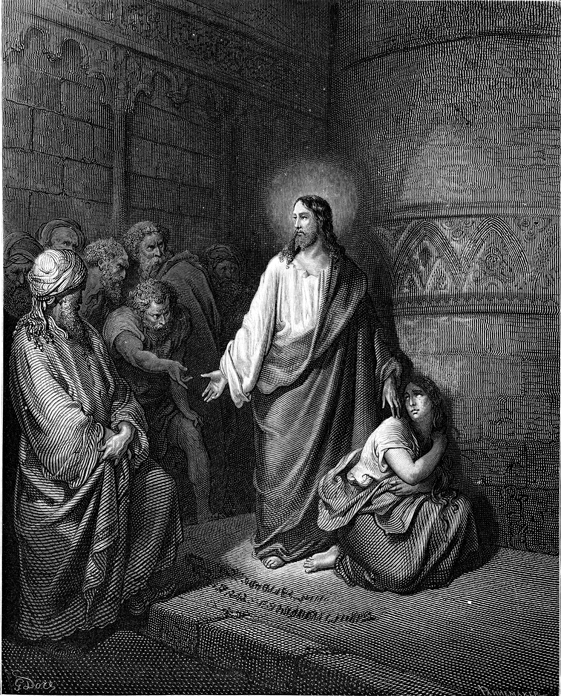
in John 8Then Jesus straightened up and asked her, “Woman, where are your accusers? Has no one condemned you?”
BSB
The same verse in ASV and KJV ▾
ASV
And Jesus lifted up himself, and said unto her, Woman, where are they? did no man condemn thee?
KJV
When Jesus had lifted up himself, and saw none but the woman, he said unto her, Woman, where are those thine accusers? hath no man condemned thee?
⋯
This verse in John 8
Commentary
18 notes on this verse"But Jesus, raising himself up," in which the fifth point is noted, namely the merciful liberation of the accused woman. And because mercy runs together with justice and is not against justice, the Lord asks her about condemnation and accusation. Therefore he says: "Woman, where …
This site's exposition
one by one, beginning with the older ones
on John 8:9-11
They leave one by one, the older ones first, until Jesus and the woman are alone. Neither do I condemn you sets her free of the sentence, and go and sin no more puts her under a charge. Both words are spoken to her together.
This site's exposition
where are your accusers
Barnes draws a line between accusing and condemning: they had brought the charge, but none took the step of judgment by casting a stone. Henry notes that the one man there without sin, who could have thrown first, is the one who shows mercy. Bonaventure sees mercy running with justice.
The record, by era
The Church Fathers5 voices
A commentator
Eusebius of CaesareaChurch History (Book III), Chapter 39, Section 16 · Written before 339.
And he [Papias] relates another story of a woman, who was accused of many sins before the Lord, which is contained in the Gospel according to the Hebrews. These things we have thought it necessary to observe in addition to what has been already stated.
He was granting pardon, but while he was granting it he raised his face to her and said, "Has no one stoned you?" And she did not say, "Why? What have I done, Lord? I'm not guilty, am I? That is not what she said. What she said was, "No one, Lord." She accused herself. They had been unable to prove it against her and had withdrawn. But she confessed, because her Lord was not unaware of her guilt but was nonetheless seeking her faith and her confession. "Has no one stoned you?" "No one, Lord." "No one"—that is confession of sins. "Lord"—that is pardon of what she deserved. "No one, Lord. I acknowledge both things. I know who you are; I know who I am. It is to you I am confessing. You see, I have heard the words, 'Confess to the Lord, for he is good.' I know my confession, I know your mercy."
If you [the bishop] are not merciful to the penitent, you sin against the Lord God because you have not been persuaded, nor have you believed our Savior and God by doing what he did for that sinful woman whom the elders set before him …
A commentator
Papias of HierapolisChurch History (Book III), Chapter 39, Section 16 · Written before 130.
proposed
And he [Papias] relates another story of a woman, who was accused of many sins before the Lord, which is contained in the Gospel according to the Hebrews. These things we have thought it necessary to observe in addition to what has been already stated.
A commentator
Papias of HierapolisUniversal History Year 12 of Trajen (110AD) Patrologia Orientalis vol. 7 p.48-49 · Written before 130.
proposed
And there was at that time in Hierapolis a distinguished master [Papias] who had many treatises, and he wrote five treatises on the Gospel. And he mentions in his treatise on the Gospel of John, that in the book of John the Evangelist, he speaks …
10 more voices on this verse
The Church Fathers2 voices
(Tract. xxxiii. 5, 6) There were left however two, the pitiable and the pitiful, And Jesus was left alone, and the woman standing in the midst: the woman, you may suppose, in great alarm, expecting punishment from one in whom no sin could be found. But He who had repelled her adversaries with the word of justice, lifted on her the eyes of mercy, and asked; When Jesus had lifted Himself up, and saw none but the woman, He said unto her, Woman, where are these thine accusers? hath no man condemned thee? She said, No man, Lord. We heard above the voice of justice; let us hear now that of mercy: Jesus said unto her, Neither do I condemn thee; I, who thou fearedst would condemn thee, because thou foundest no fault in me. What then, Lord? Dost Thou favour sin? No, surely. Listen to what follows, Go, and sin no more. So then our Lord condemned sin, but not the sinner. For did He favour sin, He would have said, Go, and live as thou wilt: depend on my deliverance: howsoever great thy sins be, it matters not: I will deliver thee from hell, and its tormentors. But He did not say this. Let those attend, who love the Lord's mercy, and fear His truth. Truly, Gracious and righteous is the Lord. (Ps. 35:7)
But when that woman was left alone, and all they were gone out, He raised His eyes to the woman. We have heard the voice of justice, let us also hear the voice of clemency. For I suppose that woman was the more terrified when she had heard it said by the Lord, "He that is without sin of you, let him first cast a stone at her." But they, turning their thought to themselves, and by that very withdrawal having confessed concerning themselves, had left the woman with her great sin to Him who was without sin. And because she had heard this, "He that is without sin, let him first cast a stone at her," she expected to be punished by Him in whom sin could not be found. But He, who had driven back her adversaries with the tongue of justice, raising the eyes of clemency towards her, asked her, "Hath no man condemned thee?" She answered, "No man, Lord." And He said, "Neither do I condemn thee;" by whom, perhaps, thou didst fear to be condemned, because in me thou hast not found sin. "Neither will I condemn thee." What is this, O Lord? Dost Thou therefore favor sins? Not so, evidently. Mark what follows: "Go, henceforth sin no more." Therefore the Lord did also condemn, but condemned sins, not man. For if He were a patron of sin, He would say, Neither will I condemn thee; go, live as thou wilt: be secure in my deliverance; how much soever thou wilt sin, I will deliver thee from all punishment even of hell, and from the tormentors of the infernal world. He said not this.
The Medieval Church2 voices
Then (v 10), he shows that Jesus did not abandon mercy, but gave a merciful sentence. First, Jesus questions the woman; then forgives her; and finally, cautions her. Jesus questioned her about her accusers; thus he says that Jesus rising up, that is, turning from …
A commentator
Agapius of HierapolisUniversal History Year 12 of Trajen (110AD) Patrologia Orientalis vol. 7 p.48-49 · Written before 942.
proposed
And there was at that time in Hierapolis a distinguished master [Papias] who had many treatises, and he wrote five treatises on the Gospel. And he mentions in his treatise on the Gospel of John, that in the book of John the Evangelist, he speaks …
The Puritans and the Awakening2 voices
Christ was without sin, and might cast the first stone; but though none more severe than he against sin, for he is infinitely just and holy, none more compassionate than he to sinners, for he is infinitely gracious and merciful, and this poor malefactor finds him so, now that she stands upon her deliverance.
When Jesus had lift himself up,....
The Nineteenth Century4 voices
A commentator
Albert Barnes1798–1870
Notes, Explanatory and Practical, on the Old and New Testaments (1832-1869)
Hath no man condemned thee? - Jesus had directed them, if innocent, to cast a stone, thus to condemn her, or to use the power which he gave them to condemn her. No one of them had done that. They had accused her, but they had not proceeded to the act expressive of judicial condemnation.
A commentator
J.C. Ryle1816–1900
Expository Thoughts on the Gospels: John (lightly modernized text, Grace Gems edition) (1869)
The narrative which begins the eighth chapter of John's Gospel is of a rather peculiar character. In some respects it stands alone. There is nothing quite like it in the whole range of the four Gospels. In every age some scrupulous minds have stumbled at the passage, and have doubted whether it was ever written by John at all. But the justice of such scruples is a point that cannot easily be proved.
A commentator
Jamieson, Fausset & Brown1802–1910
Commentary Critical and Explanatory on the Whole Bible (1871)
proposed
"And Jesus said unto her, Neither do I condemn thee, go and sin no more." He pronounces no pardon upon the woman (such as, "Thy sins are forgiven thee" [compare Lu 5:28;
quarantine:debris (2026-07-29) — unbalanced-parens+unbalanced-brackets
A commentator
J.C. Ryle1816–1900
Expository Thoughts on the Gospels: John (lightly modernized text, Grace Gems edition) (1869)
proposed
The narrative which begins the eighth chapter of John's Gospel is of a rather peculiar character. In some respects it stands alone. There is nothing quite like it in the whole range of the four Gospels. In every age some scrupulous minds have stumbled at the passage, and have doubted whether it was ever written by John at all. But the justice of such scruples is a point that cannot easily be proved. To suppose, as some have thought, that the narrative before us palliates the sin of adultery, and exhibits our Lord as making light of the seventh commandment, is surely a great mistake. There is nothing in the passage to justify such an assertion. There is not a sentence in it to warrant our saying anything of the kind. Let us calmly weigh the matter, and examine the contents of the passage. Our Lord's enemies brought before Him a woman guilty of adultery, and asked him to say what punishment she deserved. We are distinctly told that they asked the question, "to trap Him." They hoped to entrap Him into saying something for which they might accuse Him. They fancied perhaps that He who preached pardon and salvation to "publicans and harlots" might be induced to say something which would either contradict the law of Moses, or His own words. Our Lord knew the hearts of the malicious questioners before Him, and dealt with them with perfect wisdom, as He had done in the case of the "tribute-money." (Matt. 22:17.) He refused to be a "judge" and lawgiver among them, and specially in a case which their own law had already decided. He gave them at first no answer at all. But "when they continued asking," our Lord silenced them with a withering and heart-searching reply. "He that is without sin among you," he said, "let him first cast a stone at her." He did not say that the woman had not sinned, or that her sin was a trifling and excusable one.
Where this verse is studied
On this page
Studies24
On this chapter
Show the next 6 titles
About John
This page draws on 17 works. Open the list of works
This page draws on Agapius of Hierapolis, Universal History Year 12 of Trajen (110AD) Patrologia Orientalis vol. 7 p.48-49; Albert Barnes, Notes, Explanatory and Practical, on the Old and New Testaments (1832-1869); Augustine of Hippo, SERMON 16A.5; Augustine of Hippo, Catena Aurea by Aquinas; Augustine of Hippo, Tractates on John 33; Bonaventure, Commentary on John, Chapter 8; Didascalia Apostolorum, DIDASCALIA 7; Eusebius of Caesarea, Church History (Book III), Chapter 39, Section 16; J. C. Ryle, Expository Thoughts on the Gospels, John; J.C. Ryle, Expository Thoughts on the Gospels: John (lightly modernized text, Grace Gems edition); Jamieson, Fausset & Brown, Commentary Critical and Explanatory on the Whole Bible; John Calvin, Commentary on the Gospel according to John; John Gill, Exposition of the New Testament (1746-1748); Matthew Henry, Commentary on the Whole Bible; Papias of Hierapolis, Church History (Book III), Chapter 39, Section 16; Papias of Hierapolis, Universal History Year 12 of Trajen (110AD) Patrologia Orientalis vol. 7 p.48-49 and Thomas Aquinas, Commentary on John.