
John 8:8
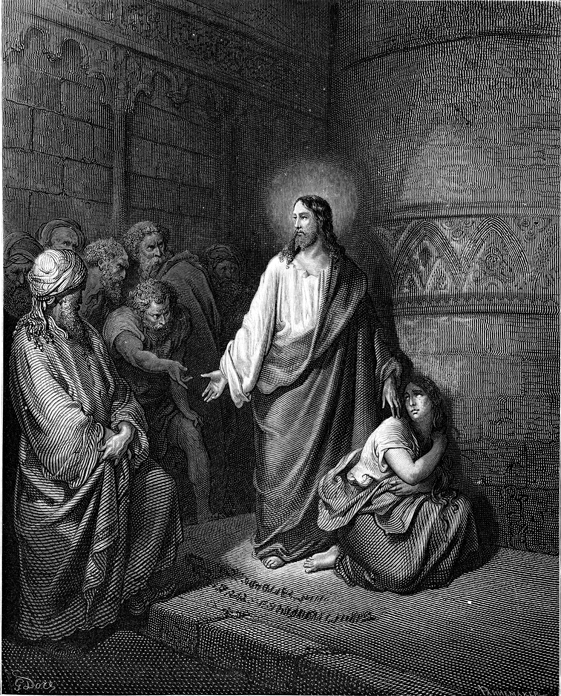
in John 8And again He bent down and wrote on the ground.
BSB
The same verse in ASV and KJV ▾
ASV
And again he stooped down, and with his finger wrote on the ground.
KJV
And again he stooped down, and wrote on the ground.
⋯
This verse in John 8
Commentary
15 notes on this verseA commentator
Eusebius of CaesareaChurch History (Book III), Chapter 39, Section 16 · Written before 339.
And he [Papias] relates another story of a woman, who was accused of many sins before the Lord, which is contained in the Gospel according to the Hebrews. These things we have thought it necessary to observe in addition to what has been already stated.
This site's exposition
Let him who is without sin among you
on John 8:7-8
Deuteronomy 17:7 put the first stone in the witnesses' hands. He keeps that procedure and adds one condition, that the man who throws it be without sin among them. He bent down and wrote a second time, and the pause gives them room to leave.
The record, by era
The Church Fathers3 voices
A commentator
Papias of HierapolisChurch History (Book III), Chapter 39, Section 16 · Written before 130.
proposed
And he [Papias] relates another story of a woman, who was accused of many sins before the Lord, which is contained in the Gospel according to the Hebrews. These things we have thought it necessary to observe in addition to what has been already stated.
A commentator
Papias of HierapolisUniversal History Year 12 of Trajen (110AD) Patrologia Orientalis vol. 7 p.48-49 · Written before 130.
proposed
And there was at that time in Hierapolis a distinguished master [Papias] who had many treatises, and he wrote five treatises on the Gospel. And he mentions in his treatise on the Gospel of John, that in the book of John the Evangelist, he speaks …
(Tract. xxxiii. 5) Having with the weapon of justice smitten them, He deigned not even to look on the fallen, but averted His eyes: And again He stooped down, and wrote on the ground.
The Medieval Church2 voices
This is like our Lord; while His eyes are fixed, and He seems attending to something else, He gives the bystanders an opportunity of retiring: a tacit admonition to us to consider always both before we condemn a brother for a sin, and after we have punished him, whether we are not guilty ourselves of the same fault, or others as bad.
In line with our usual human way of doing things, we can understand that the reason why the Lord might wish to bend before his unprincipled tempters and to write on the ground was that by directing his look elsewhere he might give them the …
8 more voices on this verse
The Medieval Church3 voices
Jesus continued to write, and again bending down, he wrote. He did this, first, to show the firmness of his sentence, "God is not like a man, who may lie, or like a son of man, so that he may change" (Num 23:19). Secondly, he …
A commentator
Agapius of HierapolisUniversal History Year 12 of Trajen (110AD) Patrologia Orientalis vol. 7 p.48-49 · Written before 942.
proposed
And there was at that time in Hierapolis a distinguished master [Papias] who had many treatises, and he wrote five treatises on the Gospel. And he mentions in his treatise on the Gospel of John, that in the book of John the Evangelist, he speaks …
"And again bending down, he wrote on the ground," so that he might give those who were confounded a place to depart without shame. Whence Bede: "He wished to bend down before his tempters and write on the ground, so that, turning his face to …
The Puritans and the Awakening2 voices
1 ), never to be forgotten till they are forgiven. [4.] The scribes and Pharisees were so strangely thunderstruck with the words of Christ that they let fall their persecution of Christ, whom they durst no further tempt, and their prosecution of the woman, whom they durst no longer accuse (
quarantine:debris (2026-07-29) — leading-citation-number
And again he stooped down, and wrote on the ground. As before, having said enough to confound them; and yet unwilling to pursue the matter any further, or publicly expose them in any other way; and that they might have an opportunity of withdrawing themselves without any further notice of his, he took this method.
The Nineteenth Century3 voices
A commentator
J.C. Ryle1816–1900
Expository Thoughts on the Gospels: John (lightly modernized text, Grace Gems edition) (1869)
The narrative which begins the eighth chapter of John's Gospel is of a rather peculiar character. In some respects it stands alone. There is nothing quite like it in the whole range of the four Gospels. In every age some scrupulous minds have stumbled at the passage, and have doubted whether it was ever written by John at all. But the justice of such scruples is a point that cannot easily be proved.
A commentator
Jamieson, Fausset & Brown1802–1910
Commentary Critical and Explanatory on the Whole Bible (1871)
proposed
again he stooped down and wrote--The design of this second stooping and writing on the ground was evidently to give her accusers an opportunity to slink away unobserved by Him, and so avoid an exposure to His eye which they could ill have stood.
quarantine:debris (2026-07-29) — starts-lowercase
A commentator
J.C. Ryle1816–1900
Expository Thoughts on the Gospels: John (lightly modernized text, Grace Gems edition) (1869)
proposed
The narrative which begins the eighth chapter of John's Gospel is of a rather peculiar character. In some respects it stands alone. There is nothing quite like it in the whole range of the four Gospels. In every age some scrupulous minds have stumbled at the passage, and have doubted whether it was ever written by John at all. But the justice of such scruples is a point that cannot easily be proved. To suppose, as some have thought, that the narrative before us palliates the sin of adultery, and exhibits our Lord as making light of the seventh commandment, is surely a great mistake. There is nothing in the passage to justify such an assertion. There is not a sentence in it to warrant our saying anything of the kind. Let us calmly weigh the matter, and examine the contents of the passage. Our Lord's enemies brought before Him a woman guilty of adultery, and asked him to say what punishment she deserved. We are distinctly told that they asked the question, "to trap Him." They hoped to entrap Him into saying something for which they might accuse Him. They fancied perhaps that He who preached pardon and salvation to "publicans and harlots" might be induced to say something which would either contradict the law of Moses, or His own words. Our Lord knew the hearts of the malicious questioners before Him, and dealt with them with perfect wisdom, as He had done in the case of the "tribute-money." (Matt. 22:17.) He refused to be a "judge" and lawgiver among them, and specially in a case which their own law had already decided. He gave them at first no answer at all. But "when they continued asking," our Lord silenced them with a withering and heart-searching reply. "He that is without sin among you," he said, "let him first cast a stone at her." He did not say that the woman had not sinned, or that her sin was a trifling and excusable one.
Where this verse is studied
About John
This page draws on 15 works. Open the list of works
This page draws on Agapius of Hierapolis, Universal History Year 12 of Trajen (110AD) Patrologia Orientalis vol. 7 p.48-49; Alcuin of York, Catena Aurea by Aquinas; Augustine of Hippo, Catena Aurea by Aquinas; Bede, Homilies on the Gospels 1.25; Bonaventure, Commentary on John, Chapter 8; Eusebius of Caesarea, Church History (Book III), Chapter 39, Section 16; J.C. Ryle, Expository Thoughts on the Gospels: John (lightly modernized text, Grace Gems edition); Jamieson, Fausset & Brown, Commentary Critical and Explanatory on the Whole Bible; Jamieson, Fausset, and Brown, Commentary Critical and Explanatory on the Whole Bible; John Gill, Exposition of the New Testament (1746-1748); John Wesley, Explanatory Notes upon the New Testament; Matthew Henry, Commentary on the Whole Bible; Papias of Hierapolis, Church History (Book III), Chapter 39, Section 16; Papias of Hierapolis, Universal History Year 12 of Trajen (110AD) Patrologia Orientalis vol. 7 p.48-49 and Thomas Aquinas, Commentary on John.