
John 8:1
in John 8But Jesus went to the Mount of Olives.
BSB
The same verse in ASV and KJV ▾
ASV
but Jesus went unto the mount of Olives.
KJV
Jesus went unto the mount of Olives.
⋯
This verse in John 8
Commentary
17 notes on this verseA commentator
Eusebius of CaesareaChurch History (Book III), Chapter 39, Section 16 · Written before 339.
And he [Papias] relates another story of a woman, who was accused of many sins before the Lord, which is contained in the Gospel according to the Hebrews. These things we have thought it necessary to observe in addition to what has been already stated.
This site's exposition
went to the Mount of Olives
on John 8:1-2
Jesus went to the Mount of Olives, the slope He lodged on through that week, as Luke 21:37 records. Early in the morning He was back in the temple courts, and the people came to Him there. He sat down to teach, the teacher's posture in that world.
The record, by era
The Church Fathers4 voices
(Tract. xxxiii. 3) And where ought Christ to teach, except on the mount of Olives; on the mount of ointment, on the mount of chrism. For the name Christ is from chrism, chrism being the Greek word for unction. He has anointed us, for wrestling with the devil.
A commentator
Papias of HierapolisUniversal History Year 12 of Trajen (110AD) Patrologia Orientalis vol. 7 p.48-49 · Written before 130.
proposed
And there was at that time in Hierapolis a distinguished master [Papias] who had many treatises, and he wrote five treatises on the Gospel. And he mentions in his treatise on the Gospel of John, that in the book of John the Evangelist, he speaks …
A commentator
Papias of HierapolisChurch History (Book III), Chapter 39, Section 16 · Written before 130.
proposed
And he [Papias] relates another story of a woman, who was accused of many sins before the Lord, which is contained in the Gospel according to the Hebrews. These things we have thought it necessary to observe in addition to what has been already stated.
"Thence Jesus went unto the mount;" namely, to mount "Olivet,"-unto the fruitful mount, unto the mount of ointment, unto the mount of chrism. For the name of Christ is from chrism; in the Greek, is called in Latin unctio, an anointing. And He has anointed us for this reason, because He has made us wrestlers against the devil. "And early in the morning He came again into the temple, and all the people came unto Him; and He sat down and taught them." And He was not taken, for He did not yet deign to suffer.
The Medieval Church1 voice
A commentator
Agapius of HierapolisUniversal History Year 12 of Trajen (110AD) Patrologia Orientalis vol. 7 p.48-49 · Written before 942.
proposed
And there was at that time in Hierapolis a distinguished master [Papias] who had many treatises, and he wrote five treatises on the Gospel. And he mentions in his treatise on the Gospel of John, that in the book of John the Evangelist, he speaks …
10 more voices on this verse
The Medieval Church4 voices
Having set forth the refutation of those rising up through power, here is set forth the refutation of those plotting through malice. Because they could not kill him, they sought to find an occasion to catch him in his speech. And therefore they proposed a …
Our Lord at the time of His passion used to spend the day in Jerusalem, preaching in the temple, and performing miracles, and return in the evening to Bethany, where He lodged with the sisters of Lazarus. Thus on the last day of the feast, having, according to His wont, preached the whole day in the temple, in the evening He went to the mount of Olives.
The Mount of Olives designates the height of the Lord's benevolence and mercy, for in Greek "mercy" is called oleos, and an olive plantation is called oleon, and also because anointing with oil usually soothes weary and aching limbs. But oil is preeminent in power …
After having treated of the origin of the doctrine of Christ, the Evangelist here considers its power. Now the doctrine of Christ has the power both to enlighten and to give life, because his words are spirit and life. So first, he treats of the …
The Reformation1 voice
Now they said this, trying him, that they might have ground for accusing him. But Jesus, casting down his eyes, wrote with the finger on the ground. And as they persisted in asking him, he lifted up his eyes, and said to them, He who is without sin amongst you, let him first cast a stone at her.
quarantine:scripture (2026-07-29) — scripture-overlap:81%@v5-7
The Puritans and the Awakening2 voices
): He went unto the mount of olives; whether to some friend's house, or to some booth pitched there, now at the feast of tabernacles, is not certain; whether he rested there, or, as some think, continued all night in prayer to God, we are not told.
quarantine:debris (2026-07-29) — leading-punctuation+unbalanced-parens
Jesus went unto the Mount of Olives.
The Nineteenth Century3 voices
A commentator
Albert Barnes1798–1870
Notes, Explanatory and Practical, on the Old and New Testaments (1832-1869)
Mount of Olives - The mountain about a mile directly east of Jerusalem. See the notes at Mat 21:1. This was the place in which he probably often passed the night when attending the feasts at Jerusalem. The Garden of Gethsemane, to which he was accustomed to resort Joh 18:2, was on the western side of that mountain, and Bethany, the abode of Martha and Mary, on its east side, Joh 11:1.
A commentator
J.C. Ryle1816–1900
Expository Thoughts on the Gospels: John (lightly modernized text, Grace Gems edition) (1869)
The narrative which begins the eighth chapter of John's Gospel is of a rather peculiar character. In some respects it stands alone. There is nothing quite like it in the whole range of the four Gospels. In every age some scrupulous minds have stumbled at the passage, and have doubted whether it was ever written by John at all. But the justice of such scruples is a point that cannot easily be proved.
A commentator
J.C. Ryle1816–1900
Expository Thoughts on the Gospels: John (lightly modernized text, Grace Gems edition) (1869)
proposed
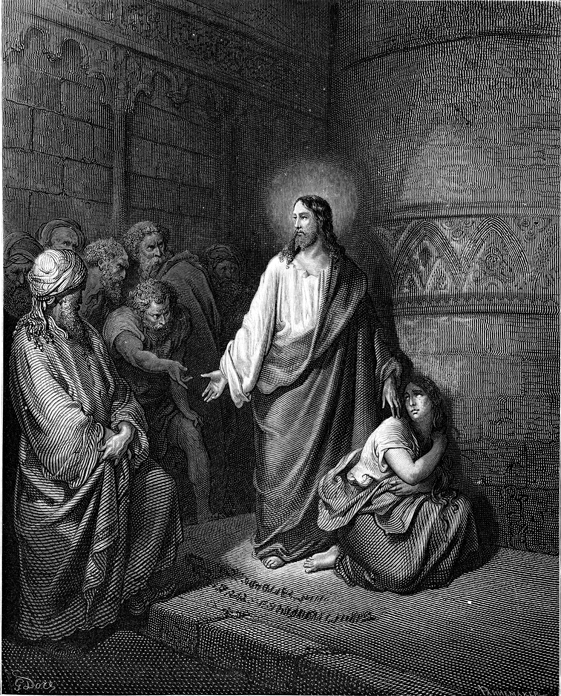
The narrative which begins the eighth chapter of John's Gospel is of a rather peculiar character. In some respects it stands alone. There is nothing quite like it in the whole range of the four Gospels. In every age some scrupulous minds have stumbled at the passage, and have doubted whether it was ever written by John at all. But the justice of such scruples is a point that cannot easily be proved. To suppose, as some have thought, that the narrative before us palliates the sin of adultery, and exhibits our Lord as making light of the seventh commandment, is surely a great mistake. There is nothing in the passage to justify such an assertion. There is not a sentence in it to warrant our saying anything of the kind. Let us calmly weigh the matter, and examine the contents of the passage. Our Lord's enemies brought before Him a woman guilty of adultery, and asked him to say what punishment she deserved. We are distinctly told that they asked the question, "to trap Him." They hoped to entrap Him into saying something for which they might accuse Him. They fancied perhaps that He who preached pardon and salvation to "publicans and harlots" might be induced to say something which would either contradict the law of Moses, or His own words. Our Lord knew the hearts of the malicious questioners before Him, and dealt with them with perfect wisdom, as He had done in the case of the "tribute-money." (Matt. 22:17.) He refused to be a "judge" and lawgiver among them, and specially in a case which their own law had already decided. He gave them at first no answer at all. But "when they continued asking," our Lord silenced them with a withering and heart-searching reply. "He that is without sin among you," he said, "let him first cast a stone at her." He did not say that the woman had not sinned, or that her sin was a trifling and excusable one.
The walk
8 stopsEach card is a verse this one points to, and under it the verses that one points to in turn. Where several paths arrive at the same place, that place is listed first: the text keeps returning to it.
Through
Matthew 21:1As they approached Jerusalem and came to Bethphage on the Mount of Olives, Jesus sent out two disciples,
it leads to
- Zechariah 14:4
On that day His feet will stand on the Mount of Olives, east of Jerusalem, and the Mount of Olives will be split in two from east to west, forming a great valley, with…
Reached by 2 separate paths from here.
- Mark 11:1–10
As they approached Jerusalem and came to Bethphage and Bethany at the Mount of Olives, Jesus sent out two of His disciples
- Matthew 24:3
While Jesus was sitting on the Mount of Olives, the disciples came to Him privately. “Tell us,” they said, “when will these things happen, and what will be the sign of Your coming and…
- Luke 21:37
Every day Jesus taught at the temple, but every evening He went out to spend the night on the Mount of Olives.
- Zechariah 14:4
Through
Luke 19:37And as He approached the descent from the Mount of Olives, the whole multitude of disciples began to praise God joyfully in a loud voice for all the miracles they had seen:
it leads to
- Matthew 21:1
As they approached Jerusalem and came to Bethphage on the Mount of Olives, Jesus sent out two disciples,
Reached by 2 separate paths from here.
- Matthew 21:1
Through
Mark 11:1As they approached Jerusalem and came to Bethphage and Bethany at the Mount of Olives, Jesus sent out two of His disciples
it leads to
- Luke 19:29–40
As He approached Bethphage and Bethany at the Mount of Olives, He sent out two of His disciples,
- Matthew 21:1–11
As they approached Jerusalem and came to Bethphage on the Mount of Olives, Jesus sent out two disciples,
- John 12:14–19
Finding a young donkey, Jesus sat on it, as it is written:
- Luke 19:29–40
Where this verse is studied
About John
This page draws on 17 works. Open the list of works
This page draws on Agapius of Hierapolis, Universal History Year 12 of Trajen (110AD) Patrologia Orientalis vol. 7 p.48-49; Albert Barnes, Notes, Explanatory and Practical, on the Old and New Testaments (1832-1869); Alcuin of York, Catena Aurea by Aquinas; Augustine, Tractates on the Gospel of John; Augustine of Hippo, Catena Aurea by Aquinas; Augustine of Hippo, Tractates on John 33; Bede, Homilies on the Gospels 1.25; Bonaventure, Commentary on John, Chapter 8; Brooke Foss Westcott, The Gospel according to St. John; Eusebius of Caesarea, Church History (Book III), Chapter 39, Section 16; J.C. Ryle, Expository Thoughts on the Gospels: John (lightly modernized text, Grace Gems edition); John Calvin, Commentaries; John Gill, Exposition of the New Testament (1746-1748); Matthew Henry, Commentary on the Whole Bible; Papias of Hierapolis, Universal History Year 12 of Trajen (110AD) Patrologia Orientalis vol. 7 p.48-49; Papias of Hierapolis, Church History (Book III), Chapter 39, Section 16 and Thomas Aquinas, Commentary on John.