
John 8:7
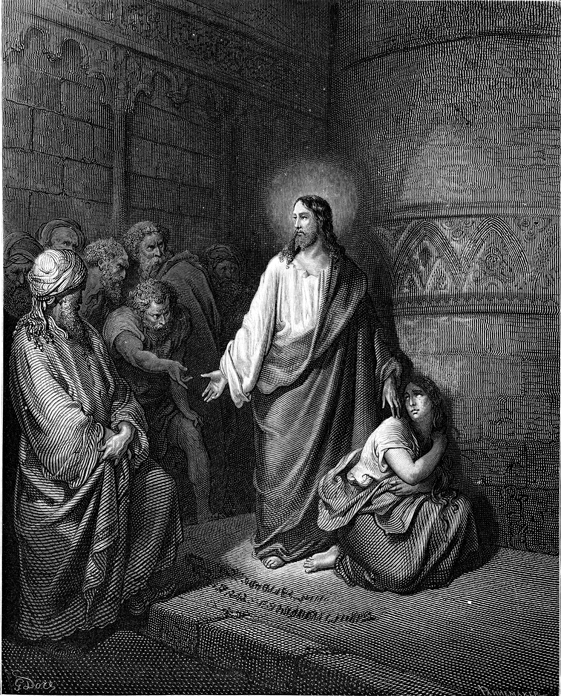
in John 8When they continued to question Him, He straightened up and said to them, “Let him who is without sin among you be the first to cast a stone at her.”
BSB
The same verse in ASV and KJV ▾
ASV
But when they continued asking him, he lifted up himself, and said unto them, He that is without sin among you, let him first cast a stone at her.
KJV
So when they continued asking him, he lifted up himself, and said unto them, He that is without sin among you, let him first cast a stone at her.
⋯
This verse in John 8
Commentary
21 notes on this verseFor he that does not judge himself first, is ignorant what to judge right in another; and if perchance he did know by the hearing what to judge right, yet he is not able to judge rightly the merits of another, who has no rule of judging supplied him by the consciousness of his own innocence. Hence it is that it is said to certain persons dealing deceitfully, when they brought an adulteress to receive punishment; "He that is without sin among you, let him first cast a stone at her."
This site's exposition
Let him who is without sin among you
on John 8:7-8
Deuteronomy 17:7 put the first stone in the witnesses' hands. He keeps that procedure and adds one condition, that the man who throws it be without sin among them. He bent down and wrote a second time, and the pause gives them room to leave.
The record, by era
The Church Fathers5 voices
A commentator
Eusebius of CaesareaChurch History (Book III), Chapter 39, Section 16 · Written before 339.
And he [Papias] relates another story of a woman, who was accused of many sins before the Lord, which is contained in the Gospel according to the Hebrews. These things we have thought it necessary to observe in addition to what has been already stated.
(Tract. xxxiii. 5) He did not say, Stone her not, lest He should seem to speak contrary to the law. But God forbid that He should say, Stone her; for He came not to destroy that which He found, but to seek that which was lost. What then did He answer? He that is without sin among you, let him first cast a stone at her. This is the voice of justice. Let the sinner be punished, but not by sinners; the law carried into effect, but not by transgressors of the law.
What answer, then, did the Lord Jesus make? How answered the Truth? How answered Wisdom? How answered that Righteousness against which a false accusation was ready? He did not say, Let her not be stoned; lest He should seem to speak against the law. But God forbid that He should say, Let her be stoned: for He came not to lose, what He had found, but to seek what was lost. What then did He answer? See you how full it is of righteousness, how full of meekness and truth! "He that is without sin of you," saith He, "let him first cast a stone at her." O answer of Wisdom! How He sent them unto themselves! For without they stood to accuse and censure, themselves they examined not inwardly: they saw the adulteress, they looked not into themselves. Transgressors of the law, they wished the law to be fulfilled, and this by heedlessly accusing; not really fulfilling it, as if condemning adulteries by chastity. You have heard, O Jews, you have heard, O Pharisees, you have heard, O teachers of the law, the guardian of the law, but have not yet understood Him as the Lawgiver. What else does He signify to you when He writes with His finger on the ground? For the law was written with the finger of God; but written on stone because of the hard-hearted. The Lord now wrote on the ground, because He was seeking fruit. You have heard then, Let the law be fulfilled, let the adulteress be stoned. But is it by punishing her that the law is to be fulfilled by those that ought to be punished? Let each of you consider himself, let him enter into himself, ascend the judgment-seat of his own mind, place himself at the bar of his own conscience, oblige himself to confess. For he knows what he is: for "no man knoweth the things of a man, but the spirit of man which is in him." Each looking carefully into himself, finds himself a sinner. Yes, indeed. […]
A commentator
Papias of HierapolisUniversal History Year 12 of Trajen (110AD) Patrologia Orientalis vol. 7 p.48-49 · Written before 130.
proposed
And there was at that time in Hierapolis a distinguished master [Papias] who had many treatises, and he wrote five treatises on the Gospel. And he mentions in his treatise on the Gospel of John, that in the book of John the Evangelist, he speaks …
A commentator
Papias of HierapolisChurch History (Book III), Chapter 39, Section 16 · Written before 130.
proposed
And he [Papias] relates another story of a woman, who was accused of many sins before the Lord, which is contained in the Gospel according to the Hebrews. These things we have thought it necessary to observe in addition to what has been already stated.
14 more voices on this verse
The Church Fathers1 voice
And He, who had come to forgive sins, said: "Whoever among you knows himself to be without sin, let him first cast a stone at her." O response, or proposal! If they wished to cast a stone at the sinner, at that moment it would again be said: "In whatever judgment you judge, you will be judged." You condemn, you will be condemned. However, although they did not recognize the Creator, they knew their own conscience. Putting their faces one after another, so that they would not see each other out of shame, from the oldest—as the Evangelist said—to the youngest, they all went out. For the Holy Spirit had said: "All have turned away, together they have become worthless; there is none who does good, not even one."
The Medieval Church5 voices
For he who judges not himself first, cannot know how to judge correctly in the case of another. For though He know what the offence is, from being told, yet He cannot judge of another's deserts, who supposing himself innocent, will not apply the rule of justice to himself.
So when they continued asking Him, He lifted Himself up.
It was at their insistence that Jesus gave his sentence; and so the Evangelist says, As they persisted in the question, he stood up and said to them: Whoever among you is without sin, let him be the first to cast a stone at her. …
"But when they persisted in questioning him," and would not desist from their folly: "he raised himself up and said to them: Let him who is without sin among you cast the first stone at her." Having bent down through mercy, he raised himself up, …
A commentator
Agapius of HierapolisUniversal History Year 12 of Trajen (110AD) Patrologia Orientalis vol. 7 p.48-49 · Written before 942.
proposed
And there was at that time in Hierapolis a distinguished master [Papias] who had many treatises, and he wrote five treatises on the Gospel. And he mentions in his treatise on the Gospel of John, that in the book of John the Evangelist, he speaks …
The Puritans and the Awakening3 voices
Let him that is without sin begin such discourse as this, and then those that are truly humbled for their own sins will blush at it, and be glad to let it drop. ( c. ) Those that are any way obliged to animadvert upon the faults of others are concerned to look well to themselves, and keep themselves pure ( Matt. vii.
quarantine:debris (2026-07-29) — unbalanced-parens
He that is without sin - He that is not guilty: his own conscience being the judge) either of the same sin, or of some nearly resembling it; let him - as a witness, cast the first stone at her.
quarantine:debris (2026-07-29) — unbalanced-parens
So when they continued asking him,....
The Nineteenth Century5 voices
A commentator
Albert Barnes1798–1870
Notes, Explanatory and Practical, on the Old and New Testaments (1832-1869)
They continued asking him - They pressed the question upon him. They were determined to extort an answer from him, and showed a perseverance in evil which has been unhappily often imitated. Is without sin - That is, without this particular sin; he who has not himself been guilty of this very crime - for in this place the connection evidently demands this meaning.
A commentator
J.C. Ryle1816–1900
Expository Thoughts on the Gospels: John (lightly modernized text, Grace Gems edition) (1869)
The narrative which begins the eighth chapter of John's Gospel is of a rather peculiar character. In some respects it stands alone. There is nothing quite like it in the whole range of the four Gospels. In every age some scrupulous minds have stumbled at the passage, and have doubted whether it was ever written by John at all. But the justice of such scruples is a point that cannot easily be proved.
A commentator
Jamieson, Fausset & Brown1802–1910
Commentary Critical and Explanatory on the Whole Bible (1871)
He that is without sin--not meaning sinless altogether; nor yet, guiltless of a literal breach of the Seventh Commandment; but probably, he whose conscience acquits him of any such sin. cast a stone--"the stone," meaning the first one (De 17:7).
A commentator
J.C. Ryle1816–1900
Expository Thoughts on the Gospels: John (lightly modernized text, Grace Gems edition) (1869)
proposed
The narrative which begins the eighth chapter of John's Gospel is of a rather peculiar character. In some respects it stands alone. There is nothing quite like it in the whole range of the four Gospels. In every age some scrupulous minds have stumbled at the passage, and have doubted whether it was ever written by John at all. But the justice of such scruples is a point that cannot easily be proved. To suppose, as some have thought, that the narrative before us palliates the sin of adultery, and exhibits our Lord as making light of the seventh commandment, is surely a great mistake. There is nothing in the passage to justify such an assertion. There is not a sentence in it to warrant our saying anything of the kind. Let us calmly weigh the matter, and examine the contents of the passage. Our Lord's enemies brought before Him a woman guilty of adultery, and asked him to say what punishment she deserved. We are distinctly told that they asked the question, "to trap Him." They hoped to entrap Him into saying something for which they might accuse Him. They fancied perhaps that He who preached pardon and salvation to "publicans and harlots" might be induced to say something which would either contradict the law of Moses, or His own words. Our Lord knew the hearts of the malicious questioners before Him, and dealt with them with perfect wisdom, as He had done in the case of the "tribute-money." (Matt. 22:17.) He refused to be a "judge" and lawgiver among them, and specially in a case which their own law had already decided. He gave them at first no answer at all. But "when they continued asking," our Lord silenced them with a withering and heart-searching reply. "He that is without sin among you," he said, "let him first cast a stone at her." He did not say that the woman had not sinned, or that her sin was a trifling and excusable one.
He that is without sin - Αναμαρτητος, meaning the same kind of sin, adultery, fornication, etc. Kypke has largely proved that the verb ἁμαρτανειν is used in this sense by the best Greek writers. Let him first cast a stone at her - Or, upon her, επ’ αυτῃ. The Jewish method of stoning, according to the rabbins, was as follows: The culprit, half naked, the hands tied behind the back, was placed on a scaffold, ten or twelve feet high; the witnesses, who stood with her, pushed her off with great force: if she was killed by the fall there was nothing farther done; but, if she was not, one of the witnesses took up a very large stone, and dashed it upon her breast, which generally was the coup de grace, or finishing stroke. This mode of punishment seems referred to, Mat 21:44. However, this procedure does not appear to have been always attended to. See Lev 24:16, and Joh 8:59 of this chapter.
Where this verse is studied
On this page
Studies24
On this chapter
Show the next 6 titles
About John
This page draws on 20 works. Open the list of works
This page draws on Adam Clarke, Commentary on the Bible; Agapius of Hierapolis, Universal History Year 12 of Trajen (110AD) Patrologia Orientalis vol. 7 p.48-49; Albert Barnes, Notes, Explanatory and Practical, on the Old and New Testaments (1832-1869); Augustine of Hippo, Catena Aurea by Aquinas; Augustine of Hippo, Tractates on John 33; Augustine of Hippo, Sermon 16A; Bede, Catena Aurea by Aquinas; Bonaventure, Commentary on John, Chapter 8; Eusebius of Caesarea, Church History (Book III), Chapter 39, Section 16; Gregory the Dialogist, Morals on the Book of Job 14.29.34; Gregory the Dialogist, Catena Aurea by Aquinas; J.C. Ryle, Expository Thoughts on the Gospels: John (lightly modernized text, Grace Gems edition); Jamieson, Fausset & Brown, Commentary Critical and Explanatory on the Whole Bible; Jamieson, Fausset, and Brown, Commentary Critical and Explanatory on the Whole Bible; John Gill, Exposition of the New Testament (1746-1748); John Wesley, Explanatory Notes upon the New Testament; Matthew Henry, Commentary on the Whole Bible; Papias of Hierapolis, Universal History Year 12 of Trajen (110AD) Patrologia Orientalis vol. 7 p.48-49; Papias of Hierapolis, Church History (Book III), Chapter 39, Section 16 and Thomas Aquinas, Commentary on John.