
John 8:5
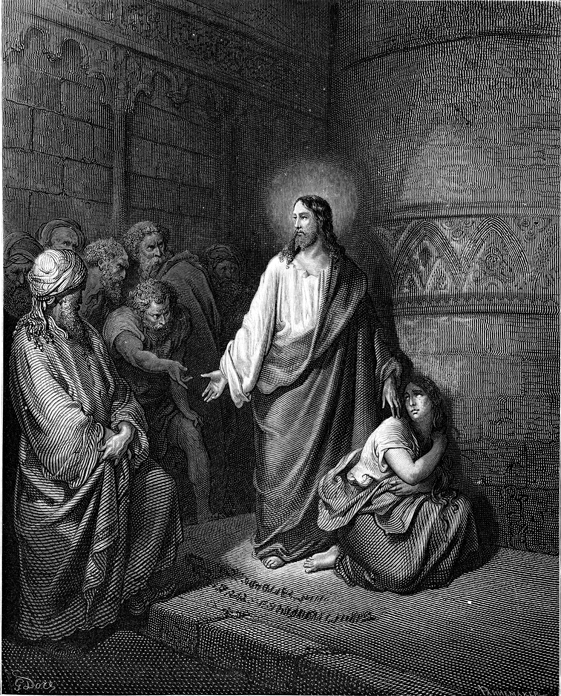
in John 8In the Law Moses commanded us to stone such a woman. So what do You say?”
BSB
The same verse in ASV and KJV ▾
ASV
Now in the law Moses commanded us to stone such: what then sayest thou of her?
KJV
Now Moses in the law commanded us, that such should be stoned: but what sayest thou?
⋯
This verse in John 8
Commentary
18 notes on this verseA commentator
Eusebius of CaesareaChurch History (Book III), Chapter 39, Section 16 · Written before 339.
And he [Papias] relates another story of a woman, who was accused of many sins before the Lord, which is contained in the Gospel according to the Hebrews. These things we have thought it necessary to observe in addition to what has been already stated.
This site's exposition
Moses commanded us to stone such a woman
on John 8:5-6
The question sets a trap with two jaws, and John says they asked it to have a basis for accusing Him. Rome kept the power of execution. A call to stone her puts Him against the governor, and a call to release her puts Him against Moses.
The record, by era
The Church Fathers5 voices
The Scribes and Pharisees kept accusing her and kept earnestly pressing the case, for they wished to stone her to death, according to the law. "But Jesus, stooping down, began to write with his finger on the ground," the sins, to be sure, of those who were making the accusation, as well as the sins of all mortal beings according to what is written in the prophet, "Those who depart from you shall be written in the earth."
(Tract. xxxiii. s. 4) They had remarked upon Him already, as being over lenient. Of Him indeed it had been prophesied, Ride on because of the word of truth, of meekness, and of righteousness. (Ps. 44) So as a teacher He exhibited truth, as a deliverer meekness, as a judge righteousness. When He spoke, His truth was acknowledged; when against His enemies He used no violence, His meekness was praised. So they raised the scandal on the score of justice. For they said among themselves, If He decide to let her go, He will not do justice; for the law cannot command what is unjust: Now Moses in the law commanded us, that such should be stoned: but to maintain His meekness, which has made Him already so acceptable to the people, He must decide to let her go. Wherefore they demand His opinion: And what sayest Thou? hoping to find an occasion to accuse Him, as a transgressor of the law: And this they said tempting Him, that they might have to accuse Him. But our Lord in His answer both maintained His justice, and departed not from meekness. Jesus stooped down, and with His finger wrote on the ground.
And now observe wherein the Lord's gentleness was tempted by His enemies. "And the scribes and Pharisees brought to Him a woman just taken in adultery: and they set her in the midst, and said to Him, Master, this woman has just been taken in adultery. Now Moses in the law commanded us, that such should be stoned: but what sayest thou? But this they said, tempting Him, that they might accuse Him." Why accuse Him? Had they detected Himself in any misdeed; or was that woman said to have been concerned with Him in any manner? What, then, is the meaning of "tempting Him, that they might accuse Him"? We understand, brethren, that a wonderful gentleness shone out pre-eminently in the Lord. They observed that He was very meek, very gentle: for of Him it had been previously foretold, "Gird Thy sword upon Thy thigh, O most Mighty; in Thy splendor and beauty urge on, march on prosperously, and reign, because of truth, and meekness, and righteousness." Accordingly, as a teacher, He brought truth; as a deliverer, He brought gentleness; as a protector, He brought righteousness. That He was to reign on account of these things, the prophet had by the Holy Spirit foretold. When He spoke His truth was acknowledged; when He was not provoked to anger against His enemies, His meekness was praised. Whilst, therefore, in respect of these two,-namely, His truth and meekness,-His enemies were tormented with malice and envy; in respect of the third,-namely, righteousness,-they laid a stumbling-block for Him. In what way? Because the law had commanded the adulterers to be stoned, and surely the law could not command what was unjust: if any man should say other than the law had commanded, he would be detected as unjust. Therefore they said among themselves, "He is accounted true, he appears to be gentle; an accusation must be sought against him in respect of righteousness. […]
A commentator
Papias of HierapolisUniversal History Year 12 of Trajen (110AD) Patrologia Orientalis vol. 7 p.48-49 · Written before 130.
proposed
And there was at that time in Hierapolis a distinguished master [Papias] who had many treatises, and he wrote five treatises on the Gospel. And he mentions in his treatise on the Gospel of John, that in the book of John the Evangelist, he speaks …
A commentator
Papias of HierapolisChurch History (Book III), Chapter 39, Section 16 · Written before 130.
proposed
And he [Papias] relates another story of a woman, who was accused of many sins before the Lord, which is contained in the Gospel according to the Hebrews. These things we have thought it necessary to observe in addition to what has been already stated.
11 more voices on this verse
The Medieval Church4 voices
They appeal to the justice contained in the Law when they remark, in the Law, that is, in Leviticus (20:10) and in Deuteronomy (22:21), Moses commanded us to stone such a woman. They ask Jesus for his verdict when they say, But what do you …
When the Lord was about to give pardon to the sinful woman, he desired to write with his finger on the ground, in order to point out that it was he himself who once wrote the Ten Commandments of the law on stone with his …
"But in the Law Moses commanded us to stone such women": Deuteronomy twenty-two: "If a man has lain with his neighbor's wife, both shall die," that is, the adulterer and the adulteress. "What therefore do you say?" They asked this not from zeal for inquiry, …
A commentator
Agapius of HierapolisUniversal History Year 12 of Trajen (110AD) Patrologia Orientalis vol. 7 p.48-49 · Written before 942.
proposed
And there was at that time in Hierapolis a distinguished master [Papias] who had many treatises, and he wrote five treatises on the Gospel. And he mentions in his treatise on the Gospel of John, that in the book of John the Evangelist, he speaks …
The Puritans and the Awakening3 voices
Moses hath commanded us to stone such - If they spoke accurately, this must have been a woman, who, having been betrothed to a husband, had been guilty of this crime before the marriage was completed; for such only Moses commanded to be stoned. He commanded indeed that other adulteresses should be put to death; but the manner of death was not specified.
Now Moses in the law commanded us, that such should, be stoned,....
Moses commanded that they should be put to death ( Lev. xx. 22 ), but not that they should be stoned, unless the adulteress was espoused, not married, or was a priest's daughter, Deut. xxii. Note, Adultery is an exceedingly sinful sin, for it is the rebellion of a vile lust, not only against the command, but against the covenant, of our God.
The Nineteenth Century4 voices
A commentator
Albert Barnes1798–1870
Notes, Explanatory and Practical, on the Old and New Testaments (1832-1869)
Moses in the law ... - The punishment of adultery commanded by Moses was death, Lev 20:10; Deu 22:22. The particular manner of the death was not specified in the law. The Jews had themselves, in the time of Christ, determined that it should be by stoning. See this described in the notes at Mat 21:35, Mat 21:44. The punishment for adultery varied. In some cases it was strangling. In the time of Ezekiel Eze 16:38-40 it was stoning and being thrust through with a sword.
A commentator
J.C. Ryle1816–1900
Expository Thoughts on the Gospels: John (lightly modernized text, Grace Gems edition) (1869)
The narrative which begins the eighth chapter of John's Gospel is of a rather peculiar character. In some respects it stands alone. There is nothing quite like it in the whole range of the four Gospels. In every age some scrupulous minds have stumbled at the passage, and have doubted whether it was ever written by John at all. But the justice of such scruples is a point that cannot easily be proved.
A commentator
J.C. Ryle1816–1900
Expository Thoughts on the Gospels: John (lightly modernized text, Grace Gems edition) (1869)
proposed
The narrative which begins the eighth chapter of John's Gospel is of a rather peculiar character. In some respects it stands alone. There is nothing quite like it in the whole range of the four Gospels. In every age some scrupulous minds have stumbled at the passage, and have doubted whether it was ever written by John at all. But the justice of such scruples is a point that cannot easily be proved. To suppose, as some have thought, that the narrative before us palliates the sin of adultery, and exhibits our Lord as making light of the seventh commandment, is surely a great mistake. There is nothing in the passage to justify such an assertion. There is not a sentence in it to warrant our saying anything of the kind. Let us calmly weigh the matter, and examine the contents of the passage. Our Lord's enemies brought before Him a woman guilty of adultery, and asked him to say what punishment she deserved. We are distinctly told that they asked the question, "to trap Him." They hoped to entrap Him into saying something for which they might accuse Him. They fancied perhaps that He who preached pardon and salvation to "publicans and harlots" might be induced to say something which would either contradict the law of Moses, or His own words. Our Lord knew the hearts of the malicious questioners before Him, and dealt with them with perfect wisdom, as He had done in the case of the "tribute-money." (Matt. 22:17.) He refused to be a "judge" and lawgiver among them, and specially in a case which their own law had already decided. He gave them at first no answer at all. But "when they continued asking," our Lord silenced them with a withering and heart-searching reply. "He that is without sin among you," he said, "let him first cast a stone at her." He did not say that the woman had not sinned, or that her sin was a trifling and excusable one.
That such should be stoned - It is not strictly true that Moses ordered adultery in general to be punished by stoning. The law simply says that the adulterer and the adulteress shall be put to death. Lev 20:10; Deu 22:22. The rabbins say they were strangled. This they affirm was the ordinary mode of punishment, where the species of death was not marked in the law, If the person guilty of an act of this kind had been betrothed, but not married, she was to be stoned: Deu 22:23. But if she was the daughter of a priest, she was to be burned alive: Lev 16:9. It appears, from Eze 16:38, Eze 16:40, that adulteresses in the time of that prophet were stoned, and pierced with a sword. Selden and Fagius suppose that this woman’s case was the same with that mentioned, Deu 22:23. If a damsel that is a virgin be betrothed unto a husband, and a man find her in the city, and lie with her; then ye shall stone them with stones that they die, the damsel because she cried not, and the man because he hath humbled his neighbors wife. As the Pharisees spoke of stoning the woman, it is possible this was her case; and some suppose that the apparent indulgence with which our Lord treated her insinuates that she had suffered some sort of violence, though not entirely innocent. Therefore he said, I do not condemn thee, i.e. to death, because violence had been used. Sin no more. Nevertheless thou art in certain respects guilty; thou mightest have made more resistance.
The walk
8 stopsEach card is a verse this one points to, and under it the verses that one points to in turn. Where several paths arrive at the same place, that place is listed first: the text keeps returning to it.
Through
Matthew 5:17Do not think that I have come to abolish the Law or the Prophets. I have not come to abolish them, but to fulfill them.
it leads to
- Romans 10:4
For Christ is the end of the law, to bring righteousness to everyone who believes.
- Luke 16:17
But it is easier for heaven and earth to pass away than for a single stroke of a pen to drop out of the Law.
- Galatians 4:4–5
But when the time had fully come, God sent His Son, born of a woman, born under the law,
- Romans 8:4
so that the righteous standard of the law might be fulfilled in us, who do not walk according to the flesh but according to the Spirit.
- Romans 3:31
Do we, then, nullify the law by this faith? Certainly not! Instead, we uphold the law.
- Romans 10:4
Through
Leviticus 20:10If a man commits adultery with another man’s wife—with the wife of his neighbor—both the adulterer and the adulteress must surely be put to death.
it leads to
- John 8:4–5
and said, “Teacher, this woman was caught in the act of adultery.
- Deuteronomy 22:22–24
If a man is found lying with another man’s wife, both the man who slept with her and the woman must die. You must purge the evil from Israel.
- Deuteronomy 5:18
You shall not commit adultery.
- John 8:4–5
Where this verse is studied
On this page
Studies21
On this verse
On this chapter
About John
Who and where
1 name in this verse with a page on the site.
This page draws on 17 works. Open the list of works
This page draws on Adam Clarke, Commentary on the Bible; Agapius of Hierapolis, Universal History Year 12 of Trajen (110AD) Patrologia Orientalis vol. 7 p.48-49; Albert Barnes, Notes, Explanatory and Practical, on the Gospels; Albert Barnes, Notes, Explanatory and Practical, on the Old and New Testaments (1832-1869); Augustine of Hippo, Catena Aurea by Aquinas; Augustine of Hippo, Tractates on John 33; Bede, Homilies on the Gospels 1.25; Bonaventure, Commentary on John, Chapter 8; Eusebius of Caesarea, Church History (Book III), Chapter 39, Section 16; J.C. Ryle, Expository Thoughts on the Gospels: John (lightly modernized text, Grace Gems edition); Jerome, Against the Pelagians 2.17; John Gill, Exposition of the New Testament (1746-1748); John Wesley, Explanatory Notes upon the New Testament; Matthew Henry, Commentary on the Whole Bible; Papias of Hierapolis, Universal History Year 12 of Trajen (110AD) Patrologia Orientalis vol. 7 p.48-49; Papias of Hierapolis, Church History (Book III), Chapter 39, Section 16 and Thomas Aquinas, Commentary on John.