
John 8:3
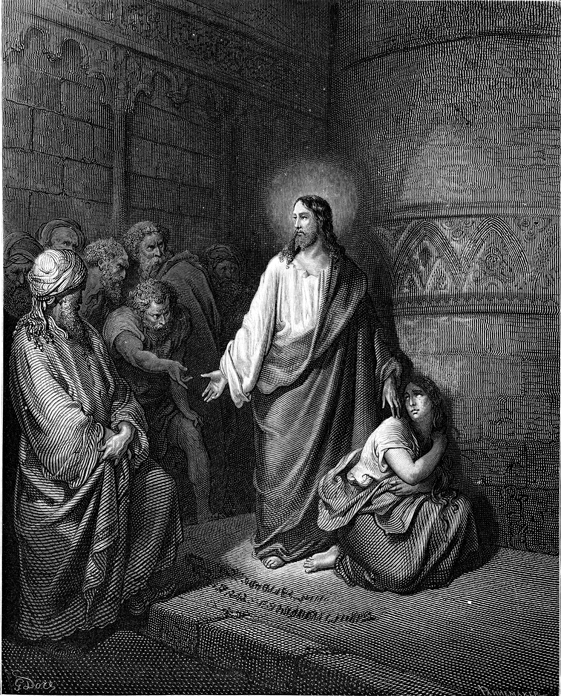
in John 8The scribes and Pharisees, however, brought to Him a woman caught in adultery. They made her stand before them
BSB
The same verse in ASV and KJV ▾
ASV
And the scribes and the Pharisees bring a woman taken in adultery; and having set her in the midst,
KJV
And the scribes and Pharisees brought unto him a woman taken in adultery; and when they had set her in the midst,
⋯
This verse in John 8
Commentary
18 notes on this verseBut while these kind and simple persons are full of admiration at our Lord's discourse, the Scribes and Pharisees put questions to Him, not for the sake of instruction, but only to entangle the truth in their nets: And the Scribes and Pharisees brought unto Him a woman taken in adultery; and when they had set her in the midst, they say unto Him, Master, this woman was taken in adultery, in the very act.
This site's exposition
a woman caught in adultery
on John 8:3-4
The scribes and Pharisees set a woman caught in adultery in front of everyone. Caught in the act means there were witnesses, and the law they quote condemns the man with her at Leviticus 20:10 and Deuteronomy 22:22. The man is nowhere in the scene.
The record, by era
The Church Fathers5 voices
A commentator
Eusebius of CaesareaChurch History (Book III), Chapter 39, Section 16 · Written before 339.
And he [Papias] relates another story of a woman, who was accused of many sins before the Lord, which is contained in the Gospel according to the Hebrews. These things we have thought it necessary to observe in addition to what has been already stated.
The Jews, it says, brought a woman, possibly a prostitute, to the Lord, to test him, and they said, "Master, this woman has just now been caught in adultery. In the law of Moses it is written that any woman caught in adultery should be stoned. What do you say?" That is what the tongue said, but it did not acknowledge the Creator. These people had no inclination to pray and say, "Snatch my soul from a deceitful tongue." It was deceitfully, after all, that they had approached him.This, you see, is what they were intending to do. The Lord had come not to destroy the law but to fulfill it and to forgive sins. So the Jews said to themselves, "If he says 'Let her be stoned,' we shall say to him, 'What has become of your forgiving sins? Aren't you the one who says "Your sins are forgiven you?" But if he says, 'Let her go,' we shall say, 'What has become of your coming to fulfill the law and not to destroy it?' " Notice how deceitful toward God the tongue is.
And now observe wherein the Lord's gentleness was tempted by His enemies. "And the scribes and Pharisees brought to Him a woman just taken in adultery: and they set her in the midst, and said to Him, Master, this woman has just been taken in adultery. Now Moses in the law commanded us, that such should be stoned: but what sayest thou? But this they said, tempting Him, that they might accuse Him." Why accuse Him? Had they detected Himself in any misdeed; or was that woman said to have been concerned with Him in any manner? What, then, is the meaning of "tempting Him, that they might accuse Him"? We understand, brethren, that a wonderful gentleness shone out pre-eminently in the Lord. They observed that He was very meek, very gentle: for of Him it had been previously foretold, "Gird Thy sword upon Thy thigh, O most Mighty; in Thy splendor and beauty urge on, march on prosperously, and reign, because of truth, and meekness, and righteousness." Accordingly, as a teacher, He brought truth; as a deliverer, He brought gentleness; as a protector, He brought righteousness. That He was to reign on account of these things, the prophet had by the Holy Spirit foretold. When He spoke His truth was acknowledged; when He was not provoked to anger against His enemies, His meekness was praised. Whilst, therefore, in respect of these two,-namely, His truth and meekness,-His enemies were tormented with malice and envy; in respect of the third,-namely, righteousness,-they laid a stumbling-block for Him. In what way? Because the law had commanded the adulterers to be stoned, and surely the law could not command what was unjust: if any man should say other than the law had commanded, he would be detected as unjust. Therefore they said among themselves, "He is accounted true, he appears to be gentle; an accusation must be sought against him in respect of righteousness. […]
A commentator
Papias of HierapolisUniversal History Year 12 of Trajen (110AD) Patrologia Orientalis vol. 7 p.48-49 · Written before 130.
proposed
And there was at that time in Hierapolis a distinguished master [Papias] who had many treatises, and he wrote five treatises on the Gospel. And he mentions in his treatise on the Gospel of John, that in the book of John the Evangelist, he speaks …
A commentator
Papias of HierapolisChurch History (Book III), Chapter 39, Section 16 · Written before 130.
proposed
And he [Papias] relates another story of a woman, who was accused of many sins before the Lord, which is contained in the Gospel according to the Hebrews. These things we have thought it necessary to observe in addition to what has been already stated.
11 more voices on this verse
The Medieval Church4 voices
If he determined that she was to be stoned, they would scoff at him inasmuch as he had forgotten the mercy that he was always teaching. If he prohibited the stoning, they would gnash their teeth at him, and, as they saw it, rightly condemn …
Then (v 3), our Lord wards off his opponents. First, we see him tested, so that he can then be accused; and secondly, he checks his accusers (v 6b). As to the first, the Evangelist does three things: first, he mentions the occasion for the …
A commentator
Agapius of HierapolisUniversal History Year 12 of Trajen (110AD) Patrologia Orientalis vol. 7 p.48-49 · Written before 942.
proposed
And there was at that time in Hierapolis a distinguished master [Papias] who had many treatises, and he wrote five treatises on the Gospel. And he mentions in his treatise on the Gospel of John, that in the book of John the Evangelist, he speaks …
Here is touched upon the second point, namely the malicious question. The question was about a woman caught in adultery, whether she was to be stoned according to the command of the Law: on account of which he says: "The scribes and Pharisees bring to …
The Reformation1 voice
But as it has always been received by the Latin Churches, and is found in many old Greek manuscripts, and contains nothing unworthy of an Apostolic Spirit, there is no reason why we should refuse to apply it to our advantage. When the Evangelist says that the scribes brought to him a woman, he means that it was done by an agreement among them, in order to lay traps for Christ.
The Puritans and the Awakening3 voices
Note, Those whose cause is brought before our Lord Jesus will never have occasion to remove it into any other court, for he is the refuge of penitents. The law which accuses us, and calls for judgment against us, is by the gospel of Christ made to withdraw; its demands are answered, and its clamours silenced, by the blood of Jesus.
And the Scribes and Pharisees,....
Those that promise themselves secrecy in sin deceive themselves. The scribes and Pharisees bring her to Christ, and set her in the midst of the assembly, as if they would leave her wholly to the judgment of Christ, he having sat down, as a judge upon the bench. (2.) They prefer an indictment against her: Master, this woman was taken in adultery,
The Nineteenth Century3 voices
A woman taken in adultery - Some of the popish writers say that her name was Susanna; that she was espoused to an old decrepid man, named Manasseh; that she died a saint in Spain, whither she had followed St. James. These accounts the judicious Calmet properly terms fables. It is allowed that adultery was exceedingly common at this time, so common that they had ceased to put the law in force against it.
A commentator
J.C. Ryle1816–1900
Expository Thoughts on the Gospels: John (lightly modernized text, Grace Gems edition) (1869)
The narrative which begins the eighth chapter of John's Gospel is of a rather peculiar character. In some respects it stands alone. There is nothing quite like it in the whole range of the four Gospels. In every age some scrupulous minds have stumbled at the passage, and have doubted whether it was ever written by John at all. But the justice of such scruples is a point that cannot easily be proved.
A commentator
J.C. Ryle1816–1900
Expository Thoughts on the Gospels: John (lightly modernized text, Grace Gems edition) (1869)
proposed
The narrative which begins the eighth chapter of John's Gospel is of a rather peculiar character. In some respects it stands alone. There is nothing quite like it in the whole range of the four Gospels. In every age some scrupulous minds have stumbled at the passage, and have doubted whether it was ever written by John at all. But the justice of such scruples is a point that cannot easily be proved. To suppose, as some have thought, that the narrative before us palliates the sin of adultery, and exhibits our Lord as making light of the seventh commandment, is surely a great mistake. There is nothing in the passage to justify such an assertion. There is not a sentence in it to warrant our saying anything of the kind. Let us calmly weigh the matter, and examine the contents of the passage. Our Lord's enemies brought before Him a woman guilty of adultery, and asked him to say what punishment she deserved. We are distinctly told that they asked the question, "to trap Him." They hoped to entrap Him into saying something for which they might accuse Him. They fancied perhaps that He who preached pardon and salvation to "publicans and harlots" might be induced to say something which would either contradict the law of Moses, or His own words. Our Lord knew the hearts of the malicious questioners before Him, and dealt with them with perfect wisdom, as He had done in the case of the "tribute-money." (Matt. 22:17.) He refused to be a "judge" and lawgiver among them, and specially in a case which their own law had already decided. He gave them at first no answer at all. But "when they continued asking," our Lord silenced them with a withering and heart-searching reply. "He that is without sin among you," he said, "let him first cast a stone at her." He did not say that the woman had not sinned, or that her sin was a trifling and excusable one.
Where this verse is studied
On this page
Studies24
On this chapter
Show the next 6 titles
About John
This page draws on 16 works. Open the list of works
This page draws on Adam Clarke, Commentary on the Bible; Agapius of Hierapolis, Universal History Year 12 of Trajen (110AD) Patrologia Orientalis vol. 7 p.48-49; Alcuin of York, Catena Aurea by Aquinas; Augustine of Hippo, SERMON 16A.4; Augustine of Hippo, Tractates on John 33; Bede, Homilies on the Gospels 1.25; Bonaventure, Commentary on John, Chapter 8; Eusebius of Caesarea, Church History (Book III), Chapter 39, Section 16; J.C. Ryle, Expository Thoughts on the Gospels: John (lightly modernized text, Grace Gems edition); John Calvin, Commentaries; John Gill, Exposition of the New Testament; John Gill, Exposition of the New Testament (1746-1748); Matthew Henry, Commentary on the Whole Bible; Papias of Hierapolis, Universal History Year 12 of Trajen (110AD) Patrologia Orientalis vol. 7 p.48-49; Papias of Hierapolis, Church History (Book III), Chapter 39, Section 16 and Thomas Aquinas, Commentary on John.