
John 8:12
in John 8Once again, Jesus spoke to the people and said, “I am the light of the world. Whoever follows Me will never walk in the darkness, but will have the light of life.”
BSB
The same verse in ASV and KJV ▾
ASV
Again therefore Jesus spake unto them, saying, I am the light of the world: he that followeth me shall not walk in the darkness, but shall have the light of life.
KJV
Then spake Jesus again unto them, saying, I am the light of the world: he that followeth me shall not walk in darkness, but shall have the light of life.
⋯
This verse in John 8
Commentary
32 notes on this verseThen spake Jesus again unto them - Allowing the story about the woman taken in adultery to be authentic, and to stand here in its proper place, we may consider that our Lord, having begun to teach the people in the temple, was interrupted by the introduction of this woman by the scribes and Pharisees; and now, having dismissed them and the woman also, he resumes his discourse. I am the light of the world - The fountain whence an intellectual light and spiritual understanding proceed: without me all is darkness, misery, and death.
This site's exposition
I am the light of the world
The Feast of Tabernacles lit great lamps in the temple court, and their light was said to reach the whole city. Jesus says I am the light of the world in that court, days after the lamps went out, and whoever follows Him will have the light of life. Chapter 9 acts the claim out on a blind man.
The record, by era
The Church Fathers5 voices
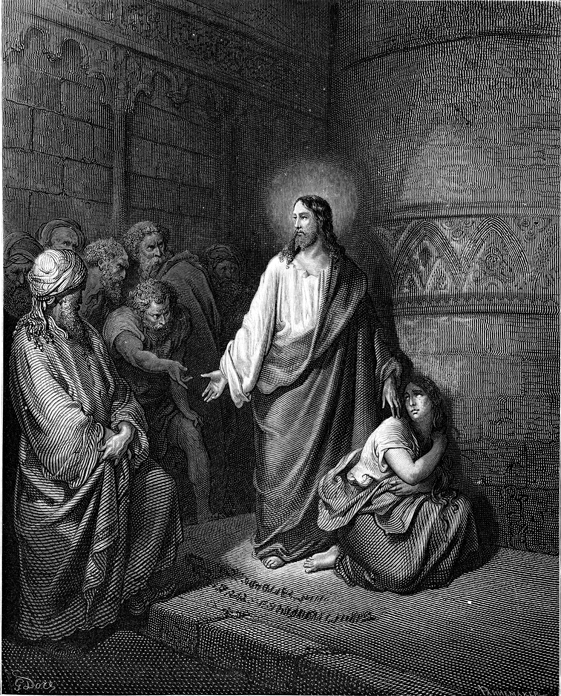
(Tract. xxxiii. 5, 6) There were left however two, the pitiable and the pitiful, And Jesus was left alone, and the woman standing in the midst: the woman, you may suppose, in great alarm, expecting punishment from one in whom no sin could be found. But He who had repelled her adversaries with the word of justice, lifted on her the eyes of mercy, and asked; When Jesus had lifted Himself up, and saw none but the woman, He said unto her, Woman, where are these thine accusers? hath no man condemned thee? She said, No man, Lord. We heard above the voice of justice; let us hear now that of mercy: Jesus said unto her, Neither do I condemn thee; I, who thou fearedst would condemn thee, because thou foundest no fault in me. What then, Lord? Dost Thou favour sin? No, surely. Listen to what follows, Go, and sin no more. So then our Lord condemned sin, but not the sinner. For did He favour sin, He would have said, Go, and live as thou wilt: depend on my deliverance: howsoever great thy sins be, it matters not: I will deliver thee from hell, and its tormentors. But He did not say this. Let those attend, who love the Lord's mercy, and fear His truth. Truly, Gracious and righteous is the Lord. (Ps. 35:7) (Tract. xxxiv. 2) The Manichæans suppose the sun of the natural world to be our Lord Christ; but the Catholic Church reprobates such a notion; for our Lord Christ was not made the sun, but the sun was made by Him: inasmuch as all things were made by Him. (c. 1:3) And for our sake did He come to be under the sun, being the light which made the sun: He hid Himself under the cloud of the flesh, not to obscure, but to temper His light. Speaking then through the cloud of the flesh, the Light unfailing, the Light of wisdom says to men, I am the Light of the world. (Tract. xxxiv. s. […]
What we have just heard and attentively received, as the holy Gospel was being read, I doubt not that all of us have also endeavored to understand, and that each of us according to his measure apprehended what he could of so great a matter as that which has been read; and while the bread of the word is laid out, no one can complain that he has tasted nothing. But again I doubt not that there is scarcely any who has understood the whole. Nevertheless, even should there be any who may sufficiently understand the words of our Lord Jesus Christ now read out of the Gospel, let him bear with our ministry, whilst, if possible, with His assistance, we may, by treating thereof, cause that either all or many may understand that which a few are joyful of having understood for themselves. I think that what the Lord says, "I am the light of the world," is clear to those that have eyes, by which they are made partakers of this light: but they who have not eyes except in the flesh alone, wonder at what is said by the Lord Jesus Christ, "I am the light of the world." And perhaps there may not be wanting some one too who says with himself: Whether perhaps the Lord Christ is that sun which by its rising and setting causes the day? For there have not been wanting heretics who thought this. The Manichaeans have supposed that the Lord Christ is that sun which is visible to carnal eyes, exposed and public to be seen, not only by men, but by the beasts. But the right faith of the Catholic Church rejects such a fiction, and perceives it to be a devilish doctrine: not only by believing acknowledges it to be such, but in the case of whom it can, proves it even by reasoning. Let us therefore reject this kind of error, which the Holy Church has anathematized from the beginning. […]
Do you not recognize the words of the prophet, in the fact that the Galileans enjoy a great light? Therefore, [Jesus says], "I am that light." And I not only provide [this light] for them but for all people. Whoever keeps close to me will …
Listen to the voice of God, which sounds so exceedingly clear to me—I who am both disciple and master of these mysteries. This is how I hope to God it may sound to you: "I am the Light of the world." Therefore approach him and be enlightened, and do not let your faces be ashamed, being signed with the true Light. It is a season of new birth; let us be born again. It is a time of reformation; let us receive again the first Adam. Let us not remain what we are, but let us become what we once were. The Light shines in darkness in this life and in the flesh. It is chased by the darkness but is not overtaken by it. I am referring to the power of the enemy that leaps up in its shamelessness against the visible Adam. But it encounters God and is defeated. Let us put away the darkness so that we may draw near to the Light and may then become perfect Light, the children of perfect Light.
He called himself "the light," not because "the light is in me"—lest someone split the one Christ into a duality of Sons. Christ, the Son, is one, both before the flesh and after the flesh. He is in truth the one and only Son of …
25 more voices on this verse
The Church Fathers9 voices
A commentator
Cyril of AlexandriaCommentary on the Gospel of John, Book 5 · Written before 444.
proposed
Again therefore spake Jesus unto them, saying, I am the Light of the world. As we said that Jesus had made His Discourse in accordance with what was written of the feast, when at its last day He was standing crying, If any man thirst, let him come unto Me and drink, because the oracle of Moses had made mention of the brook: so now too does He make His explanation most seasonable, and due to the nature of things. For since He saw that the teachers were partners in folly with the multitudes and that the laughers were sick of the like with them they laughed at, drenched (so to speak) all of them in one night of unlearning and seeking to get hold of His Mystery yet finding nought at all, He brings forward the reason of tho want of understanding that is in them, crying, I am the Light of the world. Ye (He says) going through the whole holy Scripture and thinking to test the things spoken of Me through the Prophets, are far astray of the way of Life. And no marvel: for He is not in you Who revealeth mysteries and illumineth the whole world, and like a sun shineth into the hearts of them that receive Him. And needs must he who has not within him the Divine and spiritual Light surely walk in darkness and stumble on many absurdities therefrom. But that the Only-Begotten is by Nature Light, as beaming forth from God the Father Who is by Nature Light, we have shown at great length in the first book, on the words, He was the Very Light. But we must note again that He says that He is the Light not specially or solely of them of Israel, but of all the world. […]
A commentator
Cyril of AlexandriaCommentary on the Gospel of John, Book 5 · Written before 444.
proposed
He that followeth Me shall not walk in darkness, but shall have the light of life. He is again persuading them on all sides to aim at hunting after what is profitable, and to desire rather to be led by His appointments, than to choose to follow their own unlearning and bereave themselves of everlasting life. He shows how great shall be the profit to those who are obedient to Him, seeing He is by Nature Good and willeth all men to be saved and to come unto the knowledge of the truth. But since He knew as God that they would gainsay, He fashions His speech after an elder image of things and from what had befallen their ancestors He declares plainly that the desire to follow Him will be to their great profit. It was written then of them of Israel, that in the daytime also He led them with a cloud and all the night with a light of fire. For when they were crossing the wide desert, hasting unto the Land of promise, a cloud was suspended over them like a roof in the day driving off the sun's flame, by Divine Counsel that is: by night a pillar of fire contending with the darkness and marking out to the travellers their un-erring road did lead them. For just as they who at that time followed the guiding and conducting fire, escaped straying, and were borne straight forward along their right and holy ground, recking nought of night or darkness: so he that followeth Me, i. e., who goeth in the track of My teachings, shall in no wise be in the dark, but shall gain the light of life, that is, the revelation of My mysteries able to lead him by the hand unto everlasting life. […]
To neglect these things any further, and to persevere in the former error, what is it else than to fall under the Lord's rebuke, who in the l psalm reproveth, and says, "What hast thou to do to declare my statutes, or that thou shouldest take my covenant into thy mouth, seeing thou hatest instruction and castest my words behind thee? When thou sawest a thief, thou consentedst with him, and hast been partaker with adulterers." For to declare the righteousness and the covenant of the Lord, and not to do the same that the Lord did, what else is it than to cast away His words and to despise the Lord's instruction, to commit not earthly, but spiritual thefts and adulteries? While any one is stealing from evangelical truth the words and doings of our Lord, he is corrupting and adulterating the divine precepts, as it is written in Jeremiah. He says, "What is the chaff to the wheat? Therefore, behold, I am against the prophets, saith the Lord, who steal my words every one from his neighbour, and cause my people to err by their lies and by their lightness." Also in the same prophet, in another place, He says, "She committed adultery with stocks and stones, and yet for all this she turned not unto me." That this theft and adultery may not fall unto us also, we ought to be anxiously careful, and fearfully and religiously to watch. For if we are priests of God and of Christ, I do not know any one whom we ought rather to follow than God and Christ, since He Himself emphatically says in the Gospel, "I am the light of the world; he that followeth me shall not walk in darkness, but shall have the light of life." Lest therefore we should walk in darkness, we ought to follow Christ, and to observe his precepts, because He Himself told His apostles in another place, as He sent them forth, "All power is given unto me in heaven and earth. […]
Why do you rush into the darkness of jealousy? why do you enfold yourself in the cloud of malice? why do you quench all the light of peace and charity in the blindness of envy? why do you return to the devil, whom you had renounced? why do you stand like Cain? For that he who is jealous of his brother, and has him in hatred, is bound by the guilt of homicide, the Apostle John declares in his epistle, saying, "Whosoever hateth his brother is a murderer; and ye know that no murderer hath life abiding in him." And again: "He that saith he is in the light, and hateth his brother, is in darkness even until now, and walketh in darkness, and knoweth not whither he goeth, because that darkness hath blinded his eyes." Whosoever hates, says he, his brother, walketh in darkness, and knoweth not whither he goeth. For he goeth unconsciously to Gehenna, in ignorance and blindness; he is hurrying into punishment, departing, that is, from the light of Christ, who warns and says, "I am the light of the world. He that followeth me shall not walk in darkness, but shall have the light of life." But he follows Christ who stands in His precepts, who walks in the way of His teaching, who follows His footsteps and His ways, who imitates that which Christ both did and taught; in accordance with what Peter also exhorts and warns, saying, "Christ suffered for us, leaving you an example that ye should follow His steps."
A commentator
CyprianTreatise XII. Three Books of Testimonies Against the Jews. · Written before 258.
proposed
That Christ our God should come, the En-lightener and Saviour of the human race. In Isaiah: "Be comforted, ye weakened hands; and ye weak knees, be strengthened. Ye who are of a timorous heart, fear not. Our God will recompense judgment, He Himself will come, and will save us. Then shall be opened the eves of the blind, and the ears of the deaf shall hear. Then the lame man shall leap as a stag, and the tongue of the dumb shall be intelligible; because in the wilderness the water is broken forth, and the stream in the thirsty land." Also in that place: "Not an elder nor an angel, but the Lord Himself shall deliver them; because He shall love them, and shall spare them, and He Himself shall redeem them. Also in the same place: "I the Lord God have called Thee in righteousness, that I may hold Thine hand, and I will comfort Thee; and I have given Thee for a covenant of my people, for a light of the nations; to open the eyes of the blind, to bring forth them that are bound from chains, and those who sit in darkness from the prison-house. I am the Lord God, that is my name. I will not: give any glory to another, nor my powers to given images." Also in the twenty-fourth Psalm: "Show me Thy ways, Lord, and teach me Thy paths, and lead me unto Thy truth, and teach me; for Thou art the God of my salvation." Whence, in the Gospel according to John, the Lord says: "I am the light of the world. He that will follow me shall not walk in darkness, but shall have the light of life." Moreover, in that according to Matthew, the angel Gabriel says to Joseph: "Joseph, thou son of David, fear not to take unto thee Mary thy wife. For that which shall be born to her is of the Holy Ghost. […]
What then did Christ? Since they were continually dwelling upon Galilee and "The Prophet," to free all men from this erroneous suspicion, and to show that He was not one of the prophets, but the Master of the world, He said, "I am the light of the world." Not "of Galilee," not of Palestine, nor of Judaea.
A great thing to say, great of a truth, but it did not greatly amaze them, because He did not now make Himself equal to the Father, nor assert that He was His Son, nor that He was God, but for a while calleth Himself "a light." They indeed desired to disprove this also, and yet this was a much greater thing than to say, "He that followeth Me, shall not walk in darkness." Using the words "light" and "darkness" in a spiritual sense, and meaning thereby "abideth not in error."
In this place He draweth on Nicodemus, and bringeth him in as having spoken very boldly, and praiseth the servants who had also done so. For to "cry aloud," is the act of one desirous to cause that they also should hear. At the same time He hinteth at these who were secretly contriving treacheries, being both in darkness and error, but that they should not prevail over the light. And He remindeth Nicodemus of the words which He had uttered before, "Every one that doeth evil hateth the light, neither cometh to the light, lest his deeds should be reproved." (c. iii. 20.) For since they had asserted that none of the rulers had believed on Him, therefore He saith, that "he that doeth evil cometh not to the light," to show that their not having come proceedeth not from the weakness of the light, but from their own perverse will.
For no one was able, either in heaven or in earth, or under the earth, to open the book of the Father, or to behold Him, with the exception of the Lamb who was slain, and who redeemed us with His own blood, receiving power over all things from the same God who made all things by the Word, and adorned them by [His] Wisdom, when "the Word was made flesh;" that even as the Word of God had the sovereignty in the heavens, so also might He have the sovereignty in earth, inasmuch as [He was] a righteous man, "who did no sin, neither was there found guile in His mouth;" and that He might have the pre-eminence over those things which are under the earth, He Himself being made "the first-begotten of the dead;" and that all things, as I have already said, might behold their King; and that the paternal light might meet with and rest upon the flesh of our Lord, and come to us from His resplendent flesh, and that thus man might attain to immortality, having been invested with the paternal light.
The Medieval Church7 voices
[Christ] is the brightness of souls, the one who drives away the darkness of ignorance, and the one who reveals mysteries that can be perceived only by the pure.
You may bring these words against Nestorius: for our Lord does not say, In Me is the light of the world, but, I am the Light of the world: He who appeared man, was both the Son of God, and the Light of the world; not, as Nestorius fondly holds, the Son of God dwelling in a mere man.
Since they constantly reproached Christ with Galilee and took Him to be one of the prophets, He shows them that He is not one of the prophets. "I," He says, "am the Light of the world, light in the proper sense, not a prophetic light, …
"Again therefore Jesus spoke to them: I am the light of the world." Having confuted the perversity of the Jews, in this second part the Lord manifests the dignity and nobility of his doctrine. Now the nobility of his doctrine consists in this, that it …
Having absolved the woman from her sin, lest some should doubt, seeing that He was really man, His power to forgive sins, He deigns to give further disclosure of His divine nature; Then spake Jesus again unto them, saying, I am the Light of the world.
Where it is to be observed, He does not say, I am the light of Angels, or of heaven, but the Light of the world, i. e. of mankind who live in darkness, as we read, To give light to them that sit in darkness, and in the shadow of death. (Luke 1:79)
The Evangelist has presented Christ as teaching; now he shows, first, the power which this teaching has to give light, and secondly, what Christ himself said about it (v 13). With respect to the first he does three things: first, he states Christ's prerogative concerning …
The Puritans and the Awakening3 voices
The visible light of the world is the sun, and Christ is the Sun of righteousness. One sun enlightens the whole world, so does one Christ, and there needs no more. Christ in calling himself the light expresses, (1.) What he is in himself--most excellent and glorious.
He that followeth me shall in nowise walk in darkness - In ignorance, wickedness, misery: but shall have the light of life -He that closely, humbly, steadily follows me, shall have the Divine light continually shining upon him, diffusing over his soul knowledge, holiness, joy, till he is guided by it to life everlasting.
Then spake Jesus again unto them,....
The Nineteenth Century6 voices
A commentator
Charles Spurgeon1834–1892
The Metropolitan Tabernacle Pulpit, Sermon No. 3534: “The Light of the World” (lightly modernized text, CCEL edition) · Written before 1892.
OUR Lord did not speak in this way at the beginning of His ministry. He did not thus bear witness to Himself, saying, "I am the light of the world." But it was befitting on this occasion, when the people before Him had already received sufficient evidence from other quarters. John the Baptist, whom all men counted for a Prophet, had testified that Christ was the true Light of God which lights every man that comes into the world.
A commentator
Jamieson, Fausset & Brown1802–1910
Commentary Critical and Explanatory on the Whole Bible (1871)
In "the treasury" where it was spoken (see on Joh 8:20) stood two colossal golden lamp-stands, on which hung a multitude of lamps, lighted after the evening sacrifice (probably every evening during the feast of tabernacles), diffusing their brilliancy, it is said, over all the city.
A commentator
J.C. Ryle1816–1900
Expository Thoughts on the Gospels: John (lightly modernized text, Grace Gems edition) (1869)
proposed
The conversation between our Lord and the Jews, which begins with these verses, is full of difficulties. The connection between one part and another, and the precise meaning of some of the expressions which fell from our Lord's lips, are "things hard to be understood." In passages like this it is true wisdom to acknowledge the great imperfection of our spiritual vision, and to be thankful if we can glean a few handfuls of truth. Let us notice, for one thing, in these verses, what the Lord Jesus says of Himself. He proclaims, "I am the light of the world."
A commentator
J.C. Ryle1816–1900
Expository Thoughts on the Gospels: John (lightly modernized text, Grace Gems edition) (1869)
proposed
The conversation between our Lord and the Jews, which begins with these verses, is full of difficulties. The connection between one part and another, and the precise meaning of some of the expressions which fell from our Lord's lips, are "things hard to be understood." In passages like this it is true wisdom to acknowledge the great imperfection of our spiritual vision, and to be thankful if we can glean a few handfuls of truth. Let us notice, for one thing, in these verses, what the Lord Jesus says of Himself. He proclaims, "I am the light of the world." These words imply that the world needs light, and is naturally in a dark condition. It is so in a moral and spiritual point of view—and it has been so for nearly 6,000 years. In ancient Egypt, Greece, and Rome, in modern England, France, and Germany, the same report is true. The vast majority of men neither see nor understand the value of their souls, the true nature of God, nor the reality of a world to come! Notwithstanding all the discoveries of art and science, "darkness still covers the earth, and gross darkness the people." (Isaiah. 60:2.) For this state of things, the Lord Jesus Christ declares Himself to be the only remedy. He has risen, like the sun, to diffuse light, and life, and peace, and salvation, in the midst of a dark world. He invites all who want spiritual help and guidance to turn to Him, and take Him for their leader. What the sun is to the whole solar system—the center of light, and heat, and life, and fertility—that He has come into the world to be to sinners. Let this saying sink down into our hearts. It is weighty and full of meaning. False lights on every side invite man's attention in the present day. Reason, philosophy, earnestness, liberalism, conscience, and the voice of the Church, are all, in their various ways, crying loudly that they have got "the light" to show us.
A commentator
Charles Spurgeon1834–1892
The Metropolitan Tabernacle Pulpit, Sermon No. 3534: “The Light of the World” (lightly modernized text, CCEL edition) · Written before 1892.
proposed
OUR Lord did not speak in this way at the beginning of His ministry. He did not thus bear witness to Himself, saying, "I am the light of the world." But it was befitting on this occasion, when the people before Him had already received sufficient evidence from other quarters. John the Baptist, whom all men counted for a Prophet, had testified that Christ was the true Light of God which lights every man that comes into the world. The witness of John they rejected— startling, if not conclusive, as it must have been—considering the esteem in which his oracular voice was held. Moreover, Jesus, Himself, had worked conviction in their hearts by His teaching. Had they not listened to His famous Sermon on the Mount? Could they not feel the authority with which He spoke? Did they not confess to the impressions He produced on them? The weight and the wisdom of His discourse manifested a power that could melt their thoughts into the very mold of His ministry. Nor was it merely His teaching, transparent though that was, but the signs He showed and the miracles He worked with the majesty of His voice and the virtue of His touch proclaimed that He was the Light of the world! Thus the infirmities of the creature called forth His Divine compassion. With radiant eyes of pity He looked on the wretched and gave them quick relief—He shone on their sadness like the Sun of Righteousness, with healing in His beams. They hailed His visit in every town and village as the Healer of all who were diseased. Might not the quick sense of every unprejudiced spectator detect in Him the Messiah and welcome His advent to the worlds? At length, as though aggrieved by their unbelief, He speaks loudly and proclaims plainly, "I am the light of the world." Such high ground does He take before His adversaries. Well might He say it to their teeth.
A commentator
Albert Barnes1798–1870
Notes, Explanatory and Practical, on the Old and New Testaments (1832-1869)
proposed
I am the light of the world - See the notes at Joh 1:4, Joh 1:9.
How the passage was read
On John 8:12-20On John 8:12-20
The lamps behind His claim
Jesus says “I am the light of the world” in the Temple treasury (8:20), which stood in the Court of the Women: the very court where, at the feast of Tabernacles just concluded (John 7:2, 37), four great golden lampstands were lit each night, with wicks made from the priests' worn-out garments. The Mishnah says there was not a courtyard in Jerusalem that did not glow with that light (Sukkah 5:2–3). The claim lands where the lamps had just gone out: the light of the feast fades; the light of the world is standing in its court.
This section is reception history: how the passage was read and kept in the Jewish tradition. Where a reading parts from an essential of the Christian faith, the section says so at that point.
Sources: Mishnah Sukkah 5:2–3 (the golden lampstands) · The Light (this site's symbol study)
The words behind it
28 Greek wordsEvery Greek word of this verse in the order it stands, with what it means and the door to its own study. The last column counts the times a word stands in the whole Bible: the rarer the word, the more the places it appears belong together.
| Greek | Sound | Meaning | Word study | In the Bible |
|---|---|---|---|---|
| Πάλιν | palin | Again | G3825 → | 139 times |
| οὖν | oun | therefore | G3767 → | 497 times |
| αὐτοῖς | autois | to them | G846 → | 5565 times |
| ἐλάλησεν | elalesen | spoke | G2980 → | 294 times |
| ὁ | ho | <the> | G3588 → | 19766 times |
| Ἰησοῦς | iesous | Jesus | G2424 → | 908 times |
| λέγων· | legon | saying; | G3004 → | 1325 times |
| ἐγώ | ego | I myself | G1473 → | 839 times |
| εἰμι | eimi | am | G1510 → | 2333 times |
| τὸ | to | the | G3588 → | 19766 times |
| φῶς | phos | light | G5457 → | 72 times |
| τοῦ | tou | of the | G3588 → | 19766 times |
| κόσμου. | kosmou | world. | G2889 → | 185 times |
| ὁ | ho | the [one] | G3588 → | 19766 times |
| ἀκολουθῶν | akolouthon | following | G190 → | 90 times |
| ἐμοὶ | emoi | Me myself | G1473 → | 839 times |
| οὐ | ou | certainly | G3756 → | 1664 times |
| μὴ | me | not | G3361 → | 1066 times |
| περιπατήσῃ | peripatese | may walk | G4043 → | 94 times |
| ἐν | en | in | G1722 → | 2738 times |
| τῇ | tea | the | G3588 → | 19766 times |
| σκοτίᾳ | skotia | darkness | G4653 → | 16 times |
| ἀλλ᾽ | all᾽ | but | G235 → | 635 times |
| ἕξει | hexei | will have | G2192 → | 707 times |
| τὸ | to | the | G3588 → | 19766 times |
| φῶς | phos | light | G5457 → | 72 times |
| τῆς | tes | <the> | G3588 → | 19766 times |
| ζωῆς.¶ | zoes | of life. | G2222 → | 135 times |
ΠάλινAgain
palinG3825 →139 times
οὖνtherefore
ounG3767 →497 times
αὐτοῖςto them
autoisG846 →5565 times
ἐλάλησενspoke
elalesenG2980 →294 times
ὁ<the>
hoG3588 →19766 times
ἸησοῦςJesus
iesousG2424 →908 times
λέγων·saying;
legonG3004 →1325 times
ἐγώI myself
egoG1473 →839 times
εἰμιam
eimiG1510 →2333 times
τὸthe
toG3588 →19766 times
φῶςlight
phosG5457 →72 times
τοῦof the
touG3588 →19766 times
κόσμου.world.
kosmouG2889 →185 times
ὁthe [one]
hoG3588 →19766 times
ἀκολουθῶνfollowing
akolouthonG190 →90 times
ἐμοὶMe myself
emoiG1473 →839 times
οὐcertainly
ouG3756 →1664 times
μὴnot
meG3361 →1066 times
περιπατήσῃmay walk
peripateseG4043 →94 times
ἐνin
enG1722 →2738 times
τῇthe
teaG3588 →19766 times
σκοτίᾳdarkness
skotiaG4653 →16 times
ἀλλ᾽but
all᾽G235 →635 times
ἕξειwill have
hexeiG2192 →707 times
τὸthe
toG3588 →19766 times
φῶςlight
phosG5457 →72 times
τῆς<the>
tesG3588 →19766 times
ζωῆς.¶of life.
zoesG2222 →135 times
A shaded row is a word that stands 400 times or fewer in the Bible.
The walk
8 stopsEach card is a verse this one points to, and under it the verses that one points to in turn. Where several paths arrive at the same place, that place is listed first: the text keeps returning to it.
Through
Matthew 5:14You are the light of the world. A city on a hill cannot be hidden.
it leads to
- Philippians 2:15
so that you may be blameless and pure, children of God without fault in a crooked and perverse generation, in which you shine as lights in the world
- Ephesians 5:8–14
For you were once darkness, but now you are light in the Lord. Walk as children of light,
- 1 Thessalonians 5:5
For you are all sons of the light and sons of the day; we do not belong to the night or to the darkness.
- Proverbs 4:18
The path of the righteous is like the first gleam of dawn, shining brighter and brighter until midday.
- John 12:36
While you have the Light, believe in the Light, so that you may become sons of light.” After Jesus had spoken these things, He went away and was hidden from them.
- Philippians 2:15
Through
John 12:46I have come into the world as a light, so that no one who believes in Me should remain in darkness.
it leads to
- Psalms 36:9
For with You is the fountain of life; in Your light we see light.
- Psalms 36:9
Through
John 9:5While I am in the world, I am the light of the world.”
it leads to
- John 12:46
I have come into the world as a light, so that no one who believes in Me should remain in darkness.
Reached by 2 separate paths from here.
- Acts 13:47
For this is what the Lord has commanded us: ‘I have made you a light for the Gentiles, to bring salvation to the ends of the earth.’”
- John 12:46
Where this verse is studied
About John
This page draws on 28 works. Open the list of works
This page draws on Adam Clarke, Commentary on the Bible; Albert Barnes, Notes, Explanatory and Practical, on the Old and New Testaments (1832-1869); Alcuin of York, Catena Aurea by Aquinas; Ammonius of Alexandria, FRAGMENTS ON JOHN 266; Augustine of Hippo, Catena Aurea by Aquinas; Augustine of Hippo, Tractates on John 34; Bede, Catena Aurea by Aquinas; Bonaventure, Commentary on John, Chapter 8; Charles Spurgeon, The Metropolitan Tabernacle Pulpit, Sermon No. 3534: “The Light of the World” (lightly modernized text, CCEL edition); Cyprian, Epistle LXII; Cyprian, Treatise X. On Jealousy and Envy.; Cyprian, Treatise XII. Three Books of Testimonies Against the Jews.; Cyril of Alexandria, Commentary on the Gospel of John, Book 5; Frederic Godet, Commentary on the Gospel of John; Gregory of Nazianzus, ON THE HOLY LIGHTS, ORATION 39.2; Irenaeus, Against Heresies Book IV; J.C. Ryle, Expository Thoughts on the Gospels: John (lightly modernized text, Grace Gems edition); Jamieson, Fausset & Brown, Commentary Critical and Explanatory on the Whole Bible; John Chrysostom, Homily on the Gospel of John 52; John Gill, Exposition of the New Testament (1746-1748); John Lightfoot, Horae Hebraicae et Talmudicae on John; John Wesley, Explanatory Notes upon the New Testament; Matthew Henry, Commentary on the Whole Bible; Maximus the Confessor, CHAPTERS ON KNOWLEDGE 2.70; Theodore of Mopsuestia, COMMENTARY ON JOHN 3.8.12; Theophylact of Ohrid, Catena Aurea by Aquinas; Theophylact of Ohrid, Commentary on John and Thomas Aquinas, Commentary on John.