
John 8:6
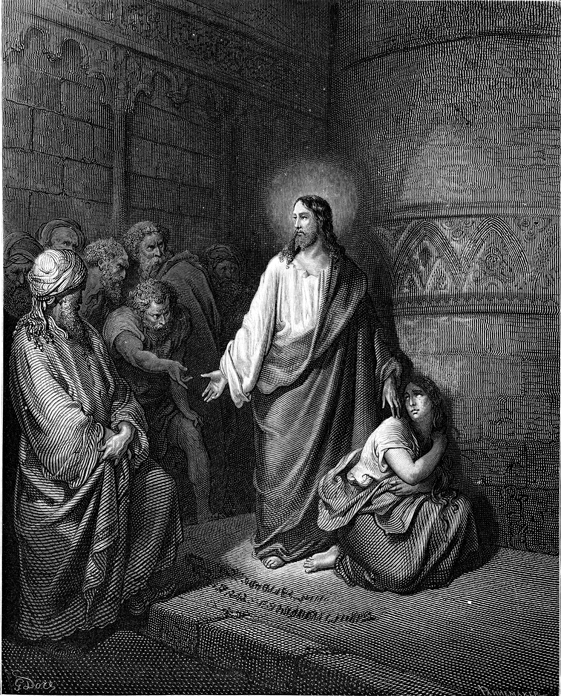
in John 8They said this to test Him, in order to have a basis for accusing Him. But Jesus bent down and began to write on the ground with His finger.
BSB
The same verse in ASV and KJV ▾
ASV
And this they said, trying him, that they might have whereof to accuse him. But Jesus stooped down, and with his finger wrote on the ground.
KJV
This they said, tempting him, that they might have to accuse him. But Jesus stooped down, and with his finger wrote on the ground, as though he heard them not.
⋯
This verse in John 8
Commentary
26 notes on this verseThe Scribes and Pharisees kept accusing her and kept earnestly pressing the case, for they wished to stone her to death, according to the law. "But Jesus, stooping down, began to write with his finger on the ground," the sins, to be sure, of those who were making the accusation, as well as the sins of all mortal beings according to what is written in the prophet, "Those who depart from you shall be written in the earth."
This site's exposition
Moses commanded us to stone such a woman
on John 8:5-6
The question sets a trap with two jaws, and John says they asked it to have a basis for accusing Him. Rome kept the power of execution. A call to stone her puts Him against the governor, and a call to release her puts Him against Moses.
This site's exposition
write on the ground with His finger
What Jesus wrote on the ground is unknown; Wesley says it may have been the words He spoke when they continued to question Him. Wesley says the silence woke their consciences.
The record, by era
The Church Fathers5 voices
A commentator
Eusebius of CaesareaChurch History (Book III), Chapter 39, Section 16 · Written before 339.
And he [Papias] relates another story of a woman, who was accused of many sins before the Lord, which is contained in the Gospel according to the Hebrews. These things we have thought it necessary to observe in addition to what has been already stated.
What did this indulgence signify? Grace. What did that hardness signify? The law given on stones. Therefore, the Lord was writing with His finger, but now on the ground, from which fruit could be received. However, whatever is sown on stone does not sprout, because it cannot send down roots. The finger of God, and the finger of God: the law was written by the finger of God, the finger of God, the Holy Spirit.
(de Con. Evang. lib. ii. c. 10) As if to signify that such persons were to be written in earth, not in heaven, where He told His disciples they should rejoice they were written. Or His bowing His head (to write on the ground), is an expression of humility; the writing on the ground signifying that His law was written on the earth which bore fruit, not on the barren stone, as before.
(Tract. xxxiii. s. 4) They had remarked upon Him already, as being over lenient. Of Him indeed it had been prophesied, Ride on because of the word of truth, of meekness, and of righteousness. (Ps. 44) So as a teacher He exhibited truth, as a deliverer meekness, as a judge righteousness. When He spoke, His truth was acknowledged; when against His enemies He used no violence, His meekness was praised. So they raised the scandal on the score of justice. For they said among themselves, If He decide to let her go, He will not do justice; for the law cannot command what is unjust: Now Moses in the law commanded us, that such should be stoned: but to maintain His meekness, which has made Him already so acceptable to the people, He must decide to let her go. Wherefore they demand His opinion: And what sayest Thou? hoping to find an occasion to accuse Him, as a transgressor of the law: And this they said tempting Him, that they might have to accuse Him. But our Lord in His answer both maintained His justice, and departed not from meekness. Jesus stooped down, and with His finger wrote on the ground.
And now observe wherein the Lord's gentleness was tempted by His enemies. "And the scribes and Pharisees brought to Him a woman just taken in adultery: and they set her in the midst, and said to Him, Master, this woman has just been taken in adultery. Now Moses in the law commanded us, that such should be stoned: but what sayest thou? But this they said, tempting Him, that they might accuse Him." Why accuse Him? Had they detected Himself in any misdeed; or was that woman said to have been concerned with Him in any manner? What, then, is the meaning of "tempting Him, that they might accuse Him"? We understand, brethren, that a wonderful gentleness shone out pre-eminently in the Lord. They observed that He was very meek, very gentle: for of Him it had been previously foretold, "Gird Thy sword upon Thy thigh, O most Mighty; in Thy splendor and beauty urge on, march on prosperously, and reign, because of truth, and meekness, and righteousness." Accordingly, as a teacher, He brought truth; as a deliverer, He brought gentleness; as a protector, He brought righteousness. That He was to reign on account of these things, the prophet had by the Holy Spirit foretold. When He spoke His truth was acknowledged; when He was not provoked to anger against His enemies, His meekness was praised. Whilst, therefore, in respect of these two,-namely, His truth and meekness,-His enemies were tormented with malice and envy; in respect of the third,-namely, righteousness,-they laid a stumbling-block for Him. In what way? Because the law had commanded the adulterers to be stoned, and surely the law could not command what was unjust: if any man should say other than the law had commanded, he would be detected as unjust. Therefore they said among themselves, "He is accounted true, he appears to be gentle; an accusation must be sought against him in respect of righteousness. […]
18 more voices on this verse
The Church Fathers4 voices
A commentator
Papias of HierapolisUniversal History Year 12 of Trajen (110AD) Patrologia Orientalis vol. 7 p.48-49 · Written before 130.
proposed
And there was at that time in Hierapolis a distinguished master [Papias] who had many treatises, and he wrote five treatises on the Gospel. And he mentions in his treatise on the Gospel of John, that in the book of John the Evangelist, he speaks …
A commentator
Papias of HierapolisChurch History (Book III), Chapter 39, Section 16 · Written before 130.
proposed
And he [Papias] relates another story of a woman, who was accused of many sins before the Lord, which is contained in the Gospel according to the Hebrews. These things we have thought it necessary to observe in addition to what has been already stated.
He who had come as the Redeemer, not the condemner (for He had come to redeem what was lost) turned away from them, as if not wishing to look at them. This turning away from them is no trivial thing. Something is implied in this turning away. As if He would say: "You bring a sinner to Me, you sinners. If you think I should condemn sins, I begin with you."
He wrote with His finger upon the ground, as if He would indicate that people of the character of these men would be written on earth, and not in heaven, as He also admonished His disciples to rejoice that their names were written in heaven! Or, it may be that He meant to convey the idea that it was by humbling Himself (which He expressed by bending down His head) that He wrought signs upon the earth; or, that the time was now come when His law should be written, not, as formerly, on the sterile stone, but on a soil which would yield fruit.
The Medieval Church6 voices
"But this they said, testing him, that they might be able to accuse him." Whence to those questioning in a similar manner the Lord responded, Matthew twenty-two: "Why do you test me, hypocrites?" "That they might accuse him," as in the Passion; Matthew twenty-seven: "And …
The Evangelist reveals the malicious intention behind those who were questioning Jesus when he says, They said this to test him so that they could accuse him. For they thought that Christ would say that she should be let go, so as not to be …
His writing with His finger on the ground perhaps showed, that it was He who had written the law on stone.
When the Lord was about to give pardon to the sinful woman, he desired to write with his finger on the ground, in order to point out that it was he himself who once wrote the Ten Commandments of the law on stone with his …
The ground denotes the human heart, which yieldeth the fruit either of good or of bad actions: the finger jointed and flexible, discretion. He instructs us then, when we see any faults in our neighbours, not immediately and rashly to condemn them, but after searching our own hearts to begin with, to examine them attentively with the finger of discretion.
A commentator
Agapius of HierapolisUniversal History Year 12 of Trajen (110AD) Patrologia Orientalis vol. 7 p.48-49 · Written before 942.
proposed
And there was at that time in Hierapolis a distinguished master [Papias] who had many treatises, and he wrote five treatises on the Gospel. And he mentions in his treatise on the Gospel of John, that in the book of John the Evangelist, he speaks …
The Puritans and the Awakening3 voices
Christ once in the New: perhaps the words which he afterward spoke, when they continued asking him. By this silent action, he, 1, fixed their wandering, hurrying thoughts, in order to awaken their consciences: and, 2, signified that he was not then come to condemn but to save the world.
Others this, The earth accuses the earth, but the judgment is mine. Christ by this teaches us to be slow to speak when difficult cases are proposed to us, not quickly to shoot our bolt; and when provocations are given us, or we are bantered, to pause and consider before we reply; think twice before we speak once: The heart of the wise studies to answer.
This they said, tempting him,....
The Nineteenth Century5 voices
That they might have to accuse him - Had our Lord condemned the woman to death, they might have accused him to Pilate, as arrogating to himself the power of life and death, which the Romans had taken away from the Jews; besides, the Roman laws did not condemn an adulteress to be put to death. On the other hand, if he had said she should not be put to death, they might have represented him to the people as one who decided contrary to the law, and favored the crime of which the woman was accused.
A commentator
J.C. Ryle1816–1900
Expository Thoughts on the Gospels: John (lightly modernized text, Grace Gems edition) (1869)
The narrative which begins the eighth chapter of John's Gospel is of a rather peculiar character. In some respects it stands alone. There is nothing quite like it in the whole range of the four Gospels. In every age some scrupulous minds have stumbled at the passage, and have doubted whether it was ever written by John at all. But the justice of such scruples is a point that cannot easily be proved.
A commentator
Jamieson, Fausset & Brown1802–1910
Commentary Critical and Explanatory on the Whole Bible (1871)
proposed
stooped down--It will be observed He was sitting when they came to Him. with his finger wrote on the ground--The words of our translators in italics ("as though He heard them not") have hardly improved the sense, for it is scarcely probable He could wish that to be thought.
quarantine:debris (2026-07-29) — starts-lowercase
A commentator
J.C. Ryle1816–1900
Expository Thoughts on the Gospels: John (lightly modernized text, Grace Gems edition) (1869)
proposed
The narrative which begins the eighth chapter of John's Gospel is of a rather peculiar character. In some respects it stands alone. There is nothing quite like it in the whole range of the four Gospels. In every age some scrupulous minds have stumbled at the passage, and have doubted whether it was ever written by John at all. But the justice of such scruples is a point that cannot easily be proved. To suppose, as some have thought, that the narrative before us palliates the sin of adultery, and exhibits our Lord as making light of the seventh commandment, is surely a great mistake. There is nothing in the passage to justify such an assertion. There is not a sentence in it to warrant our saying anything of the kind. Let us calmly weigh the matter, and examine the contents of the passage. Our Lord's enemies brought before Him a woman guilty of adultery, and asked him to say what punishment she deserved. We are distinctly told that they asked the question, "to trap Him." They hoped to entrap Him into saying something for which they might accuse Him. They fancied perhaps that He who preached pardon and salvation to "publicans and harlots" might be induced to say something which would either contradict the law of Moses, or His own words. Our Lord knew the hearts of the malicious questioners before Him, and dealt with them with perfect wisdom, as He had done in the case of the "tribute-money." (Matt. 22:17.) He refused to be a "judge" and lawgiver among them, and specially in a case which their own law had already decided. He gave them at first no answer at all. But "when they continued asking," our Lord silenced them with a withering and heart-searching reply. "He that is without sin among you," he said, "let him first cast a stone at her." He did not say that the woman had not sinned, or that her sin was a trifling and excusable one.
A commentator
Albert Barnes1798–1870
Notes, Explanatory and Practical, on the Old and New Testaments (1832-1869)
proposed
Tempting him - Trying him, or laying a plan that they might have occasion to accuse him. If he decided the case, they expected to be able to bring an accusation against him; for if he decided that she ought to die, they might accuse him of claiming power which belonged to the Romans - the power of life and death. They might allege that it was not the giving an opinion about an abstract case, but that she was formally before him, that he decided her case judicially, and that without authority or form of trial. If he decided otherwise, they would have alleged that he denied the authority of the law, and that it was his intention to abrogate it. They had had a controversy with him about the authority of the Sabbath, and they perhaps supposed that he would decide this case as he did that - against them. It may be further added that they knew that Jesus admitted publicans and sinners to eat with him; that one of their charges was that he was friendly to sinners (see Luk 15:2); and they wished, doubtless, to make it appear that he was gluttonous, and a winebibber, and a friend of sinners, and disposed to relax all the laws of morality, even in the case of adultery. Seldom was there a plan more artfully laid, and never was more wisdom and knowledge of human nature displayed than in the manner in which it was met. Wrote on the ground - This took place in the temple. The “ground,” here, means the pavement, or the dust on the pavement. By this Jesus showed them clearly that he was not solicitous to pronounce an opinion in the case, and that it was not his wish or intention to intermeddle with the civil affairs of the nation. As though he heard them not - This is added by the translators. It is not in the original, and should not have been added. […]
The walk
8 stopsEach card is a verse this one points to, and under it the verses that one points to in turn. Where several paths arrive at the same place, that place is listed first: the text keeps returning to it.
Through
Jeremiah 17:13O LORD, the hope of Israel, all who abandon You will be put to shame. All who turn away will be written in the dust, for they have abandoned the LORD, the fountain of…
it leads to
- Revelation 7:17
For the Lamb in the center of the throne will be their shepherd. ‘He will lead them to springs of living water,’ and ‘God will wipe away every tear from their eyes.’”
- John 4:14
But whoever drinks the water I give him will never thirst. Indeed, the water I give him will become in him a fount of water springing up to eternal life.”
- John 7:37–38
On the last and greatest day of the feast, Jesus stood up and called out in a loud voice, “If anyone is thirsty, let him come to Me and drink.
- John 4:10
Jesus answered, “If you knew the gift of God and who is asking you for a drink, you would have asked Him, and He would have given you living water.”
- Revelation 22:1
Then the angel showed me a river of the water of life, as clear as crystal, flowing from the throne of God and of the Lamb
- Revelation 7:17
Through
Luke 10:25One day an expert in the law stood up to test Him. “Teacher,” he asked, “what must I do to inherit eternal life?”
it leads to
- Matthew 22:34–39
And when the Pharisees heard that Jesus had silenced the Sadducees, they themselves gathered together.
- Matthew 22:34–39
Through
Ecclesiastes 3:7a time to tear and a time to mend, a time to be silent and a time to speak,
it leads to
Where this verse is studied
On this page
Studies24
On this chapter
Show the next 6 titles
About John
This page draws on 23 works. Open the list of works
This page draws on Adam Clarke, Commentary on the Bible; Agapius of Hierapolis, Universal History Year 12 of Trajen (110AD) Patrologia Orientalis vol. 7 p.48-49; Albert Barnes, Notes, Explanatory and Practical, on the Gospels; Albert Barnes, Notes, Explanatory and Practical, on the Old and New Testaments (1832-1869); Alcuin of York, Catena Aurea by Aquinas; Augustine of Hippo, Sermon 272B; Augustine of Hippo, Catena Aurea by Aquinas; Augustine of Hippo, Tractates on John 33; Augustine of Hippo, Sermon 16A; Augustine of Hippo, The Harmony of the Gospels, Book 4; Bede, Catena Aurea by Aquinas; Bede, Homilies on the Gospels 1.25; Bonaventure, Commentary on John, Chapter 8; Eusebius of Caesarea, Church History (Book III), Chapter 39, Section 16; J.C. Ryle, Expository Thoughts on the Gospels: John (lightly modernized text, Grace Gems edition); Jamieson, Fausset & Brown, Commentary Critical and Explanatory on the Whole Bible; Jerome, Against the Pelagians 2.17; John Gill, Exposition of the New Testament (1746-1748); John Wesley, Explanatory Notes upon the New Testament; Matthew Henry, Commentary on the Whole Bible; Papias of Hierapolis, Universal History Year 12 of Trajen (110AD) Patrologia Orientalis vol. 7 p.48-49; Papias of Hierapolis, Church History (Book III), Chapter 39, Section 16 and Thomas Aquinas, Commentary on John.