
Johnchapter 18
40 verses · John, by tradition · AD 85 to 95 · The Gospels
Then they led Jesus away from Caiaphas into the Praetorium. By now it was early morning, and the Jews did not enter the Praetorium, to avoid being defiled and unable to eat the Passover.
Introduction
John, by tradition, The Gospels, John Overview.
This chapter begins the account of the Passion in the Gospel written by the disciple Jesus loved, who says he saw what he reports. He writes late in his life for readers who never saw Jesus, so that they may believe. The chapter moves from a garden to two courts, one Jewish and one Roman. It keeps cutting between a prisoner under questioning and a follower under questioning. Listen for who asks the questions and who answers them truly. Listen also for the word king, which enters here and stays until the cross. Read it as a trial in which the accused is the one who judges.
Context
- Who
- Readers who needed to know exactly how this had happened legally
- What
- The arrest of Jesus in the garden, His hearing before Annas, the three denials of Peter, and the first hearing before Pilate.
- Where
- Jerusalem, in a garden across the Kidron Valley, the courtyard of the high priest, and the governor's Praetorium.
- When
- The night and early morning before the Passover meal, in about AD 30 or 33 on the usual datings of the crucifixion, with the Gospel written late in the first century on the traditional dating.
- Why
- To show that Jesus went to His death of His own will, as a King whose kingdom comes from above, while His strongest disciple failed beside Him.
Historical context
The Kidron valley runs between the temple mount and the Mount of Olives, and at Passover it was not a pleasant crossing. A channel carried the blood from the temple's sacrifices down into it, and thousands of lambs were slaughtered in those days.
Show the rest of the historical context, 3 more paragraphs
The arresting party is larger than people expect. John names a detachment of soldiers together with officers from the chief priests, which means the temple guard and a Roman unit acting together. Rome kept troops in the Antonia fortress overlooking the temple courts specifically because Passover crowds were volatile.
Annas is questioned first, and he was not the serving high priest, Caiaphas was, and was his son-in-law. Annas had held the office years earlier and, according to Josephus, five of his sons held it after him. He was the family's standing power, and being taken to him first is a portrait of how the office actually worked.
The charcoal fire in the courtyard is a weather detail: spring nights in Jerusalem, which sits at about 2,500 feet, are genuinely cold. And the refusal to enter the governor's headquarters so as not to be defiled explains the whole choreography of the trial, with Pilate walking in and out. Their own statement that it is not lawful for us to put anyone to death reflects Rome's reservation of capital jurisdiction to the governor, which later Jewish tradition also remembers.
Significance
John records the arrest as a surrender rather than a capture. Jesus goes out to meet them, asks whom they seek, answers I am he, and they draw back and fall to the ground. Then he negotiates the release of his friends: if you seek me, let these men go.
Show the rest of the significance, 1 more paragraph
The exchange with Pilate is the chapter's centre. My kingdom is not of this world, if it were, my servants would fight. For readers living under Rome and accused of sedition, that sentence was both their defence and their instructions.
The heads below are this chapter's scenes. The numbered points under each are its verses.
Arrest in the Garden: Put Up the Sword
John 18:1-2
across the Kidron Valley: The Kidron Valley runs between the city and the Mount of Olives. David crossed it weeping when Absalom drove him out, at 2 Samuel 15:23. Judas knew the garden, and the habit that made it a place of prayer is what made it easy to find.
John 18:1
“But, as the time had now come, Christ left the house where He had instructed His disciples in the mystery, and came to the place whither He Himself, the Saviour of all mankind, was wont often to resort, together with His holy disciples. He did this, too, from a wish to make it easy for the traitor to find Him. The place was a garden, typifying the Paradise of old. For in it, as it were, all places were summed up; and in it was consummated our return to man's ancient condition.”
Cyril of Alexandria · written before 444 · Commentary on the Gospel of John, Book 11patristic
3 more voices on this verseWhat preachers and commentators have said about this verse, in their own words.
John 18:1
“The brook Cedron - This was a small stream that flowed to the east of Jerusalem, through the valley of Jehoshaphat, and divided the city from the Mount of Olives. It was also called Kidron and Kedron. In summer it is almost dry. The word used here by the evangelist - χειμάῤῥου cheimarrou - denotes properly a water-stream (from χεῖρμα cheimōn, shower or water, and ῥέω reō, ῥόος roos, to flow, flowing), and the idea is that of a stream that was swollen by rain or by the melting of the snow (Passow, Lexicon).”
John 18:1
“Kedron was (as the name signifies) a dark shady valley, on the east side of Jerusalem, between the city and the Mount of Olives, through which a little brook ran, which took its name from it. It was this brook, which David, a type of Christ, went over with the people, weeping in his flight from Absalom.”
John Wesley · Explanatory Notes upon the New Testament (1755)evangelical
John 18:1
“That he entered into a garden. This circumstance is taken notice of only by this evangelist, that Christ's sufferings began in a garden. In the garden of Eden sin began; there the curse was pronounced, there the Redeemer was promised, and therefore in a garden that promised seed entered the lists with the old serpent.”
Matthew Henry · Commentary on the Whole Bible (1707-1721)puritan
Judas His betrayer also knew the place: Judas knew where to find Jesus. Luke 22:39 records that He went to the Mount of Olives as usual, and Clarke ties the habit to the crowded city at Passover. Theophylact notes that Jesus went to the one place His betrayer was sure to look.
John 18:2
“Judas - knew the place - As many had come from different quarters to celebrate the passover at Jerusalem, it could not be an easy matter to find lodging in the city: Jesus therefore chose to pass the night in the garden with his disciples which, from this verse, and from Luk 22:39, we find was his frequent custom, though he often lodged in Bethany.”
Adam Clarke · Commentary on the Bible (1810-1826)evangelical
John 18:3-4
lanterns, torches, and weapons: The band of soldiers is a Roman detachment, and the officers came from the chief priests and Pharisees. Lanterns, torches, and weapons come against a man who steps forward. Jesus knew all that was coming upon Him and asked the first question.
John 18:3
“The persons employed in this action-- a band of men and officers from the chief priests, with Judas. (1.) Here is a multitude engaged against Christ-- a band of men, speira -- cohors, a regiment, a Roman band, which some think was five hundred men, others a thousand. Christ's friends were few, his enemies many.”
Matthew Henry · Commentary on the Whole Bible (1707-1721)puritan
3 more voices on this verse
John 18:3
“A band - See the notes at Mat 26:47; Mat 27:27. John passes over the agony of Jesus in the garden, probably because it was so fully described by the other evangelists. Lanterns ... - This was the time of the full moon, but it might have been cloudy, and their taking lights with them shows their determination to find him.”
John 18:3
“The crowd that attended the traitor, when they made their attack upon Christ, carried lanterns and torches. They would seem to have guarded against stumbling in the dark, and falling into pitfalls unawares, for such accidents often happen in darkness. But, alas for their blindness! The miserable men, in their gross ignorance, did not perceive that they were stumbling on the stone concerning which God the Father says: Behold, I lay in Sion a Stone of stumbling and a Rock of offence.”
Cyril of Alexandria · written before 444 · Commentary on the Gospel of John, Book 11patristic
John 18:3
“It is certain that the band of soldiers was borrowed from the governor, who also sent a captain at the head of a thousand soldiers; for, on account of sudden mutinies, a garrison was stationed in the city, and the governor himself kept a body-guard, wherever he was.”
John Calvin · Commentaries (1554)reformed
stepped forward and asked them: The question comes from the one who already knows the answer. Cyril of Alexandria holds that it shows the arresting party face to face with the man they sought and unable to recognize Him. So He was taken only because He gave Himself up.
John 18:4
“Jesus inquires of those who come to capture him. He asks them whom they have come in search of, not because he did not know (for how could that be?) but that he might prove that those who had come to capture him and were gazing on him were not even able to recognize the very person they were searching for, and thus confirming in us the true conviction that he would never have been taken if he had not of his own will gone to those who sought him.”
Cyril of Alexandria · written before 444 · Commentary on the Gospel of John, Book 11patristic
1 more voice on this verse
John 18:4
“Jesus knowing all things, etc. - He had gone through all his preaching, working of miracles, and passion, and had nothing to do now but to offer up himself on the cross; he therefore went forth to meet them, to deliver himself up to death.”
Adam Clarke · Commentary on the Bible (1810-1826)evangelical
John 18:5-6
I am He is ego eimi in Greek, the words God gives Moses at Exodus 3:14. The armed party drew back and fell to the ground at the sound of it. He lays His life down Himself, as He said at John 10:18.
John 18:5
“Jesus of Nazareth - They did not say this till after Judas kissed Christ, which was the sign which he had agreed with the soldiers, etc., to give them, that they might know whom they were to seize: see Mat 26:48. Though some harmonists place the kiss after what is spoken in the ninth verse.”
Adam Clarke · Commentary on the Bible (1810-1826)evangelical
2 more voices on this verse
John 18:5
“I am he, Ego eimi -- I am he, is the glorious name of the blessed God ( Exod. iii. 14 ), and the honour of that name is justly challenged by the blessed Jesus. [4.] Particular notice is taken, in a parenthesis, that Judas stood with them. He that used to stand with those that followed Christ now stood with those that fought against him.”
Matthew Henry · Commentary on the Whole Bible (1707-1721)puritan
John 18:5
“But perhaps some may reply: The Roman soldier perhaps knew not Jesus, and the servants of the Jews shared their ignorance. We answer that any such suggestion is groundless. For how could they who were selected to the priesthood fail to know Him, Who was in their power continually when He was teaching daily in the temple, as our Saviour Himself says?”
Cyril of Alexandria · written before 444 · Commentary on the Gospel of John, Book 11patristic
drew back and fell to the ground: At the words I am He, the soldiers and officers drew back and fell to the ground. John alone records it. Barnes traces the fall to the fearless way Jesus stepped forward, Clarke to a power Jesus showed and then set aside.
John 18:6
“They went backward, and fell to the ground - None of the other evangelists mentions this very important circumstance. Our Lord chose to give them this proof of his infinite power, that they might know that their power could not prevail against him if he chose to exert his might, seeing that the very breath of his mouth confounded, drove back, and struck them down to the earth. Thus by the blast of God they might have perished, and by the breath of his nostrils they might have been consumed: Job 4:9.”
Adam Clarke · Commentary on the Bible (1810-1826)evangelical
1 more voice on this verse
John 18:6
“It was the glorious effulgence of the majesty of Christ which overpowered them. "This, occurring before His surrender, would show His power over His enemies, and so the freedom with which He gave Himself up" [MEYER].”
Jamieson, Fausset & Brown · Commentary Critical and Explanatory on the Whole Bible (1871)reformed
John 18:7-9
Whom are you seeking is asked a second time to get the disciples out, and Jesus sets the terms: let these men go. John ties the release to the word He had spoken at 17:12, that He would lose none of those given Him.
John 18:7
“Then asked he them again, whom seek ye?....”
1 more voice on this verse
John 18:7
See the forbearance of the Evangelist, how he doth not insult over the traitor, but relates what took place, only desiring to prove one thing, that the whole took place with His own consent.
John Chrysostom · written before 407 · Homily on the Gospel of John 83patristic
Jesus gives Himself up on one condition. Clarke reads let these men go as a word of authority from a prisoner who sets the terms. Barnes sees the Captain of salvation going first into danger, so the disciples who would carry the news of His death were kept safe.
John 18:8
“Jesus answered, I have told you that I am he,.... This he said, upbraiding them with their stupidity; signifying he was ready to deliver himself up into their hands; and which he did with intrepidity and calmness, only on this condition, with this proviso for his disciples; if therefore ye seek me, let these go their way: Christ was about to suffer for them, and therefore it was not just that they should suffer too; nor was it proper that they should suffer with him, lest their sufferings should be thought to be a part of the price of redemption.”
3 more voices on this verse
John 18:8
“He asks them again a second time, of set purpose, that He might show the extent of the blindness He had put in their minds. For they were robbed of their right judgment, and had their minds, as it were, deranged by their impiety, and knew not that they were speaking to Him Whom they sought.”
Cyril of Alexandria · written before 444 · Commentary on the Gospel of John, Book 11patristic
John 18:8
“Let these go their way - These words are rather words of authority, than words of entreaty. I voluntarily give myself up to you, but you must not molest one of these my disciples. At your peril injure them. Let them go about their business. I have already given you a sufficient proof of my power: I will not exert it in my own behalf, for I will lay down my life for the sheep; but I will not permit you to injure the least of these.”
Adam Clarke · Commentary on the Bible (1810-1826)evangelical
John 18:8
“If ye seek me, let these (my disciples) go - It was an eminent instance of his power over the spirits of men, that they so far obeyed this word, as not to seize even Peter, when he had cut off the ear of Malchus.”
John Wesley · Explanatory Notes upon the New Testament (1755)evangelical
This was to fulfill the word: John applies a fulfilment formula to a word of Jesus. The word stands at 6:39 and 17:12, where He would lose none of those given Him. Chrysostom holds that the saying spoke of eternal loss, and John here includes the safety of the disciples that night.
John 18:9
“The wise Evangelist turns to a clear proof of the general and universal mercy, which will be shown to all who come to Him through faith, this partial and special care here manifested to those who were with Him. For, he says, He procured that His disciples should be suffered to go their way, that the word might be fulfilled which He spake, Of those whom Thou gavest Me I lost not one. For how can there be any question that He will show mercy on them that come after the disciples?”
Cyril of Alexandria · written before 444 · Commentary on the Gospel of John, Book 11patristic
1 more voice on this verse
John 18:9
“That the saying might be fulfilled which he spake, Of them which thou gavest me have I lost none--The reference is to such sayings as Joh 6:39; 17:12; showing how conscious the Evangelist was, that in reporting his Lord's former sayings, he was giving them not in substance merely, but in form also.”
Jamieson, Fausset & Brown · Commentary Critical and Explanatory on the Whole Bible (1871)reformed
Cross references
John 18:9
- QuotingJohn 6:39“And this is the will of Him who sent Me, that I shall lose none of those He has given Me, but raise them up at the last day.”
hina plerothe ho logos hon eipen ('that the saying might be fulfilled which he spake'), the FULFILLMENT formula applied to JESUS' OWN prior word, not the OT (a Johannine sub-type)
John 18:10-11
The servant’s name was Malchus: John alone names the swordsman and the man he struck, Simon Peter and Malchus. Jesus tells Peter to put the sword back in its sheath. The cup the Father has given Me makes the arrest a cup handed to Him, and He takes it.
John 18:10
“The servant's name, for the greater certainty of the narrative, is recorded; it was Malchus, or Malluch, Neh. x. (1.) We must here acknowledge Peter's good-will; he had an honest zeal for his Master, though now misguided. He had lately promised to venture his life for him, and would now make his words good.”
Matthew Henry · Commentary on the Whole Bible (1707-1721)puritan
1 more voice on this verse
John 18:10
“Having a sword - See the note on Luk 22:36. Cut off his right ear - He probably designed to have cloven his scull in two, but God turned it aside, and only permitted the ear to be taken off; and this he would not have suffered, but only that he might have the opportunity of giving them a most striking proof of his Divinity in working an astonishing miracle on the occasion: see the notes on Mat 26:51-56 (note).”
Adam Clarke · Commentary on the Bible (1810-1826)evangelical
Jesus calls the arrest a cup from the Father. In the other Gospels He prays over the cup in the garden, at Matthew 26:39. Here He speaks as one who has already taken it, and Clarke reads the cup as the final sufferings.
John 18:11
“The cup which my Father hath given me - The cup signifies, sometimes the lot of life, whether prosperous or adverse: here it signifies the final sufferings of Christ.”
Adam Clarke · Commentary on the Bible (1810-1826)evangelical
2 more voices on this verse
John 18:11
“Of all that was amiss in what Peter did, he seems to resent nothing so much as that he would have hindered his sufferings now that his hour was come: "What, Peter, wilt thou step in between the cup and the lip? Get thee hence, Satan. " If Christ be determined to suffer and die, it is presumption for Peter in word or deed to oppose it: Shall I not drink it?”
Matthew Henry · Commentary on the Whole Bible (1707-1721)puritan
John 18:11
“Christ's bidding is fraught with the enactment of life according to the Gospel, and the spirit, not of the Mosaic Law revealed to the men of old time, but of the dispensation of Christ; which so dissuades us from using the sword, or offering resistance, that if a man choose to smite us on one cheek, and then to demand the other to be smitten, we ought to turn to him the other also; cutting out, as it were, by the roots the human weakness of our hearts.”
Cyril of Alexandria · written before 444 · Commentary on the Gospel of John, Book 11patristic
Annas Questions Jesus While Peter Denies Him
John 18:12-14
arrested Jesus and bound Him: They bring Him first to Annas, who had held the high priesthood before his son-in-law Caiaphas. Caiaphas is the man who had advised that one man died for the people, at John 11:49 and 50. The verdict was settled before the hearing.
John 18:12
“The captain - Χιλιαρχος, The chiliarch, or chief over one thousand men - answering nearly to a colonel with us. See the note on Luk 22:4. He was probably the prefect or captain of the temple guard.”
Adam Clarke · Commentary on the Bible (1810-1826)evangelical
They brought Him first to Annas: John alone records the hearing before Annas. Barnes notes that five of his sons held the high priesthood in turn, so the father-in-law of Caiaphas still carried great weight. Chrysostom reads the detour as a show, the Jews leading their bound prisoner about like a trophy.
John 18:13
“Annas had been high priest before his son-in-law Caiaphas. And though he had for some time resigned that office, yet they paid so much regard to his age and experience, that they brought Christ to Annas first. But we do not read of any thing remarkable which passed at the house of Annas; for, which reason, his being carried thither is omitted by the other evangelists.”
John Wesley · Explanatory Notes upon the New Testament (1755)evangelical
3 more voices on this verse
John 18:13
“To Annas first - Probably his house was nearest to them, and he had great authority and influence in the Jewish nation. He had been himself a long time high priest; he had had five sons who had successively enjoyed the office of high priest, and that office was now filled by his son-in-law. It was of importance, therefore, to obtain his sanction and counsel in their work of evil. That same year - Joh 11:49.”
John 18:13
“God was overturning them all, that he might come whose right it was. Caiaphas was high priest that same year when Messiah was to be cut off, which intimates, (1.) That when a bad thing was to be done by a high priest, according to the foreknowledge of God, Providence so ordered it that a bad man should be in the chair to do it.”
Matthew Henry · Commentary on the Whole Bible (1707-1721)puritan
John 18:13
NOTE the words in verse 13—"and led him away to Annas first." This man, Annas, has not become so infamous as Pontius Pilate because his name did not happen to be mentioned in the Creed, but, in some respects, he was even more guilty than the Roman governor. He was one of those who handed over our Lord to Pilate and he is included in the judgment, "he that delivered Me unto you has the greater sin."
Charles Spurgeon · written before 1892 · The Metropolitan Tabernacle Pulpit, Sermon No. 2820: “Christ Before Annas” (lightly modernized text, CCEL edition)Particular Baptist
Caiaphas was the one who had advised: The judge had given his verdict before the trial. Caiaphas had advised that one man should die for the people, and Clarke holds such a judge unfit to hear the case. Gill adds that Caiaphas spoke better than he knew, as 11:51 records.
John 18:14
“Now Caiaphas was he which gave council to the Jews,.... The chief priests and Pharisees, who met in council about Jesus, Joh 11:47, the counsel he gave was, that it was expedient that one man should die for the people; and which advice was given out of ill will and malice to Christ, and to prevent, as he thought, the people of the Jews being destroyed by the Romans; though the words have a very good sense which he did not understand.”
2 more voices on this verse
John 18:14
“Caiaphas was he which gave counsel, etc. - Therefore he was an improper person to sit in judgment on Christ, whom he had prejudged and precondemned: see on Joh 11:50-52 (note). But Christ must not be treated according to the rules of justice: if he had, he could not have been put to death.”
Adam Clarke · Commentary on the Bible (1810-1826)evangelical
John 18:14
“Thus the enemies of Christ's gospel are resolved, true or false, to run it down. (3.) It is a testimony to the innocency of our Lord Jesus, from the mouth of one of his worst enemies, who owned that he fell a sacrifice to the public good, and that it was not just he should die, but expedient only. The concurrence of Annas in the prosecution of Christ.”
Matthew Henry · Commentary on the Whole Bible (1707-1721)puritan
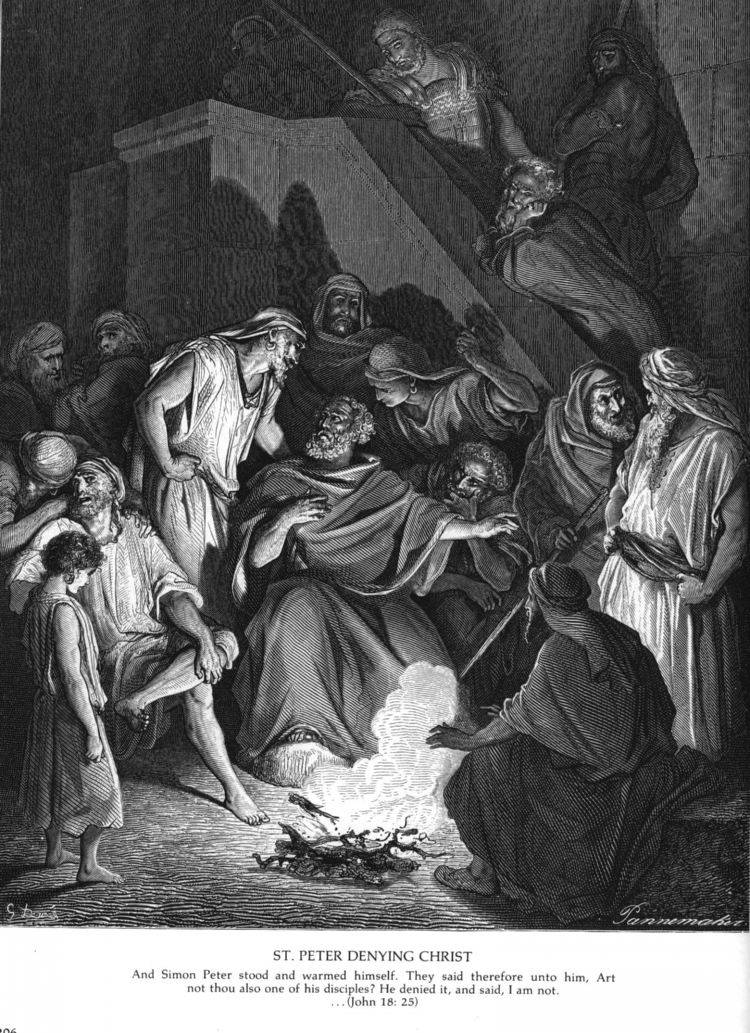
John 18:15-18
Simon Peter and another disciple: The other disciple is known to the high priest, so his access gets Peter through the door. The servant girl at the door asks first, and Peter answers, I am not. In the garden Jesus said ego eimi, at the door Peter says ouk eimi.
John 18:15
“See the notes at Mat 26:57-58. Another disciple - Not improbably John. Some critics, however, have supposed that this disciple was one who dwelt at Jerusalem, and who, not being a Galilean, could enter the palace without suspicion. John, however, mentions the circumstance of his being known to them, to show why it was that he was not questioned as Peter was. It is not probable that any danger resulted from its being known that he was a follower of Jesus, or that any harm was meditated on them for this.”
1 more voice on this verse
John 18:15
“And Simon Peter followed Jesus,.... It is certain, he first fled with the rest, and forsook him, as they all did, notwithstanding his resolution to abide by him; however, he was very desirous to know what would become of Jesus, and what would be the issue of things; with this view he followed him, and not to deny him; though that was the consequence. Other evangelists say he followed him afar off, at a distance, Mat 26:58; which showed some fear; and yet to follow him at all discovered love and zeal.”
But Peter stood outside at the door: Peter waits outside at the door. Theodore of Mopsuestia names the other disciple, known to the high priest, as John, the writer of this Gospel. Cyril notes that the woman at the door admitted only people she knew.
John 18:16
“But Peter was standing at the door without. So the other disciple, which was known unto the high priest, went out, and spake unto her that kept the door, and brought in Peter. Peter did not lag behind from any lack of fervour of heart, but only because the vigilance of the damsel at the gate made entrance perilous for those with whom she had no previous acquaintance. And though it might not have been difficult for a man to push a woman aside, yet it might have involved a charge of unruly behaviour.”
Cyril of Alexandria · written before 444 · Commentary on the Gospel of John, Book 11patristic
1 more voice on this verse
John 18:16
“But Peter stood at the door without--by preconcerted arrangement with his friend till he should get access for him. Then went out that other . . . and spake to her that kept the door, and brought in Peter--The naturalness of these small details is not unworthy of notice.”
Jamieson, Fausset & Brown · Commentary Critical and Explanatory on the Whole Bible (1871)reformed
the servant girl watching the door: The first denial comes at the door. Cyril reads it as the first of the three denials Jesus foretold to Peter at 13:38. Augustine marks its form, for Peter denies Christ by denying that he is one of His disciples.
John 18:17
“The maid, therefore, that kept the door, saith unto Peter, Art thou also one of this Man's disciples? He saith, I am not. As Christ had already foretold to Peter that he would thrice deny our Saviour Christ, and that before the cock crew his faith would fail, the inspired Evangelist relates in detail where, and how, the prophecy was fulfilled. The maid, seated at the door, then, inquires of him whether he was not one of the number of the disciples of Him Who was undergoing the unjust trial.”
Cyril of Alexandria · written before 444 · Commentary on the Gospel of John, Book 11patristic
3 more voices on this verse
John 18:17
“The damsel that kept the door - Caezarius, a writer quoted by Calmet, says this portress was named Ballila. It is worthy of remark that women, especially old women, were employed by the ancients as porters. In 2Sa 4:6, both the Septuagint and Vulgate make a woman porter to Ishbosheth. Aristophanes, in Vespis, v. 765, mentions them in the same office and calls them Σηκις, Sekis, which seems to signify a common maid-servant: - Ὁτι την θυραν ανεῳξεν ἡ Σηκις λαθρα.”
Adam Clarke · Commentary on the Bible (1810-1826)evangelical
John 18:17
“Suppose the servants had ridiculed him, and insulted over him, upon it, those can bear but little for Christ that cannot bear this; this is but running with the footmen. (2.) How speedy the surrender was.”
Matthew Henry · Commentary on the Whole Bible (1707-1721)puritan
John 18:17
“Art thou not also one of this man's disciples?--that is, thou as well as "that other disciple," whom she knew to be one, but did not challenge, perceiving that he was a privileged person.”
Jamieson, Fausset & Brown · Commentary Critical and Explanatory on the Whole Bible (1871)reformed
a charcoal fire they had made: The night was cold, though it was Passover. Ambrose reads the cold as the chill of a heart standing where Jesus went unacknowledged. A charcoal fire appears again at 21:9, beside the lake where Peter is restored.
John 18:18
“Let us also consider in what state he denied. "It was cold," he says. If we consider the temperature, it could not have been cold: but it was cold where Jesus was not recognized, where there was no one to see the light, where the consuming fire was denied. Therefore, it was cold of the mind, not of the body. In the end, Peter was standing by the coals, because he was chilled by emotion. The Jewish flame is wicked: it burns, not warms.”
Ambrose of Milan · written before 397 · Exposition on the Gospel of Luke 10.76patristic
4 more voices on this verse
John 18:18
“And the servants and officers stood there,.... In a certain part of the hall, the middle of it; the Vulgate Latin reads, "by the coals": it follows, who had made a fire of coals, for it was cold; though it was the passover, and harvest near.”
John 18:18
“Servants and officers - These belonged to the chief priests, etc.; the Roman soldiers had probably been dismissed after having conducted Christ to Annas.”
Adam Clarke · Commentary on the Bible (1810-1826)evangelical
John 18:18
“These two statements are extremely interesting. His wishing to "see the end," of issue of these proceedings, was what led him into the palace, for he evidently feared the worst. But once in, the serpent coil is drawn closer; it is a cold night, and why should not he take advantage of the fire as well as others?”
Jamieson, Fausset & Brown · Commentary Critical and Explanatory on the Whole Bible (1871)reformed
John 18:18
“WE note from this incident that it was a cold night in which our Redeemer agonized in the Garden of Gethsemane. [See Sermon #2767, Volume 48—JESUS IN GETHSEMANE.] A cold night and yet He sweat! A cold night and yet there fell from Him, not the sweat of a man who earns the staff of life, but the sweat of One who was earning life, itself. "His sweat was, as it were, great drops of blood falling down to the ground." No natural heat of the sun, or of a sultry evening caused this!”
Charles Spurgeon · written before 1892 · The Metropolitan Tabernacle Pulpit, Sermon No. 3181: “A Sermon for a Winter's Evening” (lightly modernized text, CCEL edition)Particular Baptist
John 18:19-21
about His disciples and His teaching: The high priest questioned Him about His disciples and His teaching. The answer points to the synagogues and the temple, and to a ministry with nothing said in secret. Ask those who heard My message is a demand for witnesses, which the law of Moses required at Deuteronomy 19:15.
John 18:19
“The high priest therefore asked Jesus of His disciples, and of His teaching. A teacher of the people, learned in the Law, one of those on whom the Divine bidding lays the duty, "Judge ye righteous judgment," after having taken the Lord, as though He had been a notorious robber, by a band of armed soldiers and a number of impious officers, asks Him of His disciples and of His doctrine, showing thereby that he was in want of charges to bring against Him. For the Man Who was now on trial knew no sin.”
Cyril of Alexandria · written before 444 · Commentary on the Gospel of John, Book 11patristic
2 more voices on this verse
John 18:19
“The high priest then asked Jesus,.... Being now brought from Annas to Caiaphas, who was the high priest and mouth of the sanhedrim, and to whom it appertained to hear and try a cause relating to doctrine. And what he did was by putting questions to him, instead of opening the charge against him, and calling for witnesses to support it.”
John 18:19
“The high priest then asked Jesus of his disciples - To ascertain their number and power. The charge on which they wished to arraign him was that of sedition, or of rebellion against Caesar. To make that plausible, it was necessary to show that he had made so many disciples as to form a strong and dangerous faction; but, as they had no direct proof of that, the high priest insidiously and improperly attempted to draw the Saviour into a confession.”
Jesus points to a public ministry. Theophylact hears Isaiah 45:19 in the answer, where the LORD has not spoken in secret, a reply to the suspicion of a secret party. Clarke takes the world here to mean all the Jews, everyone within reach of His teaching.
John 18:20
“I ever taught in the synagogues and in the temple, whither the Jews always resort--courting publicity, though with sublime noiselessness. in secret have I said--spake I. nothing--that is, nothing of any different nature; all His private communications with the Twelve being but explanations and developments of His public teaching.”
Jamieson, Fausset & Brown · Commentary Critical and Explanatory on the Whole Bible (1871)reformed
1 more voice on this verse
John 18:20
“I spake openly to the world - To every person in the land indiscriminately - to the people at large: the τῳ κοσμῳ, here, is tantamount to the French tout le monde, all the world, i.e. every person within reach. This is another proof that St. John uses the term world to mean the Jewish people only; for it is certain our Lord did not preach to the Gentiles. The answer of our Lord, mentioned in this and the following verse, is such as became a person conscious of his own innocence, and confident in the righteousness of his cause.”
Adam Clarke · Commentary on the Bible (1810-1826)evangelical
Ask those who heard My message: Jesus stands on the rights of a prisoner. Barnes reads the reply as a demand that the high priest prove a charge from those who heard Him. Cyril notes that the council had passed its sentence before the hearing began.
John 18:21
“Why askest thou Me? Ask them that have heard Me, what I spake unto them: behold, these know the things which I said. He rebukes those learned in the Law, for that they themselves sinned against the Law in which they took pride. For before He had been condemned, they passed premature sentence upon Him, and yet busied themselves in seeking for errors on His part. Why, then, He says, dost thou question Me, and call on Me to answer, Who have already endured your attack, and had punishment allotted Me before conviction?”
Cyril of Alexandria · written before 444 · Commentary on the Gospel of John, Book 11patristic
1 more voice on this verse
John 18:21
“Why askest thou me? Ask them ... - Jesus here insisted on his rights, and reproves the high priest for his unjust and illegal manner of extorting a confession from him. If he had done wrong, or taught erroneous and seditious doctrines, it was easy to prove it, and the course which he had a right to demand was that they should establish the charge by fair and incontrovertible evidence. We may here learn: 1. That, though Jesus was willing to be reviled and persecuted, yet he also insisted that justice should be done him.”
John 18:22-24
slapped Him in the face: An officer slapped Him in the face for the way He answered. The reply asks for evidence again: testify as to what was wrong, or why did you strike Me. Annas then sent Him, still bound, to Caiaphas.
John 18:22
“And when He had said this, one of the officers standing by struck Jesus with his hand, saying unto Him, Answerest Thou the high priest so? It had been foretold, by the mouth of the prophet, that with Christ this would come to pass: I gave My back to the scourge, and My cheeks to them that smite.”
Cyril of Alexandria · written before 444 · Commentary on the Gospel of John, Book 11patristic
1 more voice on this verse
John 18:22
“One of the officers - struck Jesus - This was an outrage to all justice: for a prisoner, before he is condemned, is ever considered to be under the especial protection of justice; nor has any one a right to touch him, but according to the direction of the law. But it has been observed before that, if justice had been done to Christ, he could neither have suffered nor died.”
Adam Clarke · Commentary on the Bible (1810-1826)evangelical
Jesus asks for the law to be kept. Barnes sets the officer's charge beside Exodus 22:28, which forbids cursing a ruler of the people. He answers that a prisoner on trial stands under the court's protection.
John 18:23
“Jesus answered him, If I have spoken evil, bear witness of the evil: but if well, why smitest thou Me? He proves the officer guilty of a gross wrong, even if He That was on His trial had been a man of obscure position. For he smote Him causelessly, contrary to his express duty; not urged thereto by legal commands, but rather incited to brutal ferocity of behaviour by his own inbred madness.”
Cyril of Alexandria · written before 444 · Commentary on the Gospel of John, Book 11patristic
2 more voices on this verse
John 18:23
“Spoken evil - In my answer to the high priest. If there was any disrespect to the office, and lack of regard for the law which appointed him, then testify to the fact, and let punishment be inflicted according to the law; compare Exo 22:28. But if well ... - While an accused person is on trial he is under the protection of the court, and has a right to demand that all legal measures shall be taken to secure his rights.”
John 18:23
“If I have spoken, &c.--"if I spoke" evil, in reply to the high priest. (Also see on Mr 14:54.) if well--He does not say "If not" evil, as if His reply were merely unobjectionable: "well" seems to challenge more than this as due to His remonstrance [BENGEL]. This shows that Mt 5:39 is not to be taken to the letter.”
Jamieson, Fausset & Brown · Commentary Critical and Explanatory on the Whole Bible (1871)reformed
Then Annas sent Him, still bound: Annas sends Jesus, still bound, on to Caiaphas the high priest. Readers divide on the order. Clarke puts the questioning of verses 19 to 23 before Caiaphas, while Jamieson, Fausset and Brown put it before Annas.
John 18:24
“Sent Him bound, not that He was bound now for the first time, for they bound Him when they took Him. They sent Him bound as they had brought Him. Or perhaps He may have been loosed from His bonds for that hour, in order to be examined, after which He was bound again, and sent to Caiaphas.”
Bede · written before 735 · Catena Aurea by Aquinaspatristic
2 more voices on this verse
John 18:24
“Annas, declining to meddle with the case, having sent Him to Caiaphas at once. But the words here literally are, "Annas sent Him [not 'had sent Him'] to Caiaphas"--and the "now" being of doubtful authority. Thus read, the verse affords no evidence that He was sent to Caiaphas before the interview just recorded, but implies rather the contrary.”
Jamieson, Fausset & Brown · Commentary Critical and Explanatory on the Whole Bible (1871)reformed
John 18:24
“Now Annas had sent him, etc. - It has been observed before that the proper place of this verse is immediately after the 13th; and, if it be allowed to stand here, it should be read in a parenthesis, and considered as a recapitulation of what had been before done.”
Adam Clarke · Commentary on the Bible (1810-1826)evangelical
John 18:25-27
still standing and warming himself: Peter is still at the fire when the second question comes, and he denied it again. The third comes from a relative of the man whose ear he had cut off, who had seen him in the garden. A rooster crowed at once, as Jesus had said at John 13:38.
John 18:25
“And Simon Peter was standing and warming himself. They said therefore . . . Art thou not also one of his disciples?--In Mt 26:71 the second charge was made by "another maid, when he was gone out into the porch," who "saw him, and said unto them that were there, This [fellow] was also with Jesus of Nazareth." So also Mr 14:69.”
Jamieson, Fausset & Brown · Commentary Critical and Explanatory on the Whole Bible (1871)reformed
1 more voice on this verse
John 18:25
“And Simon Peter stood and warmed himself,.... This is repeated from Joh 18:18 to connect the history, and carry on the thread of the account of Peter's denial of Christ, which is interrupted by inserting the examination of Christ before the high priest, which was made at the same time. Peter stood among, and continued with the servants and officers of the high priest, warming himself by a fire they had made, it being a cold night; and this proved of bad consequence to him.”
The third question comes from a relative of Malchus. A man proved to have cut off that servant's ear could face a penalty of his own, as Gill notes. Spurgeon sets the words in the garden with Him against Peter now standing among the high priest's servants.
John 18:26
“PETER was on dangerous ground. When his Master was being buffeted, he was trying to make himself comfortable. We read of the high priest's servants, that they warmed themselves and Peter stood with them and warmed himself. He stood with them and they were rough servants of ill masters. He was in bad company and he was a man who could not afford to be in bad company—for he was so impulsive and so easily provoked to rash actions.”
1 more voice on this verse
John 18:26
“For it was the bounden duty of the wise Evangelist to make mention of such things, that his hearers might know what even the teachers of the world were in themselves before Christ's Resurrection, and before the Holy Spirit descended upon them; and what they were thereafter, when they had received the grace of the Spirit, Which Christ called power from on high. For any one may see how very jealous they were in assuming virtue; how readily they girded up their loins to follow Christ, and to overcome perils of every sort which they so frequently encountered.”
Cyril of Alexandria · written before 444 · Commentary on the Gospel of John, Book 12patristic
Peter denied it once more: Peter denied Jesus once more, and a rooster crowed. Luke 22:62 tells of his tears, and Gill notes from the other Gospels that Peter denied Him the third time with cursing. Bonaventure quotes Augustine, that the prediction of Jesus was fulfilled and the presumption of Peter convicted.
John 18:27
“Peter then denied again,.... A third time, as the Ethiopic version renders it; and that, according to other evangelists, with cursing and swearing; for now he was more affrighted than before, lest should he be taken up, and it be proved upon him, that he was the person that cut off Malchus's ear, he should be sentenced to a fine, or it may be some capital punishment.”
1 more voice on this verse
John 18:27
“And - the cock crew - Peter denied our Lord three times: - Peter’s First Denial. I. This took place, when he was without, or beneath, in the hall of Caiaphas’s house. He was not in the higher part where Christ stood before the high priest; but without that division of the hall, and in the lower part with the servants and officers, at the fire kindled in the midst of the hall, Joh 18:16, Joh 18:18; and the girl who kept the door had entered into the hall, where she charged Peter. Peter’s Second Denial. II.”
Adam Clarke · Commentary on the Bible (1810-1826)evangelical
Before Pilate: My Kingdom Is Not of This World
to avoid being defiled: The leaders who brought Him stayed outside the Praetorium to avoid being defiled before the Passover. A Gentile house would make them unclean for the meal. The wording has been read of the festival meals of Passover week and of a different calendar reckoning from the Synoptics' account.
John 18:28
“They lead Jesus therefore from Caiaphas into the palace: and it was early; and they themselves entered not into the palace, that they might not be defiled, but that they might eat the passover. Judge righteous judgment, and Thou shalt not slay the innocent and just man, were the express injunctions of the Law and the Word of God.”
Cyril of Alexandria · written before 444 · Commentary on the Gospel of John, Book 12patristic
1 more voice on this verse
John 18:28
“The hall of judgment - Εις το πραιτωριον, To the praetorium. This was the house where Pilate lodged; hence called in our margin, Pilate’s house. The praetorium is so called from being the dwelling-place of the praetor, or chief of the province. It was also the place where he held his court, and tried causes. St. John has omitted all that passed in the house of Caiaphas - the accusations brought against Christ - the false witnesses - the insults which he received in the house of the high priest - and the assembling of the grand council, or Sanhedrin.”
Adam Clarke · Commentary on the Bible (1810-1826)evangelical
John 18:29-32
Pilate asks for the charge and gets none. Told to judge Him by their own law, they answer that Rome kept the power of execution. John reads their answer as the word of Jesus coming true, the kind of death He would die, crucifixion being Rome's and stoning theirs.
John 18:29
“Pilate then went out - This was an act of condescension; but, as the Romans had confirmed to the Jews the free use of all their rites and ceremonies, the governor could not do less than comply with them in this matter. He went out to them, that they might not be obliged to come into the hall, and thus run the risk of being defiled.”
Adam Clarke · Commentary on the Bible (1810-1826)evangelical
The Jews name no crime. Clarke reads the answer as a demand that Pilate carry out their sentence, with the council as judge and the governor as executioner. Cyril calls it a cover for the lack of any charge they could prove against Him.
John 18:30
“They answered and said unto him, If this Man were not an evil-doer, we should not have delivered Him up unto thee. They were perplexed for a specious plea against Him, but cloak the baseness of their impiety, and their apparent resolution to put Him to death unjustly, by the sophistical reply, that they would never have brought Jesus to suffer justice, if they had not taken Him in a criminal act.”
Cyril of Alexandria · written before 444 · Commentary on the Gospel of John, Book 12patristic
1 more voice on this verse
John 18:30
“If he were not a malefactor - So they did not wish to make Pilate the judge, but the executor of the sentence which they had already illegally passed.”
Adam Clarke · Commentary on the Bible (1810-1826)evangelical
Pilate hands the case back to the Jews. Barnes records that readers doubt what he granted, leave to execute or leave only to judge Him under their own law with a lesser penalty. Chrysostom notes that most of their authority had passed to Rome.
John 18:31
“It is not lawful for us to put any man to death - The power of inflicting capital punishment had been taken from them that very year. So the scepter was departed from Judah, and transferred to the Romans.”
John Wesley · Explanatory Notes upon the New Testament (1755)evangelical
the kind of death He was: The word of Jesus is His saying about being lifted up. John explains it at 12:32 and 33 as a sign of the death awaiting Him. Gill joins it to Matthew 20:19, where Jesus says He will be handed over to the Gentiles to be crucified.
John 18:32
“That the saying of Jesus might be fulfilled,.... That he should be delivered by the Jews to the Gentiles, to crucify him; and that he should be lifted up from the earth, and as the serpent upon the pole: which he spake, signifying what death he should die; Mat 20:19 and which was brought about this way, by the providence of God conducting this whole affair; and was cheerfully submitted to by Christ, in great love to his people, to redeem them from the curse of the law, being hereby made a curse for them.”
1 more voice on this verse
John 18:32
“That the saying . . . might be fulfilled which he spake, signifying what death he should die--that is, by crucifixion (Joh 12:32, 33; Mt 20:19); which being a Roman mode of execution, could only be carried into effect by order of the governor. (The Jewish mode in such cases as this was by stoning).”
Jamieson, Fausset & Brown · Commentary Critical and Explanatory on the Whole Bible (1871)reformed
Cross references
John 18:32
- QuotingJohn 12:32And I, when I am lifted up from the earth, will draw everyone to Myself.”
hina ho logos tou Iesou plerothe hon eipen ('that the word of Jesus might be fulfilled'), fulfillment formula over Jesus' own saying about the manner of his death
John 18:33-35
Are You the King of the Jews is a charge of treason, the one charge a Roman governor would hear. Jesus asks whether Pilate speaks for himself or repeats what others have told him. Am I a Jew puts the dispute back on them.
Cyril notes that no one had laid the charge openly, so a governor asking it on his own would be judge and accuser at once. Augustine holds that Jesus drew the answer out so that the false notions about His kingdom would be set down in Scripture.
John 18:34
“As no one, He says, has openly brought this charge against Me, whence proceeds your question? There can be no doubt that this trick proceeds from the malice of the Jews, and that they devised this cruel stratagem; for else you would not be, He says, at once judge and accuser.”
Cyril of Alexandria · written before 444 · Commentary on the Gospel of John, Book 12patristic
1 more voice on this verse
John 18:34
“Sayest thou this thing of thyself - That is, Is it because my enemies thus accuse me, or because thou hast any suspicion of me, that thou askest this question?”
Adam Clarke · Commentary on the Bible (1810-1826)evangelical
Barnes reads Am I a Jew as a disclaimer of Jewish prejudice and the rest as admitting the charge came from the chief priests alone. Cyril marks that the last question, What have You done, confesses that Pilate has no charge of his own.
John 18:35
“He now exposes the villainy of the Jews, and almost publishes the multitude of His accusers. It is as though he said: "It does not concern me to know about Thee, for I am not a Jew; but rather befits Thine own nation and kindred, who. it may be, have this knowledge, and so bring Thee to suffer death." He then accuses himself. For to say, What hast Thou done, implies nothing else but this.”
Cyril of Alexandria · written before 444 · Commentary on the Gospel of John, Book 12patristic
1 more voice on this verse
John 18:35
“Am I a Jew? - Am I likely to be influenced by Jewish prejudices and partialities? Am not I, being a Roman, likely to judge impartially, and to decide on the accusations without being blessed by the malignant charges of the accusers? Thine own nation ... - In this Pilate denies that it was from anything that he had observed that Jesus was arraigned. He admits that it was from the accusation of others; but then he tells the Saviour that the charge was one of moment, and worthy of the deepest attention.”
John 18:36-38
My kingdom is not of this world tells Pilate where it comes from, and servants of a kingdom from here would have fought. For this reason I was born, to testify to the truth, states the errand. Pilate asks what truth is, and finds no charge.
John 18:36
“My kingdom is not of this world - It is purely spiritual and Divine. If it had been of a secular nature, then my servants would have contended - they would have opposed force with force, as the kingdoms of this world do in their wars; but as my kingdom as not of this world, therefore no resistance has been made. Eusebius relates, Hist. Eccles. lib. iii. c.”
Adam Clarke · Commentary on the Bible (1810-1826)evangelical
2 more voices on this verse
John 18:36
“He dispelled the fear Pilate felt as the appointed guardian of Caesar's kingdom, for he supposed that Christ was meditating insurrection against temporal rule, as the Jews had vainly talked. For they hinted at this when they said: If this Man were not an evildoer, we should not have delivered Him up unto thee; meaning insurrection by the evil they said He was doing. For they affected to be so well-disposed to the Romans, as not even to be able to utter the word revolt. For this cause, then, they said they had brought Him to Pilate, to suffer judgment.”
Cyril of Alexandria · written before 444 · Commentary on the Gospel of John, Book 12patristic
John 18:36
“This was all that Pilate had to do with. The positive nature of His kingdom He would not obtrude upon one who was as little able to comprehend it, as entitled officially to information about it. (It is worthy of notice that the "MY," which occurs four times in this one verse--thrice of His kingdom, and once of His servants--is put in the emphatic form).”
Jamieson, Fausset & Brown · Commentary Critical and Explanatory on the Whole Bible (1871)reformed
Jesus accepts the title of king. Barnes reads You say that I am a king as a form of assent. The last line recalls 10:27, where His sheep listen to His voice.
John 18:37
“His coming into the world, His existence before assuming humanity: The truth, then, here affirmed, though Pilate would catch little of it, was that His Incarnation was expressly in order to the assumption of Royalty in our nature. Yet, instead of saying, He came to be a King, which is His meaning, He says He came to testify to the truth.”
Jamieson, Fausset & Brown · Commentary Critical and Explanatory on the Whole Bible (1871)reformed
3 more voices on this verse
John 18:37
“He makes use of Christ's truth-speaking to charge Him withal. When he heard Him say: My Kingdom is not from hence, he was indeed quit of his fear of an insurrection; but he still compels Him to openly profess this thing, and defines as a charge His mere assertion that He had a kingdom, though He asserted that it was not of this world. He drives Jesus, as it were, to make this profession; and says, Thou hast confessed already that Thou art a King.”
Cyril of Alexandria · written before 444 · Commentary on the Gospel of John, Book 12patristic
John 18:37
“Everyone that is of the truth - That is, a lover of it, heareth my voice - A universal maxim. Every sincere lover of truth will hear him, so as to understand and practice what he saith.”
John Wesley · Explanatory Notes upon the New Testament (1755)evangelical
John 18:37
“Art thou a king then? - Dost thou admit the charge in any sense, or dost thou lay claim to a kingdom of any kind? Thou sayest ... - This is a form of expression denoting affirmation. It is equivalent to yes. That I am a king - This does not mean simply that Pilate affirmed that he was a king; it does not appear that he had done this; but it means, “Thou affirmest the truth; thou declarest what is correct, for I am a king.” I am a king in a certain sense, and do not deny it.”
Clarke sets the question what is truth among the teachers of the day, some of whom held truth beyond reach. He reads the going out as despair or indifference. His finding of no basis for a charge against Jesus is the first of three, at 19:4 and 19:6.
John 18:38
“He does not deny the glory of His Kingdom, nor leave it to the voice of Pilate only to affirm it, for as God He is King, whether man so will, or no; but He once more showed the power of the truth which impelled Pilate, though reluctant, to declare the glory of Him Who was on His trial; for, He says: Thou hast said, that I am a King.”
Cyril of Alexandria · written before 444 · Commentary on the Gospel of John, Book 12patristic
1 more voice on this verse
John 18:38
“What is truth - Among the sages of that time there were many opinions concerning truth; and some had even supposed that it was a thing utterly out of the reach of men. Pilate perhaps might have asked the question in a mocking way; and his not staying to get an answer indicated that he either despaired of getting a satisfactory one, or that he was indifferent about it. This is the case with thousands: they appear desirous of knowing the truth, but have not patience to wait in a proper way to receive an answer to their question.”
Adam Clarke · Commentary on the Bible (1810-1826)evangelical
John 18:39-40
one prisoner at the Passover: Pilate offers the Passover custom, the release of one prisoner, and names the King of the Jews. The crowd at the Praetorium called for Barabbas, an insurrectionist. A guilty man walked and an innocent King stayed bound.
John 18:39
“Do not wonder that the Roman government, holding sway over the Jews who had recently become their subjects, thought it was appropriate to grant them something acceptable at the feast of the Passover. They allowed them to ask for anyone they wanted [to be freed] even though he might appear guilty of many murders. For in this way nations sometimes grant favors to those whom they have conquered, until their rule is established.”
Origen of Alexandria · written before 253 · Commentary on Matthew 120patristic
2 more voices on this verse
John 18:39
“But ye have a custom that I should release one unto you at the passover, &c.--See on Mr 15:7-11. "On the typical import of the choice of Christ to suffer, by which Barabbas was set free, see the sixteenth chapter of Leviticus, particularly Le 16:5-10, where the subject is the sin offering on the great day of atonement" [KRAFFT in LUTHARDT].”
Jamieson, Fausset & Brown · Commentary Critical and Explanatory on the Whole Bible (1871)reformed
John 18:39
“But ye have a custom - Nothing relative to the origin or reason of this custom is known. Commentators have swam in an ocean of conjecture on this point. They have lost their labor, and made nothing out: see the notes on Mat 27:15; Luk 23:17.”
Adam Clarke · Commentary on the Bible (1810-1826)evangelical
The crowd chooses Barabbas. Gill records that some copies and several old versions lack the word again in this verse. Cyril sets the choice against the Law of Moses, which gave refuge to one who killed without intent, while the Jews asked for an insurrectionist.
John 18:40
“Herein also the Jews show themselves indeed lawbreakers, and more inclined to give way to their own inclinations than to honour their ancient commandments; for though the Mosaic Law ordered that a man who had committed involuntary homicide should be released, and not a man like Barabbas (for how could such a thing be?), they prefer to ask for a notorious robber.”
Cyril of Alexandria · written before 444 · Commentary on the Gospel of John, Book 12patristic
2 more voices on this verse
John 18:40
“Then cried they all again,.... For it seems that Pilate had made this proposal once before, and that this was the second time, though not mentioned; yet some copies, and the Syriac, Arabic, Persic, and Ethiopic versions, leave out the word "again": they all, priests and people, in a very clamorous manner, cried out as one man, with one united voice, all at once; saying, not this man, but Barabbas; now Barabbas was a robber; who was an emblem of God's elect in a state of nature, released and set free when Christ was condemned.”
John 18:40
“THE custom of delivering a prisoner upon the day of the Passover was intended, no doubt, as an act of grace on the part of the Roman authorities towards the Jews. And by the Jews it may have been accepted as a significant compliment to their Passover. Since on that day they, themselves, were delivered out of the land of Egypt, they may have thought it to be most fitting that some imprisoned person should obtain his liberty.”
How this psalm is built
The form: A Passion narrative in which two hearings run side by side, Jesus questioned inside and Peter questioned at the fire, as Hippo classes it.
The patterns in this chapter
| Device | What it does | Where to see it |
|---|---|---|
| Two hearings cut together | Verses 15 to 18 put Peter at the door and the fire, verses 19 to 24 put Jesus before the high priest, and verses 25 to 27 return to Peter. Augustine records that John comes back to the place in his narrative where he had left it, to explain the denial of Peter. The prisoner inside answers openly and the disciple outside hides.Augustine of Hippo, Tractates on John 114, on John 18:28. | John 18:17, John 18:19, John 18:25 |
| I am He, and I am not | Jesus answers His captors with the words I am He at verses 5, 6 and 8, and Peter answers his questioners with I am not at verses 17 and 25. The site's published exposition of verses 5 and 6 reads I am He as ego eimi, the words God gives Moses at Exodus 3:14, and its note on verses 15 to 18 sets the two answers against each other.This site's published exposition of John 18:5 to 6 and 18:15 to 18, The exposition_notes rows on John 18:5 to 6 and 18:15 to 18, citing Augustine, Tractates on the Gospel of John, J. C. Ryle, Expository Thoughts on the Gospels, John, and Matthew Henry, Commentary on the Whole Bible. | John 18:5, John 18:8, John 18:17, John 18:25 |
| In and out of the Praetorium | The accusers stay outside for the reason verse 28 gives, so the governor carries the case between two places. Pilate goes out to them at verses 29 and 38 and back in to Jesus at verse 33, and the pattern runs on into the next chapter at 19:4, 19:9 and 19:13.The chapter's text counted from the store, The Berean Standard Bible, John 18:28 to 19:13, the verbs of going out and going in. | John 18:28, John 18:29, John 18:33, John 18:38 |
The debated readings in this chapter
4 more paragraphs on the patterns
The day. Verse 28 has the priests keeping out of the Praetorium so that they could still eat the Passover. Clement of Alexandria reads it plainly: Jesus suffered on the fourteenth day, and the priests meant to eat the Passover that evening (Fragments Found in Greek Only in the Oxford Edition, on John 18:28). Alcuin of York, in the Catena Aurea, holds that the Passover was strictly the fourteenth day but that the seven days of unleavened bread after it were reckoned under the same name, so the words can refer to the meals of the festival week. Each position is stated by its holder and the page settles neither.
The order of the hearings. Verse 24 has Annas sending Jesus to Caiaphas after the questioning of verses 19 to 23. Adam Clarke reads the verse as a recapitulation that belongs in thought after verse 13, which puts that questioning before Caiaphas (Commentary on the Bible, 1832, on John 18:24). Jamieson, Fausset and Brown read the verb as a plain past, Annas sent Him, which puts it before Annas (Commentary Critical and Explanatory on the Whole Bible, 1871, on John 18:24 to 27).
What the chapter hands forward
The charge of kingship raised at verse 33 carries the trial into chapter 19, where the governor's verdict of no charge is given twice more, at 19:4 and 19:6. The charcoal fire of verse 18 appears once more at 21:9, beside the lake, where Peter meets the risen Lord.
Keep studying
Studies19
Places1
Words12
Subjects1
Sources for this chapter
The summary
Jamieson, Fausset & Brown, Commentary Critical and Explanatory; John Calvin, Commentaries; John Wesley, Explanatory Notes Upon the New Testament and Matthew Henry, Complete Commentary.
The form and classifications
Augustine of Hippo, Tractates on John 114, on John 18:28 and Bonaventure, Commentary on John, Chapter 18, on John 18:28.
The exposition
Adam Clarke, Commentary on the Bible; Albert Barnes, Notes, Explanatory and Practical, on the Gospels; Ambrose of Milan, Exposition on the Gospel of Luke 10.76; Augustine, Tractates on the Gospel of John; Augustine of Hippo; B. F. Westcott, The Gospel according to St. John; Bonaventure, Commentary on John, Chapter 18; Charles Spurgeon, The Metropolitan Tabernacle Pulpit, Sermon No. 2106: “"In the Garden With Him"” (lightly modernized text, CCEL edition); Cyril of Alexandria; J. C. Ryle, Expository Thoughts on the Gospels, John; Jamieson, Fausset & Brown, Commentary Critical and Explanatory on the Whole Bible; John Calvin, Commentary on the Gospel according to John; John Chrysostom, Homily on the Gospel of John 83; John Gill, Exposition of the New Testament; John Lightfoot, Horae Hebraicae et Talmudicae on John; Matthew Henry, Commentary on the Whole Bible; Theodore of Mopsuestia, COMMENTARY ON JOHN 7.18.16; Theophylact of Ohrid and Thomas Aquinas, Commentary on John.
The painting
Peter's Denial, Gustave Doré (engraving), public domain