
John 18:24
in John 18Then Annas sent Him, still bound, to Caiaphas the high priest.
BSB
The same verse in ASV and KJV ▾
ASV
Annas therefore sent him bound unto Caiaphas the high priest.
KJV
Now Annas had sent him bound unto Caiaphas the high priest.
⋯
This verse in John 18
Commentary
14 notes on this verseSent Him bound, not that He was bound now for the first time, for they bound Him when they took Him. They sent Him bound as they had brought Him. Or perhaps He may have been loosed from His bonds for that hour, in order to be examined, after which He was bound again, and sent to Caiaphas.
This site's exposition
slapped Him in the face
on John 18:22-24
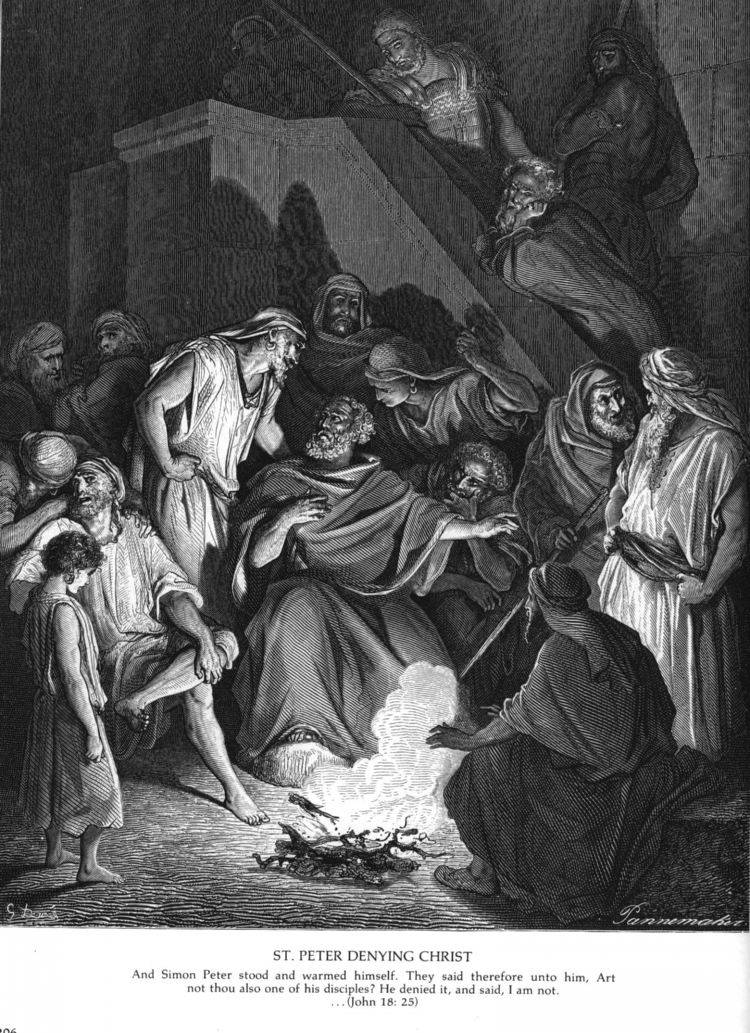
An officer slapped Him in the face for the way He answered. The reply asks for evidence again: testify as to what was wrong, or why did you strike Me. Annas then sent Him, still bound, to Caiaphas.
The record, by era
The Church Fathers3 voices
But let us return to what follows in the Gospel narrative. "And Annas sent Him bound unto Caiaphas the high priest." To him, according to Matthew's account, He was led at the outset, because he was the high priest that year. For both the pontiffs are to be understood as in the habit of acting year by year alternately, that is, as chief priests; and these were at that time Annas and Caiaphas, as recorded by the evangelist Luke, when telling of the time when John, the Lord's forerunner, began to preach the kingdom of heaven and to gather disciples. For he speaks thus: "Under the high priests Annas and Caiaphas, the word of the Lord came upon John, the son of Zacharias, in the wilderness," etc. Accordingly these two pontiffs fulfilled their years in turn: and it was the year of Caiaphas when Christ suffered. And so, according to Matthew, when He was apprehended, He was taken to him; but first, according to John, they came with Him to Annas; not because he was his colleague, but his father-in-law. And we must suppose that it was by Caiaphas' wish that it was so done; or that their houses were so situated, that Annas could not properly be overlooked by them as they passed on their way.
"And He saith, If I have spoken evil, bear witness of the evil." That is, "If thou canst lay hold on My words, declare it; but if thou canst not, why strikest thou Me?" Seest thou that the judgment-hall is full of tumult, and trouble, and passion, and confusion? The high priest asked deceitfully and treacherously, Christ answered in a straightforward manner, and as was meet. What then was next to be done? Either to refute, or to accept what He said. This however is not done, but a servant buffets Him. So far was this from being a court of justice, and the proceedings those of a conspiracy, and a deed of tyranny. Then not having even so made any farther discovery, they send Him bound to Caiaphas.
(de Con. Evang. iii. vi) This shows that Annas was the high priest, for this was before He was sent to Caiaphas. And Luke in the beginning of his Gospel says, that Annas and Caiaphas were both high priests. (Tr. cxiii) He was the one to whom they were taking Him from the first, as Matthew says; he being the high priest of this year. We must understand that the pontificate was taken between them year by year alternately, and that it was by Caiaphas's consent that they led Him first to Annas; or that their houses were so situated, that they could not but pass straight by that of Annas.
The Medieval Church2 voices
Since they found no fault in Him, they lead Him away to Caiaphas, perhaps hoping that he, being more cunning, would find something against Jesus worthy of death, either by catching Him in some answer, or by convicting Him of some deed.
"And Annas sent Him," etc. Here is treated the examination conducted under Caiaphas; and this part is divided into two, because first is set forth the leading of Christ to the judge; second, His denial by the disciple, at the words: "And Simon Peter was …
7 more voices on this verse
The Medieval Church2 voices
2322 Now there is mention that he was sent from one high priest to the other. First, it is mentioned that Jesus was sent to the other high priest; secondly, the narration of Peter's denial is completed (v 25). 2323 He says, Annas then sent …
Thinking that as he was more cunning, he might find out something against Him worthy of death.
The Puritans and the Awakening1 voice
Now Annas had sent him bound,.... As he found him, when the captain, band, and officers brought him to him; who having pleased himself with so agreeable a sight, and had asked him some few questions, and perhaps insulted him, sent him away in this manner, unto Caiaphas the high priest: his son-in-law, as the more proper person to be examined before; and especially as the grand council was sitting at his house.
The Nineteenth Century4 voices
Now Annas had sent him, etc. - It has been observed before that the proper place of this verse is immediately after the 13th; and, if it be allowed to stand here, it should be read in a parenthesis, and considered as a recapitulation of what had been before done.
A commentator
Jamieson, Fausset & Brown1802–1910
Commentary Critical and Explanatory on the Whole Bible (1871)
Annas, declining to meddle with the case, having sent Him to Caiaphas at once. But the words here literally are, "Annas sent Him [not 'had sent Him'] to Caiaphas"--and the "now" being of doubtful authority. Thus read, the verse affords no evidence that He was sent to Caiaphas before the interview just recorded, but implies rather the contrary.
A commentator
J.C. Ryle1816–1900
Expository Thoughts on the Gospels: John (lightly modernized text, Grace Gems edition) (1869)
proposed
In this part of John's history of Christ's sufferings, three wonderful things stand out upon the surface of the narrative. To these three let us confine our attention. We should mark, for one thing, the amazing hardness of unconverted men. We see this in the conduct of the men by whom our Lord was taken prisoner. Some of them most probably were Roman soldiers, and some of them were Jewish servants of the priests and Pharisees. But in one respect they were all alike.
A commentator
J.C. Ryle1816–1900
Expository Thoughts on the Gospels: John (lightly modernized text, Grace Gems edition) (1869)
proposed
In this part of John's history of Christ's sufferings, three wonderful things stand out upon the surface of the narrative. To these three let us confine our attention. We should mark, for one thing, the amazing hardness of unconverted men. We see this in the conduct of the men by whom our Lord was taken prisoner. Some of them most probably were Roman soldiers, and some of them were Jewish servants of the priests and Pharisees. But in one respect they were all alike. Both parties saw our Lord's divine power exhibited, when they "went backward, and fell to the ground." Both saw a miracle, according to Luke's Gospel, when Jesus touched the ear of Malchus and healed him. Yet both remained unmoved, cold, indifferent and insensible, as if they had seen nothing out of the common way. They went on coolly with their odious business; "They took Jesus, bound Him, and led Him away." The degree of hardness and insensibility of conscience to which men may attain, when they live twenty or thirty years without the slightest contact with religion, is something dreadful and appalling. God and the things of God seem to sink out of sight and disappear from the mind's eye. The world and the things of the world seem to absorb the whole attention. In such cases we may well believe miracles would produce little or no effect, as in the case before us. The eye would gaze on them, like the eye of a beast looking at a romantic landscape, without any impression being made on the heart. He who thinks that seeing a miracle would convert him into a thorough Christian has got much to learn. Let us not wonder if we see cases of hardness and unbelief in our own day and generation. Such cases will continually be found among those classes of mankind, who from their profession or position are completely cut off from means of grace.
The words behind it
10 Greek wordsEvery Greek word of this verse in the order it stands, with what it means and the door to its own study. The last column counts the times a word stands in the whole Bible: the rarer the word, the more the places it appears belong together.
| Greek | Sound | Meaning | Word study | In the Bible |
|---|---|---|---|---|
| Ἀπέστειλεν | apesteilen | Sent | G649 → | 132 times |
| οὖν | oun | then | G3767 → | 497 times |
| αὐτὸν | auton | Him | G846 → | 5565 times |
| ὁ | ho | <the> | G3588 → | 19766 times |
| Ἅννας | hannas | Annas | G452 → | |
| δεδεμένον | dedemenon | bound | G1210 → | 43 times |
| πρὸς | pros | to | G4314 → | 700 times |
| Καϊάφαν | kaiaphan | Caiaphas | G2533 → | 9 times |
| τὸν | ton | the | G3588 → | 19766 times |
| ἀρχιερέα. | archierea | high priest. | G749 → | 122 times |
ἈπέστειλενSent
apesteilenG649 →132 times
οὖνthen
ounG3767 →497 times
αὐτὸνHim
autonG846 →5565 times
ὁ<the>
hoG3588 →19766 times
ἍνναςAnnas
hannasG452 →
δεδεμένονbound
dedemenonG1210 →43 times
πρὸςto
prosG4314 →700 times
ΚαϊάφανCaiaphas
kaiaphanG2533 →9 times
τὸνthe
tonG3588 →19766 times
ἀρχιερέα.high priest.
archiereaG749 →122 times
A shaded row is a word that stands 400 times or fewer in the Bible.
The walk
8 stopsEach card is a verse this one points to, and under it the verses that one points to in turn. Where several paths arrive at the same place, that place is listed first: the text keeps returning to it.
Through
John 18:13They brought Him first to Annas, who was the father-in-law of Caiaphas, the high priest that year.
it leads to
- Matthew 26:3
At that time the chief priests and elders of the people assembled in the courtyard of the high priest, whose name was Caiaphas,
Reached by 2 separate paths from here.
- Luke 3:2
during the high priesthood of Annas and Caiaphas, the word of God came to John son of Zechariah in the wilderness.
- Matthew 26:57
Those who had arrested Jesus led Him away to the house of Caiaphas the high priest, where the scribes and elders had gathered.
- John 11:51
Caiaphas did not say this on his own. Instead, as high priest that year, he was prophesying that Jesus would die for the nation,
- Acts 4:6
along with Annas the high priest, Caiaphas, John, Alexander, and many others from the high priest’s family.
- Matthew 26:3
Through
Matthew 26:57Those who had arrested Jesus led Him away to the house of Caiaphas the high priest, where the scribes and elders had gathered.
it leads to
- John 11:49
But one of them, named Caiaphas, who was high priest that year, said to them, “You know nothing at all!
- Luke 22:54–55
Then they seized Jesus, led Him away, and took Him into the house of the high priest. And Peter followed at a distance.
- Mark 14:53–65
They led Jesus away to the high priest, and all the chief priests, elders, and scribes assembled.
- John 11:49
Where this verse is studied
On this page
Studies9
About John
Who and where
2 names in this verse with a page on the site.
This page draws on 14 works. Open the list of works
This page draws on Adam Clarke, Commentary on the Bible; Augustine of Hippo, Tractates on John 113; Augustine of Hippo, Catena Aurea by Aquinas; Bede, Catena Aurea by Aquinas; Bonaventure, Commentary on John, Chapter 18; J.C. Ryle, Expository Thoughts on the Gospels: John (lightly modernized text, Grace Gems edition); Jamieson, Fausset & Brown, Commentary Critical and Explanatory on the Whole Bible; John Chrysostom, Homily on the Gospel of John 83; John Gill, Exposition of the New Testament; John Gill, Exposition of the New Testament (1746-1748); Matthew Henry, Commentary on the Whole Bible; Theophylact of Ohrid, Commentary on John; Theophylact of Ohrid, Catena Aurea by Aquinas and Thomas Aquinas, Commentary on John.