
John 18:3
in John 18So Judas brought a band of soldiers and officers from the chief priests and Pharisees. They arrived at the garden carrying lanterns, torches, and weapons.
BSB
The same verse in ASV and KJV ▾
ASV
Judas then, having received the band of soldiers, and officers from the chief priests and the Pharisees, cometh thither with lanterns and torches and weapons.
KJV
Judas then, having received a band of men and officers from the chief priests and Pharisees, cometh thither with lanterns and torches and weapons.
⋯
This verse in John 18
Commentary
21 notes on this verseThe crowd that attended the traitor, when they made their attack upon Christ, carried lanterns and torches. They would seem to have guarded against stumbling in the dark, and falling into pitfalls unawares, for such accidents often happen in darkness. But, alas for their blindness! The miserable men, in their gross ignorance, did not perceive that they were stumbling on the stone concerning which God the Father says: Behold, I lay in Sion a Stone of stumbling and a Rock of offence.
This site's exposition
lanterns, torches, and weapons
on John 18:3-4
The band of soldiers is a Roman detachment, and the officers came from the chief priests and Pharisees. Lanterns, torches, and weapons come against a man who steps forward. Jesus knew all that was coming upon Him and asked the first question.
The record, by era
The Church Fathers5 voices
(Tr. cxii) It was a band not of Jews, but of soldiers, granted, we must understand, by the Governor, with legal authority to take the criminal, as He was considered, and crush any opposition that might be made.
"Judas then," he adds, "having received a cohort, and officers from the chief men and the Pharisees, cometh thither with lanterns, and torches, and weapons." It was a cohort, not of Jews, but of soldiers. We are therefore to understand it as having been received from the governor, as if for the purpose of securing the person of a criminal, and by preserving the forms of legal power, to deter any from venturing to resist his captors: although at the same time so great a band had been assembled, and came armed in such a way as either to terrify or even attack any one who should dare to make a stand in Christ's defense. For only in so far was His power concealed and prominence given to His weakness, that these very measures were deemed necessary by His enemies to be taken against Him, for whose hurt nothing would have sufficed but what was pleasing to Himself; in His own goodness making a good use of the wicked, and doing what was good in regard to the wicked, that He might transform the evil into the good, and distinguish between the good and the evil.
A commentator
Cyril of AlexandriaCommentary on the Gospel of John, Book 11 · Written before 444.
proposed
Judas then, having received the band of soldiers and officers from the chief priests and Pharisees, cometh thither, with lanterns, and torches, and weapons. Very appropriately, then, the inspired Evangelist says that Jesus was in the garden, when no number of men, nor any crowd, were congregating together, or contemplated coming to His succour; and that He was alone with His disciples, that He might display, in all its nakedness, the great folly of the thoughts the traitor harboured in his heart. For our conscience is very apt to create alarms in us, and torment us with the pangs of cowardice, whenever we are bent on any unholy deed. Such, I think, was the state of the traitor's mind, when he brought in his train the cohort, armed with weapons of war, together with the officers of the Jews, as though to capture a notorious malefactor. For in all likelihood he knew that he could never take Him, unless He chose to suffer, and encountered death by His own Will. But he had his understanding perverted by his unholy enterprise, and was, as it were, intoxicated by his own excessive audacity; and so he did not see whither he was tending, nor perceive that he was attempting what it was beyond his power to perform. For he thought, that by the multitude of his followers, and by the hand of man, he could prevail over the Divine power of Christ. And be not amazed that the miserable man should be afflicted with such madness, and be convicted of conceiving so ridiculous an idea. For when he gave up the rudder of his mind into another's hand, and sold to the devil the power over his desires, he was wholly possessed by his madness; for the devil leapt upon him once for all, and nestled in his bosom like a poisonous snake. Surely, one may well wonder at the traitor's fall, and find in it cause for ceaseless weeping. […]
And these men had often at other times sent to seize Him, but had not been able; whence it is plain, that at this time He voluntarily surrendered Himself. And how did they persuade the band? They were soldiers, who had made it their practice to do anything for money.
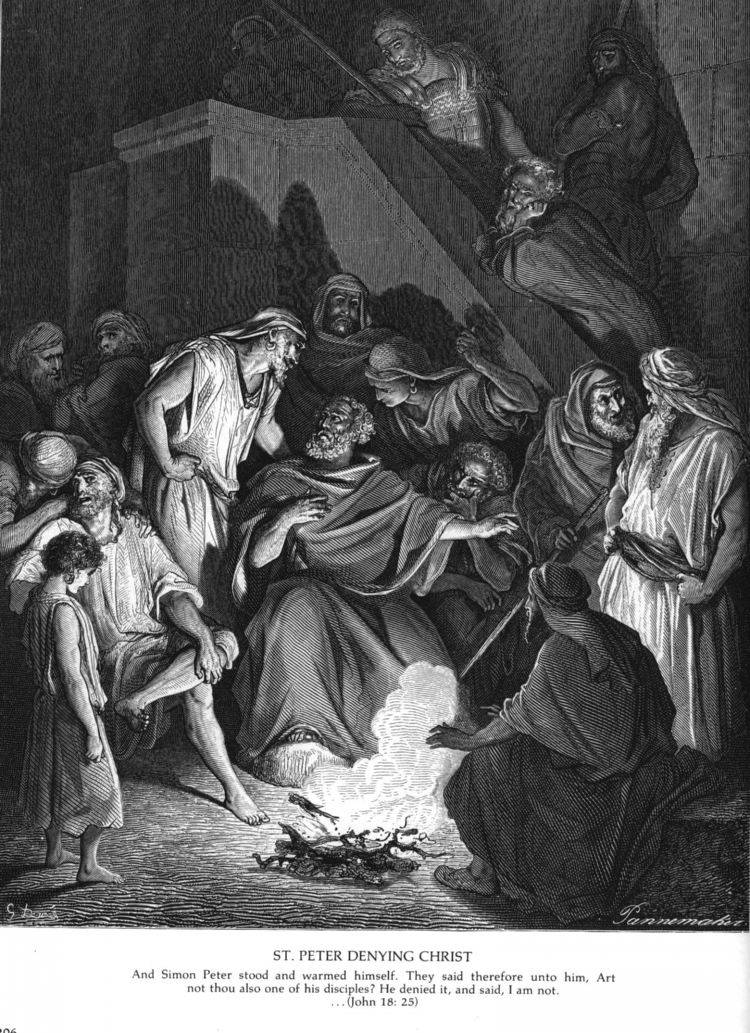
Take the cross first, therefore, as an indestructible foundation, and build on it the other articles of the faith. Do not deny the crucified. For if you deny him, you have many to arraign you. Judas the traitor will arraign you first. For he who betrayed him knows that Jesus was condemned to death by the chief priests and elders. The thirty pieces of silver bear witness. Gethsemane bears witness, where the betrayal occurred. I am not even speaking yet of the Mount of Olives on which they were with him at night, praying. The moon in the night bears witness; the day bears witness, and the sun, which was darkened. For it endured not to look on the crime of the conspirators. The fire will arraign you by which Peter stood and warmed himself. If you deny the cross, the eternal fire awaits you. I speak harsh words so that you may not experience harsh pains. Remember the swords that came against him in Gethsemane so that you do not feel the eternal sword.
14 more voices on this verse
The Medieval Church5 voices
They persuade a detachment of soldiers to assist them for money; for soldiers are such that they can be bribed with gold. Many of them come, because they fear the followers of Jesus, who were attached to Him on account of His teaching and miracles. …
"Judas therefore, having received the cohort." Here is noted the arrival of the betrayer with such persons as could seize and hold and lead him away. Therefore, "having received the cohort," namely from the Gentiles, "and from the chief priests and Pharisees, servants," because he …
(Nihil tale in G.) The Evangelist had shown how Judas had found out the place where Christ was, now he relates how he went there. Judas then, having received a band of men and officers from the chief priests and Pharisees, cometh thither with lanterns and torches and weapons.
Judas knew that at the feast time our Lord was wont to teach His disciples high and mysterious doctrines, and that He taught in places like this. And as it was then a solemn season, he thought He would be found there, teaching His disciples things relating to the feast. They carry torches and lanterns, to guard against Christ escaping in the dark.
2278 Now the Evangelist shows the procedure of the traitor. Notice, as we see from Luke (22:4), that after Judas had agreed with the chief priests to betray Christ, he looked for an opportunity to deliver him without disturbing the people. Consequently, he wanted to …
The Reformation1 voice
It is certain that the band of soldiers was borrowed from the governor, who also sent a captain at the head of a thousand soldiers; for, on account of sudden mutinies, a garrison was stationed in the city, and the governor himself kept a body-guard, wherever he was.
The Puritans and the Awakening2 voices
The persons employed in this action-- a band of men and officers from the chief priests, with Judas. (1.) Here is a multitude engaged against Christ-- a band of men, speira -- cohors, a regiment, a Roman band, which some think was five hundred men, others a thousand. Christ's friends were few, his enemies many.
Judas then having received a band of men,....
The Nineteenth Century6 voices
A commentator
Albert Barnes1798–1870
Notes, Explanatory and Practical, on the Old and New Testaments (1832-1869)
A band - See the notes at Mat 26:47; Mat 27:27. John passes over the agony of Jesus in the garden, probably because it was so fully described by the other evangelists. Lanterns ... - This was the time of the full moon, but it might have been cloudy, and their taking lights with them shows their determination to find him.
A commentator
Jamieson, Fausset & Brown1802–1910
Commentary Critical and Explanatory on the Whole Bible (1871)
proposed
over the brook Kedron--a deep, dark ravine, to the northeast of Jerusalem, through which flowed this small storm brook or winter torrent, and which in summer is dried up. where was a garden--at the foot of the Mount of Olives, "called Gethsemane"; that is, olive press (Mt 26:30, 36).
quarantine:debris (2026-07-29) — starts-lowercase
A commentator
Jamieson, Fausset & Brown1802–1910
Commentary Critical and Explanatory on the Whole Bible (1871)
proposed
"Now he that betrayed Him had given them a sign, saying, Whomsoever I shall kiss, that same is He, hold Him fast" (Mt 26:48). The cold-bloodedness of this speech was only exceeded by the deed itself.
A commentator
J.C. Ryle1816–1900
Expository Thoughts on the Gospels: John (lightly modernized text, Grace Gems edition) (1869)
proposed
These verses begin John's account of Christ's sufferings and crucifixion. We now enter on the closing scene of our Lord's ministry, and pass at once from His intercession to His sacrifice. We shall find that, like the other Gospel-writers, the beloved disciple enters fully into the story of the cross. But we shall also find, if we read carefully, that he mentions several interesting points in the story, which Matthew, Mark, and Luke, for some wise reasons, have passed over. We should notice, first, in these verses, the exceeding hardness of heart to which a backsliding professor may attain.
A commentator
J.C. Ryle1816–1900
Expository Thoughts on the Gospels: John (lightly modernized text, Grace Gems edition) (1869)
proposed
These verses begin John's account of Christ's sufferings and crucifixion. We now enter on the closing scene of our Lord's ministry, and pass at once from His intercession to His sacrifice. We shall find that, like the other Gospel-writers, the beloved disciple enters fully into the story of the cross. But we shall also find, if we read carefully, that he mentions several interesting points in the story, which Matthew, Mark, and Luke, for some wise reasons, have passed over. We should notice, first, in these verses, the exceeding hardness of heart to which a backsliding professor may attain. We are told that Judas, one of the twelve Apostles, became guide to those who captured Jesus. We are told that he used his knowledge of the place of our Lord's retirement, in order to bring His deadly enemies upon Him; and we are told that when the band of men and officers approached his Master, in order to take Him prisoner, Judas "stood with them." Yet this was a man who for three years had been a constant companion of Christ, had seen His miracles, had heard His sermons, had enjoyed the benefit of His private instruction, had professed himself a believer, had even worked and preached in Christ's name! "Lord," we may well say, "what is man?" From the highest degree of privilege down to the lowest depth of sin, there is but a succession of steps. Privileges misused seem to paralyze the conscience. The same fire that melts wax, will harden clay. Let us beware of resting our hopes of salvation on religious knowledge, however great; or religious advantages, however many. We may know all doctrinal truth and be able to teach others, and yet prove rotten at heart, and go down to the pit with Judas.
A band - Την σπειραν, The band or troop. Some think that the spira was the same as the Roman cohort, and was the tenth part of a legion, which consisted sometimes of 4200, and sometimes of 5000 foot. But Raphelius, on Mat 27:27, has clearly proved, from Polybius, that the spira was no more than a tenth of the fourth part of a legion. And as the number of the legion was uncertain, and their divisions not at all equal, no person can tell how many the band or spira contained. See many curious particulars in Raphelius on this point, vol. i. p. 351, edit. 1747. This band was probably those Roman soldiers given by the governor for the defense of the temple; and the officers were those who belonged to the Sanhedrin. With lanterns and torches - With these they had intended to search the corners and caverns, provided Christ had hidden himself; for they could not have needed them for any other purpose, it being now the fourteenth day of the moon’s age, in the month Nisan, and consequently she appeared full and bright. The weapons mentioned here were probably no other than clubs, staves, and instruments of that kind, as we may gather from Mat 26:55; Mar 14:48; Luk 22:52. The swords mentioned by the other evangelists were probably those of the Roman soldiers; the clubs and staves belonged to the chief priest’s officers.
The words behind it
23 Greek wordsEvery Greek word of this verse in the order it stands, with what it means and the door to its own study. The last column counts the times a word stands in the whole Bible: the rarer the word, the more the places it appears belong together.
| Greek | Sound | Meaning | Word study | In the Bible |
|---|---|---|---|---|
| Ὁ | ho | <the> | G3588 → | 19766 times |
| οὖν | oun | Therefore | G3767 → | 497 times |
| Ἰούδας | ioudas | Judas | G2455 → | 41 times |
| λαβὼν | labon | having procured | G2983 → | 257 times |
| τὴν | ten | the | G3588 → | 19766 times |
| σπεῖραν | speiran | cohort | G4686 → | |
| καὶ | kai | and | G2532 → | 9120 times |
| ἐκ | ek | from | G1537 → | 911 times |
| τῶν | ton | the | G3588 → | 19766 times |
| ἀρχιερέων | archiereon | chief priests | G749 → | 122 times |
| καὶ | kai | and | G2532 → | 9120 times |
| ἐκ | ek | from | G1537 → | 911 times |
| τῶν | ton | the | G3588 → | 19766 times |
| Φαρισαίων | pharisaion | Pharisees | G5330 → | 97 times |
| ὑπηρέτας | huperetas | officers | G5257 → | 20 times |
| ἔρχεται | erchetai | comes | G2064 → | 628 times |
| ἐκεῖ | ekei | there | G1563 → | 105 times |
| μετὰ | meta | with | G3326 → | 461 times |
| φανῶν | phanon | lanterns | G5322 → | |
| καὶ | kai | and | G2532 → | 9120 times |
| λαμπάδων | lampadon | torches | G2985 → | |
| καὶ | kai | and | G2532 → | 9120 times |
| ὅπλων.¶ | hoplon | weapons. | G3696 → |
Ὁ<the>
hoG3588 →19766 times
οὖνTherefore
ounG3767 →497 times
ἸούδαςJudas
ioudasG2455 →41 times
λαβὼνhaving procured
labonG2983 →257 times
τὴνthe
tenG3588 →19766 times
σπεῖρανcohort
speiranG4686 →
καὶand
kaiG2532 →9120 times
ἐκfrom
ekG1537 →911 times
τῶνthe
tonG3588 →19766 times
ἀρχιερέωνchief priests
archiereonG749 →122 times
καὶand
kaiG2532 →9120 times
ἐκfrom
ekG1537 →911 times
τῶνthe
tonG3588 →19766 times
ΦαρισαίωνPharisees
pharisaionG5330 →97 times
ὑπηρέταςofficers
huperetasG5257 →20 times
ἔρχεταιcomes
erchetaiG2064 →628 times
ἐκεῖthere
ekeiG1563 →105 times
μετὰwith
metaG3326 →461 times
φανῶνlanterns
phanonG5322 →
καὶand
kaiG2532 →9120 times
λαμπάδωνtorches
lampadonG2985 →
καὶand
kaiG2532 →9120 times
ὅπλων.¶weapons.
hoplonG3696 →
A shaded row is a word that stands 400 times or fewer in the Bible.
The walk
8 stopsEach card is a verse this one points to, and under it the verses that one points to in turn. Where several paths arrive at the same place, that place is listed first: the text keeps returning to it.
Through
Acts 1:16“Brothers, the Scripture had to be fulfilled which the Holy Spirit foretold through the mouth of David concerning Judas, who became a guide for those who arrested Jesus.
it leads to
- Psalms 41:9
Even my close friend whom I trusted, the one who shared my bread, has lifted up his heel against me.
- John 13:18
I am not speaking about all of you; I know whom I have chosen. But this is to fulfill the Scripture: ‘The one who shares My bread has lifted up his heel against Me.’
- Psalms 55:12–15
For it is not an enemy who insults me; that I could endure. It is not a foe who rises against me; from him I could hide.
- Acts 1:20
“For it is written in the book of Psalms: ‘May his place be deserted; let there be no one to dwell in it,’ and, ‘May another take his position.’
- John 12:38–40
This was to fulfill the word of Isaiah the prophet: “Lord, who has believed our message? And to whom has the arm of the Lord been revealed?”
- Psalms 41:9
Through
Psalms 22:12Many bulls surround me; strong bulls of Bashan encircle me.
it leads to
- Amos 4:1–3
Hear this word, you cows of Bashan on Mount Samaria, you women who oppress the poor and crush the needy, who say to your husbands, “Bring us more to drink.”
- Acts 4:27
In fact, this is the very city where Herod and Pontius Pilate conspired with the Gentiles and the people of Israel against Your holy servant Jesus, whom You anointed.
- Psalms 68:30
Rebuke the beast in the reeds, the herd of bulls among the calves of the nations, until it submits, bringing bars of silver. Scatter the nations who delight in war.
- Amos 4:1–3
Where this verse is studied
On this page
Studies9
About John
This page draws on 19 works. Open the list of works
This page draws on Adam Clarke, Commentary on the Bible; Albert Barnes, Notes, Explanatory and Practical, on the Gospels; Albert Barnes, Notes, Explanatory and Practical, on the Old and New Testaments (1832-1869); Augustine of Hippo, Catena Aurea by Aquinas; Augustine of Hippo, Tractates on John 112; B. F. Westcott, The Gospel according to St. John; Bonaventure, Commentary on John, Chapter 18; Cyril of Alexandria, Commentary on the Gospel of John, Book 11; Cyril of Jerusalem, Catechetical Lecture 13:38; Glossa Ordinaria, Catena Aurea by Aquinas; J.C. Ryle, Expository Thoughts on the Gospels: John (lightly modernized text, Grace Gems edition); Jamieson, Fausset & Brown, Commentary Critical and Explanatory on the Whole Bible; John Calvin, Commentaries; John Chrysostom, Homily on the Gospel of John 83; John Gill, Exposition of the New Testament (1746-1748); Matthew Henry, Commentary on the Whole Bible; Theophylact of Ohrid, Commentary on John; Theophylact of Ohrid, Catena Aurea by Aquinas and Thomas Aquinas, Commentary on John.