
John 18:16
in John 18But Peter stood outside at the door. Then the disciple who was known to the high priest went out and spoke to the doorkeeper, and brought Peter in.
BSB
The same verse in ASV and KJV ▾
ASV
but Peter was standing at the door without. So the other disciple, who was known unto the high priest, went out and spake unto her that kept the door, and brought in Peter.
KJV
But Peter stood at the door without. Then went out that other disciple, which was known unto the high priest, and spake unto her that kept the door, and brought in Peter.
⋯
This verse in John 18
Commentary
15 notes on this verseBut Peter was standing at the door without. So the other disciple, which was known unto the high priest, went out, and spake unto her that kept the door, and brought in Peter. Peter did not lag behind from any lack of fervour of heart, but only because the vigilance of the damsel at the gate made entrance perilous for those with whom she had no previous acquaintance. And though it might not have been difficult for a man to push a woman aside, yet it might have involved a charge of unruly behaviour.
This site's exposition
Simon Peter and another disciple
on John 18:15-18
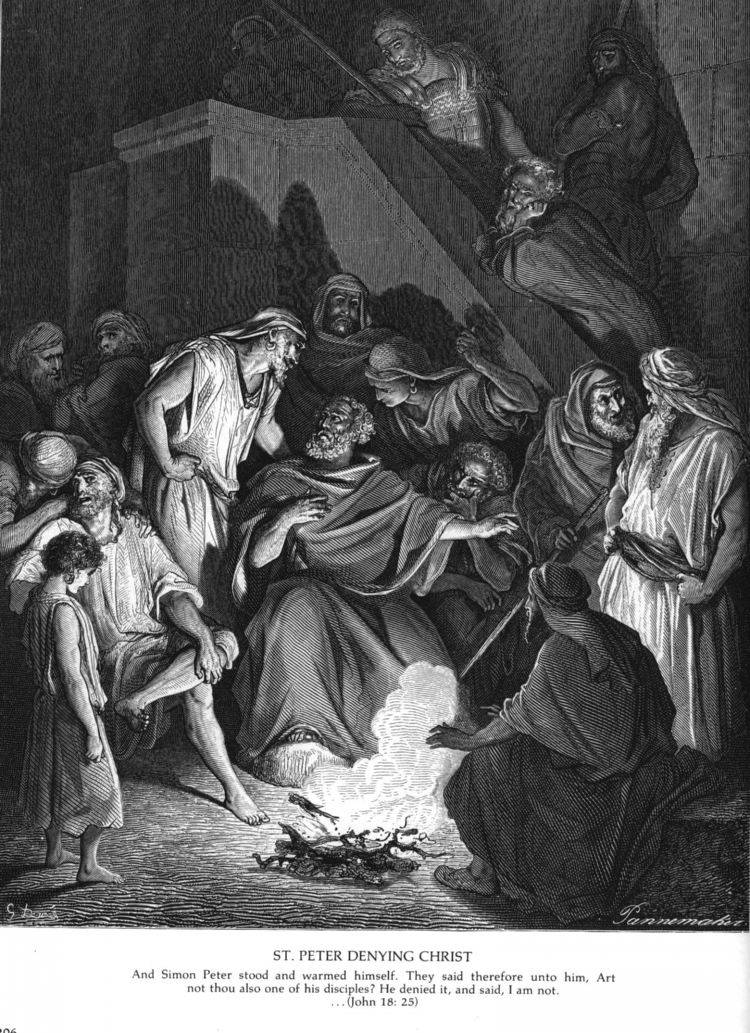
The other disciple is known to the high priest, so his access gets Peter through the door. The servant girl at the door asks first, and Peter answers, I am not; in the garden Jesus said ego eimi, at the door Peter says ouk eimi. He warms himself at the charcoal fire with the officers.
The record, by era
The Church Fathers3 voices
"But Jesus was followed," he says, "by Simon Peter, and another disciple." Who that other disciple is, we cannot affirm with confidence, because it is left unnoticed here. But it is in this way that John usually refers to himself, with the addition, "whom Jesus loved." Perhaps, therefore, it is he also in the present case; but whoever it is, let us look at what follows. "And that disciple," he says, "was known unto the high priest, and went in with Jesus into the palace of the high priest; but Peter stood at the door without. Then went out that other disciple, who was known unto the high priest, and spake unto her that kept the door, and brought in Peter. Then saith the damsel that kept the door unto Peter, Art thou also one of this man's disciples? He saith, I am not." Lo, the pillar of greatest strength has at a single breath of air trembled to its foundations. Where is now all that boldness of the promiser, and his overweening confidence in himself beforehand? What now of those words, when he said, "Why cannot I follow Thee now? I will lay down my life for Thy sake." Is this the way to follow the Master, to deny his own discipleship? is it thus that one's life is laid down for the Lord, when one is frightened at a maid-servant's voice, lest it should compel us to the sacrifice? But what wonder, if God foretold what was true, and man presumptuously imagined what was false? Assuredly in this denial of the Apostle Peter, which had now entered on its first stage, we ought to take notice that not only is Christ denied by one who says that He is not Christ, but by him also who, while really a Christian, himself denies that he is so. For the Lord said not to Peter, Thou shall deny that thou art my disciple; but, "Thou shall deny me." Him, therefore, he denied, when he denied that he was His disciple. […]
And that Peter would have also entered had he been permitted, he shows by the sequel; for when he went out, and bade the damsel who kept the door bring in Peter, he straightway came in. But why did he not bring him in himself? He clung to Christ, and followed Him; on this account he bade the woman bring him in.
After he had showed his power through these things, our Lord surrendered voluntarily and was bound. First they took him to Annas, who was the father-in-law of Caiaphas the high priest. His disciples Simon Peter and John, who wrote this Gospel, followed him. John, who …
The Medieval Church2 voices
2303 Now the order in which they entered is given: John entered first and then he brought in Peter (v 16). 2304 It was John who entered first, with Jesus, as this disciple was known to the high priest... while Peter stood outside at the …
Concerning Peter, he declares that he followed Jesus out of love for Him, but stopped outside the courtyard because he was not acquainted. That Peter would have entered, if he had been allowed, is evident from the fact that when John came out and told …
8 more voices on this verse
The Medieval Church2 voices
"But Peter stood at the door outside," either because he did not dare to enter, or because he was not permitted. Therefore that was true which was said to him above in the thirteenth chapter: "Where I go, you cannot follow me now." "Therefore that …
He stood without, as being about to deny his Lord. He was not in Christ, who dared not confess Christ.
The Puritans and the Awakening2 voices
But Peter stood at the door without,....
Those that have a real kindness for Christ and his ways, though their temper may be reserved and their circumstances may lead them to be cautious and retired, yet, if their faith be sincere, they will discover, when they are called to it, which way their inclination lies, by being ready to do a professed disciple a good turn.
The Nineteenth Century3 voices
A commentator
Jamieson, Fausset & Brown1802–1910
Commentary Critical and Explanatory on the Whole Bible (1871)
But Peter stood at the door without--by preconcerted arrangement with his friend till he should get access for him. Then went out that other . . . and spake to her that kept the door, and brought in Peter--The naturalness of these small details is not unworthy of notice.
A commentator
J.C. Ryle1816–1900
Expository Thoughts on the Gospels: John (lightly modernized text, Grace Gems edition) (1869)
proposed
In this part of John's history of Christ's sufferings, three wonderful things stand out upon the surface of the narrative. To these three let us confine our attention. We should mark, for one thing, the amazing hardness of unconverted men. We see this in the conduct of the men by whom our Lord was taken prisoner. Some of them most probably were Roman soldiers, and some of them were Jewish servants of the priests and Pharisees. But in one respect they were all alike.
A commentator
J.C. Ryle1816–1900
Expository Thoughts on the Gospels: John (lightly modernized text, Grace Gems edition) (1869)
proposed
In this part of John's history of Christ's sufferings, three wonderful things stand out upon the surface of the narrative. To these three let us confine our attention. We should mark, for one thing, the amazing hardness of unconverted men. We see this in the conduct of the men by whom our Lord was taken prisoner. Some of them most probably were Roman soldiers, and some of them were Jewish servants of the priests and Pharisees. But in one respect they were all alike. Both parties saw our Lord's divine power exhibited, when they "went backward, and fell to the ground." Both saw a miracle, according to Luke's Gospel, when Jesus touched the ear of Malchus and healed him. Yet both remained unmoved, cold, indifferent and insensible, as if they had seen nothing out of the common way. They went on coolly with their odious business; "They took Jesus, bound Him, and led Him away." The degree of hardness and insensibility of conscience to which men may attain, when they live twenty or thirty years without the slightest contact with religion, is something dreadful and appalling. God and the things of God seem to sink out of sight and disappear from the mind's eye. The world and the things of the world seem to absorb the whole attention. In such cases we may well believe miracles would produce little or no effect, as in the case before us. The eye would gaze on them, like the eye of a beast looking at a romantic landscape, without any impression being made on the heart. He who thinks that seeing a miracle would convert him into a thorough Christian has got much to learn. Let us not wonder if we see cases of hardness and unbelief in our own day and generation. Such cases will continually be found among those classes of mankind, who from their profession or position are completely cut off from means of grace.
Modern Voices1 voice
Let's begin with some things that we ought to know about John, but which we usually don't. John was very likely the Lord's first cousin on their mothers' side. John was a son of Zebedee, and his mother's name was Salome, which we can find …
The words behind it
26 Greek wordsEvery Greek word of this verse in the order it stands, with what it means and the door to its own study. The last column counts the times a word stands in the whole Bible: the rarer the word, the more the places it appears belong together.
| Greek | Sound | Meaning | Word study | In the Bible |
|---|---|---|---|---|
| Ὁ | ho | <the> | G3588 → | 19766 times |
| δὲ | de | But | G1161 → | 2765 times |
| Πέτρος | petros | Peter | G4074 → | 155 times |
| εἱστήκει | heistekei | had stood | G2476 → | 153 times |
| πρὸς | pros | at | G4314 → | 700 times |
| τῇ | tea | the | G3588 → | 19766 times |
| θύρᾳ | thura | door | G2374 → | 39 times |
| ἔξω. | exo | outside. | G1854 → | 63 times |
| ἐξῆλθεν | exelthen | Went out | G1831 → | 216 times |
| οὖν | oun | therefore | G3767 → | 497 times |
| ὁ | ho | the | G3588 → | 19766 times |
| μαθητὴς | mathetes | disciple | G3101 → | 260 times |
| ὁ | ho | <the> | G3588 → | 19766 times |
| ἄλλος | allos | other | G243 → | 155 times |
| ὁ | ho | who | G3588 → | 19766 times |
| γνωστὸς | gnostos | known | G1110 → | |
| τοῦ | tou | to the | G3588 → | 19766 times |
| ἀρχιερέως | archiereos | high priest | G749 → | 122 times |
| καὶ | kai | and | G2532 → | 9120 times |
| εἶπεν | eipen | spoke | G2036 → | 925 times |
| τῇ | tea | to the | G3588 → | 19766 times |
| θυρωρῷ | thuroro | doorkeeper | G2377 → | 4 times |
| καὶ | kai | and | G2532 → | 9120 times |
| εἰσήγαγεν | eisegagen | brought in | G1521 → | |
| τὸν | ton | <the> | G3588 → | 19766 times |
| Πέτρον. | petron | Peter. | G4074 → | 155 times |
Ὁ<the>
hoG3588 →19766 times
δὲBut
deG1161 →2765 times
ΠέτροςPeter
petrosG4074 →155 times
εἱστήκειhad stood
heistekeiG2476 →153 times
πρὸςat
prosG4314 →700 times
τῇthe
teaG3588 →19766 times
θύρᾳdoor
thuraG2374 →39 times
ἔξω.outside.
exoG1854 →63 times
ἐξῆλθενWent out
exelthenG1831 →216 times
οὖνtherefore
ounG3767 →497 times
ὁthe
hoG3588 →19766 times
μαθητὴςdisciple
mathetesG3101 →260 times
ὁ<the>
hoG3588 →19766 times
ἄλλοςother
allosG243 →155 times
ὁwho
hoG3588 →19766 times
γνωστὸςknown
gnostosG1110 →
τοῦto the
touG3588 →19766 times
ἀρχιερέωςhigh priest
archiereosG749 →122 times
καὶand
kaiG2532 →9120 times
εἶπενspoke
eipenG2036 →925 times
τῇto the
teaG3588 →19766 times
θυρωρῷdoorkeeper
thuroroG2377 →4 times
καὶand
kaiG2532 →9120 times
εἰσήγαγενbrought in
eisegagenG1521 →
τὸν<the>
tonG3588 →19766 times
Πέτρον.Peter.
petronG4074 →155 times
A shaded row is a word that stands 400 times or fewer in the Bible.
The walk
5 stopsEach card is a verse this one points to, and under it the verses that one points to in turn. Where several paths arrive at the same place, that place is listed first: the text keeps returning to it.
Through
Matthew 26:69Meanwhile, Peter was sitting out in the courtyard, and a servant girl came up to him. “You also were with Jesus the Galilean,” she said.
it leads to
- 1 Kings 19:13
When Elijah heard it, he wrapped his face in his cloak and went out and stood at the mouth of the cave. Suddenly a voice came to him and said, “What are you doing…
- Matthew 26:71
When Peter had gone out to the gateway, another servant girl saw him and said to the people there, “This man was with Jesus of Nazareth.”
- John 18:16–18
But Peter stood outside at the door. Then the disciple who was known to the high priest went out and spoke to the doorkeeper, and brought Peter in.
- Acts 5:37
After him, Judas the Galilean appeared in the days of the census and drew away people after him. He too perished, and all his followers were scattered.
- 2 Peter 2:7–9
and if He rescued Lot, a righteous man distressed by the depraved conduct of the lawless
- 1 Kings 19:13
Where this verse is studied
On this page
Studies9
About John
This page draws on 14 works. Open the list of works
This page draws on Alcuin of York, Catena Aurea by Aquinas; Augustine of Hippo, Tractates on John 113; Bonaventure, Commentary on John, Chapter 18; Cyril of Alexandria, Commentary on the Gospel of John, Book 11; Douglas Wilson, Surveying the Text: John; J. C. Ryle, Expository Thoughts on the Gospels, John; J.C. Ryle, Expository Thoughts on the Gospels: John (lightly modernized text, Grace Gems edition); Jamieson, Fausset & Brown, Commentary Critical and Explanatory on the Whole Bible; John Chrysostom, Homily on the Gospel of John 83; John Gill, Exposition of the New Testament (1746-1748); Matthew Henry, Commentary on the Whole Bible; Theodore of Mopsuestia, COMMENTARY ON JOHN 7.18.16; Theophylact of Ohrid, Commentary on John and Thomas Aquinas, Commentary on John.