
John 18:25
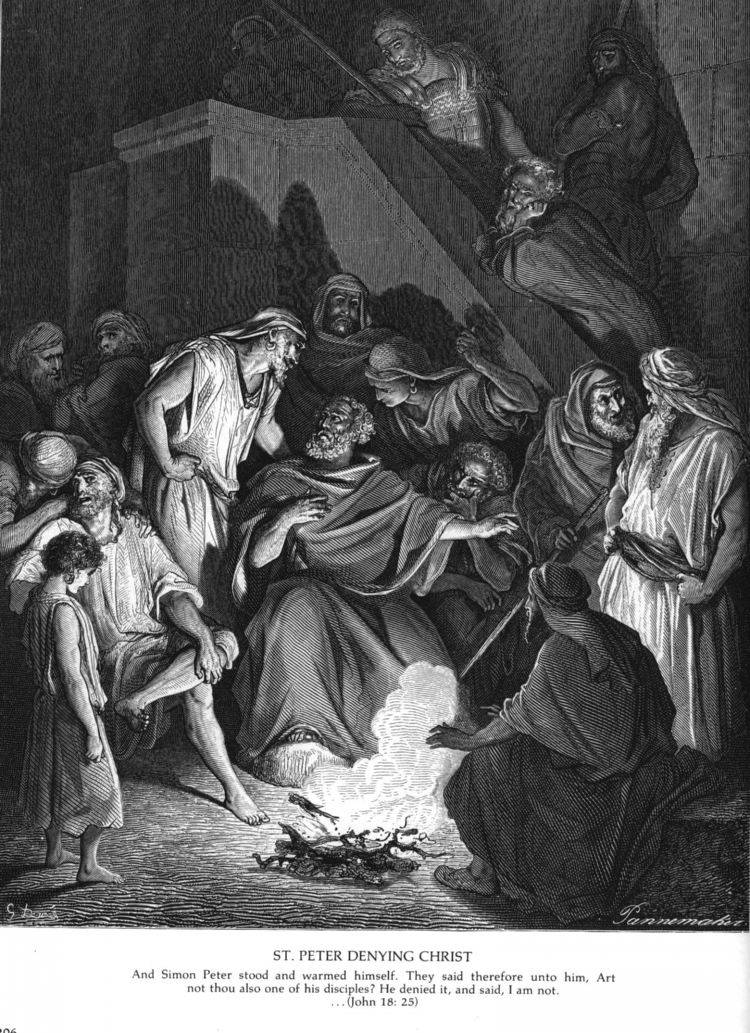
in John 18Simon Peter was still standing and warming himself. So they asked him, “Aren’t you also one of His disciples?” He denied it and said, “I am not.”
BSB
The same verse in ASV and KJV ▾
ASV
Now Simon Peter was standing and warming himself. They said therefore unto him, Art thou also one of his disciples? He denied, and said, I am not.
KJV
And Simon Peter stood and warmed himself. They said therefore unto him, Art not thou also one of his disciples? He denied it, and said, I am not.
⋯
This verse in John 18
Commentary
16 notes on this verseAnd Simon Peter stood and warmed himself,.... This is repeated from Joh 18:18 to connect the history, and carry on the thread of the account of Peter's denial of Christ, which is interrupted by inserting the examination of Christ before the high priest, which was made at the same time. Peter stood among, and continued with the servants and officers of the high priest, warming himself by a fire they had made, it being a cold night; and this proved of bad consequence to him.
This site's exposition
still standing and warming himself
on John 18:25-27
Peter is still at the fire when the second question comes, and he denied it again. The third comes from a relative of the man whose ear he had cut off, who had seen him in the garden. A rooster crowed at once, as Jesus had said at John 13:38.
The record, by era
The Church Fathers5 voices
(Tr. cxiii) After the Evangelist has said that they sent Jesus bound from Annas to Caiaphas, he returns to Peter and his three denials, which took place in the house of Annas: And Simon Peter stood and warmed himself. He repeats what he had said before.
(de Con. Evang. iii. 6) Here we find Peter not at the gate, but at the fire, when he denies the second time: so that he must have returned after he had gone out of doors, where Matthew says he was. He did not go out, and another damsel see him on the outside, but another damsel saw him as he was rising to go out, and remarked him, and told those who were by, i. e. those who were standing with her at the fire inside the hall, This fellow also was with Jesus of Nazareth. (Matt. 26:71, 72) He heard this outside, and returned, and swore, I do not know the man. Then John continues: They said therefore unto him, Art not thou also one of His disciples? which words we suppose to have been said to him when he had come back, and was standing at the fire. And this explanation is confirmed by the fact, that besides the other damsel mentioned by Matthew and Mark in the second denial, there was another person, mentioned by Luke, who also questioned him. So John uses the plural: They said therefore unto him. And then follows the third denial: One of the servants of the high priest, being his kinsman whose ear Peter cut off, saith, Did not I see thee in the garden with Him? That Matthew and Mark speak of the party who here question Peter in the plural number, whereas Luke mentions only one, and John also, adding that that one was the kinsman of him whose ear Peter cut off, is easily explained by supposing that Matthew and Mark used the plural number by a common form of speech for the singular; or that one who had observed him most strictly put the question first, and others followed it up, and pressed Peter with more.
But the evangelist, after saying that Annas sent Him bound unto Caiaphas, returns to the place of his narrative, where he had left Peter, in order to explain what had taken place in Annas' house in regard to his threefold denial. "But Peter was standing," he says, "and warming himself." He thus repeats what he had already stated before; and then adds what follows. "They said therefore unto him, Art thou also one of his disciples? He denied, and said, I am not." He had already denied once; this is the second time. And then, that the third denial might also be fulfilled, "one of the servants of the high priest, being his kinsman whose ear Peter cut off, saith, Did I not see thee in the garden with him? Peter then denied again, and immediately the cock crew." Behold, the prediction of the Physician is fulfilled, the presumption of the sick man is brought to the light. For there is no performance of what the latter had asserted, "I will lay down my life for Thy sake;" but a performance of what the former had predicted, "Thou shall thrice deny me."
"And Simon Peter stood and warmed himself." Wonderful, by what a lethargy that hot and furious one was possessed, when Jesus was being led away! After such things as had taken place, he doth not move, but still warms himself, that thou mayest learn how great is the weakness of our nature if God abandoneth. And, being questioned, he denies again.
A commentator
Cyril of AlexandriaCommentary on the Gospel of John, Book 12 · Written before 444.
proposed
Annas therefore sent Him bound unto Caiaphas, the high priest. Now Simon Peter was standing warming himself. They said therefore unto him, Art thou also one of His disciples? He denied, and said, I am not. One of the servants of the high priest, being a kinsman of him whose ear Peter cut off, saith, Did not I see thee in the garden with Him? Peter therefore denied again: and straightway the cock crew. The inspired Evangelist, to our profit, checks the course of his narrative, like a horse at full speed, and turns it back again. And why?
9 more voices on this verse
The Medieval Church3 voices
"Now he was." Here is set forth the denial of Peter, and the occasion for denying is placed in this, that he was mingled with the servants; whence he says: "And Simon Peter was standing and warming himself," namely with the servants, as above. And …
2324 Now the second and third denials of Peter are presented: first, the circumstances of the denials; secondly, the two denials; and thirdly, the fulfillment of Christ's prediction (v 27). 2325 The circumstance of Peter's second denial was his staying with the officers of the …
Mystically, by the first denial of Peter are denoted those who before our Lord's Passion denied that He was God, by the second, those who did so after His resurrection. So by the first crowing of the cock His resurrection is signified; by the second, the general resurrection at the end of the world. By the first damsel, who obliged Peter to deny, is denoted lust, by the second, carnal delight: by one or more servants, the devils who persuade men to deny Christ.
The Nineteenth Century6 voices
A commentator
Jamieson, Fausset & Brown1802–1910
Commentary Critical and Explanatory on the Whole Bible (1871)
And Simon Peter was standing and warming himself. They said therefore . . . Art thou not also one of his disciples?--In Mt 26:71 the second charge was made by "another maid, when he was gone out into the porch," who "saw him, and said unto them that were there, This [fellow] was also with Jesus of Nazareth." So also Mr 14:69.
A commentator
Jamieson, Fausset & Brown1802–1910
Commentary Critical and Explanatory on the Whole Bible (1871)
Annas, declining to meddle with the case, having sent Him to Caiaphas at once. But the words here literally are, "Annas sent Him [not 'had sent Him'] to Caiaphas"--and the "now" being of doubtful authority. Thus read, the verse affords no evidence that He was sent to Caiaphas before the interview just recorded, but implies rather the contrary.
A commentator
J.C. Ryle1816–1900
Expository Thoughts on the Gospels: John (lightly modernized text, Grace Gems edition) (1869)
proposed
In this part of John's history of Christ's sufferings, three wonderful things stand out upon the surface of the narrative. To these three let us confine our attention. We should mark, for one thing, the amazing hardness of unconverted men. We see this in the conduct of the men by whom our Lord was taken prisoner. Some of them most probably were Roman soldiers, and some of them were Jewish servants of the priests and Pharisees. But in one respect they were all alike.
A commentator
Charles Spurgeon1834–1892
The Metropolitan Tabernacle Pulpit, Sermon No. 3207: “Secret Disciples Encouraged” (lightly modernized text, CCEL edition) · Written before 1892.
proposed
BLESSED be His name, there are some of us who count it our highest joy to answer this question, "Yes." Whatever may be entailed by the confession, we shall be glad to endure! We could not do otherwise than say, "He acknowledged us of old and He is still not ashamed to call us brethren and, therefore, we are not ashamed of Him, but we delight to call Him Master and Lord."
A commentator
J.C. Ryle1816–1900
Expository Thoughts on the Gospels: John (lightly modernized text, Grace Gems edition) (1869)
proposed
In this part of John's history of Christ's sufferings, three wonderful things stand out upon the surface of the narrative. To these three let us confine our attention. We should mark, for one thing, the amazing hardness of unconverted men. We see this in the conduct of the men by whom our Lord was taken prisoner. Some of them most probably were Roman soldiers, and some of them were Jewish servants of the priests and Pharisees. But in one respect they were all alike. Both parties saw our Lord's divine power exhibited, when they "went backward, and fell to the ground." Both saw a miracle, according to Luke's Gospel, when Jesus touched the ear of Malchus and healed him. Yet both remained unmoved, cold, indifferent and insensible, as if they had seen nothing out of the common way. They went on coolly with their odious business; "They took Jesus, bound Him, and led Him away." The degree of hardness and insensibility of conscience to which men may attain, when they live twenty or thirty years without the slightest contact with religion, is something dreadful and appalling. God and the things of God seem to sink out of sight and disappear from the mind's eye. The world and the things of the world seem to absorb the whole attention. In such cases we may well believe miracles would produce little or no effect, as in the case before us. The eye would gaze on them, like the eye of a beast looking at a romantic landscape, without any impression being made on the heart. He who thinks that seeing a miracle would convert him into a thorough Christian has got much to learn. Let us not wonder if we see cases of hardness and unbelief in our own day and generation. Such cases will continually be found among those classes of mankind, who from their profession or position are completely cut off from means of grace.
A commentator
Charles Spurgeon1834–1892
The Metropolitan Tabernacle Pulpit, Sermon No. 3207: “Secret Disciples Encouraged” (lightly modernized text, CCEL edition) · Written before 1892.
proposed
BLESSED be His name, there are some of us who count it our highest joy to answer this question, "Yes." Whatever may be entailed by the confession, we shall be glad to endure! We could not do otherwise than say, "He acknowledged us of old and He is still not ashamed to call us brethren and, therefore, we are not ashamed of Him, but we delight to call Him Master and Lord." In an interview I had about a fortnight ago, with a dear and venerable friend who is just upon the borders of the grave, he said to me, "There is a verse in the Hymn-Hook which I know you do not like, Sir, and which I do not like, though both of us have sometimes been obliged to sing it— "Tis a point I long to know, Oft it causes anxious thought Do I love the Lord, or no? Am I His, or am I not?" "But I have no doubt about it," he went on to say, "any more than I have about my own existence! Let others doubt if they like. I know I love the Lord. I am sure I do. If there is anything in all this world that is beyond a question to me, it is that I do love Him with all my heart, soul and strength." That ought to be the condition of every Christian! There ought to be no question here. We should, each one, be able to reply at once, when asked, "Are not you also one of His disciples?" "I am! I count it my honor, my joy that He permits me to sit at His feet and to be instructed by Him, and to go forth into the world bearing His reproach." But, at the same time, dear Friends, there are some in the world who could not go that length, of whom, nevertheless, we have the hopeful belief that they are His disciples. I thought of speaking a little to such persons. This, perhaps, will be unfortunate for most of you, for I shall not be addressing many, perhaps, here present. Still, if there are but a few such, we must look after the one at the risk even of leaving the ninety-nine.
The words behind it
24 Greek wordsEvery Greek word of this verse in the order it stands, with what it means and the door to its own study. The last column counts the times a word stands in the whole Bible: the rarer the word, the more the places it appears belong together.
| Greek | Sound | Meaning | Word study | In the Bible |
|---|---|---|---|---|
| ἦν | en | Was | G1510 → | 2333 times |
| δὲ | de | now | G1161 → | 2765 times |
| Σίμων | simon | Simon | G4613 → | 75 times |
| Πέτρος | petros | Peter | G4074 → | 155 times |
| ἑστὼς | hestos | already standing | G2476 → | 153 times |
| καὶ | kai | and | G2532 → | 9120 times |
| θερμαινόμενος. | thermainomenos | warming himself. | G2328 → | 6 times |
| εἶπον | eipon | They said | G2036 → | 925 times |
| οὖν | oun | therefore | G3767 → | 497 times |
| αὐτῷ· | auto | to him; | G846 → | 5565 times |
| μὴ | me | Surely | G3361 → | 1066 times |
| καὶ | kai | also | G2532 → | 9120 times |
| σὺ | su | you yourself | G4771 → | 2973 times |
| ἐκ | ek | of | G1537 → | 911 times |
| τῶν | ton | the | G3588 → | 19766 times |
| μαθητῶν | matheton | disciples | G3101 → | 260 times |
| αὐτοῦ | autou | of Him | G846 → | 5565 times |
| εἶ; | ei | are? | G1510 → | 2333 times |
| ἠρνήσατο | ernesato | Denied | G720 → | 33 times |
| ἐκεῖνος | ekeinos | he | G1565 → | 260 times |
| καὶ | kai | and | G2532 → | 9120 times |
| εἶπεν· | eipen | said; | G2036 → | 925 times |
| οὐκ | ouk | Not | G3756 → | 1664 times |
| εἰμί. | eimi | I am. | G1510 → | 2333 times |
ἦνWas
enG1510 →2333 times
δὲnow
deG1161 →2765 times
ΣίμωνSimon
simonG4613 →75 times
ΠέτροςPeter
petrosG4074 →155 times
ἑστὼςalready standing
hestosG2476 →153 times
καὶand
kaiG2532 →9120 times
θερμαινόμενος.warming himself.
thermainomenosG2328 →6 times
εἶπονThey said
eiponG2036 →925 times
οὖνtherefore
ounG3767 →497 times
αὐτῷ·to him;
autoG846 →5565 times
μὴSurely
meG3361 →1066 times
καὶalso
kaiG2532 →9120 times
σὺyou yourself
suG4771 →2973 times
ἐκof
ekG1537 →911 times
τῶνthe
tonG3588 →19766 times
μαθητῶνdisciples
mathetonG3101 →260 times
αὐτοῦof Him
autouG846 →5565 times
εἶ;are?
eiG1510 →2333 times
ἠρνήσατοDenied
ernesatoG720 →33 times
ἐκεῖνοςhe
ekeinosG1565 →260 times
καὶand
kaiG2532 →9120 times
εἶπεν·said;
eipenG2036 →925 times
οὐκNot
oukG3756 →1664 times
εἰμί.I am.
eimiG1510 →2333 times
A shaded row is a word that stands 400 times or fewer in the Bible.
The walk
5 stopsEach card is a verse this one points to, and under it the verses that one points to in turn. Where several paths arrive at the same place, that place is listed first: the text keeps returning to it.
Through
Proverbs 29:25The fear of man is a snare, but whoever trusts in the LORD is set securely on high.
it leads to
- Psalms 118:8
It is better to take refuge in the LORD than to trust in man.
- Luke 12:4
I tell you, My friends, do not be afraid of those who kill the body and after that can do no more.
- Proverbs 18:10
The name of the LORD is a strong tower; the righteous run to it and are safe.
- Psalms 91:14
“Because he loves Me, I will deliver him; because he knows My name, I will protect him.
- Proverbs 16:20
Whoever heeds instruction will find success, and blessed is he who trusts in the LORD.
- Psalms 118:8
Where this verse is studied
On this page
Studies11
On this verse
About John
This page draws on 12 works. Open the list of works
This page draws on Augustine of Hippo, Catena Aurea by Aquinas; Augustine of Hippo, Tractates on John 113; Bede, Catena Aurea by Aquinas; Bonaventure, Commentary on John, Chapter 18; Charles Spurgeon, The Metropolitan Tabernacle Pulpit, Sermon No. 3207: “Secret Disciples Encouraged” (lightly modernized text, CCEL edition); Cyril of Alexandria, Commentary on the Gospel of John, Book 12; J.C. Ryle, Expository Thoughts on the Gospels: John (lightly modernized text, Grace Gems edition); Jamieson, Fausset & Brown, Commentary Critical and Explanatory on the Whole Bible; John Chrysostom, Homily on the Gospel of John 83; John Gill, Exposition of the New Testament (1746-1748); Matthew Henry, Commentary on the Whole Bible and Thomas Aquinas, Commentary on John.