
John 18:15
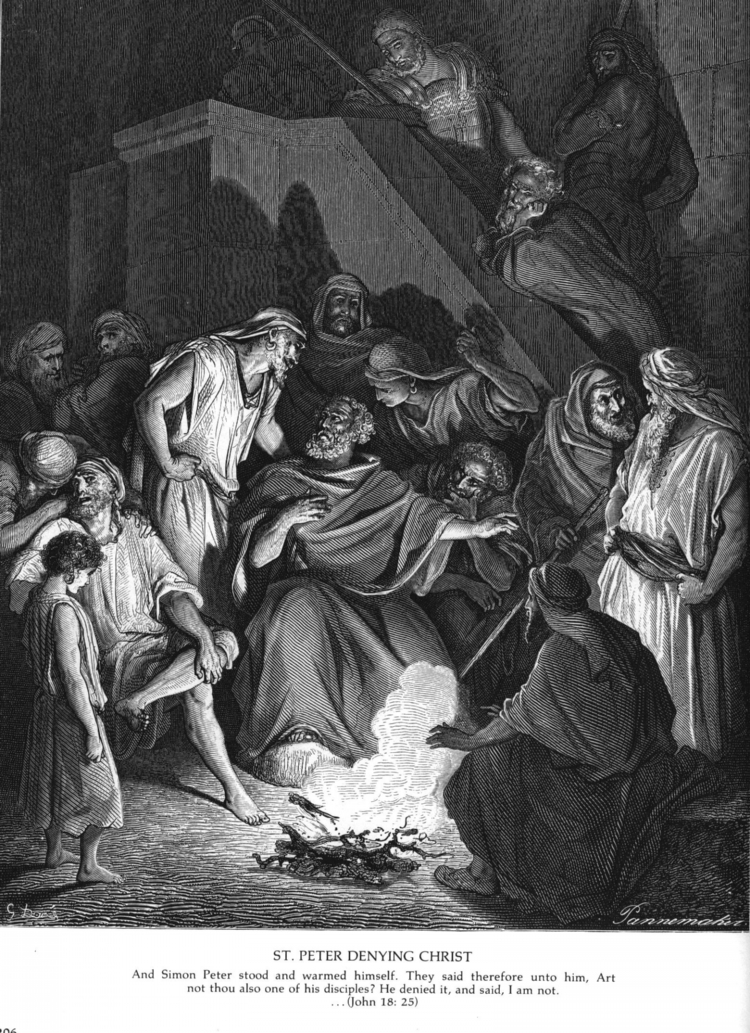
in John 18Now Simon Peter and another disciple were following Jesus. Since that disciple was known to the high priest, he also went with Jesus into the courtyard of the high priest.
BSB
The same verse in ASV and KJV ▾
ASV
And Simon Peter followed Jesus, and so did another disciple. Now that disciple was known unto the high priest, and entered in with Jesus into the court of the high priest;
KJV
And Simon Peter followed Jesus, and so did another disciple: that disciple was known unto the high priest, and went in with Jesus into the palace of the high priest.
⋯
This verse in John 18
Commentary
19 notes on this verseAnd Simon Peter followed Jesus,.... It is certain, he first fled with the rest, and forsook him, as they all did, notwithstanding his resolution to abide by him; however, he was very desirous to know what would become of Jesus, and what would be the issue of things; with this view he followed him, and not to deny him; though that was the consequence. Other evangelists say he followed him afar off, at a distance, Mat 26:58; which showed some fear; and yet to follow him at all discovered love and zeal.
This site's exposition
Simon Peter and another disciple
on John 18:15-18
The other disciple is known to the high priest, so his access gets Peter through the door. The servant girl at the door asks first, and Peter answers, I am not. In the garden Jesus said ego eimi, at the door Peter says ouk eimi.
The record, by era
The Church Fathers5 voices
"But Jesus was followed," he says, "by Simon Peter, and another disciple." Who that other disciple is, we cannot affirm with confidence, because it is left unnoticed here. But it is in this way that John usually refers to himself, with the addition, "whom Jesus loved." Perhaps, therefore, it is he also in the present case; but whoever it is, let us look at what follows. "And that disciple," he says, "was known unto the high priest, and went in with Jesus into the palace of the high priest; but Peter stood at the door without. Then went out that other disciple, who was known unto the high priest, and spake unto her that kept the door, and brought in Peter. Then saith the damsel that kept the door unto Peter, Art thou also one of this man's disciples? He saith, I am not." Lo, the pillar of greatest strength has at a single breath of air trembled to its foundations. Where is now all that boldness of the promiser, and his overweening confidence in himself beforehand? What now of those words, when he said, "Why cannot I follow Thee now? I will lay down my life for Thy sake." Is this the way to follow the Master, to deny his own discipleship? is it thus that one's life is laid down for the Lord, when one is frightened at a maid-servant's voice, lest it should compel us to the sacrifice? But what wonder, if God foretold what was true, and man presumptuously imagined what was false? Assuredly in this denial of the Apostle Peter, which had now entered on its first stage, we ought to take notice that not only is Christ denied by one who says that He is not Christ, but by him also who, while really a Christian, himself denies that he is so. For the Lord said not to Peter, Thou shall deny that thou art my disciple; but, "Thou shall deny me." Him, therefore, he denied, when he denied that he was His disciple. […]
The temptation of Peter, which took place during the time that the Lord was enduring these injuries, is not placed by all Evangelists in the same order. Matthew and Mark first narrate the injuries inflicted on the Lord and then this temptation of Peter. Luke first describes Peter's temptation, and only after this does he record the reproaches borne by the Lord. John begins with Peter's temptation but then introduces some verses that record what the Lord had to bear, appending the statement that the Lord was sent away from Annas to Caiaphas the high priest, and then at this point he resumes and sums up what he had been relating about Peter's temptation in the house to which Jesus was first conducted. He then gives a full account of that incident and thereafter reverts to the succession of events that happened to the Lord, telling us how Jesus was brought to Caiaphas.
(de Con. Evang. iii. vi) The temptation of Peter, which took place in the midst of the contumelies offered to our Lord, is not placed by all in the same order. Matthew and Mark put the contumelies first, the temptation of Peter afterwards; Luke the temptation first, the contumelies after. John begins with the temptation: And Simon Peter followed Jesus, and so did another disciple. (Tr. cxiii) Who that other disciple was we cannot hastily decide, as his name is not told us. John however is wont to signify himself by this expression, with the addition of, whom Jesus loved. Perhaps therefore he is the one.
A commentator
Cyril of AlexandriaCommentary on the Gospel of John, Book 11 · Written before 444.
proposed
And Simon Peter followed Jesus, and so did the other disciple. While the other disciples, it seems, were panic-stricken, and fled from the present wrath of the murderers, Peter, who was always moved thereto by more fervent passion, clings to his love for Christ, and follows Him at the peril of his life, and watches the issue of events; the other disciple accompanying him, and, with like courage, sustaining a similar resolution. This was John, the truly pious writer of this Divine work. For he calls himself that other disciple, without giving himself a definite name, fearing to seem boastful, and abhorring the appearance of being better than the rest. For the crowning achievements of virtue, if manifested by any of the righteous, yet are never blazoned forth to the world by their own mouth. For it very ill beseems a man to win praise rather out of his own mouth than the conversation of other men. In the Book of Proverbs it is written: Let another man praise thee, and not thine own mouth; a stranger, and not thine own lips.
"And Simon Peter followed Jesus, and so did another disciple." Who is that other disciple? It is the writer himself. "And wherefore doth he not name himself? When he lay on the bosom of Jesus, he with reason concealed his name; but now why doth he this?" For the same reason, for here too he mentions a great good deed, that when all had started away, he followed. Therefore he conceals himself, and puts Peter before him. He was obliged to mention himself, that thou mightest understand that he narrates more exactly than the rest what took place in the hall, as having been himself within. But observe how he detracts from his own praise; for, lest any one should ask, "How, when all had retreated, did this man enter in farther than Simon?" he saith, that he "was known to the high priest." So that no one should wonder that he followed, or cry him up for his manliness. But the wonder was that matter of Peter, that being in such fear, he came even as far as the hall, when the others had retreated.
12 more voices on this verse
The Church Fathers2 voices
His coming thither was caused by love, his not entering within by distress and fear. For the Evangelist hath recorded these things, to clear a way for excusing his denial; with regard to himself, he doth not set it down as any great matter that he was known to the high priest, but since he had said that he alone with Jesus went in, lest thou shouldest suppose that the action proceeded from any exalted feelings, he puts also the cause.
A commentator
Cyril of AlexandriaCommentary on the Gospel of John, Book 11 · Written before 444.
proposed
Now that disciple was known unto the high priest, and entered in with Jesus into the court of the high priest. The Apostle shows great forethought in condescending to mention this fact, and does not scruple to enter into detail where it is profitable for us. For, as he was about to set down in order in his book what was done and said in the palace of the high priest, he was, as it were, compelled to show us how he was able to enter there with Christ; for, he says, he was known unto the high priest.
The Medieval Church4 voices
"Now Simon Peter followed Jesus." Here he treats of Peter's denial, which he describes in this order. First is noted the occasion of the denial; second, the denial itself; third, from the denial, the cooling of love. The occasion of the denial was in this, …
He followed his Master out of devotion, though afar off, on account of fear.
2299 Now we see how the disciples joined Christ. First, how Peter and another disciple followed him; secondly, we see how they entered the place where Christ was; thirdly, how one denied him. 2300 In regard to the first he says, Simon Peter followed Jesus, …
Who was this other disciple? The very one who wrote about this, but he conceals himself out of humility. Since he wishes to highlight the virtue that he followed Jesus while the others fled, he therefore conceals himself and places Peter before himself. "Simon Peter …
The Puritans and the Awakening1 voice
Those that have a real kindness for Christ and his ways, though their temper may be reserved and their circumstances may lead them to be cautious and retired, yet, if their faith be sincere, they will discover, when they are called to it, which way their inclination lies, by being ready to do a professed disciple a good turn.
The Nineteenth Century4 voices
A commentator
Albert Barnes1798–1870
Notes, Explanatory and Practical, on the Old and New Testaments (1832-1869)
See the notes at Mat 26:57-58. Another disciple - Not improbably John. Some critics, however, have supposed that this disciple was one who dwelt at Jerusalem, and who, not being a Galilean, could enter the palace without suspicion. John, however, mentions the circumstance of his being known to them, to show why it was that he was not questioned as Peter was. It is not probable that any danger resulted from its being known that he was a follower of Jesus, or that any harm was meditated on them for this.
A commentator
J.C. Ryle1816–1900
Expository Thoughts on the Gospels: John (lightly modernized text, Grace Gems edition) (1869)
proposed
In this part of John's history of Christ's sufferings, three wonderful things stand out upon the surface of the narrative. To these three let us confine our attention. We should mark, for one thing, the amazing hardness of unconverted men. We see this in the conduct of the men by whom our Lord was taken prisoner. Some of them most probably were Roman soldiers, and some of them were Jewish servants of the priests and Pharisees. But in one respect they were all alike.
A commentator
J.C. Ryle1816–1900
Expository Thoughts on the Gospels: John (lightly modernized text, Grace Gems edition) (1869)
proposed
In this part of John's history of Christ's sufferings, three wonderful things stand out upon the surface of the narrative. To these three let us confine our attention. We should mark, for one thing, the amazing hardness of unconverted men. We see this in the conduct of the men by whom our Lord was taken prisoner. Some of them most probably were Roman soldiers, and some of them were Jewish servants of the priests and Pharisees. But in one respect they were all alike. Both parties saw our Lord's divine power exhibited, when they "went backward, and fell to the ground." Both saw a miracle, according to Luke's Gospel, when Jesus touched the ear of Malchus and healed him. Yet both remained unmoved, cold, indifferent and insensible, as if they had seen nothing out of the common way. They went on coolly with their odious business; "They took Jesus, bound Him, and led Him away." The degree of hardness and insensibility of conscience to which men may attain, when they live twenty or thirty years without the slightest contact with religion, is something dreadful and appalling. God and the things of God seem to sink out of sight and disappear from the mind's eye. The world and the things of the world seem to absorb the whole attention. In such cases we may well believe miracles would produce little or no effect, as in the case before us. The eye would gaze on them, like the eye of a beast looking at a romantic landscape, without any impression being made on the heart. He who thinks that seeing a miracle would convert him into a thorough Christian has got much to learn. Let us not wonder if we see cases of hardness and unbelief in our own day and generation. Such cases will continually be found among those classes of mankind, who from their profession or position are completely cut off from means of grace.
And - another disciple - Not That other disciple, for the article is omitted by AD, two others; some editions; Syriac, Persic, Gothic, and Nonnus. So the Vulgate is to be understood. There are many conjectures who this disciple was: Jerome, Chrysostom, Theophylact, Nonnus, Lyra, Erasmus, Piscator, and others, say it was John. It is true John frequently mentions himself in the third person; but then he has always, whom Jesus loved, as in Joh 13:23; Joh 19:26; Joh 21:7, Joh 21:20, except in Joh 19:35, where he has plainly pointed out himself as writer of this Gospel; but, in the place before us, he has mentioned no circumstance by which that disciple may be known to be John. To this may be added that John being not only a Galilean, but a fisherman by trade, it is not likely that he should have been known to the high priest, as it is here said of that disciple who followed Jesus with Peter. See Bishop Pearce and Calmet. The conjecture of Grotius is the most likely: viz. that it was the person at whose house Jesus had supped. St. Augustin, Tract. 113, speaks like a man of sound sense: We should not decide hastily, says he, on a subject concerning which the Scripture is silent.
Modern Voices1 voice
Let's begin with some things that we ought to know about John, but which we usually don't. John was very likely the Lord's first cousin on their mothers' side. John was a son of Zebedee, and his mother's name was Salome, which we can find …
The words behind it
26 Greek wordsEvery Greek word of this verse in the order it stands, with what it means and the door to its own study. The last column counts the times a word stands in the whole Bible: the rarer the word, the more the places it appears belong together.
| Greek | Sound | Meaning | Word study | In the Bible |
|---|---|---|---|---|
| Ἠκολούθει | ekolouthei | Were following | G190 → | 90 times |
| δὲ | de | now | G1161 → | 2765 times |
| τῷ | to | <the> | G3588 → | 19766 times |
| Ἰησοῦ | iesou | after Jesus | G2424 → | 908 times |
| Σίμων | simon | Simon | G4613 → | 75 times |
| Πέτρος | petros | Peter | G4074 → | 155 times |
| καὶ | kai | and | G2532 → | 9120 times |
| ἄλλος | allos | other | G243 → | 155 times |
| μαθητής. | mathetes | disciple. | G3101 → | 260 times |
| ὁ | ho | the | G3588 → | 19766 times |
| δὲ | de | Now | G1161 → | 2765 times |
| μαθητὴς | mathetes | disciple | G3101 → | 260 times |
| ἐκεῖνος | ekeinos | that [one] | G1565 → | 260 times |
| ἦν | en | was | G1510 → | 2333 times |
| γνωστὸς | gnostos | known | G1110 → | |
| τῷ | to | to the | G3588 → | 19766 times |
| ἀρχιερεῖ | archierei | high priest | G749 → | 122 times |
| καὶ | kai | also | G2532 → | 9120 times |
| συνεισῆλθεν | suneiselthen | he entered with | G4897 → | |
| τῷ | to | <the> | G3588 → | 19766 times |
| Ἰησοῦ | iesou | Jesus | G2424 → | 908 times |
| εἰς | eis | into | G1519 → | 1755 times |
| τὴν | ten | the | G3588 → | 19766 times |
| αὐλὴν | aulen | court | G833 → | 12 times |
| τοῦ | tou | of the | G3588 → | 19766 times |
| ἀρχιερέως.¶ | archiereos | high priest. | G749 → | 122 times |
ἨκολούθειWere following
ekoloutheiG190 →90 times
δὲnow
deG1161 →2765 times
τῷ<the>
toG3588 →19766 times
Ἰησοῦafter Jesus
iesouG2424 →908 times
ΣίμωνSimon
simonG4613 →75 times
ΠέτροςPeter
petrosG4074 →155 times
καὶand
kaiG2532 →9120 times
ἄλλοςother
allosG243 →155 times
μαθητής.disciple.
mathetesG3101 →260 times
ὁthe
hoG3588 →19766 times
δὲNow
deG1161 →2765 times
μαθητὴςdisciple
mathetesG3101 →260 times
ἐκεῖνοςthat [one]
ekeinosG1565 →260 times
ἦνwas
enG1510 →2333 times
γνωστὸςknown
gnostosG1110 →
τῷto the
toG3588 →19766 times
ἀρχιερεῖhigh priest
archiereiG749 →122 times
καὶalso
kaiG2532 →9120 times
συνεισῆλθενhe entered with
suneiselthenG4897 →
τῷ<the>
toG3588 →19766 times
ἸησοῦJesus
iesouG2424 →908 times
εἰςinto
eisG1519 →1755 times
τὴνthe
tenG3588 →19766 times
αὐλὴνcourt
aulenG833 →12 times
τοῦof the
touG3588 →19766 times
ἀρχιερέως.¶high priest.
archiereosG749 →122 times
A shaded row is a word that stands 400 times or fewer in the Bible.
The walk
8 stopsEach card is a verse this one points to, and under it the verses that one points to in turn. Where several paths arrive at the same place, that place is listed first: the text keeps returning to it.
Through
Matthew 26:3At that time the chief priests and elders of the people assembled in the courtyard of the high priest, whose name was Caiaphas,
it leads to
- John 18:24
Then Annas sent Him, still bound, to Caiaphas the high priest.
Reached by 2 separate paths from here.
- John 11:47–53
Then the chief priests and Pharisees convened the Sanhedrin and said, “What are we to do? This man is performing many signs.
- Mark 14:54
Peter followed Him at a distance, right into the courtyard of the high priest. And he sat with the officers and warmed himself by the fire.
- John 18:24
Through
Luke 22:54Then they seized Jesus, led Him away, and took Him into the house of the high priest. And Peter followed at a distance.
it leads to
- Mark 14:53–54
They led Jesus away to the high priest, and all the chief priests, elders, and scribes assembled.
- Matthew 26:57–58
Those who had arrested Jesus led Him away to the house of Caiaphas the high priest, where the scribes and elders had gathered.
- John 18:12–17
Then the band of soldiers, with its commander and the officers of the Jews, arrested Jesus and bound Him.
- 2 Chronicles 32:31
And so when ambassadors of the rulers of Babylon were sent to him to inquire about the wonder that had happened in the land, God left him alone to test him, that He might…
- Mark 14:53–54
Through
Mark 14:54Peter followed Him at a distance, right into the courtyard of the high priest. And he sat with the officers and warmed himself by the fire.
it leads to
- John 18:18
Because it was cold, the servants and officers were standing around a charcoal fire they had made to keep warm. And Peter was also standing with them, warming himself.
- John 18:18
Where this verse is studied
On this page
Studies18
On this verse
On this chapter
About John
This page draws on 16 works. Open the list of works
This page draws on Adam Clarke, Commentary on the Bible; Albert Barnes, Notes, Explanatory and Practical, on the Old and New Testaments (1832-1869); Alcuin of York, Catena Aurea by Aquinas; Augustine of Hippo, Tractates on John 113; Augustine of Hippo, HARMONY OF THE GOSPELS 3.6.21; Augustine of Hippo, Catena Aurea by Aquinas; Bonaventure, Commentary on John, Chapter 18; Cyril of Alexandria, Commentary on the Gospel of John, Book 11; Douglas Wilson, Surveying the Text: John; J. C. Ryle, Expository Thoughts on the Gospels, John; J.C. Ryle, Expository Thoughts on the Gospels: John (lightly modernized text, Grace Gems edition); John Chrysostom, Homily on the Gospel of John 83; John Gill, Exposition of the New Testament (1746-1748); Matthew Henry, Commentary on the Whole Bible; Theophylact of Ohrid, Commentary on John and Thomas Aquinas, Commentary on John.