
John 18:17
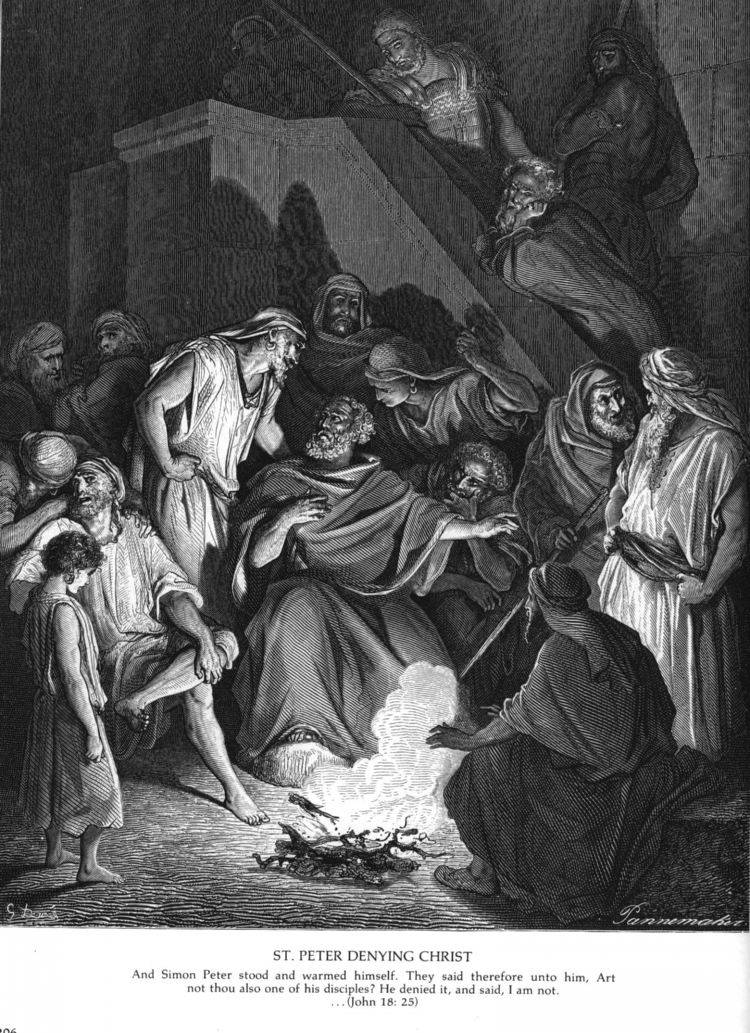
in John 18At this, the servant girl watching the door said to Peter, “Aren’t you also one of this man’s disciples?” “I am not,” he answered.
BSB
The same verse in ASV and KJV ▾
ASV
The maid therefore that kept the door saith unto Peter, Art thou also one of this man’s disciples? He saith, I am not.
KJV
Then saith the damsel that kept the door unto Peter, Art not thou also one of this man’s disciples? He saith, I am not.
⋯
This verse in John 18
Commentary
20 notes on this verseThe maid, therefore, that kept the door, saith unto Peter, Art thou also one of this Man's disciples? He saith, I am not. As Christ had already foretold to Peter that he would thrice deny our Saviour Christ, and that before the cock crew his faith would fail, the inspired Evangelist relates in detail where, and how, the prophecy was fulfilled. The maid, seated at the door, then, inquires of him whether he was not one of the number of the disciples of Him Who was undergoing the unjust trial.
This site's exposition
Simon Peter and another disciple
on John 18:15-18
The other disciple is known to the high priest, so his access gets Peter through the door. The servant girl at the door asks first, and Peter answers, I am not. In the garden Jesus said ego eimi, at the door Peter says ouk eimi.
This site's exposition
the servant girl watching the door
The first denial comes at the door. Cyril reads it as the first of the three denials Jesus foretold to Peter at 13:38. Augustine marks its form, for Peter denies Christ by denying that he is one of His disciples.
The record, by era
The Church Fathers5 voices
"But Jesus was followed," he says, "by Simon Peter, and another disciple." Who that other disciple is, we cannot affirm with confidence, because it is left unnoticed here. But it is in this way that John usually refers to himself, with the addition, "whom Jesus loved." Perhaps, therefore, it is he also in the present case; but whoever it is, let us look at what follows. "And that disciple," he says, "was known unto the high priest, and went in with Jesus into the palace of the high priest; but Peter stood at the door without. Then went out that other disciple, who was known unto the high priest, and spake unto her that kept the door, and brought in Peter. Then saith the damsel that kept the door unto Peter, Art thou also one of this man's disciples? He saith, I am not." Lo, the pillar of greatest strength has at a single breath of air trembled to its foundations. Where is now all that boldness of the promiser, and his overweening confidence in himself beforehand? What now of those words, when he said, "Why cannot I follow Thee now? I will lay down my life for Thy sake." Is this the way to follow the Master, to deny his own discipleship? is it thus that one's life is laid down for the Lord, when one is frightened at a maid-servant's voice, lest it should compel us to the sacrifice? But what wonder, if God foretold what was true, and man presumptuously imagined what was false? Assuredly in this denial of the Apostle Peter, which had now entered on its first stage, we ought to take notice that not only is Christ denied by one who says that He is not Christ, but by him also who, while really a Christian, himself denies that he is so. For the Lord said not to Peter, Thou shall deny that thou art my disciple; but, "Thou shall deny me." Him, therefore, he denied, when he denied that he was His disciple. […]
(Tr. cxiii) But what wonder, if God foretold truly, man presumed falsely. Respecting this denial of Peter we should remark, that Christ is not only denied by him, who denies that He is Christ, but by him also who denies himself to be a Christian. For the Lord did not say to Peter, Thou shalt deny that thou art My disciple, but, Thou shalt deny Me. (Luke 22:34) He denied Him then, when he denied that he was His disciple. And what was this but to deny that he was a Christian? How many afterwards, even boys and girls, were able to despise death, confess Christ, and enter courageously into the kingdom of heaven; which he who received the keys of the kingdom, was now unable to do? Wherein we see the reason for His saying above, Let these go their way, for of those which Thou hast given Me, have I lost none. If Peter had gone out of this world immediately after denying Christ, He must have been lost.
For although the disciples of Christ were not yet called by such a name,-because it was after His ascension, in Antioch, first that the disciples began to be called Christians,-yet the thing itself, that afterwards assumed such a name, already existed, those who were afterwards called Christians were already disciples; and this common name, like the common faith, they transmitted to their posterity. He, therefore, who denied that he was Christ's disciple, denied the reality of the thing, of which the being called a Christian was only the name. How many afterwards, not to speak of old men and women, whose satiated feelings as regards the present life might more easily enable them to brave death for the confession of Christ; and not merely the youth of both sexes, when of an age at which the exercise of fortitude seems to be fairly required; but even boys and girls could do-even as an innumerable company of holy martyrs with brave hearts and by a violent death entered the kingdom of heaven-what at that moment he was unable to do, who received the keys of that kingdom. It is here we see why it was said, "Let these go their way," when He, who hath redeemed us by His own blood, gave Himself for us; that the saying which He spake might be fulfilled, "Of those whom Thou hast given me I have lost none." For assuredly, had Peter gone hence after denying the Christ, what else would have awaited him but destruction?
Peter had once almost been lost and taken away from the consecration of the apostolic number by the instigation of the devil through the mouth of the maidservant of the high priest. But when Jesus simply looked on him and turned toward him the lines of his gentle face, he immediately came to himself and, recovering his footing, wept bitterly. Peter, looked on by God in this way, recovered by weeping his place that he had lost by denying.
Peter was permitted to be the first to fall, in order that he might be less severe to sinners from the remembrance of his own fall.… Peter, the teacher and master of the whole world, sinned, and he obtained pardon in order that judges might from there on out have that rule to go by in dispensing pardon.… For this reason I suppose the priesthood was not given to angels. Otherwise, being without sin themselves, they would punish the sins of the people without pity. Rather, man [a human being] is placed over man in order that remembering his own sin, he may be merciful to others who are sinners.
12 more voices on this verse
The Church Fathers2 voices
"Art not thou also one of this man's disciples? And he saith, I am not." What sayest thou, Peter? Didst thou not declare but now, "If need be that I lay down my life for Thee, I will lay it down"? What hath happened then, that thou canst not even endure the questioning of a door-keeper? Is it a soldier who questions thee? Is it one of those who seized Him? No, it is a mean and abject door-keeper, nor is the questioning of a rough kind. She saith not, "Art thou a disciple of that cheat and corrupter," but, "of that man," which was the expression rather of one pitying and relenting. But Peter could not bear any of these words. The, "Art not thou also," is said on this account, that John was within. So mildly did the woman speak. But he perceived none of this, nor took it into his mind, neither the first time, nor the second, nor the third, but when the cock crew; nor did this even bring him to his senses, till Jesus gave him the bitter look. And he stood warming himself with the servants of the high priest, but Christ was kept bound within. This we say not as accusing Peter, but showing the truth of what had been said by Christ.
A commentator
Romanos the MelodistKONTAKION ON PETER'S DENIAL 34, PROOIMION 1-3 · Written before 555.
proposed
O Good Shepherd, you who have placed his Spirit among the flocks, Hurry, save your sheep, O Holy One. Forgetful of the fearful waves And transformed by the remark of the maiden, Peter said, "Christ, God, when I was sinking into the depths of the …
The Medieval Church4 voices
Some however foolishly favour Peter, so far as to say that he denied Christ, because he did not wish to be away from Christ, and he knew, they say, that if he confessed that he was one of Christ's disciples, he would be separated from Him, and would no longer have the liberty of following and seeing his beloved Lord; and therefore pretended to be one of the servants, that his sad countenance might not be perceived, and so exclude him: And the servants and officers stood there, who had made a fire of coals, and warmed themselves; and Peter stood with them, and warmed himself.
"The doorkeeper said to Peter." Here is described the second, namely the denial proceeding from weakness; and this is evident in this, that Peter denied the Lord at the voice of a maidservant. Therefore the inquiry of the maidservant is introduced: "Are you not also …
2307 Now we see the denial of Peter: first, the circumstances or the incitement of his denial; secondly the denial itself (v 17b); thirdly, Peter strengthens his denial (v 18). 2308 The circumstances and incitement of his denial was the question of the maid who …
The woman asks Peter without audacity, without rudeness, but very meekly. For she did not say "are you not also one of the disciples of this deceiver," but rather "of this Man," and these were more the words of one who felt pity and compassion …
The Puritans and the Awakening2 voices
Suppose the servants had ridiculed him, and insulted over him, upon it, those can bear but little for Christ that cannot bear this; this is but running with the footmen. (2.) How speedy the surrender was.
Then saith the damsel that kept the door unto Peter,....
The Nineteenth Century4 voices
The damsel that kept the door - Caezarius, a writer quoted by Calmet, says this portress was named Ballila. It is worthy of remark that women, especially old women, were employed by the ancients as porters. In 2Sa 4:6, both the Septuagint and Vulgate make a woman porter to Ishbosheth. Aristophanes, in Vespis, v. 765, mentions them in the same office and calls them Σηκις, Sekis, which seems to signify a common maid-servant: - Ὁτι την θυραν ανεῳξεν ἡ Σηκις λαθρα.
A commentator
Jamieson, Fausset & Brown1802–1910
Commentary Critical and Explanatory on the Whole Bible (1871)
Art thou not also one of this man's disciples?--that is, thou as well as "that other disciple," whom she knew to be one, but did not challenge, perceiving that he was a privileged person.
A commentator
J.C. Ryle1816–1900
Expository Thoughts on the Gospels: John (lightly modernized text, Grace Gems edition) (1869)
proposed
In this part of John's history of Christ's sufferings, three wonderful things stand out upon the surface of the narrative. To these three let us confine our attention. We should mark, for one thing, the amazing hardness of unconverted men. We see this in the conduct of the men by whom our Lord was taken prisoner. Some of them most probably were Roman soldiers, and some of them were Jewish servants of the priests and Pharisees. But in one respect they were all alike.
A commentator
J.C. Ryle1816–1900
Expository Thoughts on the Gospels: John (lightly modernized text, Grace Gems edition) (1869)
proposed
In this part of John's history of Christ's sufferings, three wonderful things stand out upon the surface of the narrative. To these three let us confine our attention. We should mark, for one thing, the amazing hardness of unconverted men. We see this in the conduct of the men by whom our Lord was taken prisoner. Some of them most probably were Roman soldiers, and some of them were Jewish servants of the priests and Pharisees. But in one respect they were all alike. Both parties saw our Lord's divine power exhibited, when they "went backward, and fell to the ground." Both saw a miracle, according to Luke's Gospel, when Jesus touched the ear of Malchus and healed him. Yet both remained unmoved, cold, indifferent and insensible, as if they had seen nothing out of the common way. They went on coolly with their odious business; "They took Jesus, bound Him, and led Him away." The degree of hardness and insensibility of conscience to which men may attain, when they live twenty or thirty years without the slightest contact with religion, is something dreadful and appalling. God and the things of God seem to sink out of sight and disappear from the mind's eye. The world and the things of the world seem to absorb the whole attention. In such cases we may well believe miracles would produce little or no effect, as in the case before us. The eye would gaze on them, like the eye of a beast looking at a romantic landscape, without any impression being made on the heart. He who thinks that seeing a miracle would convert him into a thorough Christian has got much to learn. Let us not wonder if we see cases of hardness and unbelief in our own day and generation. Such cases will continually be found among those classes of mankind, who from their profession or position are completely cut off from means of grace.
The words behind it
22 Greek wordsEvery Greek word of this verse in the order it stands, with what it means and the door to its own study. The last column counts the times a word stands in the whole Bible: the rarer the word, the more the places it appears belong together.
| Greek | Sound | Meaning | Word study | In the Bible |
|---|---|---|---|---|
| λέγει | legei | Says | G3004 → | 1325 times |
| οὖν | oun | therefore | G3767 → | 497 times |
| τῷ | to | <the> | G3588 → | 19766 times |
| Πέτρῳ | petro | to Peter | G4074 → | 155 times |
| ἡ | he | the | G3588 → | 19766 times |
| παιδίσκη | paidiske | servant girl | G3814 → | |
| ἡ | he | the | G3588 → | 19766 times |
| θυρωρός· | thuroros | doorkeeper: | G2377 → | 4 times |
| μὴ | me | Surely | G3361 → | 1066 times |
| καὶ | kai | also | G2532 → | 9120 times |
| σὺ | su | you yourself | G4771 → | 2973 times |
| ἐκ | ek | of | G1537 → | 911 times |
| τῶν | ton | the | G3588 → | 19766 times |
| μαθητῶν | matheton | disciples | G3101 → | 260 times |
| εἶ | ei | are | G1510 → | 2333 times |
| τοῦ | tou | of the | G3588 → | 19766 times |
| ἀνθρώπου | anthropou | man | G444 → | 549 times |
| τούτου; | toutou | this? | G3778 → | 1381 times |
| λέγει | legei | Says | G3004 → | 1325 times |
| ἐκεῖνος· | ekeinos | he; | G1565 → | 260 times |
| οὐκ | ouk | Not | G3756 → | 1664 times |
| εἰμί. | eimi | I am. | G1510 → | 2333 times |
λέγειSays
legeiG3004 →1325 times
οὖνtherefore
ounG3767 →497 times
τῷ<the>
toG3588 →19766 times
Πέτρῳto Peter
petroG4074 →155 times
ἡthe
heG3588 →19766 times
παιδίσκηservant girl
paidiskeG3814 →
ἡthe
heG3588 →19766 times
θυρωρός·doorkeeper:
thurorosG2377 →4 times
μὴSurely
meG3361 →1066 times
καὶalso
kaiG2532 →9120 times
σὺyou yourself
suG4771 →2973 times
ἐκof
ekG1537 →911 times
τῶνthe
tonG3588 →19766 times
μαθητῶνdisciples
mathetonG3101 →260 times
εἶare
eiG1510 →2333 times
τοῦof the
touG3588 →19766 times
ἀνθρώπουman
anthropouG444 →549 times
τούτου;this?
toutouG3778 →1381 times
λέγειSays
legeiG3004 →1325 times
ἐκεῖνος·he;
ekeinosG1565 →260 times
οὐκNot
oukG3756 →1664 times
εἰμί.I am.
eimiG1510 →2333 times
A shaded row is a word that stands 400 times or fewer in the Bible.
The walk
8 stopsEach card is a verse this one points to, and under it the verses that one points to in turn. Where several paths arrive at the same place, that place is listed first: the text keeps returning to it.
Through
Luke 22:54Then they seized Jesus, led Him away, and took Him into the house of the high priest. And Peter followed at a distance.
it leads to
- Mark 14:53–54
They led Jesus away to the high priest, and all the chief priests, elders, and scribes assembled.
- Matthew 26:57–58
Those who had arrested Jesus led Him away to the house of Caiaphas the high priest, where the scribes and elders had gathered.
- John 18:12–17
Then the band of soldiers, with its commander and the officers of the Jews, arrested Jesus and bound Him.
- John 18:24
Then Annas sent Him, still bound, to Caiaphas the high priest.
- 2 Chronicles 32:31
And so when ambassadors of the rulers of Babylon were sent to him to inquire about the wonder that had happened in the land, God left him alone to test him, that He might…
- Mark 14:53–54
Through
Matthew 26:33Peter said to Him, “Even if all fall away on account of You, I never will.”
it leads to
- Luke 22:33
“Lord,” said Peter, “I am ready to go with You even to prison and to death.”
- Luke 22:33
Through
John 18:25Simon Peter was still standing and warming himself. So they asked him, “Aren’t you also one of His disciples?” He denied it and said, “I am not.”
it leads to
- Mark 14:67–72
and saw him warming himself there. She looked at Peter and said, “You also were with Jesus the Nazarene.”
- John 18:17–18
At this, the servant girl watching the door said to Peter, “Aren’t you also one of this man’s disciples?” “I am not,” he answered.
- Mark 14:67–72
Where this verse is studied
On this page
Studies11
On this verse
About John
This page draws on 17 works. Open the list of works
This page draws on Adam Clarke, Commentary on the Bible; Augustine of Hippo, Catena Aurea by Aquinas; Augustine of Hippo, Tractates on John 113; Bonaventure, Commentary on John, Chapter 18; Cyril of Alexandria, Commentary on the Gospel of John, Book 11; J. C. Ryle, Expository Thoughts on the Gospels, John; J.C. Ryle, Expository Thoughts on the Gospels: John (lightly modernized text, Grace Gems edition); Jamieson, Fausset & Brown, Commentary Critical and Explanatory on the Whole Bible; John Chrysostom, SERMON ON ST. PETER AND ELIJAH 1; John Chrysostom, Homily on the Gospel of John 83; John Gill, Exposition of the New Testament (1746-1748); Matthew Henry, Commentary on the Whole Bible; Origen of Alexandria, HOMILIES ON LEVITICUS 16.7.3; Romanos the Melodist, KONTAKION ON PETER'S DENIAL 34, PROOIMION 1-3; Theophylact of Ohrid, Catena Aurea by Aquinas; Theophylact of Ohrid, Commentary on John and Thomas Aquinas, Commentary on John.