
John 18:27
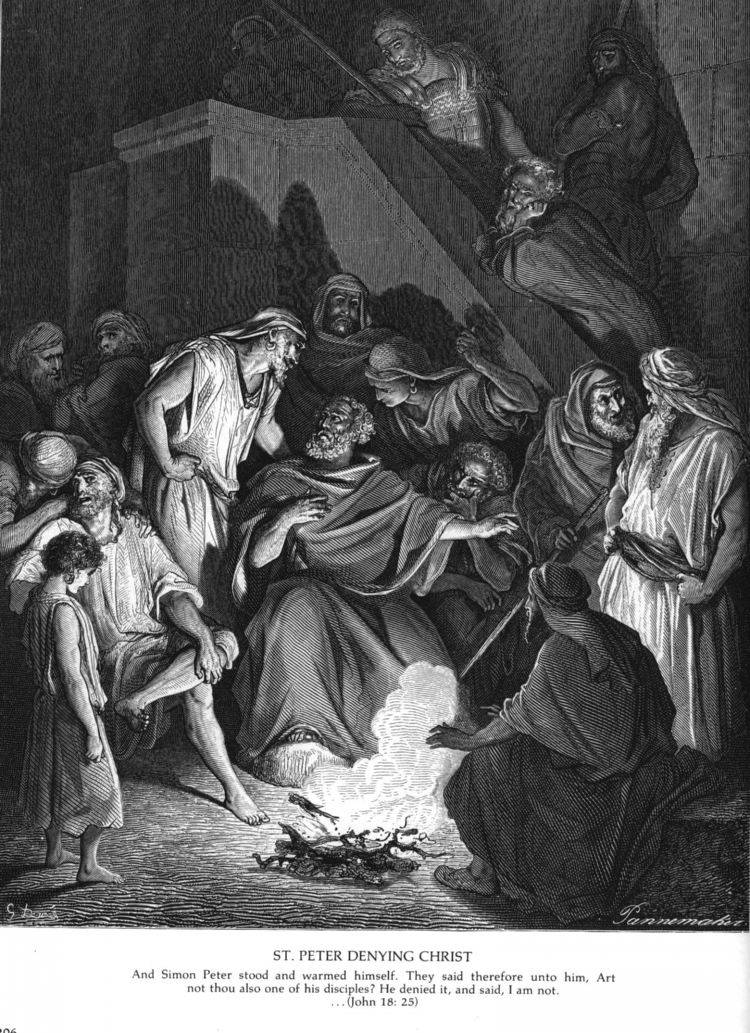
in John 18Peter denied it once more, and immediately a rooster crowed.
BSB
The same verse in ASV and KJV ▾
ASV
Peter therefore denied again: and straightway the cock crew.
KJV
Peter then denied again: and immediately the cock crew.
⋯
This verse in John 18
Commentary
18 notes on this verseFor it was the bounden duty of the wise Evangelist to make mention of such things, that his hearers might know what even the teachers of the world were in themselves before Christ's Resurrection, and before the Holy Spirit descended upon them; and what they were thereafter, when they had received the grace of the Spirit, Which Christ called power from on high. For any one may see how very jealous they were in assuming virtue; how readily they girded up their loins to follow Christ, and to overcome perils of every sort which they so frequently encountered.
This site's exposition
still standing and warming himself
on John 18:25-27
Peter is still at the fire when the second question comes, and he denied it again. The third comes from a relative of the man whose ear he had cut off, who had seen him in the garden. A rooster crowed at once, as Jesus had said at John 13:38.
This site's exposition
Peter denied it once more
Peter denied Jesus once more, and a rooster crowed. Luke 22:62 tells of his tears, and Gill notes from the other Gospels that Peter denied Him the third time with cursing. Bonaventure quotes Augustine, that the prediction of Jesus was fulfilled and the presumption of Peter convicted.
The record, by era
The Church Fathers5 voices
(Tr. cxiii) Lo, the prophecy of the Physician is fulfilled, the presumption of the sick man demonstrated. That which Peter had said he would do, he had not done. I will lay down my life for Thy sake; but what our Lord had foretold had come to pass, Thou shall deny Me thrice. (Luke 22:34)
(de Con. Evang. iii. 6) Here we find Peter not at the gate, but at the fire, when he denies the second time: so that he must have returned after he had gone out of doors, where Matthew says he was. He did not go out, and another damsel see him on the outside, but another damsel saw him as he was rising to go out, and remarked him, and told those who were by, i. e. those who were standing with her at the fire inside the hall, This fellow also was with Jesus of Nazareth. (Matt. 26:71, 72) He heard this outside, and returned, and swore, I do not know the man. Then John continues: They said therefore unto him, Art not thou also one of His disciples? which words we suppose to have been said to him when he had come back, and was standing at the fire. And this explanation is confirmed by the fact, that besides the other damsel mentioned by Matthew and Mark in the second denial, there was another person, mentioned by Luke, who also questioned him. So John uses the plural: They said therefore unto him. And then follows the third denial: One of the servants of the high priest, being his kinsman whose ear Peter cut off, saith, Did not I see thee in the garden with Him? That Matthew and Mark speak of the party who here question Peter in the plural number, whereas Luke mentions only one, and John also, adding that that one was the kinsman of him whose ear Peter cut off, is easily explained by supposing that Matthew and Mark used the plural number by a common form of speech for the singular; or that one who had observed him most strictly put the question first, and others followed it up, and pressed Peter with more.
But the evangelist, after saying that Annas sent Him bound unto Caiaphas, returns to the place of his narrative, where he had left Peter, in order to explain what had taken place in Annas' house in regard to his threefold denial. "But Peter was standing," he says, "and warming himself." He thus repeats what he had already stated before; and then adds what follows. "They said therefore unto him, Art thou also one of his disciples? He denied, and said, I am not." He had already denied once; this is the second time. And then, that the third denial might also be fulfilled, "one of the servants of the high priest, being his kinsman whose ear Peter cut off, saith, Did I not see thee in the garden with him? Peter then denied again, and immediately the cock crew." Behold, the prediction of the Physician is fulfilled, the presumption of the sick man is brought to the light. For there is no performance of what the latter had asserted, "I will lay down my life for Thy sake;" but a performance of what the former had predicted, "Thou shall thrice deny me."
Then saith "the kinsman of him whose ear Peter cut off, (grieving at what had taken place,) Did I not see thee in the garden?" But neither did the garden bring him to remember what had taken place, nor the great affection which Jesus there had shown by those words, but all these from pressure of anxiety he banished from his mind. But why have the Evangelists with one accord written concerning him? Not as accusing the disciple, but as desiring to teach us, how great an evil it is not to commit all to God, but to trust to one's self. But do thou admire the tender care of his Master, who, though a prisoner and bound, took great forethought for His disciple, raising Peter up, when he was down, by His look, and launching him into a sea of tears.
Consider that when Peter sat outside, separated from Jesus while he was in the court of the high priest, he denied Jesus before everyone. And again a second time he denied him in the same way, not having gone outside the door but wanting to go out, yet still not having gone out. But also the third time, when those who stood by said, "Truly you are one of them" and he began to call a curse on himself and swore, "I do not know the man," he was still not outside. And notice that all of his denials were made in the night and in the darkness before the coming of the day and the sign of day, that is, the rooster crowing, which wakes up those who are willing from their sleep. And I may say that if Peter had denied after the rooster crowed—when it might be said "the night is far spent, the day is at hand, let us walk honorably as in the day"—Peter would have deserved no excuse. But perhaps when anyone denies Jesus in such a way that the sin of denial may admit of healing, that person too appears to deny him before the rooster crows, since the Sun of righteousness has not yet been born to them, nor have they drawn near to his rising.
10 more voices on this verse
The Medieval Church4 voices
2327 Now he mentions the sign given by Christ which Peter recalled. And at once the cock crowed, moved by God's power, so that the prediction of the physician would be fulfilled and to demonstrate the presumption of the one who was sick.
Mystically, by the first denial of Peter are denoted those who before our Lord's Passion denied that He was God, by the second, those who did so after His resurrection. So by the first crowing of the cock His resurrection is signified; by the second, the general resurrection at the end of the world. By the first damsel, who obliged Peter to deny, is denoted lust, by the second, carnal delight: by one or more servants, the devils who persuade men to deny Christ.
And Peter, the ardent lover, is overcome by such insensibility that they have already led the Teacher away, yet he still does not move from his place and warms himself, so that he is questioned again, and he denies Him — and not only a …
"Then Peter denied again." Here the denial of Peter is completed, because it was threefold: and as a sign of its completion it is added: "And immediately the cock crowed." Augustine: "Behold, the Physician's prediction is fulfilled, the sick man's presumption is convicted. For what …
The Puritans and the Awakening1 voice
Peter then denied again,.... A third time, as the Ethiopic version renders it; and that, according to other evangelists, with cursing and swearing; for now he was more affrighted than before, lest should he be taken up, and it be proved upon him, that he was the person that cut off Malchus's ear, he should be sentenced to a fine, or it may be some capital punishment.
The Nineteenth Century5 voices
And - the cock crew - Peter denied our Lord three times: - Peter’s First Denial. I. This took place, when he was without, or beneath, in the hall of Caiaphas’s house. He was not in the higher part where Christ stood before the high priest; but without that division of the hall, and in the lower part with the servants and officers, at the fire kindled in the midst of the hall, Joh 18:16, Joh 18:18; and the girl who kept the door had entered into the hall, where she charged Peter. Peter’s Second Denial. II.
A commentator
Jamieson, Fausset & Brown1802–1910
Commentary Critical and Explanatory on the Whole Bible (1871)
Annas, declining to meddle with the case, having sent Him to Caiaphas at once. But the words here literally are, "Annas sent Him [not 'had sent Him'] to Caiaphas"--and the "now" being of doubtful authority. Thus read, the verse affords no evidence that He was sent to Caiaphas before the interview just recorded, but implies rather the contrary.
A commentator
Jamieson, Fausset & Brown1802–1910
Commentary Critical and Explanatory on the Whole Bible (1871)
proposed
(See on Mr 14:53-65). [The notes broken off there at Mr 14:54 are here concluded]. Mr 14:53-65: Mr 14:61: The high priest asked Him, Art Thou the Christ, the Son of the blessed?--Matthew says the high priest put Him upon solemn oath, saying, "I adjure Thee by the living God that Thou tell us whether Thou be the Christ, the Son of God" (Mt 26:63).
A commentator
J.C. Ryle1816–1900
Expository Thoughts on the Gospels: John (lightly modernized text, Grace Gems edition) (1869)
proposed
In this part of John's history of Christ's sufferings, three wonderful things stand out upon the surface of the narrative. To these three let us confine our attention. We should mark, for one thing, the amazing hardness of unconverted men. We see this in the conduct of the men by whom our Lord was taken prisoner. Some of them most probably were Roman soldiers, and some of them were Jewish servants of the priests and Pharisees. But in one respect they were all alike.
A commentator
J.C. Ryle1816–1900
Expository Thoughts on the Gospels: John (lightly modernized text, Grace Gems edition) (1869)
proposed
In this part of John's history of Christ's sufferings, three wonderful things stand out upon the surface of the narrative. To these three let us confine our attention. We should mark, for one thing, the amazing hardness of unconverted men. We see this in the conduct of the men by whom our Lord was taken prisoner. Some of them most probably were Roman soldiers, and some of them were Jewish servants of the priests and Pharisees. But in one respect they were all alike. Both parties saw our Lord's divine power exhibited, when they "went backward, and fell to the ground." Both saw a miracle, according to Luke's Gospel, when Jesus touched the ear of Malchus and healed him. Yet both remained unmoved, cold, indifferent and insensible, as if they had seen nothing out of the common way. They went on coolly with their odious business; "They took Jesus, bound Him, and led Him away." The degree of hardness and insensibility of conscience to which men may attain, when they live twenty or thirty years without the slightest contact with religion, is something dreadful and appalling. God and the things of God seem to sink out of sight and disappear from the mind's eye. The world and the things of the world seem to absorb the whole attention. In such cases we may well believe miracles would produce little or no effect, as in the case before us. The eye would gaze on them, like the eye of a beast looking at a romantic landscape, without any impression being made on the heart. He who thinks that seeing a miracle would convert him into a thorough Christian has got much to learn. Let us not wonder if we see cases of hardness and unbelief in our own day and generation. Such cases will continually be found among those classes of mankind, who from their profession or position are completely cut off from means of grace.
The words behind it
8 Greek wordsEvery Greek word of this verse in the order it stands, with what it means and the door to its own study. The last column counts the times a word stands in the whole Bible: the rarer the word, the more the places it appears belong together.
| Greek | Sound | Meaning | Word study | In the Bible |
|---|---|---|---|---|
| πάλιν | palin | Again | G3825 → | 139 times |
| οὖν | oun | then | G3767 → | 497 times |
| ἠρνήσατο | ernesato | denied | G720 → | 33 times |
| Πέτρος, | petros | Peter, | G4074 → | 155 times |
| καὶ | kai | and | G2532 → | 9120 times |
| εὐθέως | eutheos | immediately | G2112 → | 87 times |
| ἀλέκτωρ | alektor | a rooster | G220 → | |
| ἐφώνησεν.¶ | ephonesen | crowed. | G5455 → | 43 times |
πάλινAgain
palinG3825 →139 times
οὖνthen
ounG3767 →497 times
ἠρνήσατοdenied
ernesatoG720 →33 times
Πέτρος,Peter,
petrosG4074 →155 times
καὶand
kaiG2532 →9120 times
εὐθέωςimmediately
eutheosG2112 →87 times
ἀλέκτωρa rooster
alektorG220 →
ἐφώνησεν.¶crowed.
ephonesenG5455 →43 times
A shaded row is a word that stands 400 times or fewer in the Bible.
The walk
8 stopsEach card is a verse this one points to, and under it the verses that one points to in turn. Where several paths arrive at the same place, that place is listed first: the text keeps returning to it.
Through
John 13:38“Will you lay down your life for Me?” Jesus replied. “Truly, truly, I tell you, before the rooster crows, you will deny Me three times.
it leads to
- Luke 22:34
But Jesus replied, “I tell you, Peter, the rooster will not crow today until you have denied three times that you know Me.”
Reached by 2 separate paths from here.
- Matthew 26:34
“Truly I tell you,” Jesus declared, “this very night, before the rooster crows, you will deny Me three times.”
- Mark 14:30
“Truly I tell you,” Jesus replied, “this very night, before the rooster crows twice, you will deny Me three times.”
- Proverbs 16:18
Pride goes before destruction, and a haughty spirit before a fall.
- Luke 22:56–62
A servant girl saw him seated in the firelight and looked intently at him. “This man also was with Him,” she said.
- Luke 22:34
Through
Matthew 26:34“Truly I tell you,” Jesus declared, “this very night, before the rooster crows, you will deny Me three times.”
it leads to
- John 13:38
“Will you lay down your life for Me?” Jesus replied. “Truly, truly, I tell you, before the rooster crows, you will deny Me three times.
- Matthew 26:75
Then Peter remembered the word that Jesus had spoken: “Before the rooster crows, you will deny Me three times.” And he went outside and wept bitterly.
- Mark 14:30–31
“Truly I tell you,” Jesus replied, “this very night, before the rooster crows twice, you will deny Me three times.”
- John 13:38
Where this verse is studied
On this page
Studies11
On this verse
About John
This page draws on 15 works. Open the list of works
This page draws on Adam Clarke, Commentary on the Bible; Augustine of Hippo, Catena Aurea by Aquinas; Augustine of Hippo, Tractates on John 113; Bede, Catena Aurea by Aquinas; Bonaventure, Commentary on John, Chapter 18; Cyril of Alexandria, Commentary on the Gospel of John, Book 12; J.C. Ryle, Expository Thoughts on the Gospels: John (lightly modernized text, Grace Gems edition); Jamieson, Fausset & Brown, Commentary Critical and Explanatory on the Whole Bible; John Chrysostom, Homily on the Gospel of John 83; John Gill, Exposition of the New Testament; John Gill, Exposition of the New Testament (1746-1748); Matthew Henry, Commentary on the Whole Bible; Origen of Alexandria, COMMENTARY ON MATTHEW 114; Theophylact of Ohrid, Commentary on John and Thomas Aquinas, Commentary on John.