
John 18:18
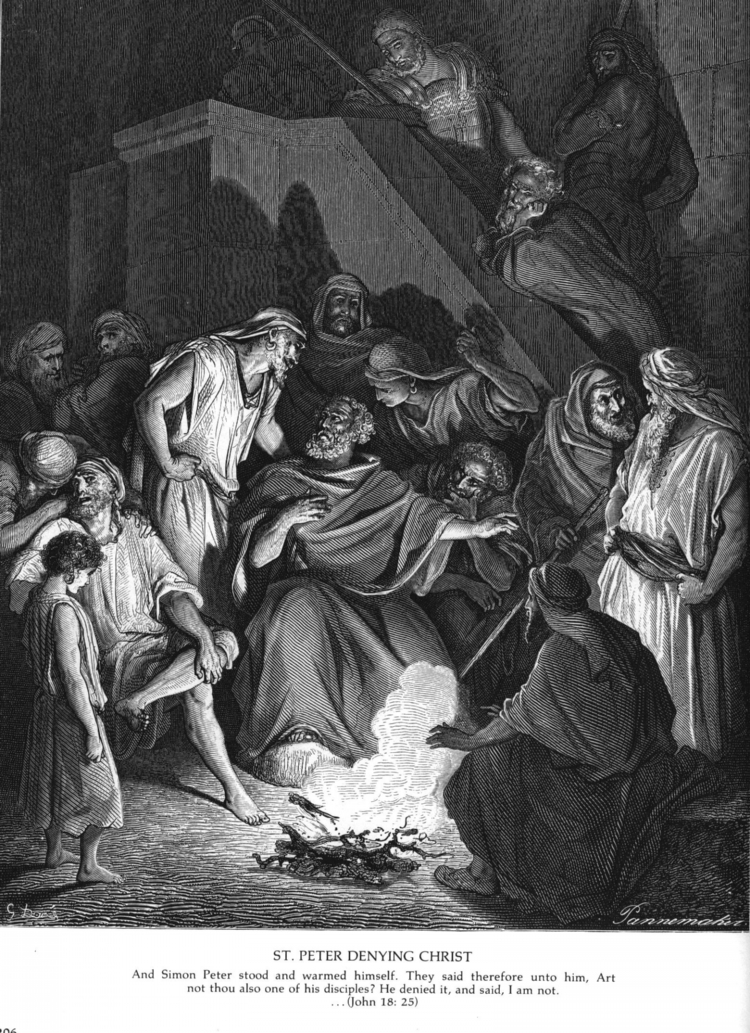
in John 18Because it was cold, the servants and officers were standing around a charcoal fire they had made to keep warm. And Peter was also standing with them, warming himself.
BSB
The same verse in ASV and KJV ▾
ASV
Now the servants and the officers were standing there, having made a fire of coals; for it was cold; and they were warming themselves: and Peter also was with them, standing and warming himself.
KJV
And the servants and officers stood there, who had made a fire of coals; for it was cold: and they warmed themselves: and Peter stood with them, and warmed himself.
⋯
This verse in John 18
Commentary
20 notes on this verseLet us also consider in what state he denied. "It was cold," he says. If we consider the temperature, it could not have been cold: but it was cold where Jesus was not recognized, where there was no one to see the light, where the consuming fire was denied. Therefore, it was cold of the mind, not of the body. In the end, Peter was standing by the coals, because he was chilled by emotion. The Jewish flame is wicked: it burns, not warms.
This site's exposition
Simon Peter and another disciple
on John 18:15-18
The other disciple is known to the high priest, so his access gets Peter through the door. The servant girl at the door asks first, and Peter answers, I am not. In the garden Jesus said ego eimi, at the door Peter says ouk eimi.
This site's exposition
a charcoal fire they had made
The night was cold, though it was Passover. Ambrose reads the cold as the chill of a heart standing where Jesus went unacknowledged. A charcoal fire appears again at 21:9, beside the lake where Peter is restored.
The record, by era
The Church Fathers4 voices
(Tr. cxiii) It was not winter, and yet it was cold, as it often is at the vernal equinox.
"And the servants and officers stood beside the fire of burning coals, for it was cold, and warmed themselves." Though it was not winter, it was cold: which is sometimes wont to be the case even at the vernal equinox. "And Peter was standing with them, and warming himself."
See how clearly this description of the day of our Savior's passion, a day in which "there shall be no light," was fulfilled, since "from the sixth hour to the ninth hour there was darkness over all the earth." And also the "frost and cold," since according to Luke: "They led Jesus to the palace of the high priest. And Peter followed afar off. And while they kindled a fire in the midst of the hall, he sat down," according to Mark, with the others to warm himself. And John, too, especially mentions the cold, saying, "The servants and the ministers stood, having made a fire of coals, for it was cold, and they warmed themselves." And this day, he says, was known to the Lord and was not night. It was not day, because, as has been said already, "there shall be no light." This was fulfilled when "from the sixth hour there was darkness over all the earth until the ninth hour." Nor was it night, because "at eventide it shall be light" was added, which also was fulfilled when the day regained its natural light after the ninth hour.
A commentator
Cyril of AlexandriaCommentary on the Gospel of John, Book 11 · Written before 444.
proposed
Now the servants and the officers were standing there, having made a fire of coals; for it was cold, and they were warming themselves: and Peter also was with them, standing and warming himself. Peter, having passed inside the door, and finding himself encircled by the servants, affects to do what they do (though bowed down with grief and with an intolerable burden of agony at heart), that he might not be convicted by his despondent and sorrowful countenance of feeling sympathy with the Man Who was on trial, and be cast out from the doors which contained all he loved. For it is quite incredible that the disciple should have been so carnally minded as to seek out a means of appeasing the chill of winter, when he was thus heavy with grief. For if he might have enjoyed greater luxuries than this, he could not have borne to do so while Christ was thus afflicted. He intentionally models his behaviour on the apathy of the attendants, and, as though he had no inducement to despondency, shakes off the chill of winter, in order that he might create the belief that he was one of the inmates of the house, and might thus for the future escape answering any further questions with a denial. But the word of the Saviour could not be falsified; for He foretold to the disciple what He, as God, knew would certainly happen.
The Medieval Church1 voice
"Now the servants stood." Here is described the third, namely from the denial the cooling of affection: which is intimated in this, that Peter, now forgetful of the Lord, stood at the charcoal fire with the servants, and again, his interior warmth having grown lukewarm, …
12 more voices on this verse
The Medieval Church5 voices
A commentator
Gregory the DialogistMorals on the Book of Job, Book 2.2.2 · Written before 604.
proposed
Hence it is that it is beforehand remarked of Peter, when on the point of denying our Lord, that it was cold, and Peter stood with them, and warmed himself. For he was now inwardly unenlivened by the warmth of Divine love, but to the love of this present life he was warming up, as though his weakness were set boiling by the persecutors' coals.
2310 We see Peter strengthen his denial when we read, Now the servants and officers had made a charcoal fire... Peter also was with them, standing and warming himself, so he would not seem to be one of Christ's disciples. Trying not to seem a …
(ii. Mor. c. 11) The fire of love was smothered in Peter's breast, and he was warming himself before the coals of the persecutors, i. e. with the love of this present life, whereby his weakness was increased.
With this same thought he also warmed himself. For outwardly he did the same thing as the servants, as one of them, so that they would not detect him by a change in his countenance, drive him out from their midst as a disciple of …
Some however foolishly favour Peter, so far as to say that he denied Christ, because he did not wish to be away from Christ, and he knew, they say, that if he confessed that he was one of Christ's disciples, he would be separated from Him, and would no longer have the liberty of following and seeing his beloved Lord; and therefore pretended to be one of the servants, that his sad countenance might not be perceived, and so exclude him: And the servants and officers stood there, who had made a fire of coals, and warmed themselves; and Peter stood with them, and warmed himself.
The Puritans and the Awakening1 voice
And the servants and officers stood there,.... In a certain part of the hall, the middle of it; the Vulgate Latin reads, "by the coals": it follows, who had made a fire of coals, for it was cold; though it was the passover, and harvest near.
The Nineteenth Century6 voices
Servants and officers - These belonged to the chief priests, etc.; the Roman soldiers had probably been dismissed after having conducted Christ to Annas.
A commentator
Charles Spurgeon1834–1892
The Metropolitan Tabernacle Pulpit, Sermon No. 3181: “A Sermon for a Winter's Evening” (lightly modernized text, CCEL edition) · Written before 1892.
WE note from this incident that it was a cold night in which our Redeemer agonized in the Garden of Gethsemane. [See Sermon #2767, Volume 48—JESUS IN GETHSEMANE.] A cold night and yet He sweat! A cold night and yet there fell from Him, not the sweat of a man who earns the staff of life, but the sweat of One who was earning life, itself. "His sweat was, as it were, great drops of blood falling down to the ground." No natural heat of the sun, or of a sultry evening caused this!
A commentator
Jamieson, Fausset & Brown1802–1910
Commentary Critical and Explanatory on the Whole Bible (1871)
These two statements are extremely interesting. His wishing to "see the end," of issue of these proceedings, was what led him into the palace, for he evidently feared the worst. But once in, the serpent coil is drawn closer; it is a cold night, and why should not he take advantage of the fire as well as others?
A commentator
J.C. Ryle1816–1900
Expository Thoughts on the Gospels: John (lightly modernized text, Grace Gems edition) (1869)
proposed
In this part of John's history of Christ's sufferings, three wonderful things stand out upon the surface of the narrative. To these three let us confine our attention. We should mark, for one thing, the amazing hardness of unconverted men. We see this in the conduct of the men by whom our Lord was taken prisoner. Some of them most probably were Roman soldiers, and some of them were Jewish servants of the priests and Pharisees. But in one respect they were all alike.
A commentator
J.C. Ryle1816–1900
Expository Thoughts on the Gospels: John (lightly modernized text, Grace Gems edition) (1869)
proposed
In this part of John's history of Christ's sufferings, three wonderful things stand out upon the surface of the narrative. To these three let us confine our attention. We should mark, for one thing, the amazing hardness of unconverted men. We see this in the conduct of the men by whom our Lord was taken prisoner. Some of them most probably were Roman soldiers, and some of them were Jewish servants of the priests and Pharisees. But in one respect they were all alike. Both parties saw our Lord's divine power exhibited, when they "went backward, and fell to the ground." Both saw a miracle, according to Luke's Gospel, when Jesus touched the ear of Malchus and healed him. Yet both remained unmoved, cold, indifferent and insensible, as if they had seen nothing out of the common way. They went on coolly with their odious business; "They took Jesus, bound Him, and led Him away." The degree of hardness and insensibility of conscience to which men may attain, when they live twenty or thirty years without the slightest contact with religion, is something dreadful and appalling. God and the things of God seem to sink out of sight and disappear from the mind's eye. The world and the things of the world seem to absorb the whole attention. In such cases we may well believe miracles would produce little or no effect, as in the case before us. The eye would gaze on them, like the eye of a beast looking at a romantic landscape, without any impression being made on the heart. He who thinks that seeing a miracle would convert him into a thorough Christian has got much to learn. Let us not wonder if we see cases of hardness and unbelief in our own day and generation. Such cases will continually be found among those classes of mankind, who from their profession or position are completely cut off from means of grace.
A commentator
Charles Spurgeon1834–1892
The Metropolitan Tabernacle Pulpit, Sermon No. 3181: “A Sermon for a Winter's Evening” (lightly modernized text, CCEL edition) · Written before 1892.
proposed
WE note from this incident that it was a cold night in which our Redeemer agonized in the Garden of Gethsemane. [See Sermon #2767, Volume 48—JESUS IN GETHSEMANE.] A cold night and yet He sweat! A cold night and yet there fell from Him, not the sweat of a man who earns the staff of life, but the sweat of One who was earning life, itself. "His sweat was, as it were, great drops of blood falling down to the ground." No natural heat of the sun, or of a sultry evening caused this! The heat within His soul distilled those sacred drops! His heart's throbs were so mighty that it seemed to empty itself and His life-floods rushed with such awful force that the veins, like overfilled rivers, burst their banks and covered His blessed Person with gory drops! On such a wintry night as this, while you wrap your garments about you, I would ask you to remember the olive garden and the lone Sufferer, all unsheltered, entering into the dread anguish by which He won our souls from death and Hell! The sharp frost may be a useful monitor to us if it makes us think of Him and remember that dark, that doleful night when all the powers of evil met and, even unto blood, He strove with them for our sakes! Now we will take you away from the Garden to the high priest's hall where the incident occurred which is regarded in the text—and we will make as good a use as we can of it. I suppose it was a large dark hall in which the soldiers, the priests and the rabble were gathered together. There may have been a few lamps lighting up the far end where Christ was with His judge and His accusers. But the greater part of the hall would have no other light than the glare of the fire which had been kindled—a charcoal fire, around which the band of men who had seized Christ and the servants of the high priest gathered to keep themselves warm.
The words behind it
24 Greek wordsEvery Greek word of this verse in the order it stands, with what it means and the door to its own study. The last column counts the times a word stands in the whole Bible: the rarer the word, the more the places it appears belong together.
| Greek | Sound | Meaning | Word study | In the Bible |
|---|---|---|---|---|
| εἱστήκεισαν | heistekeisan | Had been standing | G2476 → | 153 times |
| δὲ | de | now | G1161 → | 2765 times |
| οἱ | hoi | the | G3588 → | 19766 times |
| δοῦλοι | douloi | servants | G1401 → | 129 times |
| καὶ | kai | and | G2532 → | 9120 times |
| οἱ | hoi | the | G3588 → | 19766 times |
| ὑπηρέται | huperetai | officers | G5257 → | 20 times |
| ἀνθρακιὰν | anthrakian | a fire of coals | G439 → | |
| πεποιηκότες, | pepoiekotes | having made, | G4160 → | 569 times |
| ὅτι | hoti | for | G3754 → | 1292 times |
| ψῦχος | psuchos | cold | G5592 → | |
| ἦν, | en | it was | G1510 → | 2333 times |
| καὶ | kai | and | G2532 → | 9120 times |
| ἐθερμαίνοντο· | ethermainonto | they were warming themselves; | G2328 → | 6 times |
| ἦν | en | Was | G1510 → | 2333 times |
| δὲ | de | now | G1161 → | 2765 times |
| καὶ | kai | also | G2532 → | 9120 times |
| ὁ | ho | <the> | G3588 → | 19766 times |
| Πέτρος | petros | Peter | G4074 → | 155 times |
| μετ᾽ | met᾽ | with | G3326 → | 461 times |
| αὐτῶν | auton | them | G846 → | 5565 times |
| ἑστὼς | hestos | having stood | G2476 → | 153 times |
| καὶ | kai | and | G2532 → | 9120 times |
| θερμαινόμενος.¶ | thermainomenos | warming himself. | G2328 → | 6 times |
εἱστήκεισανHad been standing
heistekeisanG2476 →153 times
δὲnow
deG1161 →2765 times
οἱthe
hoiG3588 →19766 times
δοῦλοιservants
douloiG1401 →129 times
καὶand
kaiG2532 →9120 times
οἱthe
hoiG3588 →19766 times
ὑπηρέταιofficers
huperetaiG5257 →20 times
ἀνθρακιὰνa fire of coals
anthrakianG439 →
πεποιηκότες,having made,
pepoiekotesG4160 →569 times
ὅτιfor
hotiG3754 →1292 times
ψῦχοςcold
psuchosG5592 →
ἦν,it was
enG1510 →2333 times
καὶand
kaiG2532 →9120 times
ἐθερμαίνοντο·they were warming themselves;
ethermainontoG2328 →6 times
ἦνWas
enG1510 →2333 times
δὲnow
deG1161 →2765 times
καὶalso
kaiG2532 →9120 times
ὁ<the>
hoG3588 →19766 times
ΠέτροςPeter
petrosG4074 →155 times
μετ᾽with
met᾽G3326 →461 times
αὐτῶνthem
autonG846 →5565 times
ἑστὼςhaving stood
hestosG2476 →153 times
καὶand
kaiG2532 →9120 times
θερμαινόμενος.¶warming himself.
thermainomenosG2328 →6 times
A shaded row is a word that stands 400 times or fewer in the Bible.
The walk
8 stopsEach card is a verse this one points to, and under it the verses that one points to in turn. Where several paths arrive at the same place, that place is listed first: the text keeps returning to it.
Through
Mark 14:54Peter followed Him at a distance, right into the courtyard of the high priest. And he sat with the officers and warmed himself by the fire.
it leads to
- Matthew 26:3
At that time the chief priests and elders of the people assembled in the courtyard of the high priest, whose name was Caiaphas,
- John 18:15–16
Now Simon Peter and another disciple were following Jesus. Since that disciple was known to the high priest, he also went with Jesus into the courtyard of the high priest.
- John 18:25
Simon Peter was still standing and warming himself. So they asked him, “Aren’t you also one of His disciples?” He denied it and said, “I am not.”
- Matthew 26:3
Through
John 18:25Simon Peter was still standing and warming himself. So they asked him, “Aren’t you also one of His disciples?” He denied it and said, “I am not.”
it leads to
- John 18:17–18
At this, the servant girl watching the door said to Peter, “Aren’t you also one of this man’s disciples?” “I am not,” he answered.
- Mark 14:67–72
and saw him warming himself there. She looked at Peter and said, “You also were with Jesus the Nazarene.”
- Matthew 26:71–75
When Peter had gone out to the gateway, another servant girl saw him and said to the people there, “This man was with Jesus of Nazareth.”
- Mark 14:37–38
Then Jesus returned and found them sleeping. “Simon, are you asleep?” He asked. “Were you not able to keep watch for one hour?
- Genesis 18:15
But Sarah was afraid, so she denied it and said, “I did not laugh.” “No,” replied the LORD, “but you did laugh.”
- John 18:17–18
Where this verse is studied
On this page
Studies18
On this verse
On this chapter
About John
This page draws on 19 works. Open the list of works
This page draws on Adam Clarke, Commentary on the Bible; Ambrose of Milan, Exposition on the Gospel of Luke 10.76; Augustine of Hippo, Catena Aurea by Aquinas; Augustine of Hippo, Tractates on John 113; Bonaventure, Commentary on John, Chapter 18; Charles Spurgeon, The Metropolitan Tabernacle Pulpit, Sermon No. 3181: “A Sermon for a Winter's Evening” (lightly modernized text, CCEL edition); Cyril of Alexandria, Commentary on the Gospel of John, Book 11; Eusebius of Caesarea, PROOF OF THE GOSPEL 6.18; Gregory the Dialogist, Morals on the Book of Job, Book 2.2.2; Gregory the Dialogist, Catena Aurea by Aquinas; J. C. Ryle, Expository Thoughts on the Gospels, John; J.C. Ryle, Expository Thoughts on the Gospels: John (lightly modernized text, Grace Gems edition); Jamieson, Fausset & Brown, Commentary Critical and Explanatory on the Whole Bible; John Gill, Exposition of the New Testament; John Gill, Exposition of the New Testament (1746-1748); Matthew Henry, Commentary on the Whole Bible; Theophylact of Ohrid, Commentary on John; Theophylact of Ohrid, Catena Aurea by Aquinas and Thomas Aquinas, Commentary on John.