
Genesischapter 27
46 verses · Moses, by tradition · 15th to 13th century BC · The Law
In Jewish life
The reading
Weekly portion 6 of 54
תּוֹלְדֹת Toldot, Genesis 25:19 to 28:9
Read with it: Malachi 1:1 to 2:7.
The verse numbers here are the ones a Hebrew Bible carries, which differ from an English Bible by a verse or two in several places. The Sephardi reading is named only where this site records a difference; communities vary beyond what is listed. What these books are, and how a Christian reader meets them →
How it is read
The classical readers fill this chapter with motive, because the plain account gives so little of it. Rashi opens on the dimness of Isaac's eyes with three explanations set side by side and no ruling between them: the smoke of the idol offerings of Esau's wives, the tears of the ministering angels at the binding, and a dimness given so that the blessing would reach Jacob. The second is the one that has travelled: when Isaac was bound and his father was about to slay him, "the heavens opened, the ministering angels saw it and wept, and their tears flowed and fell upon Isaac's eyes which thus became dim" (Rashi on Genesis 27:1:1, the Pentateuch with Rashi's commentary by M. Rosenbaum and A. M. Silbermann, 1929 to 1934, public domain). On Isaac's not knowing the day of his death Rashi hands on the saying of R. Joshua the son of Korcha, that "When a person approaches the age at which his parents died he may well be anxious five years before and five years after", and does the arithmetic against Sarah's age. He reads Isaac's instruction to Esau as an instruction about ritual slaughter, that the knife be sharpened and the animal killed by the rules so that his father would not be given the flesh of a beast not ritually slaughtered (Rashi on Genesis 27:3:1). At the moment of the touch he takes Isaac's suspicion to rest on the name of God on the speaker's lips, and he sets the two brothers apart by their manner of speech, the voice of Jacob being the voice of one who speaks "because he speaks in an entreating strain" while Esau speaks harshly (Rashi on Genesis 27:21:1 and 27:22:1). Radak works the same chapter for its ordinary human sense. On the request for venison he denies any shortage in the house and explains the craving from age: "We observe that aged people progressively get tired of the food they are used to, and they crave something new to give them an incentive to eat and enjoy their food" (Radak on Genesis 27:4:1, translated by Eliyahu Munk, HaChut Hameshulash, CC-BY). On the questioning at the twentieth verse he reads Isaac as already alert, "because of the sound of Yaakov's voice his mind had been alerted so that he began to examine the person standing before him more closely". Ibn Ezra comments here at 27:13:1 and 27:25:1, Sforno at 27:23:1 and Radak again at 27:26:1, and the corpus holds no English of those four under a licence permitting quotation, so they stand as citations.
What the rabbis say
The corpus records forty rabbinic locators on this chapter, thirty-six of them Midrash and four Talmud, every one a locator without text. Bereshit Rabbah carries the weight of them, and the run through the scene is close to verse by verse: the sharpened knife at Bereshit Rabbah 65:13, the two kids of the goats at 65:14, the smooth man at 65:15, the costly garments at 65:16, the drawing near at 65:18, the questioning at 65:19, the touch and the blessing at 65:22, and Esau's cry and the trembling of his father at 67:4, 67:5 and 67:7. Aggadat Bereshit takes the chapter up at 40:1, 43:1, 43:3, 46:1, 49:5 and 82:1, Bereshit Rabbati at Parashat Toldot 28, 32 and 33 and Parashat Vayigash 3, and Midrash Aggadah at Genesis 27:4:1, 27:8:1, 27:13:1 and 27:14:1. The four Talmud locators stand at the twenty-seventh, thirty-third, thirty-sixth and thirty-eighth verses: Avot DeRabbi Natan, Recension B 43:12 and 47:6, Bava Batra 15a:12 and Berakhot 7b:7. Rashi himself hands on his sayings with their locators, and the ones he names here are Midrash Tanchuma, Toldot 8 and 11 and a series of passages of Genesis Rabbah at 65:8, 65:10, 65:12, 65:13, 65:14, 65:16 and 65:19.
The text, verse by verse
Each word shows the Hebrew, the English under it, how it sounds and its Strong’s number. A rule between verses marks where the Hebrew manuscripts end a paragraph.
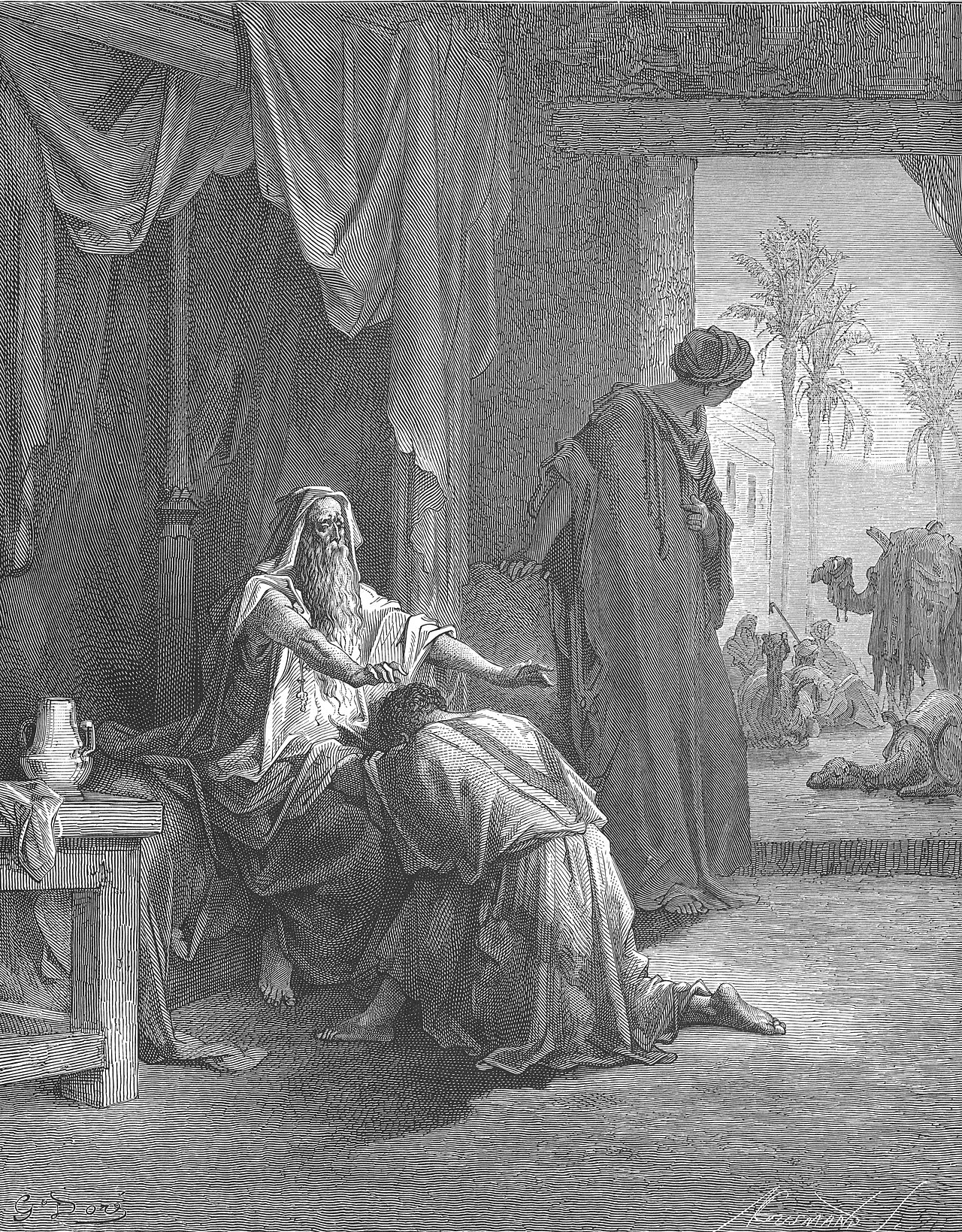
Rebekah Plots for the Blessing
Onkelos Genesis 27:1
And when Yitzchok grew old his eyesight faded and he could not see.
Read it in full at Sefaria · Metsudah Chumash, Metsudah Publications, 2009 [with Onkelos translation]
Ramban on Genesis 27:12
The reason that Isaac will feel him is not for the purpose of recognition.
Read it in full at Sefaria · Commentary on the Torah by Ramban (Nachmanides). Translated and annotated by Charles B. Chavel. New York, Shilo Pub. House, 1971-1976
Ibn Ezra on Genesis 27:13
Don’t be afraid that your father might curse you. If he does, the curse will be upon me, not on you.
Read it in full at Sefaria · Ibn Ezra's commentary on the Pentateuch, tran. and annot. by H. Norman Strickman and Arthur M. Silver. Menorah Pub., 1988-2004
Ramban on Genesis 27:15
The reason why Scripture mentions this is to accentuate the unusual action of the righteous one, 210 Rebekah. for parents customarily give recognition to the firstborn in blessing, honor, and gift, 211 See Ramban above,:34.
Read it in full at Sefaria · Commentary on the Torah by Ramban (Nachmanides). Translated and annotated by Charles B. Chavel. New York, Shilo Pub. House, 1971-1976
Radak on Genesis 27:16
Rivkah also covered Yaakov’s throat and arms with the skins from the goats so that Yitzchok would think that Esau was indeed standing before him.
Read it in full at Sefaria · Eliyahu Munk, HaChut Hameshulash
The Voice of Jacob, Hands of Esau
Esau's Bitter and Desperate Cry
Jacob Must Flee for His Life
Hebrew words in this chapter
The 40 most used Hebrew words of the chapter, counted by lemma. The article, the object marker, the negatives and the common prepositions are left out.
| Word | Sense here | Uses | Strong’s |
|---|---|---|---|
| אָמַרʼâmar | to say | 34 | H559 |
| בֵּןbên | son | 25 | H1121 |
| אָבʼâb | father | 24 | H1 |
| עֵשָׂוʻÊsâv | Esau | 21 | H6215 |
| בָרַךְbârak | to bless | 17 | H1288 |
| יַעֲקֹבYaʻăqôb | Jacob | 15 | H3290 |
| יִצְחָקYitschâq | Isaac | 13 | H3327 |
| בּוֹאbôwʼ | and bring | 13 | H935 |
| אָחʼâch | brother | 13 | H251 |
| עָשָׂהʻâsâh | and prepare | 9 | H6213 |
| לָקַחlâqach | and fetch | 9 | H3947 |
| צַיִדtsayid | wild game | 8 | H6718 |
| אָכַלʼâkal | to eat | 8 | H398 |
| הִנֵּהhinnêh | here I | 7 | H2009 |
| נָאnâʼ | please | 6 | H4994 |
| מַטְעַםmaṭʻam | savory food | 6 | H4303 |
| רִבְקָהRibqâh | Rebekah | 6 | H7259 |
| שָׁמַעshâmaʻ | listening | 6 | H8085 |
| קוֹלqôwl | voice | 6 | H6963 |
| בְּרָכָהBᵉrâkâh | blessing | 6 | H1293 |
| Word | Sense here | Uses | Strong’s |
|---|---|---|---|
| יָדyâd | hand | 6 | H3027 |
| נָגַשׁnâgash | draw near | 6 | H5066 |
| גָּדוֹלgâdôwl | great | 5 | H1419 |
| אֵםʼêm | mother | 5 | H517 |
| יוֹםyôwm | day | 4 | H3117 |
| עַתָּהʻattâh | now | 4 | H6258 |
| עָבוּרʻâbûwr | inorder that | 4 | H5668 |
| נֶפֶשׁnephesh | self my | 4 | H5315 |
| הָלַךְhâlak | went | 4 | H1980 |
| קָרָאqârâʼ | to call | 3 | H7121 |
| מָוֶתmâveth | death | 3 | H4194 |
| יָצָאyâtsâʼ | to come out | 3 | H3318 |
| שָׂדֶהsâdeh | the field | 3 | H7704 |
| צוּדtsûwd | to hunt | 3 | H6679 |
| אָהַבʼâhab | to love | 3 | H157 |
| דָבַרdâbar | to speak | 3 | H1696 |
| יְהֹוָהYᵉhôvâh | yahweh | 3 | H3068 |
| נָתַןnâthan | to give | 3 | H5414 |
| קוּםqûwm | arise | 3 | H6965 |
| רֵיחַrêyach | smell of | 3 | H7381 |
Keep studying
Studies6
Sources for this chapter
The Hebrew text
STEP Bible, the tagged Hebrew text and its English glosses and James Strong, Strong's Exhaustive Concordance.
In Jewish life
Rashi, Rashi on Genesis 27:1:1, 27:2:1, 27:3:1, 27:5:1, 27:7:1, 27:9:1, 27:11:1, 27:12:1, 27:15:1, 27:19:1, 27:21:1, 27:22:1 and 27:24:1, the Pentateuch with Rashi's commentary by M. Rosenbaum and A. M. Silbermann, 1929 to 1934, public domain; Radak, Radak on Genesis 27:4:1, 27:6:1, 27:8:1, 27:16:1, 27:17:1, 27:18:1 and 27:20:1, translated by Eliyahu Munk, HaChut Hameshulash, CC-BY; Radak on Genesis 27:26:1, cited only; Ibn Ezra, Ibn Ezra on Genesis 27:13:1 and 27:25:1, cited only, no English version in the corpus under a licence permitting quotation; Sforno, Sforno on Genesis 27:23:1, cited only; Midrash, Bereshit Rabbah 44:3, 65:13, 65:14, 65:15, 65:18, 65:19, 65:22, 66:4, 66:5, 67:4, 67:5, 67:7, 67:12, 98:4 and 16:4; Aggadat Bereshit 40:1, 43:1, 43:3, 46:1, 49:5 and 82:1; Bereshit Rabbati, Parashat Toldot 28, 32 and 33 and Parashat Vayigash 3; Midrash Aggadah, Genesis 27:4:1, 27:8:1, 27:13:1 and 27:14:1; Midrash Lekach Tov, Genesis 27:17:1, 27:32:1 and 27:35:1; Bamidbar Rabbah 10:6, 20:13 and 20:19; Babylonian Talmud, Bava Batra 15a:12, Berakhot 7b:7; Avot DeRabbi Natan, Avot DeRabbi Natan, Recension B 43:12 and 47:6 and Midrash Tanchuma, Midrash Tanchuma, Toldot 8 and 11, as Rashi cites them.
The rabbinic texts
Ramban, Commentary on the Torah by Ramban (Nachmanides). Translated and annotated by Charles B. Chavel. New York, Shilo Pub. House, 1971-1976; Ibn Ezra, Ibn Ezra's commentary on the Pentateuch, tran. and annot. by H. Norman Strickman and Arthur M. Silver. Menorah Pub., 1988-2004; Radak, Eliyahu Munk, HaChut Hameshulash; Targum, Metsudah Chumash, Metsudah Publications, 2009 [with Onkelos translation] and Sefaria, texts and citation data.