
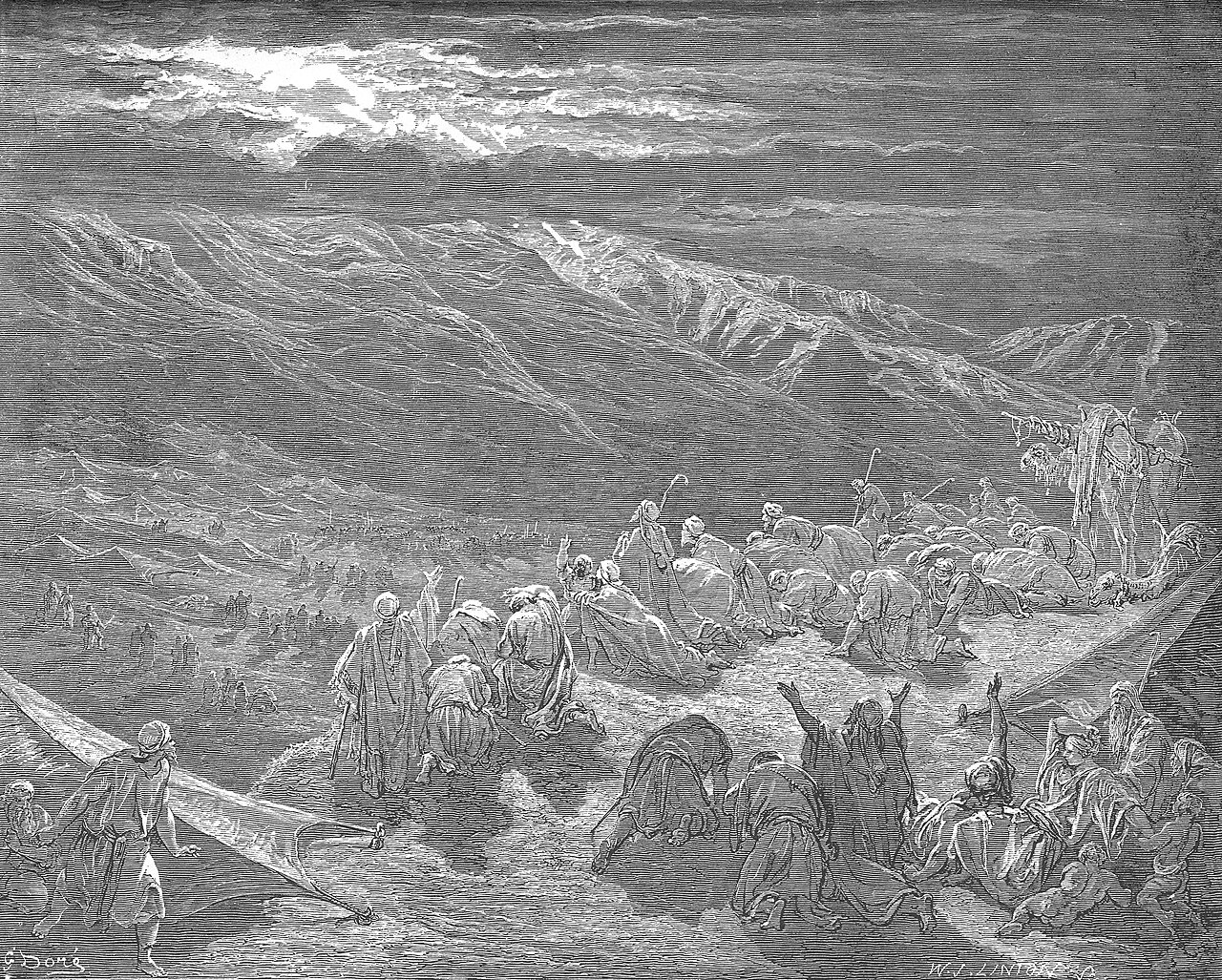
Exoduschapter 20
26 verses · Moses, by tradition · 15th or 13th century BC · The Law
“I am the LORD your God, who brought you out of the land of Egypt, out of the house of slavery.
Introduction
Moses, by tradition, The Law, Exodus Overview.
Exodus is given as the work of Moses, and this is the chapter whose words the whole assembly heard spoken out of the fire. Its first hearers were former slaves who had lived under Egyptian law and among Egyptian gods, with no written law of their own. Deuteronomy gives the same words again forty years later. The chapter is the centre of the book, the terms of the covenant spoken before any other law. Listen for the name and the rescue that come before the first command. Listen for how the commands turn from God to the neighbour, and for the people's fear at the close.
Context
- Who
- Israel in the wilderness, hearing the terms of the covenant they were to live under
- What
- Exodus 20 is the giving of the Ten Words at Sinai, the people's fearful answer, and the first law about altars.
- Where
- The foot of Mount Sinai, with God speaking from the mountain; the mountain is unlocated, and Jebel Musa is the traditional site among several proposed.
- When
- A few days after Israel reached Sinai in the third month after leaving Egypt, and the exodus itself is dated to the fifteenth century BC or to the thirteenth century BC by the two main datings, both held, with Exodus 12:40 to 41 and 1 Kings 6:1 bearing on the question.
- Why
- It states the terms of the covenant between the LORD and Israel, first toward God and then toward the neighbour.
Historical context
The words are given as God's own speech to the whole people, with Moses standing by and then approaching the thick darkness alone.
Show the rest of the historical context, 5 more paragraphs
It follows directly on the theophany of the chapter before. The early dating puts it about 1446 BC from the four hundred and eighty years of 1 Kings 6:1 read literally, while Kenneth Kitchen and James Hoffmeier date the exodus to the thirteenth century from the store cities of Exodus 1:11, and the chapter names no Pharaoh and no year.
The place is the foot of the mountain, with the people held back behind the boundary.
The occasion is the speaking of the Ten Words, which this site's dossier places at 20:1 to 17, and the altar law that closes the chapter.
A first hearer knew the opening for what it was, because a treaty between a great king and a vassal began by naming the king and reciting what he had done, and this begins with the God who brought them out of the house of slavery. He knew what the first commands were aimed at, since he had just left a country with a god for every office, a civilisation of statues, and a use of divine names in curses and spells. He knew how unusual the Sabbath command was, because it covers sons, daughters, male and female servants, livestock and the foreigner inside the gates, and no other law code of that world gives a whole population a guaranteed day of rest each week. He also knew why an altar of earth or of uncut stone, with no steps, stood apart from the carved and stepped altars of the nations around him.
How the ten are numbered differs between the Jewish, the Catholic and Lutheran, and the Reformed and Orthodox reckonings, and the chapter study row for Exodus 20 names each division with the work that holds it.
Significance
The people asked that God speak to them through Moses instead, and Moses told them the fear itself was the point, given so that it would be before them and keep them from sinning.
Show the rest of the significance, 1 more paragraph
For a nation of former slaves, a law that opened with a rescue and gave the lowest servant in the house a day off every week was a new account of what a god is like.
This chapter in Jewish lifeWhat this chapter is in Jewish life and reading.
What is done
The Sabbath commanded in this chapter is the practice a Christian reader meets most often in the Gospels. This site's own note on Exodus 31 describes what the day became: a covenant sign guarded by a detailed body of rules, which the Mishnah itself called mountains suspended by a hair. The same note carries the saying of the later tradition that the day is given into human hands rather than the reverse. It also records that one Sabbath may be broken to save a life so that many may be kept. Rashi puts the weekly practice in a sentence at verse 9. When the Sabbath comes, he says, a man should look on his work "as though all thy work were done", and think about it no further (Rashi on Exodus 20:9:1). At verse 10 he reads the naming of the son and the daughter as the parents' duty to keep small children from work on the day (Rashi on Exodus 20:10:1).
How it is read
Rashi holds that the words were spoken together before they were spoken apart. God said all of them "in one utterance", which no man can do, and then repeated the first two by themselves (Rashi on Exodus 20:1:2). He counts the opening declaration among the commandments, naming it and the prohibition of other gods as those first two. At verse 1 he reads the divine name used there as the name of the Judge, so that these words carry punishment rather than reward alone (Rashi on Exodus 20:1:1). At verse 6 he weighs the two measures against each other. Punishment is threatened to four generations and mercy kept for thousands, which he reckons as a proportion of one to five hundred (Rashi on Exodus 20:6:1). At verse 8 he reads the remember of this chapter and the observe of Deuteronomy as one utterance heard twice (Rashi on Exodus 20:8:1). One caution belongs on these references. The corpus numbers the verses of this chapter as a Hebrew Bible numbers them, and the two counts part company after the Sabbath commandment. Rashi on Exodus 20:13:1 comments on the words about adultery, which an English Bible numbers 20:14. Rashi on Exodus 20:15:1 comments on the people seeing the thunder, which an English Bible numbers 20:18. The text is the Rosenbaum and Silbermann Rashi of 1929 to 1934, in the public domain.
What the rabbis say
The rabbis take up the speaking of the words at Bamidbar Rabbah 11:2 and 11:7. On the graven image they taught at Avodah Zarah 43b:6, and on the jealous God at Avodah Zarah 54a:4. On the oath taken in vain they taught at Avot DeRabbi Natan 26:2 and Beitzah 15b:4. On the Sabbath of the household they taught at Bava Kamma 54b:12 and 54b:13, and on the honouring of father and mother in Bamidbar Rabbah 8:4. On the altar of earth and the ban on hewn stone they taught at Avodah Zarah 42b:19 and Ein Yaakov, Zevakhim 6:2.
Sources: Rashi, Rashi on Exodus 20:1:1, 20:1:2, 20:6:1, 20:8:1, 20:9:1 and 20:10:1, Pentateuch with Rashi's commentary by M. Rosenbaum and A. M. Silbermann, 1929 to 1934 (public domain); Ibn Ezra, Ibn Ezra on Exodus 20:14:1 and 20:16:1, cited by ref alone under the corpus licence rule; This site's Hebraic note on Exodus 31, src/lib/hebraic/pharisees.ts, the entry titled Why the Sabbath became the identity marker; The Babylonian Talmud, Avodah Zarah 43b:6, 54a:4 and 42b:19, Beitzah 15b:4, and Bava Kamma 54b:12 and 54b:13, cited by ref; The Midrash, Bamidbar Rabbah 11:2, 11:7 and 8:4, Avot DeRabbi Natan 26:2, and Ein Yaakov, Zevakhim 6:2, cited by ref.
The heads below are this chapter's scenes. The numbered points under each are its verses.
The First Four Commandments
Exodus 20:1-2
God speaks these words to the whole nation at once, and Deuteronomy 5:4 says he talked with them face to face out of the midst of the fire. The law opens with a rescue already finished rather than with a demand, since the house of bondage is behind them before a single commandment is given. The Hebrew root behind bondage is the one Exodus 1:13 and 1:14 use five times over for the slave labour, and the same root carries the service of the tabernacle at the end of the book.
Exodus 20:1
“The Hebrew name which is rendered in our King James Version as the ten commandments occurs in Exo 34:28; Deu 4:13; Deu 10:4. It literally means “the Ten Words.” The Ten Commandments are also called the law, even the commandment Exo 24:12, the words of the covenant Exo 34:28, the tables of the covenant Deu 9:9, the covenant Deu 4:13, the two tables Deu 9:10, Deu 9:17, and, most frequently, the testimony (e. g. Exo 16:34; Exo 25:16), or the two tables of the testimony (e. g. Exo 31:18).”
1 more voice on this verseWhat preachers and commentators have said about this verse, in their own words.
Exodus 20:1
“They were not only spoken audibly (so he owned the Redeemer by a voice from heaven, Matt. iii. 17 ), but with a great deal of dreadful pomp. This law God had given to man before (it was written in his heart by nature); but sin had so defaced that writing that it was necessary, in this manner, to revive the knowledge of it.”
Matthew Henry · Commentary on the Whole Bible (1707-1721)puritan
Your is singular in Hebrew, and Adam Clarke notes that the LORD addresses each hearer alone. Jamieson, Fausset and Brown read the verse as the preface to the commandments, with the first clause binding all people and the rescue out of the house of slavery binding Israel. The name comes before any command.
Exodus 20:2
“I am the Lord thy God - יהוה אלהיך Yehovah eloheycha. On the word Jehovah, which we here translate Lord, see Clarke’s note on Gen 2:4, and see Clarke’s note on Exo 6:3. And on the word Elohim, here translated God, see Clarke’s note on Gen 1:1. It is worthy of remark that each individual is addressed here, and not the people collectively, though they are all necessarily included; that each might feel that he was bound for himself to hear and do all these words.”
Adam Clarke · Commentary on the Bible (1810-1826)evangelical
2 more voices on this verse
Exodus 20:2
“And surely it was necessary that, first of all, the right of the legislator should be established, lest what He chose to command should be despised, or contemptuously received. In these words, then, God seeks to procure reverence to Himself, before He prescribes the rule of a holy and righteous life.”
John Calvin · Commentaries (1554)reformed
Exodus 20:2
“I am the Lord thy God--This is a preface to the ten commandments--the latter clause being specially applicable to the case of the Israelites, while the former brings it home to all mankind; showing that the reasonableness of the law is founded in their eternal relation as creatures to their Creator, and their mutual relations to each other.”
Jamieson, Fausset & Brown · Commentary Critical and Explanatory on the Whole Bible (1871)reformed
The first demand is exclusive loyalty, and it is put to a people who have just watched judgment fall on the gods of Egypt at Exodus 12:12. The phrase before me reads in the Hebrew as before my face, which the older commentators take to mean in my presence rather than ahead of me in rank. Within weeks of hearing this the people make a calf and say these be thy gods, O Israel, at Exodus 32:4.
Exodus 20:3
“God commands us by His prophet not to esteem any new God to be God, and not to worship any strange God. Now it is clear that that is called new which is not from everlasting, and on the contrary, that is called everlasting which is not new.”
Gregory of Nyssa · written before 395 · ON THE FAITHpatristic
1 more voice on this verse
Exodus 20:3
“Thou shalt have no other gods before me - אלהים אחרים elohim acherim, no strange gods - none that thou art not acquainted with, none who has not given thee such proofs of his power and godhead as I have done in delivering thee from the Egyptians, dividing the Red Sea, bringing water out of the rock, quails into the desert, manna from heaven to feed thee, and the pillar of cloud to direct, enlighten, and shield thee.”
Adam Clarke · Commentary on the Bible (1810-1826)evangelical
Exodus 20:4-5
Graven image occurs here for the first time in Scripture and jealous occurs for the first time in the next verse, so God's first self-description at Sinai is that he is jealous. The image is forbidden in three directions, heaven above, earth beneath and water under the earth, which covers everything a craftsman could copy. Visiting the iniquity of the fathers upon the children unto the third and fourth generation is limited in the same breath to them that hate me, and Deuteronomy 24:16 forbids a court to put children to death for their fathers.
Exodus 20:4
“Thou shalt not make . . . any graven image . . . thou shalt not bow down thyself to them--that is, "make in order to bow." Under the auspices of Moses himself, figures of cherubim, brazen serpents, oxen, and many other things in the earth beneath, were made and never condemned. The mere making was no sin--it was the making with the intent to give idolatrous worship.”
Jamieson, Fausset & Brown · Commentary Critical and Explanatory on the Whole Bible (1871)reformed
for I, the LORD your God, am a jealous God: Jamieson, Fausset and Brown read verses 4 and 5 as one command, making in order to bow down and worship. They point to the cherubim and the bronze serpent, both made at God's command, and Hezekiah broke the serpent when Israel burned incense to it at 2 Kings 18:4. Adam Clarke reads jealous as a husband's love for his wife.
Mercy runs to thousands where the visiting ran to the third and fourth generation, and the two numbers are set against each other on purpose. The same pairing returns at Exodus 34:6 and 34:7 after the calf, where God proclaims his own name and the mercy comes first. That sentence is quoted or echoed at Numbers 14:18, Psalm 103:8, Joel 2:13 and Jonah 4:2, more often than any other statement about God in the Old Testament.
Exodus 20:6
“And showing mercy unto thousands - Mark; even those who love God and keep his commandments merit nothing from him, and therefore the salvation and blessedness which these enjoy come from the mercy of God: Showing mercy, etc. What a disproportion between the works of justice and mercy! Justice works to the third or fourth, mercy to thousands of generations! The heathen had maxims like these.”
Adam Clarke · Commentary on the Bible (1810-1826)evangelical
The name is what God gave Moses at the bush and called his memorial unto all generations at Exodus 3:15, where memorial occurs for the first time in Scripture. Taking it in vain covers an empty oath and a light use alike, since the Hebrew word carries the sense of emptiness or falsehood. This is the one commandment of the ten that attaches its own sanction, that the LORD will not hold him guiltless.
Exodus 20:7
“Thou shalt not take the name of the Lord thy God in vain - This precept not only forbids all false oaths, but all common swearing where the name of God is used, or where he is appealed to as a witness of the truth. It also necessarily forbids all light and irreverent mention of God, or any of his attributes; and this the original word לשוא lashshav particularly imports: and we may safely add to all these, that every prayer, ejaculation, etc., that is not accompanied with deep reverence and the genuine spirit of piety, is here condemned also.”
Adam Clarke · Commentary on the Bible (1810-1826)evangelical
1 more voice on this verse
Exodus 20:7
“Those that name the name of Christ, but do not depart from iniquity, as that name binds them to do, name it in vain; their worship is vain ( Matt. xv. 7-9 ), their oblations are vain ( Isa. i. 11, 13 ), their religion is vain, Jam. i.”
Matthew Henry · Commentary on the Whole Bible (1707-1721)puritan
Exodus 20:8-9
Remember the Sabbath day: Remember points back to something the reader has already seen, since sabbath first occurs at Exodus 16:23 in the manna chapter, four chapters before this commandment. There the case was made by events rather than by law, with a double portion on the sixth day, worms in what was kept over on any other day, and men who went out to gather on the seventh and found nothing. Genesis 2:2-3 has God resting and blessing and sanctifying the seventh day while never using the noun.
Exodus 20:8
“Remember the sabbath day--implying it was already known, and recognized as a season of sacred rest. The first four commandments [Ex 20:3-11] comprise our duties to God--the other six [Ex 20:12-17] our duties to our fellow men; and as interpreted by Christ, they reach to the government of the heart as well as the lip (Mt 5:17).”
Jamieson, Fausset & Brown · Commentary Critical and Explanatory on the Whole Bible (1871)reformed
1 more voice on this verse
Exodus 20:8
“A late pious Writer seems to prove, That the sabbath was changed, when Israel came out of Egypt; which change continued till our Lord rose again: But that then the Original Sabbath was restored. And he makes it highly probable, at least, That the sabbath we observe, is the seventh day from the creation.”
John Wesley · Explanatory Notes upon the Old Testament (1765)evangelical
Six days you shall labor: Six days of labour belong to the commandment as much as the rest does, and Adam Clarke draws from it that idleness on the working days breaks it too. He also holds that work which could be done before the Sabbath should be done then. Work was given in Eden, at Genesis 2:15.
Exodus 20:9
“Six days shalt thou labor - Therefore he who idles away time on any of the six days, is as guilty before God as he who works on the Sabbath. No work should be done on the Sabbath that can be done on the preceding days, or can be deferred to the succeeding ones. Works of absolute necessity and mercy are alone excepted. He who works by his servants or cattle is equally guilty as if he worked himself.”
Adam Clarke · Commentary on the Bible (1810-1826)evangelical
The rest reaches down the whole household to the son, the daughter, the servants, the cattle and the stranger inside the gates, so the one day covers people who own nothing. The ground given here is the creation, that in six days the LORD made heaven and earth and rested the seventh. Deuteronomy 5:15 repeats the commandment and gives a different ground, that thou wast a servant in the land of Egypt, and both stand in the canon side by side.
Exodus 20:10
“Wherefore when He speaks to us of another commandment, not known to us by the dictate of conscience, He not only prohibits, but adds the reason. When, for instance, He gave commandment respecting the Sabbath; "On the seventh day thou shalt do no work;" He subjoined also the reason for this cessation. What was this? "Because on the seventh day God rested from all His works which He had begun to make." And again; "Because thou wert a servant in the land of Egypt."”
John Chrysostom · written before 407 · HOMILIES CONCERNING THE STATUES 12.9patristic
1 more voice on this verse
Exodus 20:10
“It is sacrilege to alienate it; the sanctification of it is a debt. [3.] It is designed for a memorial of the creation of the world, and therefore to be observed to the glory of the Creator, as an engagement upon ourselves to serve him and an encouragement to us to trust in him who made heaven and earth.”
Matthew Henry · Commentary on the Whole Bible (1707-1721)puritan
Duties Toward Parents and Neighbors
This commandment turns from God to men and it is the hinge between the two tables. Ephesians 6:2 calls it the first commandment with promise, so the New Testament itself notices that it carries a reward the others leave unstated. The promise attaches to length of days upon the land, which is a national promise given to a people who have no land yet.
Exodus 20:12
“Honor thy father and thy mother - There is a degree of affectionate respect which is owing to parents, that no person else can properly claim. For a considerable time parents stand as it were in the place of God to their children, and therefore rebellion against their lawful commands has been considered as rebellion against God. This precept therefore prohibits, not only all injurious acts, irreverent and unkind speeches to parents, but enjoins all necessary acts of kindness, filial respect, and obedience.”
Adam Clarke · Commentary on the Bible (1810-1826)evangelical
1 more voice on this verse
Exodus 20:12
“The formation of the children is then the prerogative of the parents. Therefore honor your father, that he may bless you. Let the godly man honor his father out of gratitude and the ingrate do so on account of fear. Even if the father is poor and does not have plenty of resources to leave to his sons, still he has the heritage of his final blessing with which he may bestow the wealth of sanctification on his descendants. And it is a far greater thing to be blessed than it is to be rich.”
Ambrose of Milan · written before 397 · THE PATRIARCHS 1.1patristic
Cross references
Exodus 20:12
- Quoted inEphesians 6:2“Honor your father and mother” (which is the first commandment with a promise),
'Honour thy father and mother, the first commandment with promise'
- Quoted inMark 10:19You know the commandments: ‘Do not murder, do not commit adultery, do not steal, do not bear false witness, do not cheat others, honor your father and mother.’”
the commandments to the rich young ruler
- Quoted inMark 7:10“For Moses said, ‘Honor your father and your mother’ and ‘Anyone who curses his father or mother must be put to death.’”
'Honour thy father and thy mother' (Corban dispute, 'Moses said')
- Quoted inMatthew 15:4“For God said, ‘Honor your father and mother’ and ‘Anyone who curses his father or mother must be put to death.’”
'Honour thy father and mother' (Corban dispute)
- Quoted inMatthew 19:18“Which ones?” the man asked. Jesus answered, “‘Do not murder, do not commit adultery, do not steal, do not bear false witness,
the commandments recited to the rich young ruler (Decalogue, second table)
ConnectionsEphesians 6:2
The Hebrew verb here is ratsach, the word the Old Testament uses for the killing a court or an avenger of blood deals with, and Numbers 35:16 to 35:31 sets out its cases. Other Hebrew words cover war, execution and sacrifice, and the law that follows in chapter 21 prescribes death for several crimes. Jesus takes the commandment inward at Matthew 5:21 and 5:22, putting anger against a brother under the same heading.
Exodus 20:13
“Thou shalt not kill - This commandment, which is general, prohibits murder of every kind. 1. All actions by which the lives of our fellow creatures may be abridged. 2. All wars for extending empire, commerce, etc. 3. All sanguinary laws, by the operation of which the lives of men may be taken away for offenses of comparatively trifling demerit. 4. All bad dispositions which lead men to wish evil to, or meditate mischief against, one another; for, says the Scripture, He that hateth his brother in his heart is a murderer.”
Adam Clarke · Commentary on the Bible (1810-1826)evangelical
1 more voice on this verse
Exodus 20:13
“This doth not forbid our own necessary defense, or the magistrates putting offenders to death; but it forbids all malice and hatred to any, for he that hateth his brother is a murderer, and all revenge arising therefrom; likewise anger and hurt said or done, or aimed to be done in a passion; of this our saviour expounds this commandment, Matt. v, 22.”
John Wesley · Explanatory Notes upon the Old Testament (1765)evangelical
Cross references
Exodus 20:13
- Quoted inJames 2:11“For He who said, “Do not commit adultery,” also said, “Do not murder.” If you do not commit adultery, but do commit murder, you have become a lawbreaker.”
'Do not commit adultery... Do not kill' (the whole law argument)
- Quoted inMatthew 5:21“You have heard that it was said to the ancients, ‘Do not murder’ and ‘Anyone who murders will be subject to judgment.’”
'Ye have heard that it was said... Thou shalt not kill' (Decalogue antithesis)
- Quoted inRomans 13:9The commandments “Do not commit adultery,” “Do not murder,” “Do not steal,” “Do not covet,” and any other commandments, are summed up in this one decree: “Love your neighbor as yourself.”
'Thou shalt not commit adultery... kill... steal', commandments summed in love
Adultery and theft guard the two things a household is built on, the marriage and the property. Jesus reads the seventh commandment inward at Matthew 5:27 and 5:28 the same way he reads the sixth, putting the look under the act. Paul quotes both of these commandments at Romans 13:9 and concludes that love worketh no ill to his neighbour, therefore love is the fulfilling of the law.
Exodus 20:14
“This commandment forbids all acts of uncleanness, with all those fleshly lusts which produce those acts and war against the soul, and all those practices which cherish and excite those fleshly lusts, as looking, in order to lust, which, Christ tells us, is forbidden in this commandment, Matt. v. 28 .”
Matthew Henry · Commentary on the Whole Bible (1707-1721)puritan
Cross references
Exodus 20:14
- Quoted inMatthew 5:27“You have heard that it was said, ‘Do not commit adultery.’”
'Thou shalt not commit adultery' (Sermon on the Mount antithesis)
Exodus 20:15
“Thou shalt not steal - All rapine and theft are forbidden by this precept; as well national and commercial wrongs as petty larceny, highway robberies, and private stealing: even the taking advantage of a seller’s or buyer’s ignorance, to give the one less and make the other pay more for a commodity than its worth, is a breach of this sacred law. All withholding of rights and doing of wrongs are against the spirit of it. But the word is principally applicable to clandestine stealing, though it may undoubtedly include all political injustice and private wrongs.”
Adam Clarke · Commentary on the Bible (1810-1826)evangelical
The ninth commandment is set in a courtroom, since bearing witness against a neighbour is what a witness does at a trial. Deuteronomy 19:16 to 19:19 supplies the penalty, that a false witness receives what he intended for the accused. Matthew 26:59 and 26:60 report the council seeking false witness against Jesus and finding none that agreed until two came forward.
Exodus 20:16
“Thou shalt not bear false witness, etc. - Not only false oaths, to deprive a man of his life or of his right, are here prohibited, but all whispering, tale-bearing, slander, and calumny; in a word, whatever is deposed as a truth, which is false in fact, and tends to injure another in his goods, person, or character, is against the spirit and letter of this law.”
Adam Clarke · Commentary on the Bible (1810-1826)evangelical
The tenth commandment reaches something no court can try, since coveting leaves no evidence and gives nobody a charge to bring. Paul names this one commandment at Romans 7:7, saying he had not known lust except the law had said, Thou shalt not covet, and it is the one he picks to show what the law does inside a man. The list runs from the house down to the ox and the ass, the same kind of household inventory the sabbath commandment used at verse 10.
Exodus 20:17
“Love of money then is an old, an ancient vice, which showed itself even at the declaration of the divine law; for a law was given to check it.”
Ambrose of Milan · written before 397 · On the Duties of the Clergy 2.26.130patristic
The People Stand Far Off
Exodus 20:18-19
The people see the thunder and the trumpet and move back, and their request is that Moses stand between them and the voice. Deuteronomy 5:28 records God's answer, that they have well said all that they have spoken, and Deuteronomy 18:15 to 18:18 meets the request with the promise of a prophet like unto Moses from among their brethren. Peter applies that promise to Christ at Acts 3:22, so the New Testament reads this moment of fear as the origin of a promise.
Exodus 20:18
“And all the people saw the thunderings, etc. - They had witnessed all these awful things before, (see Exo 19:16), but here they seem to have been repeated; probably at the end of each command, there was a peal of thunder, a blast of the trumpet, and a gleam of lightning, to impress their hearts the more deeply with a due sense of the Divine Majesty, of the holiness of the law which was now delivered, and of the fearful consequences of disobedience.”
Adam Clarke · Commentary on the Bible (1810-1826)evangelical
2 more voices on this verse
Exodus 20:18
“And all the people saw the thunderings, and the lightnings,.... That is, they heard the one, and saw the other; they heard the dreadful volleys of thunder, and saw the amazing flashes of lightning, which were like lamps and torches, as the word used signifies; by a communication of senses, one sense is put for another, and the sense of sight being the principal, as Ben Melech observes, it is put for the rest, and so in the following.”
Exodus 20:18
“It was an indication of the terror of those convictions which the law brings into conscience, to prepare the soul for the comforts of the gospel. Thus was the law given by Moses in such a way as might startle, affright, and humble men, that the grace and truth which came by Jesus Christ might be the more welcome.”
Matthew Henry · Commentary on the Whole Bible (1707-1721)puritan
Hebrews 12:19 recalls the plea, hearers who begged that the voice of God stop speaking to them. Matthew Henry sets it beside the calf. The terror of the voice from the mountain, he notes, made the people stand at a distance and still left them ready to worship gods of gold within forty days.
Exodus 20:19
“Once God tried the expedient of speaking to the children of men immediately, but it was found that they could not bear it; it rather drove men from God than brought them to him, and, as it proved in the issue, though it terrified them, it did not deter them from idolatry, for soon after this they worshipped the golden calf.”
Matthew Henry · Commentary on the Whole Bible (1707-1721)puritan
Moses puts two fears in one sentence, telling the people to fear not and then saying God came so that his fear would be before their faces. The first is terror at the noise on the mountain and the second is the reverence that keeps a man from sinning. Hebrews 12:18 to 12:21 looks back at this scene and reports that even Moses said, I exceedingly fear and quake, which quotes Deuteronomy 9:19.
Exodus 20:20
“And Moses said - Fear not: for God is come to prove you, and that his fear may be before your faces - The maxim contained in this verse is, Fear not, that he may fear - do not fear with such a fear as brings consternation into the soul, and produces nothing but terror and confusion; but fear with that fear which reverence and filial affection inspire, that ye sin not - that, through the love and reverence ye feel to your Maker and Sovereign, ye may abstain from every appearance of evil, lest you should forfeit that love…”
Adam Clarke · Commentary on the Bible (1810-1826)evangelical
The people stand back and Moses walks toward the darkness, and the verse puts both movements in one line. Thick darkness is where God is said to be, which Psalm 18:11 and 1 Kings 8:12 repeat, so the nearer approach at Sinai runs into less light rather than more. Hebrews 12:22 sets this mountain against the mount Sion its readers are said to have come to.
Exodus 20:21
“While the people continued to stand afar off - Afraid of God's wrath, Moses drew near unto the thick darkness; he was made to draw near, so the word is: Moses of himself durst not have ventured into the thick darkness if God had not called him, and encouraged him, and, as some of the Rabbins suppose, sent an angel to take him by the hand, and lead him up.”
John Wesley · Explanatory Notes upon the Old Testament (1765)evangelical
1 more voice on this verse
Exodus 20:21
“Thus it is said of the great Mediator, I will cause him to draw near ( Jer. xxx. 21 ), and by him it is that we also are introduced, Eph. iii. The Law Concerning Altars.”
Matthew Henry · Commentary on the Whole Bible (1707-1721)puritan
An Altar of Earth and Unhewn Stone
Exodus 20:22-23
God grounds the next word on what the people have just been through, that they have seen him talk with them from heaven. The second commandment is then applied straight to their own metal, gods of silver and gods of gold, before any silver or gold has been gathered for anything. Chapter 32 breaks this line first, where the gold of the earrings becomes a molten calf, and molten occurs there for the first time in Scripture at Exodus 32:4.
Exodus 20:22
“I have talked with you from heaven - Though God manifested himself by the fire, the lightning, the earthquake, the thick darkness, etc., yet the ten words, or commandments were probably uttered from the higher regions of the air, which would be an additional proof to the people that there was no imposture in this case; for though strange appearances and voices might be counterfeited on earth, as was often, no doubt, done by the magicians of Egypt; yet it would be utterly impossible to represent a voice, in a long continued series of instruction, as proceeding from heaven itself,…”
Adam Clarke · Commentary on the Bible (1810-1826)evangelical
1 more voice on this verse
Exodus 20:22
“Moses being gone into the thick darkness where God was, God there spoke in his hearing only, all that follows from hence to the end of chap. 23, which is mostly an exposition of the ten commandments; and he was to transmit it to the people. The laws in these verses relate to God's worship.”
John Wesley · Explanatory Notes upon the Old Testament (1765)evangelical
You are not to make any gods alongside Me: The phrase any gods alongside Me forbids a god set up beside the LORD in his own worship, and Aaron proclaims the calf's feast as a feast to the LORD at 32:5. Jamieson, Fausset and Brown draw the rule from Deuteronomy 4:15 and 16. Israel saw no form at Sinai.
The first thing commanded after the ten words is an altar, and it is made of earth. Sacrifice on it is older than the priesthood and older than the tabernacle, and it belongs to the line of altars Noah builds at Genesis 8:20 and Abram at Genesis 12:7. The promise attached is that in all places where I record my name I will come unto thee, and I will bless thee, which ties the blessing to the name rather than to the site.
Exodus 20:24
“Thy burnt-offerings, and thy peace-offerings - The law concerning which was shortly to be given, though sacrifices of this kind were in use from the days of Abel. In all places where I record my name - Wherever I am worshipped, whether in the open wilderness, at the tabernacle, in the temple, the synagogues, or elsewhere, I will come unto thee and bless thee. These words are precisely the same in signification with those of our Lord, Mat 18:20: For where two or three are gathered together in my name, there am I in the midst of them.”
Adam Clarke · Commentary on the Bible (1810-1826)evangelical
1 more voice on this verse
Exodus 20:24
“This rule being prescribed before the establishment of the ceremonial law, which appointed altars much more costly, intimates that, after the period of that law, plainness should be accepted as the best ornament of the external services of religion, and that gospel-worship should not be performed with external pomp and gaiety.”
Matthew Henry · Commentary on the Whole Bible (1707-1721)puritan
Exodus 20:25-26
A stone altar is allowed and a tool taken to the stone pollutes it, so the one thing that would turn it into a work of craftsmanship is what disqualifies it. Deuteronomy 27:5 and 27:6 repeat the rule, and Joshua 8:31 reports it kept on mount Ebal with whole stones over which no man lifted up any iron. Steps are forbidden for the sake of modesty, and Exodus 28:42 meets the same concern for the priests with linen breeches, which is why Jewish tradition describes the later temple altar as reached by a ramp.
Exodus 20:25
“Thou shalt not build it of hewn stone - Because they were now in a wandering state, and had as yet no fixed residence; and therefore no time should be wasted to rear costly altars, which could not be transported with them, and which they must soon leave.”
Adam Clarke · Commentary on the Bible (1810-1826)evangelical
you must not go up to My altar on steps: Adam Clarke traces the Latin altare to altus, high, and notes that the nations built their altars tall, where the Hebrew word for altar names a place of sacrifice. The rule keeps altars of earth or unshaped stones low. Solomon's bronze altar at 2 Chronicles 4:1 stood ten cubits high, and John Wesley holds that the priests went up to it by a slope.
Exodus 20:26
“Neither shalt thou go up by steps unto mine altar - The word altar comes from altus, high or elevated, though the Hebrew word מזבח mizbach, from זבח zabach, to slay, kill, etc., signifies merely a place for sacrifice; see Gen 8:20. But the heathens, who imitated the rites of the true God in their idolatrous worship, made their altars very high; whence they derived their name altaria, altars, i.e., very high or elevated places; which they built thus, partly through pride and vain glory, and partly that their gods might the better hear them.”
Adam Clarke · Commentary on the Bible (1810-1826)evangelical
1 more voice on this verse
Exodus 20:26
“Neither shall thou go at by steps unto mine altar - Indeed afterwards God appointed an altar ten cubits high. But it is probable, they went not up to that by steps, but by a sloping ascent.”
John Wesley · Explanatory Notes upon the Old Testament (1765)evangelical
How this psalm is built
The form: Covenant terms spoken to a whole people, opening with a preface that names the speaker and what he has done, as Jamieson, Fausset & Brown classes it.
The patterns in this chapter
| Device | What it does | Where to see it |
|---|---|---|
| You shall not, said eight times | The negative form stands at verses 3, 4, 5, 7, 13, 14, 15, 16 and 17, and only two of the ten are given as things to do, at verse 8 and verse 12. The weight of the ten falls on what is forbidden, and the two positive commands stand at the centre of the list. | Exodus 20:3, Exodus 20:8, Exodus 20:12, Exodus 20:17 |
| The ten, counted as ten | Verses 3 to 17 are a list, and the list is the chapter's form. How the ten are divided out of the text differs between the traditions, which is set out under the debated points below, and the site states the divisions with their sources rather than adopting one. | Exodus 20:3, Exodus 20:17 |
| The third and fourth generations set against a thousand | Verses 5 and 6 answer one another. The iniquity of the fathers reaches the third and fourth generations of those who hate God, and loving devotion reaches a thousand generations of those who love him. The pair is built so that the second number dwarfs the first. | Exodus 20:5, Exodus 20:6 |
| Spoken from heaven, at the head of the chapter and at the foot | Verse 1 opens with God speaking all these words. Verse 22 has the LORD telling Moses to say that the people have seen for themselves that he spoke to them from heaven. The chapter is bracketed by the fact that the people heard this directly, which is what the altar law at the end is grounded on. | Exodus 20:1, Exodus 20:22 |
| The whole law addressed to one man at a time | The Hebrew of verses 3 to 17 is second person singular throughout, so a law given to a nation standing together is worded to each person in it. Adam Clarke works the wording of verse 3 closely and John Gill does the same at verse 7.Adam Clarke, Commentary on the Bible, 1832, on Exodus 20:3. | Exodus 20:3, Exodus 20:17 |
The chapter is the centre of the book and of the Pentateuch's law. What follows it to the end of chapter 23 is case law working out these ten in particular situations, and chapter 24 seals the whole in blood.
10 more paragraphs on the patterns
The pattern the ten work by is rescue before demand. The people are told who is speaking and what he did before they are told anything to do, and every commentator in the store's pool for this chapter marks that order. The second pattern is reach. The first nine can be prosecuted in a court and the tenth cannot, since coveting leaves no evidence, and Augustine and Ambrose both take verse 17 as the command that shows the law reaching inside a man.
The third pattern is that several of the ten are aimed directly at what Israel had just left. A country with a god for every office lies behind verse 3, a civilisation of statues behind verse 4, and a world that used divine names in curses and spells behind verse 7. The Sabbath command at verses 8 to 11 reaches further than any law of that world, since it covers sons, daughters, servants of both sexes, livestock and the foreigner inside the gates.
The New Testament's use
This chapter is quoted more often in the New Testament than any other in Exodus apart from chapter 12. Jesus takes the sixth and seventh commands at Matthew 5:21 and 5:27 and extends each to the thought behind the act. He lists five of them to the rich young man at Matthew 19:18 and 19 and at Mark 10:19. Paul quotes verse 17 at Romans 7:7 as the command that taught him what coveting was, and at Romans 13:9 he gathers four of them under the love of a neighbour. Ephesians 6:2 and 3 quote verse 12 and call it the first commandment with a promise. James 2:11 sets the seventh and the sixth side by side to argue that breaking one breaks the law.
The debated points
The first is how the ten are counted, and three divisions stand. The division that takes verse 3 as the first command and verses 4 to 6 as the second is carried by Philo in On the Decalogue and by Josephus in Antiquities of the Jews 3.5.4, and it is followed by the Eastern Orthodox and by the Reformed. The division that takes the preface of verses 1 and 2 as the first of ten sayings and joins verses 3 to 6 as the second is the Talmudic one and is followed in Jewish practice. The division that begins with verses 3 to 6 as one command and splits the coveting of verse 17 into two is Augustine's, set out in his Questions on Exodus 71, and it is followed by the Roman Catholic Church and, with the order of Exodus 20 rather than Deuteronomy 5 in the last two, by Lutherans. The three divisions and their sources are recorded in the Jewish Encyclopedia article on the Decalogue and in Charles Hodge's Systematic Theology, volume 3. The site states the three and adopts none.
The second is the reach of the sixth command. John Wesley holds that it forbids neither necessary self-defence nor the magistrate putting an offender to death, and that what it forbids is malice. Augustine works the same question at length in On Lying 13.23 and rules out suicide from it in City of God 1.20. The disagreement is about scope rather than about the words.
The third is whether the Sabbath command institutes the day or recalls one already kept. Jamieson, Fausset and Brown read the word remember at verse 8 as implying that the day was already known and recognised as a season of sacred rest, and Adam Clarke points back to Genesis 2:2. Exodus 16 has the day kept in practice four chapters before this command. John Wesley records a contrary view from a writer of his own time that the Sabbath was changed when Israel came out of Egypt.
Where to go deeper
The ten themselves are set out at the Ten Commandments, and the covenant they belong to at the Mosaic covenant. The fourth is set out at Sabbath rest and the third at oaths. The readings Jesus gives the sixth and the seventh are set out at anger and murder of the heart and lust and adultery of the heart. The law at the end of the chapter is set out at the altar, and what the people felt at the foot of the mountain at the fear of the LORD.
Keep studying
Studies7
People1
Words12
Sources for this chapter
The summary
Jamieson, Fausset & Brown, Commentary Critical and Explanatory; John Calvin, Commentaries; John Wesley, Notes on the Old Testament and Matthew Henry, Complete Commentary.
The form and classifications
Jamieson, Fausset & Brown, Commentary Critical and Explanatory on the Whole Bible, 1871, on Exodus 20:2; John Wesley, Explanatory Notes upon the Old Testament, 1765, on Exodus 20:2 and Meredith G. Kline, Treaty of the Great King.
The exposition
Adam Clarke, Commentary on the Bible; Alfred Edersheim, The Temple: Its Ministry and Services; Jamieson, Fausset & Brown, Commentary Critical and Explanatory on the Whole Bible; John Calvin, Commentary on the Four Last Books of Moses Arranged in the Form of a Harmony; John Gill, Exposition of the Old Testament; John Wesley, Explanatory Notes upon the Old Testament; Keil and Delitzsch, Biblical Commentary on the Old Testament: The Pentateuch and Matthew Henry, Commentary on the Whole Bible.