
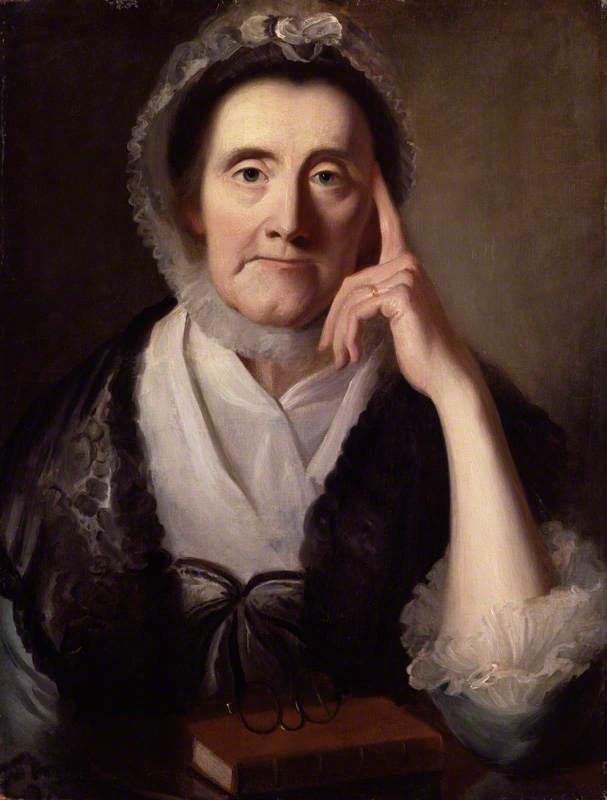
Unknown artist, Selina Hastings, Countess of Huntingdon, about 1770. Public domain.
England and Wales, 1707 to 1791 · Person · Featured Study
The Countess of Huntingdon
She built chapels across England for the evangelical revival and founded a college at Trevecca in Wales.
Her biographer reckoned that she gave more than a hundred thousand pounds in her life to spread the faith she held.
Brothers, consider the time of your calling: Not many of you were wise by human standards; not many were powerful; not many were of noble birth.
Brothers, consider the time of your calling: Not many of you were wise by human standards; not many were powerful; not many were of noble birth.
- Born
- 24 August 1707
- Died
- 17 June 1791, at her house in Spa Fields, London
- Family
- father: Washington, second Earl Ferrers; husband: Theophilus, Earl of Huntingdon; son: Francis, Earl of Huntingdon
- Places
- London, Brighton, Trevecca, Tunbridge Wells, Bethesda in Georgia, Ashby-de-la-Zouch
Summary
The Countess was the daughter of one earl and the widow of another. She gave her money and her rank to the revival. George Whitefield preached as her chaplain, and young men trained at her college in Wales. Her chapels grew into a body of their own, named after her.
- Whitefield left her his estate in Georgia and the slaves held there.
- She made the men of her college reject the Minutes of Wesley's Conference, and Joseph Benson was dismissed.
- Her ministers left the Church of England so that her chapels could stay open.
The Noble Called
1 Corinthians 1 says that few of noble birth were called, and her biographer opens her conversion with that word.
No verse of Scripture names her. Seymour writes that though few of the noble are called, God "is pleased sometimes to select the monuments of his mercy from among the wealthy and noble", and he tells her conversion next.
The question of this life is how a peeress used her rank and her money in the revival, and where the law of the Church of England stopped her.
You are to make for Me an altar of earth, and sacrifice on it your burnt offerings and peace offerings, your sheep and goats and cattle. In every place where I cause My name to be remembered, I will come to you and bless you.Whitefield took this verse as his text at the opening of Trevecca.
The Life in Order
Seymour gives most of the dates, and the will of Whitefield and the book of Phillis Wheatley give the rest.
Her work for the revival filled the last forty-five years of her life.
- 24 August 1707BirthSeymour, volume 1, page 7
- 3 June 1728MarriageSeymour, volume 1, page 8
- No year givenConversionSeymour, volume 1, pages 14 and 15
- 13 October 1746WidowedThe Earl's monument
- 1 September 1748Whitefield her chaplainSeymour, volume 1, page 91
- Summer of 1761The Brighton chapelSeymour, volume 1, on Brighton
- 24 August 1768Trevecca openedSeymour, volume 2, page 92
- 1770Benson dismissedSeymour, volume 2, page 236
- 30 September 1770Whitefield's death and willThe elegy of 1770; the will
- 12 June 1773Wheatley's PoemsThe book of 1773
- 19 July 1782The secession plannedSeymour, volume 2, page 146
- 17 June 1791DeathSeymour, volume 2, page 502
Each step of the life stands with its witness.
24 August 1768, 1770, 30 September 1770, 12 June 1773, 19 July 1782, 17 June 1791
From the Earl's House to the London Chapel
Seymour gives her conversion, her chaplains, her college and her break with the Church.
Lady Selina Shirley was born in 1707, the second of the three daughters of Washington, second Earl Ferrers. In 1728 she married Theophilus, Earl of Huntingdon, and she bore him four sons and three daughters.
Her sister-in-law Lady Margaret Hastings told her that since she had believed in Christ she had been "as happy as an angel". Seymour writes that the Countess felt a stranger to such happiness. In a dangerous illness she cast herself wholly upon Christ, and "all her distress and fears were removed".
She was widowed in 1746, when the Earl died of a fit of apoplexy. Two years later she made George Whitefield one of her chaplains, and he wrote to thank her for the honour.
She built chapels where her preachers could be heard. At Brighton she paid for the first, in whole or in part, by selling her jewels for six hundred and ninety-eight pounds fifteen shillings, and it opened in the summer of 1761.
In 1768, on her birthday, Whitefield opened her college in Trevecca House, in the parish of Talgarth in South Wales. Seymour writes that it was opened as a college "for religious and literary instruction".
When Whitefield died in 1770, his will left her the orphan house at Bethesda in Georgia, with its "buildings, lands, negroes, books, furniture". Seymour counts fifty slaves at the orphan house that year, children among them. With the first money the estate sent her, she asked her agents in Georgia to buy a woman as a slave and to have her called after the Countess herself.
The Bishop of London's court ruled against her chapel at Spa Fields. Seymour writes that she was compelled "either to close the chapels she had been the means of erecting, or place them under the Toleration Act".
She died at her house next door to that chapel in 1791, in the eighty-fourth year of her age.
The Book Behind the Life
One large Life of 1839 and 1840 holds most of what is known of her.
Seymour's Life and Times came out in two volumes in 1839 and 1840. The book is credited to A. C. H. Seymour, and it prints her letters and those of her preachers at length.
Seymour writes that she forbade the publication of her papers and gave her charities mostly through her chaplains. His opening pages describe the Connexion and its later history.
Seymour sets out the slavery of Bethesda plainly. He writes that those who succeeded Whitefield bought slaves "in unusual numbers", and that "the Countess of Huntingdon, or her chaplain, ought never to have held a slave".
In Their Own Words
Two lines of her own, and the letter in which Whitefield thanked her.
My work is done1 quotation, 1 paragraph
Seymour gives these as almost her last words, in June 1791.
One of your Chaplains1 quotation, 1 paragraph
Whitefield wrote this from London on 1 September 1748, on the eve of his departure, when she had made him her chaplain.
Dear to me as my own soul1 quotation, 1 paragraph
She wrote this from the college on 10 July 1781, in her seventy-fourth year, of the ministers of her Connexion and her friends in Wales.
The People Around Her
The sources name her family, her chaplain, the men of her college and a poet who dedicated a book to her.
Whitefield stands nearest to her of all her preachers.
| Person | Tie to the Countess | The witness |
|---|---|---|
| Lady Margaret Hastings | Her sister-in-law, whose words led to her conversion. | Seymour, on her conversion |
| Theophilus, Earl of Huntingdon | Her husband from 1728 until his death in 1746. | The inscription Seymour prints |
| George Whitefield | Her chaplain from 1748, who opened her college and left her Bethesda. | Seymour; the will |
| Joseph Benson | Head master at Trevecca, dismissed in 1770 over the Minutes. | Seymour, on the college |
| Thomas Wills and William Taylor | Her ministers, who seceded under the Toleration Act. | Their letter to the bishops |
| Phillis Wheatley | She dedicated her Poems of 1773 to the Countess. | Her dedication |
Wheatley's elegy of 1770 names Whitefield "Chaplain to the Right Honourable the Countess of Huntingdon" on its title.
The Places of Her Life
Her chapels stood in London, Brighton and Tunbridge Wells, and her college stood in Wales.
Her work ran from London to Wales and, by Whitefield's will, to Georgia.
| Place | What the sources say | The witness |
|---|---|---|
| Brighton | Where she built her first chapel. | Seymour, on Brighton |
| Trevecca, Talgarth, South Wales | Seat of her college for preachers. | Seymour, on the college |
| Spa Fields, London | The London chapel at the centre of the court case. | Seymour, on the trials |
| Tunbridge Wells | She wrote in 1782 of settling her chapel there at the secession. | Her letter to William Taylor |
| Bethesda, Georgia | The Georgia estate she held after 1770. | The will; Seymour |
| Ashby-de-la-Zouch | She was buried there in the family vault. | The account of her burial |
What Her Chapels Became
The court's ruling turned her chapels into dissenting chapels.
Her ministers held that her chapels, under her protection as a peeress, were not contrary to the laws. The court's ruling showed that she "cannot authorise us to officiate in her chapels" as they had done, Wills and Taylor wrote to the bishops.
They chose to "secede or withdraw peaceably from the Established Church" and to keep its doctrines under the Toleration Act. Seymour writes that the trials over Spa Fields "first decided the character of her Ladyship's chapels, as dissenting places of worship."
How the Key Verse Was Taught
The commentary of Matthew Henry turns the verse toward the ministry.
How this text has been taught1 voice, Matthew Henry
Matthew Henry's Commentary reads the verse as a word about whom God chose to carry the gospel.
What the Sources Leave Open
Readers weigh her rule over her college and her part in the slavery of Bethesda.
Her rule over TreveccaSeymour; Joseph Benson
Seymour reports that she declared that whoever did not wholly disavow the Minutes of 1770 "should quit her College". Benson held to the Minutes "and was dismissed".
Bethesda and its slavesWhitefield; John Gillies; Seymour
Whitefield wrote to her in 1748 that Georgia "will flourish" if the Trustees allowed negroes.
Seymour, writing in 1840, put her part down to ignorance, "as did their and our fathers".
Books to Read Next
The Life and Times of Selina, Countess of Huntingdon, volume 1
A. C. H. Seymour · 1839
The first volume gives her family, her conversion and her years with Whitefield.
Read volume 1 free at the Internet ArchiveThe Life and Times of Selina, Countess of Huntingdon, volume 2
A. C. H. Seymour · 1840
The second volume gives Trevecca, the secession and her death.
Read volume 2 free at the Internet ArchiveWhat the Countess Left
The Countess left a college, a Connexion of chapels and the preachers it trained. Her biographer still wrote of congregations "associated in the Countess's Connexion".
Sources
Scripture is the Berean Standard Bible.
- The Holy Bible, Berean Standard Bible (read 2026)
- [A. C. H. Seymour], The Life and Times of Selina, Countess of Huntingdon, 2 volumes (London, 1839 and 1840), volume 1 (1839), pages 7, 8, 14, 15, 75, 76 and 91, and the chapter on Brighton.
- [A. C. H. Seymour], The Life and Times of Selina, Countess of Huntingdon, 2 volumes (London, 1839 and 1840), volume 2 (1840), pages 92, 146, 236, 312 to 314, 318 and 502, and the opening pages on the Connexion.
- Matthew Henry, Commentary on the Whole Bible, volume 6 (Acts to Revelation), on 1 Corinthians 1:26.
Keep Studying
Studies1
People and groups8
Subjects1
Church history2