
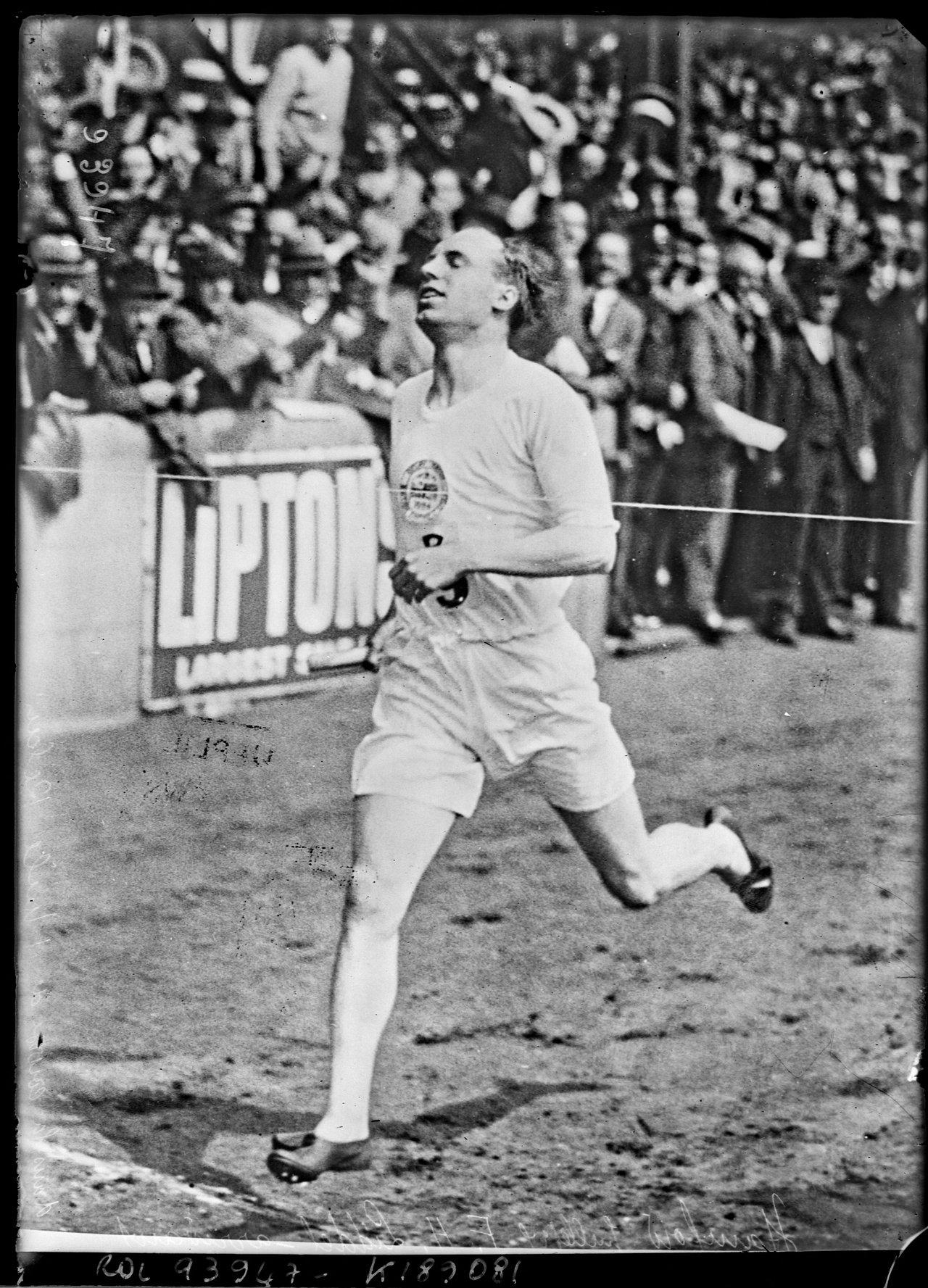
Eric Liddell finishing the mile relay at Stamford Bridge, Agence Rol, Bibliothèque nationale de France. Public domain.
Scotland and North China, 1902 to 1945 · Person · Featured Study
Eric Liddell
He was a Scottish athlete who taught and preached in North China from 1925 until his death in a Japanese camp in 1945.
Months before the Paris Games of 1924 he told the British Olympic Committee that he would not run on a Sunday.
Therefore, the LORD, the God of Israel, declares: ‘I did indeed say that your house and the house of your father would walk before Me forever. But now the LORD declares: Far be it from Me! For I will honor those who honor Me, but those who despise Me will be disdained.
Therefore, the LORD, the God of Israel, declares: ‘I did indeed say that your house and the house of your father would walk before Me forever. But now the LORD declares: Far be it from Me! For I will honor those who honor Me, but those who despise Me will be disdained.
- Born
- 16 January 1902
- Died
- 21 February 1945
- Family
- father: James Dunlop Liddell; mother: Mary Liddell; brother: Robert; sister: Jenny; brother: Ernest; wife: Florence Mackenzie; daughter: Patricia; daughter: Heather; daughter: Maureen
- Places
- Tientsin, Eltham, Edinburgh, Paris, Siaochang, Weihsien
Summary
Eric Liddell was born at Tientsin in 1902 to missionary parents. He won the 400 metres at the Paris Olympics. A year later he returned to China as a teacher of the London Missionary Society.
- He gave up the 100 metres in Paris because its heats fell on a Sunday.
- His wife and daughters left for Canada in 1941, and he never saw his youngest child.
- He died at Weihsien Internment Camp in February 1945.
The Texts He Leaned On
His Sunday rule stands under the fourth commandment, and the note said to have reached him in Paris under 1 Samuel 2.
The question of this life is why an Olympic champion went back to China and stayed there through a war. American newspapers witness the Games, and modern accounts, each named in its place, witness his years in China.
Remember the Sabbath day by keeping it holy.His rule against running on a Sunday stands under this command to keep the holy day.
The Life in Order
The Games stand on the newspapers of their day, and the rest on modern accounts named in each row.
He gave the last twenty years of his life to China.
- 16 January 1902He was born at Tientsin in North Chinaericliddell.org; SOAS Archives
- 1908 to 1920He was schooled at Eltham College, Blackheathericliddell.org
- 28 March 1924American papers carried his standThe Washington Times
- 9 July 1924He took third place in the Olympic 200 metresEvening Star, Washington
- 11 July 1924He won the Olympic 400 metresEvening Star, Washington
- 17 July 1924He graduated in pure science at EdinburghUniversity of Edinburgh
- August 1925He left Edinburgh for ChinaThe Bismarck Tribune
- 1932He was ordained a minister of the Congregational Union of Scotlandericliddell.org
- 1934He married Florence Mackenzie at Tientsinericliddell.org
- 1937He moved to the rural station of SiaochangSOAS Archives
- March 1943He was taken to Weihsien Internment CampSOAS Archives
- 21 February 1945He died in the campSOAS Archives
Each step of the life stands with its witness.
August 1925, 1932, 1934, 1937, March 1943, 21 February 1945
From Colombes to Weihsien
The champion went home to China, taught and preached there, and died in a camp.
The community in Edinburgh that bears his name calls him the second son of James Dunlop Liddell and his wife, missionaries of the London Missionary Society. He went up to Edinburgh University in 1920.
Before the Games The Washington Times reported his refusal to compete on Sundays under any circumstances. In Paris he ran third in the 200 metres.
On 11 July the Associated Press wired from Colombes that his time of 47 3/5 seconds was a world record, with Horatio Fitch of Chicago second. Ten days later it reported that he had drawn almost as many hearers to the Church of Scotland in Paris as had watched him run.
At his graduation an American paper reported the Principal's words, that none could pass him except the examiners. In August 1925 a crowd at the station sang "Jesus shall reign" as he left Edinburgh for China. He taught science and athletics at the Anglo-Chinese College in Tientsin.
He married Florence Mackenzie, the daughter of Canadian missionaries, at Tientsin in 1934, and they had three daughters. In 1937 he moved to Siaochang, where his brother Robert was the mission doctor, and worked as an evangelist in the villages.
In 1943 the Japanese interned him at Weihsien in Shantung with missionaries and other foreigners. The Community writes that in the camp he helped the elderly, taught Bible classes and science to the children and arranged games. A brain tumour killed him there some months before the camp was freed.
In Their Own Words
Four of his sayings come through writers on his life and a fellow prisoner, and his last words through the missionary at his bedside.
Eric Liddell (1902 to 1945)
Grant Jarvie, Ross Walker, Amy Woodgate, Hong Fan and Huijie Zhang, "Eric Henry Liddell 100 Years on from 1924", Asian Journal of Sport History and Culture 3, number 2 (2024), quoting Duncan Hamilton, For the Glory (2016), page 143, note 23
The Olympics and the nations
“Don't forget I wasn't running for Scotland. The Olympic Games are not like that, we've had enough struggles between nations, the Olympics are not a struggle between nations and should never be like that.”
Congregational
About this saying1 paragraph
He said this in Paris in July 1924 to Philip Christison, assistant manager of the British team, who had congratulated him after the race.
Eric Liddell
Joel S. Woodruff, "Eric Liddell: Muscular Disciple and Olympic Champion", Knowing and Doing (C. S. Lewis Institute), Summer 2012, quoting David McCasland, Eric Liddell: Pure Gold (2001), page 117
A leader worthy of all your devotion
“In Jesus Christ you will find a leader worthy of all your devotion and mine. I looked for one I could admire and I found Christ.”
Congregational
About this saying1 paragraph
He said this at meetings in the months after the Games, while he prepared to go to China.
Eric Liddell
Joel S. Woodruff, "Eric Liddell: Muscular Disciple and Olympic Champion", Knowing and Doing (C. S. Lewis Institute), Summer 2012, quoting Max O'Neill, "The Guts and Heart of a Man of Faith", 21st Century Christianity, June 2010, note 12
We are all missionaries
“We are all missionaries. Wherever we go, we either bring people nearer to Christ, or we repel them from Christ. We are working for the great Kingdom of God.”
Congregational
About this saying1 paragraph
He said this to his countrymen on his first furlough, in 1932, the year he was ordained.
Eric Liddell
Grant Jarvie, Ross Walker, Amy Woodgate, Hong Fan and Huijie Zhang, "Eric Henry Liddell 100 Years on from 1924", Asian Journal of Sport History and Culture 3, number 2 (2024), page 145
A few weeks of wear
“I see your shoes are worn out and it is now midwinter. Perhaps you will be able to get a few weeks of wear out of these.”
Congregational
About this saying1 paragraph
In the camp at Weihsien, one winter between 1943 and 1945, he gave his running shoes to a fellow prisoner, Stephen Metcalf, with these words, as Metcalf told it.
His last words, as reported
The saying1 paragraph
Attributed to Eric Liddell as his last words in 1945 by Annie Buchan at his bedside, in Richard Clements's account from Bethel McGrew (Word on Fire, 2025): “it’s complete surrender.”
The People Around Him
The witnesses name his parents, his brother and sister, his wife and daughters, a rival and a boy of the camp.
His brother Robert drew him to Siaochang in 1937.
| Person | Tie to Liddell | The witness |
|---|---|---|
| James Dunlop and Mary Liddell | His parents, who served in China | ericliddell.org; Woodruff |
| Robert Liddell | His elder brother | SOAS Archives |
| Jenny Liddell | His sister, who did not oppose his running, against the film | Prentis, 2024 |
| Florence Mackenzie | His wife and the mother of his children | ericliddell.org |
| Patricia, Heather and Maureen | His three daughters, the youngest born after 1941 | ericliddell.org |
| Horatio Fitch | The American he beat in the 400 metres final | Evening Star, Washington |
| Norman Cliff | A boy in the camp who later wrote of him | Cliff |
The Places of His Life
His life runs from Tientsin to London, Edinburgh and Paris, and back to the plain of North China.
He was born at Tientsin and taught there for twelve years.
| Place | What the witnesses say | The witness |
|---|---|---|
| Tientsin | His birthplace, and his home as a teacher. | ericliddell.org |
| Blackheath | Eltham College there taught the sons of missionaries. | ericliddell.org |
| Edinburgh | He took his degree there in July 1924. | University of Edinburgh |
| Colombes, Paris | Its stadium held the Olympic track events. | Evening Star, Washington |
| Siaochang | His country station from 1937. | SOAS Archives |
| Weihsien, Shantung | He was interned there from 1943 and died there. | SOAS Archives |
The Sunday Decision and the Film
The papers before the Games and Chariots of Fire tell the Sunday decision differently.
The film Chariots of Fire (1981) has him learn on the boat to France that the heats fall on a Sunday. Malcolm Prentis writes that the schedule had been known for months, and Grant Jarvie and his colleagues note that the programme was published at the end of 1923. The papers of March and April 1924 show the decision already made.
Prentis also writes that the note before the final came from team-mates through a team masseur, and that the line "He also made me fast" belongs to the film's script.
How the Key Verse Was Taught
John Chrysostom, Jerome and Matthew Henry read God's promise to honour those who honour Him.
John Chrysostom (died 407)
HOMILIES ON EPHESIANS 2
Chrysostom read the verse as a claim God makes on those He has made His friends.
“If He says, ‘Them that honor Me I will honor, and they that despise Me shall be lightly esteemed,’ let us reflect that there is that which He requires of us also. True, it is the praise of His glory to save those that are enemies, but those who, after being made friends, continue His friends. So that if they were to return back to their former state of enmity, all were vain and to no purpose. There is not another Baptism, nor is there a second reconciliation again, but ‘a certain fearful expectation of judgment which shall devour the adversaries.’ If we intend at the same time to be always at enmity with Him and yet to claim forgiveness at His hand, we shall never cease to be at enmity, and to be wanton, to grow in depravity, and to be blind to the Sun of Righteousness which has risen.… But when thou hast tasted the goodness and the honey, if thou again abandonest them, and turnest to thine own vomit, what else art thou doing but bringing forward evidence of excessive hatred and contempt?”
on 1 Samuel 2:30Patristic
Jerome (died 420)
LETTER 66.7
Jerome held that the promise is kept even in this present life.
“A pearl will shine in the midst of squalor, and a gem … will sparkle in the mire. This is what the Lord promised when he said, ‘Those who honor me I will honor.’ Others may understand this of the future when sorrow shall be turned into joy and when, although the world shall pass away, the saints shall receive a crown which shall never pass. But I for my part see that the promises made to the saints are fulfilled even in this present life.”
on 1 Samuel 2:30Patristic
Matthew Henry (1662 to 1714)
Commentary on the Whole Bible
Matthew Henry noted the condition the promise carries, faithful service.
“But observe, the promise carried its own condition along with it: They shall walk before me forever, that is, ‘they shall have the honour, provided they faithfully do the service.’ Walking before God is the great condition of the covenant, Gen. xvii.”
on 1 Samuel 2:30Puritan
What the Witnesses Leave Open
The witnesses differ on a story of his last months and on the site of his grave.
The prisoner exchange storySOAS Archives; Joel Woodruff
The SOAS archives blog of 2014 says it was later revealed that he refused a place in a prisoner exchange negotiated by Winston Churchill and gave it to a pregnant woman. Joel Woodruff writes that this was found in 2008, when certain documents were released.
Neither names the documents, so the claim stands as a later report.
The place of his graveericliddell.org; SOAS Archives
The Community's account says he was buried under a small wooden cross in the garden behind the Japanese officers' quarters. It adds that the site was found again in 1989 at what is now Weifang Middle School.
The SOAS archives blog says he is buried in the Mausoleum of Martyrs at Shih Cha Chuang.
Books to Read Next
Eric Henry Liddell 100 Years on from 1924
Grant Jarvie and others · 2024
Five scholars weigh the record of the Games against the film and the later tellings.
Read the article free at the University of StirlingEric Liddell: Muscular Disciple and Olympic Champion
Joel S. Woodruff · 2012
It is a short life with notes that name the books it draws on.
Read Woodruff free at the C. S. Lewis InstituteWhat Liddell Left
Liddell left an Olympic record, and a centre named for him has served Edinburgh since 1980.
Sources
Scripture is the Berean Standard Bible.
- The Holy Bible, Berean Standard Bible (read 2026)
- The Washington Times, 28 March and 24 April 1924; Evening Star (Washington), 9, 11 and 21 July and 22 December 1924; Springfield Weekly Republican, 7 August 1924; The Bismarck Tribune, 24 August 1925.
- The Eric Liddell Community, Edinburgh, "About Eric Liddell".
- SOAS Library, Special Collections, "The Man Who Wouldn't Run on a Sunday: Eric Liddell in the SOAS Archives", 1 August 2014.
- University of Edinburgh, news of the honorary degree of 2024, and its archive gallery on Liddell.
- Joel S. Woodruff, "Eric Liddell: Muscular Disciple and Olympic Champion", Knowing and Doing (C. S. Lewis Institute), Summer 2012.
- Duncan Hamilton, For the Glory: The Life of Eric Liddell from Olympic Hero to Modern Martyr (London: Transworld, 2016), page 143, as Jarvie and others quote it in their note 23; the book was not opened.
- David McCasland, Eric Liddell: Pure Gold (Grand Rapids: Discovery House, 2001), page 117, as Joel S. Woodruff quotes it in his note 11; the book was not opened.
- Max O'Neill, "The Guts and Heart of a Man of Faith", 21st Century Christianity, June 2010, as Joel S. Woodruff quotes it in his note 12; the article was not opened.
- Richard Clements, "Eric Liddell and Complete Self-Surrender", Word on Fire, 27 March 2025, reporting an article by Bethel McGrew.
- Malcolm Prentis, "Paris 24: a hundred years, the story of Eric Liddell", Australian Presbyterian, 9 July 2024.
- Grant Jarvie, Ross Walker, Amy Woodgate, Hong Fan and Huijie Zhang, "Eric Henry Liddell 100 Years on from 1924", Asian Journal of Sport History and Culture 3, number 2 (2024)
- Norman Cliff, conclusion of his account of Eric Liddell.
- John Chrysostom, Homilies on Ephesians 2, on 1 Samuel 2:30.
- Jerome, Letter 66, section 7, on 1 Samuel 2:30.
- Matthew Henry, Commentary on the Whole Bible (1710), on 1 Samuel 2:30.
Keep Studying
Studies1
Church history1
People and groups3
Subjects1
Values1